

Fleet defect reporting explained: UK compliance guide

Fleet defect reporting is the process by which fleet operators detect, record, and resolve vehicle faults to maintain roadworthiness and meet UK legal requirements. Under the DVSA’s Guide to Maintaining Roadworthiness, this process is not optional. It is a mandatory part of holding an Operator Licence. Operators who treat defect reports as routine paperwork rather than legal evidence put their licence, their vehicles, and public safety at risk. This guide covers the full defect reporting process, from legal requirements and lifecycle stages to the practical difference between paper and digital workflows.
What does fleet defect reporting explained mean for UK operators?
Fleet defect reporting, formally known as defect management under the DVSA’s Guide to Maintaining Roadworthiness, is the structured process of identifying vehicle faults during daily walkaround checks, recording them in a compliant format, and tracking them through to verified repair. Every commercial vehicle operator holding a Standard or Restricted Operator Licence in the UK must operate this process. The DVSA uses defect records as primary evidence when assessing whether an operator is fit to hold a licence. A missing or incomplete record is treated the same as a missing inspection.
Daily walkaround checks are the starting point. Drivers must inspect tyres, lights, brakes, mirrors, bodywork, and fluid levels before each journey. Any fault found triggers a defect report. If no fault is found, a nil defect report is still required as legal proof that the inspection took place. Missing nil defect records are one of the most common causes of failed DVSA audits.

Records must be retained for at least 15 months as mandated by the DVSA from april 2026. That retention window covers both defect reports and the remedial action records that confirm repairs were completed. Traffic Commissioners and DVSA examiners can request these records at any time, including during roadside inspections.
What are the legal requirements for fleet defect reporting in the UK?
The DVSA sets out specific requirements for what a compliant defect report must contain. Each record must include:
- Date and time of the inspection
- Driver name and licence number
- Vehicle registration and fleet number
- A completed checklist covering all mandatory inspection items
- A clear description of any defect found
- Details of the remedial action taken
- Signatures from the driver, the mechanic who completed the repair, and the next driver who accepts the vehicle
That three-signature chain is not a formality. Effective defect records require three signatures: driver finding the defect, mechanic certifying the repair, and the next driver acknowledging safety. This chain forms a complete audit trail under UK standards.
PG9 prohibition notices and operator responsibility
A PG9 prohibition notice is issued when a vehicle is found to be unsafe at the roadside. A critical point that many operators misunderstand: a PG9 notice applies to the vehicle and the operator licence, not to the driver personally. This means the operator carries the legal and commercial consequences, including potential licence suspension. Defect records are the primary defence an operator can present to a Traffic Commissioner when a PG9 is issued.
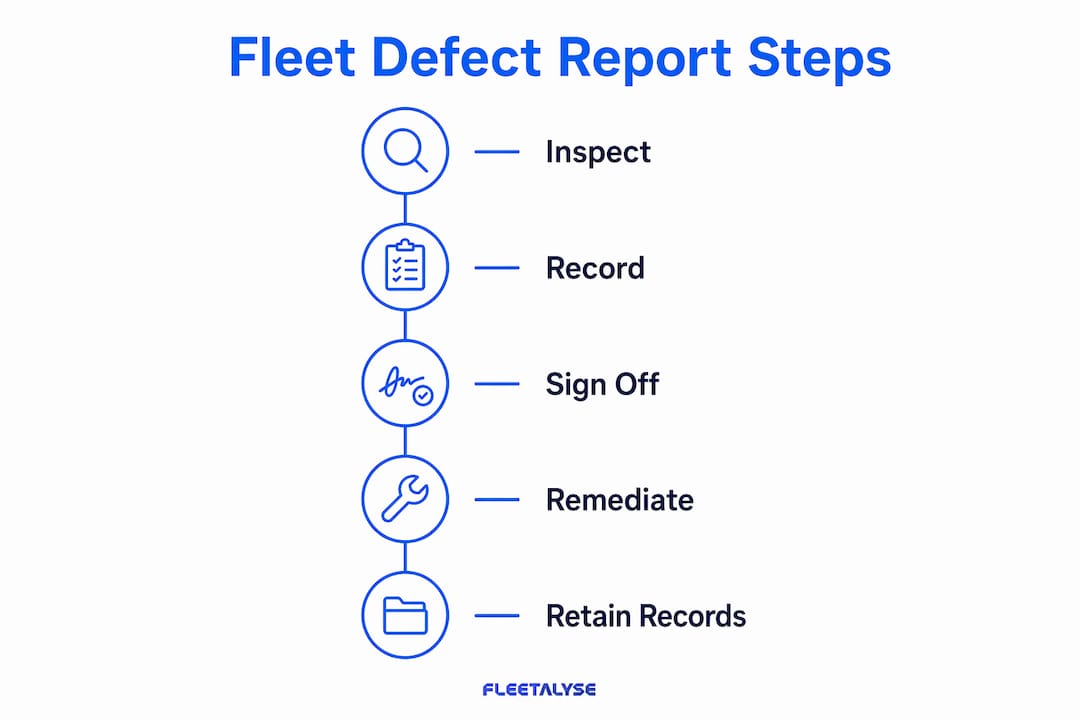
Nil defect reports carry equal legal weight to defect reports. Nil defect reports are mandatory legal records proving inspections happened. Missing them frequently causes failed audits, even when no actual faults were present on those dates.
How does the defect management lifecycle work from detection to resolution?
The defect management lifecycle runs through seven distinct stages. Each stage must be completed and recorded for the process to be legally compliant.
- Detection. The driver identifies a fault during the walkaround check and records it immediately, including the time, location, and vehicle ID.
- Recording. The defect is logged with a description, photo evidence where possible, and a severity classification.
- Classification. The defect is categorised as safety-critical or standard. Safety-critical defects, such as brake failure or tyre damage, require the vehicle to be taken off the road immediately.
- Work order creation. A repair job is raised and assigned to a named technician with a clear deadline based on the severity classification.
- Technician repair. The mechanic completes the repair and documents the work carried out, including parts used and time taken.
- Repair sign-off. The mechanic signs the defect record to certify the vehicle is roadworthy.
- Next-driver acknowledgement. The following driver inspects the vehicle, confirms the repair, and signs the record before taking the vehicle out.
Where manual processes break down
The highest risk in defect management is manual hand-offs causing loss or delay of information. Phone calls, text messages, and group chats leave no audit trail. A defect reported verbally to a depot manager and then forgotten is indistinguishable from a defect that was never reported. Operators should treat any reporting channel that cannot produce a timestamped, signed record as a compliance gap.
Pro Tip: Attach a photo to every defect record, even for minor issues. A photograph removes ambiguity about the fault’s nature and severity, speeds up the mechanic’s assessment, and strengthens your position if the record is ever reviewed by a Traffic Commissioner.
For a detailed walkthrough of fleet vehicle inspection workflow best practices, including how to structure handoffs between drivers and maintenance teams, the Premier Fleet Repair guide is a practical reference.
What are the advantages of digital defect reporting over manual methods?
The difference between paper and digital defect reporting is not just convenience. It is the difference between an 18–30 hour repair cycle and a 2–4 hour one. Manual defect reporting delays average 18–30 hours from detection to repair. Digital workflows cut this to 2–4 hours. That gap represents vehicles sitting off the road, drivers waiting, and compliance risk accumulating.
The operational benefits of digital systems extend well beyond speed:
- Timestamped, unalterable records that satisfy DVSA audit requirements without manual filing
- Automatic severity classification that routes safety-critical defects to the top of the repair queue
- Photo evidence attached at the point of reporting, giving mechanics clear repair guidance before they touch the vehicle
- Real-time dashboards showing every open defect, its current status, and the assigned technician
- Automated work order generation that removes the administrative step of manually raising a job
Automating fleet reporting enables managers to reclaim over 250 hours annually. That is the equivalent of six full working weeks redirected from administration to operations. For a fleet manager running 20 or more vehicles, that time saving is material.
Pro Tip: When evaluating digital defect reporting systems, check whether the records are truly unalterable after submission. Editable records do not satisfy DVSA audit standards. Look for systems that lock entries with a timestamp and user ID the moment they are submitted.
For operators exploring fleet maintenance solutions that integrate defect tracking with repair scheduling, a connected platform removes the manual hand-off entirely and keeps every record in one place.
What are the best practices for effective defect reporting?
Compliance does not happen by accident. The following practices define the difference between a fleet that passes DVSA audits and one that does not.
- Assign named responsibility. Every open defect must have a named person accountable for its resolution. Anonymous ownership means no ownership.
- Set deadlines by severity. Safety-critical defects require same-day resolution. Standard defects should have a maximum 48-hour resolution window.
- Record nil defect reports without exception. A day with no defect record is a day that cannot be proven to have been inspected.
- Train drivers on defect identification. A driver who cannot recognise a worn tyre or a failing brake light is a liability. Regular training closes this gap.
- Use photo evidence on every report. Photo evidence and severity classification improve prioritisation and give mechanics clear repair guidance.
- Review open defects daily. Daily supervisory review of defect reports prevents faults from sitting unresolved and reduces compliance risk.
- Use data to predict maintenance needs. Recurring defects on the same vehicle or component are a signal. Fleets that analyse defect patterns can schedule preventive maintenance before a fault becomes a prohibition.
Defect reports are evidence, not paperwork. That distinction changes how you build your process. A report that cannot be produced, verified, and signed is not a report at all.
Key takeaways
Effective fleet defect reporting is the foundation of UK Operator Licence compliance, requiring documented daily inspections, a three-signature audit chain, and 15-month record retention to satisfy DVSA standards.
| Point | Details |
|---|---|
| Legal retention requirement | Keep all defect and remedial records for at least 15 months to meet DVSA standards. |
| Nil defect reports are mandatory | Record a nil defect report every day an inspection occurs, even when no faults are found. |
| Three-signature chain | Driver, mechanic, and next driver must all sign each defect record to create a compliant audit trail. |
| Digital reporting cuts repair time | Digital workflows reduce defect-to-repair time from 18–30 hours to 2–4 hours. |
| PG9 notices affect operators | A PG9 prohibition notice applies to the operator licence, not the driver, making operator-level records critical. |
Why defect reporting is the most underestimated compliance tool in UK fleet management
Fleet managers often tell me they have a defect reporting process. What they actually have, in most cases, is a paper form in the cab and a vague expectation that drivers will fill it in. Those are not the same thing.
The most common misunderstanding I encounter is that defect reports are a driver issue. They are not. Defect reports are operator responsibilities affecting business compliance. When a Traffic Commissioner reviews your records, they are not assessing your drivers. They are assessing you.
The second misunderstanding is that a clean fleet needs fewer records. The opposite is true. A fleet with no defect reports looks, to a DVSA examiner, like a fleet that is not inspecting its vehicles. Nil defect reports are the proof that your process is running, not a sign that nothing is happening.
What I have seen work consistently is treating the defect record as the start of a maintenance conversation, not the end of a compliance obligation. When a driver submits a report with a photo and a clear description, a good mechanic can assess the fault before the vehicle even arrives at the workshop. That is where digital reporting changes the culture, not just the admin.
The fleets that get this right are not necessarily the largest. They are the ones where every person in the chain, driver, mechanic, and manager, understands that their signature on a defect record carries weight. That understanding is built through training, clear processes, and the right tools.
— Vytautas
How Fleetalyse supports compliant defect reporting
Fleetalyse integrates GPS vehicle tracking, smart dashcams, and telematics data to give fleet managers real-time visibility across their entire operation. For defect management, that means location-stamped records, photo evidence captured at the point of inspection, and automated alerts when a vehicle’s status changes.
The Fleetalyse solutions platform connects drivers, maintenance teams, and compliance managers in one place, removing the manual hand-offs that cause delays and audit failures. For operators running HGVs, vans, or mixed fleets, asset and trailer GPS trackers from Fleetalyse provide the location and condition data that supports a complete, audit-ready defect record. UK-based support means you get practical help from people who understand DVSA requirements, not a generic helpdesk.
FAQ
What is fleet defect reporting?
Fleet defect reporting is the process of identifying, documenting, and resolving vehicle faults during daily walkaround checks. It is a legal requirement for UK commercial fleet operators under the DVSA’s Guide to Maintaining Roadworthiness.
How long must defect records be kept in the UK?
Defect reports and remedial records must be retained for at least 15 months, as mandated by the DVSA. This applies to both defect reports and the records confirming that repairs were completed.
What happens if a defect report is missing?
A missing defect report is treated by the DVSA as evidence that an inspection did not take place. This can result in a failed audit, a Traffic Commissioner hearing, or, in serious cases, suspension of the Operator Licence.
Are nil defect reports legally required?
Yes. A nil defect report is mandatory legal proof that an inspection occurred on a given day. Failing to record nil defect reports is one of the most common causes of failed DVSA audits.
What is a PG9 prohibition notice?
A PG9 is a roadside prohibition notice issued when a vehicle is found to be unsafe. It applies to the operator licence, not the driver, meaning the operator bears the legal and commercial consequences.