


Fleet driver licence checking explained for UK fleets

Fleet driver licence checking is the systematic process of verifying that every driver in your fleet holds a valid, appropriate, and current driving licence before operating a company vehicle. Under the Road Traffic Act 1988 and the Health and Safety at Work etc. Act 1974, UK employers carry a legal duty to confirm drivers are licensed, competent, and medically fit. This is not an optional administrative exercise. The DVLA’s Share Driving Licence service is the primary mechanism for fleet driver licence verification in the UK, and recent updates including the GOV.UK Wallet and DVLA Licence Check API have made digital, real-time checks increasingly accessible. Grey fleet drivers, agency staff, and vocational licence holders all fall within scope. A proper audit trail is the difference between demonstrating compliance and facing regulatory action.
What are the legal obligations for fleet driver licence checks?
Employers must verify that drivers are licensed under the Road Traffic Act 1988. Failing to do so exposes your organisation to criminal liability, not just civil risk. The Health and Safety at Work etc. Act 1974 reinforces this by requiring employers to take all reasonably practicable steps to protect workers and third parties from harm caused by vehicle use.
For operator licence holders, the stakes are higher still. Licence checking is a mandatory control imposed by the Traffic Commissioner, not a discretionary best practice. Operators who cannot demonstrate effective licence verification risk losing their operator licence entirely. That outcome is not recoverable in the short term.

The duty extends beyond permanent employees. Agency drivers, contractors, and grey fleet drivers who use their own vehicles for business journeys carry the same legal obligations. Grey fleet drivers must have their licence, MOT status, and business-use insurance verified before any work journey. Many fleets overlook this group, which creates a significant and hidden compliance gap.
Key legal obligations at a glance:
- Verify licence validity and correct vehicle entitlement before a driver operates any fleet vehicle.
- Check for endorsements, penalty points, and disqualifications that affect driving eligibility.
- Confirm medical fitness, particularly for HGV and PCV vocational licence holders.
- Apply the same checks to grey fleet and agency drivers as to directly employed drivers.
- Retain documented evidence of every check, including consent, method, date, and result.
Pro Tip: If your organisation uses agency drivers regularly, build licence verification into your agency contract terms. Require the agency to confirm checks have been completed and to provide evidence on request. This protects you if an incident occurs.
How to perform effective driver licence checks
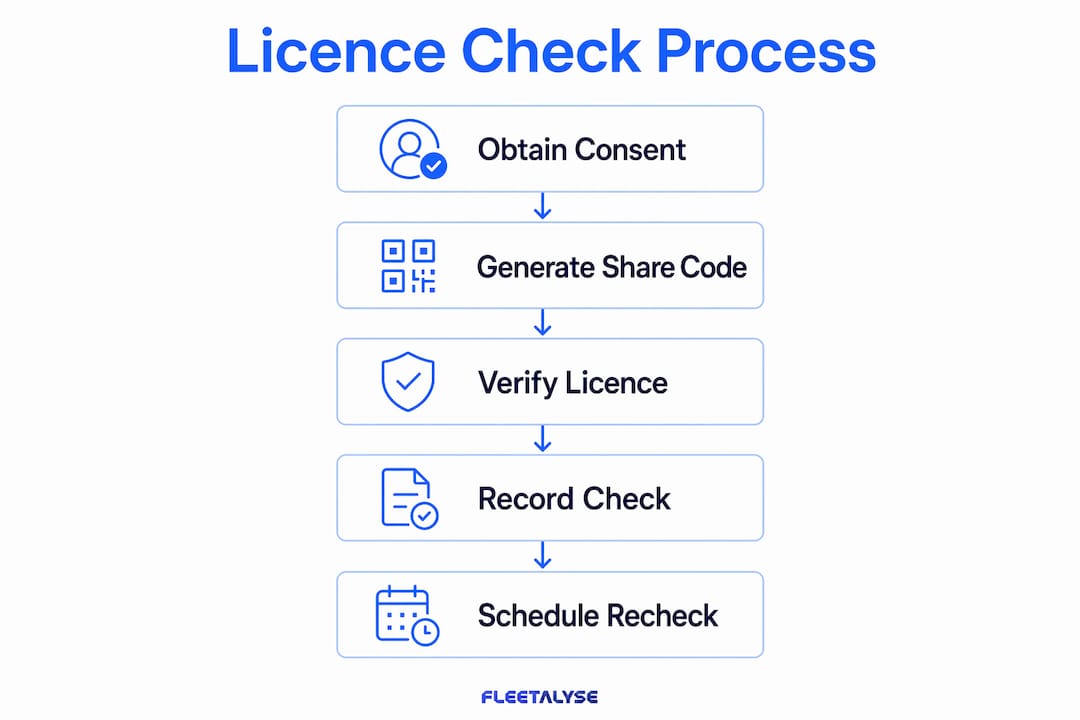
The standard process for fleet driver licence verification in the UK uses the DVLA Share Driving Licence service. The steps are straightforward, but the administrative discipline required to manage them across a large fleet is where most operators struggle.
- Request driver consent. The driver must actively agree to share their licence data with you. Consent must be recorded and retained.
- Driver generates a share code. The driver logs into GOV.UK and generates a one-time check code. This code is valid for 21 days only.
- Employer redeems the code. You enter the code alongside the last eight digits of the driver’s licence number on the GOV.UK portal. The check reveals entitlements, endorsements, and any disqualifications.
- Record the result. Log the date, method, result, and the name of the person who conducted the check. Store this securely.
- Act on findings. If the check reveals issues, take documented action immediately. Do not allow a driver to continue operating until the issue is resolved.
The 21-day validity window on share codes is a practical problem for busy fleets. If a driver fails to generate a code promptly, or if you fail to redeem it in time, the code expires. You must then chase the driver for a new one, creating a gap in your compliance record.
The DVLA Licence Check API and GOV.UK Wallet address this limitation directly. The API allows automated, consent-based, real-time licence checks with cryptographic audit logs. It removes the 21-day share code constraint entirely and is well suited to fleets with large driver populations or high turnover. The GOV.UK Wallet enables drivers to store a digital version of their licence and grant ongoing consent, which means you can verify status without requiring the driver to generate a new code each time.
Pro Tip: If you manage more than 50 drivers, the manual share code process will create compliance gaps at scale. Investigate API-based verification or a fleet compliance platform that integrates DVLA data directly. The time saving is significant, and the audit trail is far more defensible.
What is the recommended frequency for fleet driver licence checking?
Risk-based checking frequencies are the industry standard for UK fleets. A single annual check is insufficient for drivers who accumulate points or hold vocational licences. The recommended schedule reflects the level of risk each driver presents.
| Risk category | Points on licence | Recommended check frequency |
|---|---|---|
| Low risk | 0 points | Annual |
| Medium risk | 3–6 points | Every 6 months |
| High risk | 9+ points | Quarterly |
| HGV/PCV vocational | Any | Quarterly minimum |
| Grey fleet drivers | Any | At least annual, plus pre-journey confirmation |
Industry best practice places HGV and PCV drivers in the quarterly category regardless of their current points total. This reflects the greater consequences of a vocational licence issue and the higher duty of care associated with larger vehicles.
Beyond scheduled checks, certain events should trigger an immediate ad-hoc verification:
- A driver receives a new endorsement or fixed penalty notice.
- A driver reports a medical condition that may affect their fitness to drive.
- A driver changes vehicle category or takes on a new role requiring different entitlements.
- Your insurer requests confirmation of licence status following an incident.
- A driver returns from an extended absence such as long-term sick leave.
Grey fleet drivers present a particular scheduling challenge. They are often invisible to fleet management systems because they do not appear in vehicle tracking data. Building grey fleet drivers into your licence checking schedule requires a separate register and a clear process for obtaining consent and share codes before business journeys.
How to handle issues discovered during licence checks
Common issues found during checks include wrong vehicle entitlement, accumulated penalty points, active disqualifications, and lapsed medical self-declarations for vocational drivers. Each requires a different response, but all require documented action.
A mismatch between a driver’s licence class and the vehicle they operate can void your insurance policy following an incident. This is not a theoretical risk. Insurers actively investigate licence validity when processing claims, and a single gap in your verification records can result in a declined liability claim.
The correct responses by issue type:
- Disqualification. Ground the driver immediately. Do not allow them to operate any fleet vehicle until the disqualification is resolved. Document the date you discovered the issue and the action taken.
- High penalty points. Reassign the driver to lower-risk duties if possible. Increase their check frequency to quarterly. Notify your insurer if required under your policy terms.
- Wrong entitlement. Remove the driver from vehicles they are not licensed to operate. Arrange retraining or reclassification before returning them to those duties.
- Medical self-declaration lapse. HGV and PCV drivers must renew their medical declarations periodically. If a renewal is overdue, suspend vocational driving duties until the declaration is updated and confirmed.
- Expired licence. Treat this as equivalent to no licence. The driver must not operate a fleet vehicle until renewal is confirmed.
Pro Tip: Create a simple issue log that records the driver name, issue type, date discovered, action taken, and date resolved. This single document can be the most important piece of evidence you present during a Traffic Commissioner audit.
How to maintain proper records and audit trails
A sufficient audit trail for fleet driver licence checking contains five elements: the date of the check, the method used, the result, the name of the person responsible for conducting the check, and a record of any action taken following the result. Traffic Commissioners and auditors look for all five. Missing any one of them weakens your compliance position significantly.
Consent documentation is equally important. You must be able to demonstrate that each driver actively agreed to share their licence data with you. Verbal consent is not sufficient. A signed consent form or a digital consent record tied to a specific check date is the minimum standard.
A structured approach to record keeping:
- Maintain a central driver register listing every driver, their licence number, vehicle entitlements, and check history.
- Store check results with the date, method, and responsible person clearly recorded against each entry.
- Retain consent records for the duration of employment plus a minimum of three years after the driver leaves.
- Log all actions taken in response to issues, including the date the issue was resolved.
- Integrate licence check records with your wider fleet compliance platform so that auditors can access a single, coherent compliance picture.
The most common audit pitfall is a gap in the checking schedule. A driver who was checked 14 months ago when your policy requires annual checks is a compliance failure, even if their licence is clean. Automated scheduling and reminder systems prevent this from happening.
Key takeaways
Fleet driver licence checking is a legal duty under the Road Traffic Act 1988 and the Health and Safety at Work etc. Act 1974, requiring documented, risk-based verification for every driver including grey fleet and agency staff.
| Point | Details |
|---|---|
| Legal duty is absolute | Both the Road Traffic Act 1988 and Health and Safety at Work etc. Act 1974 require employers to verify driver licences. |
| Risk-based frequency matters | Check low-risk drivers annually, medium-risk every six months, and high-risk or HGV/PCV drivers quarterly. |
| Grey fleet is in scope | Grey fleet drivers require the same licence, MOT, and insurance verification as company vehicle drivers. |
| Digital tools reduce gaps | The DVLA Licence Check API and GOV.UK Wallet replace the 21-day share code limitation with real-time, automated verification. |
| Audit trails are non-negotiable | Records must show date, method, result, responsible person, and actions taken to satisfy Traffic Commissioner scrutiny. |
The shift I keep seeing fleets get wrong
The biggest compliance failure I encounter is not a lack of awareness about licence checking. Most fleet managers know they need to do it. The failure is treating it as a one-time onboarding task rather than an ongoing management control.
A driver who was clean at recruitment can accumulate nine points within 18 months. Without a scheduled re-check, you have no visibility of that change. You are effectively operating on outdated information and calling it compliance. That is the gap that costs operators their licence.
The move to digital verification through the DVLA API and GOV.UK Wallet is genuinely significant. It removes the friction of chasing share codes and creates an audit trail that is far more defensible than a spreadsheet of manually recorded check dates. Fleets that have adopted API-based verification report fewer compliance gaps and faster responses to licence changes. The technology is available now, and the case for adopting it is strong.
Grey fleet is the area where I see the most complacency. Managers assume that because the vehicle is not on the fleet register, the liability is reduced. It is not. The duty of care follows the journey, not the vehicle. If a grey fleet driver causes a serious incident and you cannot produce a licence check record, the consequences are the same as for any company vehicle driver.
My practical advice is this: build licence checking into your operational culture, not just your compliance calendar. When a new driver joins, checking their licence should feel as automatic as issuing them a fuel card. When a driver reports a speeding fine, a re-check should follow within the week. That level of discipline is what separates operators who pass audits from those who do not.
— Vytautas
Fleetalyse: compliance and tracking working together
Driver licence verification is one part of a wider compliance picture. Knowing a driver holds the right licence is valuable. Knowing how they are actually driving, where their vehicle is, and whether their hours are within legal limits gives you the complete picture.
Fleetalyse integrates GPS vehicle tracking, driver behaviour monitoring, and tachograph compliance into a single platform built for UK commercial fleets. The Teltonika FMC650 HGV GPS tracker pairs directly with the Fleetalyse platform to give you real-time visibility across your HGV fleet, supporting both DVSA compliance and operator licence requirements. For fleets managing vans and mixed assets, the full range of vehicle GPS trackers provides the same level of oversight. Licence checking tells you who should be driving. Fleetalyse tells you what is actually happening on the road.
FAQ
What is fleet driver licence checking?
Fleet driver licence checking is the process of verifying that each driver holds a valid, appropriate, and current driving licence before operating a fleet vehicle. It is a legal requirement under the Road Traffic Act 1988 and the Health and Safety at Work etc. Act 1974.
How often should fleet driver licences be checked?
Low-risk drivers with no points should be checked annually. Medium-risk drivers with 3–6 points require checks every six months. High-risk drivers with 9 or more points, and all HGV and PCV drivers, should be checked quarterly.
Do grey fleet drivers need licence checks?
Yes. Grey fleet drivers carry the same legal obligations as company vehicle drivers. Employers must verify their licence, MOT status, and business-use insurance before any work journey.
What happens if a DVLA share code expires before it is redeemed?
The code becomes invalid and cannot be used. The driver must generate a new code, which creates a gap in your compliance record. Using the DVLA Licence Check API eliminates this problem by enabling real-time, automated verification without share codes.
What records do I need to keep for licence checks?
You must record the date of each check, the method used, the result, the name of the person who conducted the check, driver consent, and any actions taken in response to issues found. Traffic Commissioners require all five elements to be present for a check to be considered compliant.