

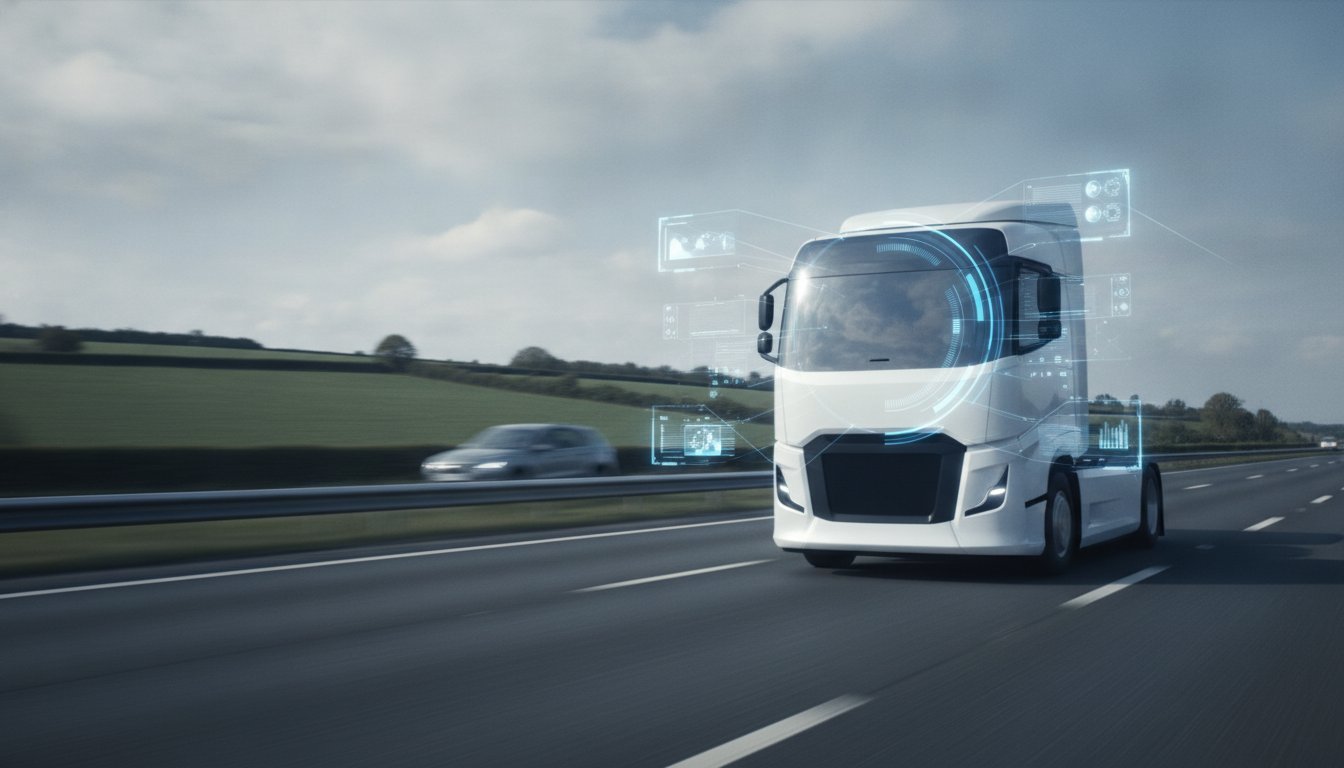
In 2026, a vehicle camera is no longer just a silent witness; it's a critical piece of compliance hardware that protects your bottom line. You're likely facing the combined pressure of rising insurance premiums and increasingly sophisticated 'crash for cash' scams. It's frustrating when your drivers feel monitored by 'spy-in-the-cab' tech whilst you're struggling to manage data from multiple disconnected systems. We understand that regional operators need practical tools, not more digital noise.
This guide shows you how integrated vehicle camera systems for haulage firms can turn that data overload into clear HD evidence, ensuring HGV compliance and lowering your fleet insurance rates. You'll learn how to secure your business against false claims whilst meeting the latest regulatory standards. We'll examine the July 2026 mandate for Driver Drowsiness and Attention Warning (DDAW) systems, the impact of the Direct Vision Standard (DVS), and how to sync your footage with tachograph analysis for a complete, transparent view of your fleet's daily operations. This is about moving beyond simple recording to achieve total operational clarity.
Key Takeaways
- Understand how modern vehicle camera systems for haulage firms provide 360-degree protection that standalone dash cams simply cannot match.
- Identify the critical hardware specifications, such as night vision and HD resolution, necessary for admissible evidence in all conditions.
- Reduce administrative overhead by switching from manual SD card management to a centralised, cloud-based video telematics setup.
- Use clear video evidence to safeguard your Operator Licence and support your firm's case during DVSA audits or roadside inspections.
- Implement a successful rollout strategy that focuses on driver protection to ensure team buy-in and long-term operational success.
Why Vehicle Camera Systems are Essential for Modern Haulage Firms
A vehicle camera system is a proactive compliance and security tool that combines multi-angle recording with real-time data transmission to protect HGVs from operational risks. This technology has moved far beyond basic Dashcam technology. Modern operators now rely on multi-channel, 360-degree surveillance to provide a complete picture of the vehicle's surroundings. This shift from simple forward-facing cameras to integrated networks is essential for managing the complexities of a modern fleet.
UK haulage firms operate in a high-pressure environment with unique risks. You face specific threats like 'crash for cash' scams and the constant scrutiny of DVSA roadside inspections. Relying on a driver's memory or a third-party witness statement is no longer sufficient. High-quality video evidence is the most reliable way to exonerate your drivers and protect your firm's reputation when an incident occurs. It transforms a potential legal dispute into a clear, evidence-based resolution.
The Cost of Inaction: False Claims and Rising Premiums
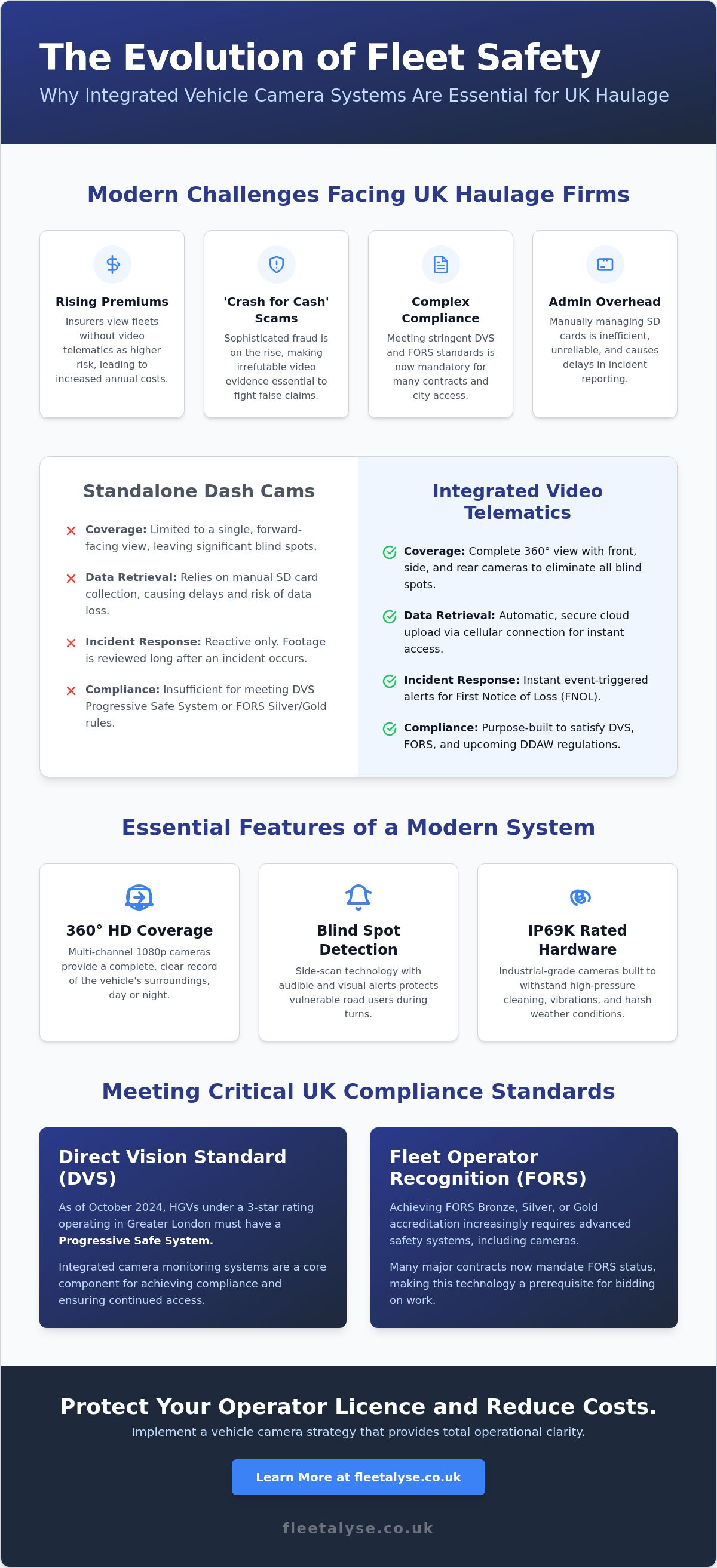
Insurance companies view firms without integrated video telematics as a higher risk. This perception directly impacts your annual premiums and your ability to secure competitive rates. One of the most significant factors in claim costs is the speed of First Notice of Loss (FNOL). Integrated vehicle camera systems for haulage firms allow you to provide HD footage to your insurer almost immediately after an event. This rapid response prevents third parties from inflating claims or fabricating injuries. By stopping fraudulent claims before they gain momentum, you protect your firm's bottom line and maintain a cleaner insurance history.
Meeting National Safety Standards: FORS and DVS
Compliance requirements are becoming more stringent across the UK. For example, the Direct Vision Standard (DVS) in Greater London requires HGVs over 12 tonnes to meet specific safety ratings. As of October 2024, vehicles failing to meet the three-star threshold must be fitted with a Progressive Safe System, which includes a camera monitoring setup. These systems are also vital for achieving FORS (Fleet Operator Recognition Scheme) accreditation. Many major contracts now mandate FORS Bronze, Silver, or Gold status to even bid for work. Investing in integrated camera technology ensures your fleet remains compliant with current laws and is prepared for future regulatory shifts.
Key Features of High-Definition HGV Camera Systems
Modern vehicle camera systems for haulage firms must offer more than just a forward-facing view. Effective protection requires a multi-angle setup. This usually involves a combination of dash cams, side-view cameras, and rear-view units. By capturing every angle, you eliminate the "he-said, she-said" scenarios that often follow minor collisions or loading bay incidents. It provides a complete 360-degree digital shield around the vehicle.
Resolution is non-negotiable. You need 1080p HD footage to read number plates at a distance. Night vision is equally critical. Most haulage operations happen during low-light hours or in poorly lit depots. High-quality infrared sensors ensure that evidence remains clear regardless of the conditions. Hardware must also be resilient. Look for IP69K-rated cameras. These units are built to withstand high-pressure steam cleaning and the constant vibration of long-haul routes. Standard consumer hardware will not survive these industrial conditions.
Connectivity changes how you manage this data. Relying on SD cards creates an administrative nightmare. Drivers must remember to report incidents, and managers must manually retrieve cards. Cellular-connected systems upload footage automatically when an event is triggered. This instant access is vital for First Notice of Loss (FNOL). It allows your insurance team to see exactly what happened within minutes of the event. Live streaming also enables real-time monitoring for high-value loads or complex manoeuvres.
Blind Spot Detection and Side-Scan Technology
Urban driving presents the highest risk for HGVs. Side-view cameras are now a core requirement for the Direct Vision Standard (DVS) in London. These systems use side-scan technology to detect vulnerable road users in the vehicle's blind spots. Integrating audible alarms with visual feeds gives drivers an immediate warning during left-hand turns. This proactive approach significantly reduces the risk of accidents with cyclists and pedestrians. It is a vital component for any firm seeking FORS Silver or Gold accreditation.
AI-Powered Driver Monitoring and ADAS
Advanced Driver Assistance Systems (ADAS) and AI-powered monitoring are the next steps in fleet safety. These systems identify dangerous behaviour like fatigue, phone usage, or lane departure. Whilst some drivers may view this as intrusive, the focus is on protection and coaching. It's about preventing a collision before it happens. When implementing these systems, you must consider your legal obligations. This includes registering with the ICO and potentially paying a data protection fee to ensure GDPR compliance for business use.
If you're looking to upgrade your fleet's safety profile, you can view our full range of tracking and integration options to find the right fit for your vehicles.
Video Telematics vs Standalone Dash Cams: Choosing the Right Setup
Choosing between standalone dash cams and integrated video telematics is a decision between manual labour and operational automation. Standalone units often attract operators looking for a low entry price. However, the hidden administrative costs are substantial. Manual SD card retrieval is a logistical headache. If a driver fails to report a minor bump, that footage is often overwritten before a manager can secure it. You cannot afford to lose evidence because of a full memory card or a forgotten report.
Modern vehicle camera systems for haulage firms must be scalable. As your fleet grows, the time spent managing individual cameras becomes unsustainable. Video telematics solves this by using 'event-triggered' recording. Integrated G-force sensors detect harsh braking, cornering, or impacts, automatically uploading the relevant clip to the cloud. This filters out the 'data noise' of standard motorway driving. It allows you to focus only on critical incidents that require your attention.
Centralising Your Fleet Data
True efficiency comes from having a single point of truth. By combining GPS Fleet Tracking with live video feeds, you gain a complete overview of your operations. If a vehicle is stationary, you don't need to call the driver; you can check the live feed to see if they are stuck in traffic or at a busy delivery bay. This level of visibility streamlines the investigation process for near-misses. You see the vehicle's speed, location, and the road conditions simultaneously. It removes the guesswork from fleet management.
Evaluating Long-Term ROI
A 'cheap' camera is often a false economy. Standalone systems lack the reliability of industrial-grade hardware. If a card corrupts during a major insurance claim, the lack of evidence could cost your firm thousands in increased premiums or lost legal battles. When calculating ROI, compare the upfront hardware cost against the long-term value of a subscription. Integrated systems offer remote health checks and automatic updates. This ensures your equipment is actually recording when you need it most. Reducing your accident rate and lowering your insurance excess provides a much faster return than saving a few pounds on a basic dash cam.
Protecting Your Operator Licence Through Integrated Video Evidence
Your Operator Licence is the foundation of your business. Any threat to your 'O' Licence is a threat to your firm's survival. The DVSA uses safety records and roadworthiness data to determine your professional competence. High-quality vehicle camera systems for haulage firms provide the transparency needed to maintain a clean record. When a roadside inspection occurs, having immediate access to footage can clarify the context of an alleged infringement. It shows you take your duty of care seriously. Proving that you have robust systems in place is often the difference between a warning and a formal inquiry.
Integrated video evidence acts as a digital logbook that provides an indisputable visual record of every road incident and operational event. This data is most powerful when it complements your remote tachograph download strategy. Whilst the tachograph records the 'what' and 'when', the camera provides the 'why'. If a driver is forced to move during a rest period due to police instruction or an emergency at a depot, the video provides the necessary proof to avoid a compliance penalty. It bridges the gap between raw data and real-world context, ensuring that your records are always accurate and defensible.
Supporting Driver Hours and Compliance
Reliable oversight is about more than just checking boxes. Combining live driver hours monitoring with visual confirmation allows you to verify exactly what your drivers are doing. It prevents common mistakes, such as drivers accidentally staying in 'work' mode whilst they are actually on a break. This dual-layer approach significantly reduces the risk of compliance infringements. It gives you the confidence that your fleet is operating within legal limits at all times. Better oversight leads to better behaviour and fewer costly errors during long-haul routes.
Audit Readiness and Earned Recognition
Being prepared for a DVSA audit should not be a source of stress. Integrated systems store video data in a secure, organised format that satisfies strict regulatory requirements. For firms aiming for DVSA Earned Recognition status, this level of transparency is essential. It proves to the authorities that you have a proactive culture of safety. You aren't just reacting to incidents; you are managing them with precise data. Providing this evidence during an audit demonstrates that your firm is a low-risk operator. It protects your reputation and ensures long-term operational stability.
Ready to secure your fleet's compliance? Get started with our integrated tracking and camera solutions today to protect your Operator Licence.
Implementing a Vehicle Camera Strategy with Fleetalyse
Successful implementation of vehicle camera systems for haulage firms requires a structured approach rather than a rushed installation. Don't attempt to equip your entire fleet overnight. Start with a pilot programme involving a small selection of vehicles and drivers. This initial phase allows you to identify specific hardware mounting challenges and refine your data alert settings. Once you've proven the system's reliability and established your internal workflows, move to a phased rollout. This ensures your operations continue without significant downtime whilst your fleet is upgraded.
Establishing clear protocols for data access is vital. You must decide who has the authority to view live feeds and review incident footage. Transparency is the best way to avoid internal friction. Document your policies regarding data storage and privacy to ensure you remain compliant with UK regulations. Fleetalyse simplifies this process by providing a centralised platform where vision and compliance data live together. This integration reduces the need for multiple logins and prevents the data overload that often plagues regional operators.
Winning Over Your Drivers
Driver resistance is a common hurdle when introducing new technology. The most effective way to overcome this is through an 'Exoneration First' approach. Show your team real-world examples of how video footage has cleared drivers of blame in 'crash for cash' scenarios or disputed deliveries. When drivers see that the system is there to protect their livelihood and professional reputation, they are far more likely to embrace it. Use the data for fair, transparent coaching rather than just disciplinary action. Rewarding safe behaviour amongst your team improves retention and builds a positive safety culture.
Next Steps for Your Haulage Firm
Your next move should be a thorough assessment of your current technology gaps. Consider your specific security needs and the routes your vehicles frequent. Choosing a partner that understands the nuances of UK transport regulations is essential for long-term success. We provide a straightforward, transparent breakdown of how our technology secures your fleet and supports your bottom line. We don't hide behind complex jargon or hidden fees. We focus on practical utility that solves your daily operational struggles.
Discover how Fleetalyse integrates vehicle cameras with compliance monitoring to secure your firm's future and streamline your fleet management.
Future-Proof Your Fleet with Integrated Vision
Investing in vehicle camera systems for haulage firms is no longer optional for operators who value their professional reputation. You've seen how integrated video telematics removes the guesswork from incident investigation whilst protecting your Operator Licence. By choosing hardware with HD resolution and night vision, you ensure that your evidence is always admissible and clear. The real strength lies in the synergy between your cameras and your compliance software. This joined-up approach turns raw footage into a powerful tool for driver exoneration and insurance negotiation.
As specialists in UK transport compliance, we provide seamless tachograph analysis integration and expert support for HGV and van operators. We focus on the practical needs of regional firms, providing the tools you need without unnecessary complexity. It's time to move beyond standalone dash cams and adopt a system that actively supports your business growth and regulatory standing. Don't wait for a costly false claim to reveal the gaps in your current setup.
Take control of your fleet's safety and financial security. Secure your fleet and protect your compliance with Fleetalyse. We're ready to help you build a more transparent, efficient operation today.
Frequently Asked Questions
Are vehicle camera systems mandatory for UK haulage firms?
No, there is no universal mandate, but they are essential for specific compliance standards. For example, HGVs over 12 tonnes operating in Greater London must meet the Direct Vision Standard (DVS). As of October 2024, vehicles failing to meet the three-star rating must install a Progressive Safe System, which includes camera monitoring. Additionally, from July 2026, new vehicles must feature Driver Drowsiness and Attention Warning (DDAW) systems under updated safety regulations.
How do vehicle cameras help reduce fleet insurance premiums?
Insurers offer lower rates to fleets that can provide immediate First Notice of Loss (FNOL). Integrated vehicle camera systems for haulage firms allow you to submit HD evidence within minutes of an incident. This prevents third parties from inflating claims or fabricating 'crash for cash' scenarios. By significantly reducing the cost of claims and proving a commitment to safety, you improve your firm's risk profile and secure better insurance terms.
Can vehicle camera data be used as evidence in a UK court?
Yes, digital footage is widely accepted as admissible evidence in UK courts to determine liability. To be effective, the footage must be high-definition and accurately timestamped. It provides an indisputable record that often settles disputes before they reach a full trial. You must ensure your system is maintained correctly so the data remains reliable and clear enough to identify number plates and road conditions.
What is the difference between a dash cam and a full vehicle camera system?
A standard dash cam is typically a standalone, forward-facing device that records onto an SD card. A full vehicle camera system provides 360-degree coverage using multiple cameras around the HGV. These integrated systems use cellular connectivity to upload footage to the cloud automatically. This removes the administrative burden of manual data retrieval and ensures you never lose critical evidence due to a corrupted memory card.
How do I manage driver privacy when installing in-cab cameras?
GDPR compliance is your primary responsibility when using driver-facing technology. You must register with the ICO, pay the data protection fee, and have a clear, written policy explaining why the cameras are in use. Focus on the 'exoneration first' approach. Show your drivers that the system is there to protect them from false accusations and to support their professional development through fair, evidence-based coaching.
Is it possible to integrate cameras with my existing tachograph software?
Yes, modern systems allow for deep integration between video feeds and tachograph data. This synergy is a core feature of vehicle camera systems for haulage firms looking for total operational clarity. By syncing the two, you can see the visual context behind a driver hours infringement or a sudden G-force alert. It helps you determine if a rest-period break was necessary due to an emergency or police instruction.
What happens to the video data if a vehicle is involved in a serious collision?
Integrated systems use G-force sensors to detect serious impacts and trigger an automatic cloud upload. This ensures that the footage is secured on a remote server even if the vehicle's physical hardware is destroyed. Industrial-grade cameras and DVRs are also built to survive extreme vibrations and temperatures. This redundancy provides peace of mind that your evidence is safe regardless of the severity of the incident.
How long should a haulage firm keep vehicle camera footage for compliance?
Most operators retain standard daily footage for 30 days before it is overwritten. However, you must store any footage related to a specific incident, near-miss, or insurance claim until the matter is fully resolved. UK GDPR guidelines state that you should not keep personal data for longer than is operationally necessary. Establish a clear data retention policy that balances your legal protection with your privacy obligations.
Frequently asked questions
The Cost of Inaction: False Claims and Rising Premiums
Insurance companies view firms without integrated video telematics as a higher risk. This perception directly impacts your annual premiums and your ability to secure competitive rates. One of the most significant factors in claim costs is the speed of First Notice of Loss (FNOL). Integrated vehicle camera systems for haulage firms allow you to provide HD footage to your insurer almost immediately after an event. This rapid response prevents third parties from inflating claims or fabricating injuries. By stopping fraudulent claims before they gain momentum, you protect your firm's bottom line and maintain a cleaner insurance history.
Meeting National Safety Standards: FORS and DVS
Compliance requirements are becoming more stringent across the UK. For example, the Direct Vision Standard (DVS) in Greater London requires HGVs over 12 tonnes to meet specific safety ratings. As of October 2024, vehicles failing to meet the three-star threshold must be fitted with a Progressive Safe System, which includes a camera monitoring setup. These systems are also vital for achieving FORS (Fleet Operator Recognition Scheme) accreditation. Many major contracts now mandate FORS Bronze, Silver, or Gold status to even bid for work. Investing in integrated camera technology ensures your fleet remains compliant with current laws and is prepared for future regulatory shifts. Modern vehicle camera systems for haulage firms must offer more than just a forward-facing view. Effective protection requires a multi-angle setup. This usually involves a combination of dash cams, side-view cameras, and rear-view units. By capturing every angle, you eliminate the "he-said, she-said" scenarios that often follow minor collisions or loading bay incidents. It provides a complete 360-degree digital shield around the vehicle. Resolution is non-negotiable. You need 1080p HD footage to read number plates at a distance. Night vision is equally critical. Most haulage operations happen during low-light hours or in poorly lit depots. High-quality infrared sensors ensure that evidence remains clear regardless of the conditions. Hardware must also be resilient. Look for IP69K-rated cameras. These units are built to withstand high-pressure steam cleaning and the constant vibration of long-haul routes. Standard consumer hardware will not survive these industrial conditions. Connectivity changes how you manage this data. Relying on SD cards creates an administrative nightmare. Drivers must remember to report incidents, and managers must manually retrieve cards. Cellular-connected systems upload footage automatically when an event is triggered. This instant access is vital for First Notice of Loss (FNOL). It allows your insurance team to see exactly what happened within minutes of the event. Live streaming also enables real-time monitoring for high-value loads or complex manoeuvres.
Blind Spot Detection and Side-Scan Technology
Urban driving presents the highest risk for HGVs. Side-view cameras are now a core requirement for the Direct Vision Standard (DVS) in London. These systems use side-scan technology to detect vulnerable road users in the vehicle's blind spots. Integrating audible alarms with visual feeds gives drivers an immediate warning during left-hand turns. This proactive approach significantly reduces the risk of accidents with cyclists and pedestrians. It is a vital component for any firm seeking FORS Silver or Gold accreditation.
AI-Powered Driver Monitoring and ADAS
Advanced Driver Assistance Systems (ADAS) and AI-powered monitoring are the next steps in fleet safety. These systems identify dangerous behaviour like fatigue, phone usage, or lane departure. Whilst some drivers may view this as intrusive, the focus is on protection and coaching. It's about preventing a collision before it happens. When implementing these systems, you must consider your legal obligations. This includes registering with the ICO and potentially paying a data protection fee to ensure GDPR compliance for business use. If you're looking to upgrade your fleet's safety profile, you can view our full range of tracking and integration options to find the right fit for your vehicles. Choosing between standalone dash cams and integrated video telematics is a decision between manual labour and operational automation. Standalone units often attract operators looking for a low entry price. However, the hidden administrative costs are substantial. Manual SD card retrieval is a logistical headache. If a driver fails to report a minor bump, that footage is often overwritten before a manager can secure it. You cannot afford to lose evidence because of a full memory card or a forgotten report. Modern vehicle camera systems for haulage firms must be scalable. As your fleet grows, the time spent managing individual cameras becomes unsustainable. Video telematics solves this by using 'event-triggered' recording. Integrated G-force sensors detect harsh braking, cornering, or impacts, automatically uploading the relevant clip to the cloud. This filters out the 'data noise' of standard motorway driving. It allows you to focus only on critical incidents that require your attention.
Centralising Your Fleet Data
True efficiency comes from having a single point of truth. By combining GPS Fleet Tracking with live video feeds, you gain a complete overview of your operations. If a vehicle is stationary, you don't need to call the driver; you can check the live feed to see if they are stuck in traffic or at a busy delivery bay. This level of visibility streamlines the investigation process for near-misses. You see the vehicle's speed, location, and the road conditions simultaneously. It removes the guesswork from fleet management.
Evaluating Long-Term ROI
A 'cheap' camera is often a false economy. Standalone systems lack the reliability of industrial-grade hardware. If a card corrupts during a major insurance claim, the lack of evidence could cost your firm thousands in increased premiums or lost legal battles. When calculating ROI, compare the upfront hardware cost against the long-term value of a subscription. Integrated systems offer remote health checks and automatic updates. This ensures your equipment is actually recording when you need it most. Reducing your accident rate and lowering your insurance excess provides a much faster return than saving a few pounds on a basic dash cam. Your Operator Licence is the foundation of your business. Any threat to your 'O' Licence is a threat to your firm's survival. The DVSA uses safety records and roadworthiness data to determine your professional competence. High-quality vehicle camera systems for haulage firms provide the transparency needed to maintain a clean record. When a roadside inspection occurs, having immediate access to footage can clarify the context of an alleged infringement. It shows you take your duty of care seriously. Proving that you have robust systems in place is often the difference between a warning and a formal inquiry. Integrated video evidence acts as a digital logbook that provides an indisputable visual record of every road incident and operational event. This data is most powerful when it complements your remote tachograph download strategy. Whilst the tachograph records the 'what' and 'when', the camera provides the 'why'. If a driver is forced to move during a rest period due to police instruction or an emergency at a depot, the video provides the necessary proof to avoid a compliance penalty. It bridges the gap between raw data and real-world context, ensuring that your records are always accurate and defensible.
Supporting Driver Hours and Compliance
Reliable oversight is about more than just checking boxes. Combining live driver hours monitoring with visual confirmation allows you to verify exactly what your drivers are doing. It prevents common mistakes, such as drivers accidentally staying in 'work' mode whilst they are actually on a break. This dual-layer approach significantly reduces the risk of compliance infringements. It gives you the confidence that your fleet is operating within legal limits at all times. Better oversight leads to better behaviour and fewer costly errors during long-haul routes.
Audit Readiness and Earned Recognition
Being prepared for a DVSA audit should not be a source of stress. Integrated systems store video data in a secure, organised format that satisfies strict regulatory requirements. For firms aiming for DVSA Earned Recognition status, this level of transparency is essential. It proves to the authorities that you have a proactive culture of safety. You aren't just reacting to incidents; you are managing them with precise data. Providing this evidence during an audit demonstrates that your firm is a low-risk operator. It protects your reputation and ensures long-term operational stability. Ready to secure your fleet's compliance? Get started with our integrated tracking and camera solutions today to protect your Operator Licence. Successful implementation of vehicle camera systems for haulage firms requires a structured approach rather than a rushed installation. Don't attempt to equip your entire fleet overnight. Start with a pilot programme involving a small selection of vehicles and drivers. This initial phase allows you to identify specific hardware mounting challenges and refine your data alert settings. Once you've proven the system's reliability and established your internal workflows, move to a phased rollout. This ensures your operations continue without significant downtime whilst your fleet is upgraded. Establishing clear protocols for data access is vital. You must decide who has the authority to view live feeds and review incident footage. Transparency is the best way to avoid internal friction. Document your policies regarding data storage and privacy to ensure you remain compliant with UK regulations. Fleetalyse simplifies this process by providing a centralised platform where vision and compliance data live together. This integration reduces the need for multiple logins and prevents the data overload that often plagues regional operators.
Winning Over Your Drivers
Driver resistance is a common hurdle when introducing new technology. The most effective way to overcome this is through an 'Exoneration First' approach. Show your team real-world examples of how video footage has cleared drivers of blame in 'crash for cash' scenarios or disputed deliveries. When drivers see that the system is there to protect their livelihood and professional reputation, they are far more likely to embrace it. Use the data for fair, transparent coaching rather than just disciplinary action. Rewarding safe behaviour amongst your team improves retention and builds a positive safety culture.
Next Steps for Your Haulage Firm
Your next move should be a thorough assessment of your current technology gaps. Consider your specific security needs and the routes your vehicles frequent. Choosing a partner that understands the nuances of UK transport regulations is essential for long-term success. We provide a straightforward, transparent breakdown of how our technology secures your fleet and supports your bottom line. We don't hide behind complex jargon or hidden fees. We focus on practical utility that solves your daily operational struggles. Discover how Fleetalyse integrates vehicle cameras with compliance monitoring to secure your firm's future and streamline your fleet management. Investing in vehicle camera systems for haulage firms is no longer optional for operators who value their professional reputation. You've seen how integrated video telematics removes the guesswork from incident investigation whilst protecting your Operator Licence. By choosing hardware with HD resolution and night vision, you ensure that your evidence is always admissible and clear. The real strength lies in the synergy between your cameras and your compliance software. This joined-up approach turns raw footage into a powerful tool for driver exoneration and insurance negotiation. As specialists in UK transport compliance, we provide seamless tachograph analysis integration and expert support for HGV and van operators. We focus on the practical needs of regional firms, providing the tools you need without unnecessary complexity. It's time to move beyond standalone dash cams and adopt a system that actively supports your business growth and regulatory standing. Don't wait for a costly false claim to reveal the gaps in your current setup. Take control of your fleet's safety and financial security. Secure your fleet and protect your compliance with Fleetalyse. We're ready to help you build a more transparent, efficient operation today.
Are vehicle camera systems mandatory for UK haulage firms?
No, there is no universal mandate, but they are essential for specific compliance standards. For example, HGVs over 12 tonnes operating in Greater London must meet the Direct Vision Standard (DVS). As of October 2024, vehicles failing to meet the three-star rating must install a Progressive Safe System, which includes camera monitoring. Additionally, from July 2026, new vehicles must feature Driver Drowsiness and Attention Warning (DDAW) systems under updated safety regulations.
How do vehicle cameras help reduce fleet insurance premiums?
Insurers offer lower rates to fleets that can provide immediate First Notice of Loss (FNOL). Integrated vehicle camera systems for haulage firms allow you to submit HD evidence within minutes of an incident. This prevents third parties from inflating claims or fabricating 'crash for cash' scenarios. By significantly reducing the cost of claims and proving a commitment to safety, you improve your firm's risk profile and secure better insurance terms.
Can vehicle camera data be used as evidence in a UK court?
Yes, digital footage is widely accepted as admissible evidence in UK courts to determine liability. To be effective, the footage must be high-definition and accurately timestamped. It provides an indisputable record that often settles disputes before they reach a full trial. You must ensure your system is maintained correctly so the data remains reliable and clear enough to identify number plates and road conditions.
What is the difference between a dash cam and a full vehicle camera system?
A standard dash cam is typically a standalone, forward-facing device that records onto an SD card. A full vehicle camera system provides 360-degree coverage using multiple cameras around the HGV. These integrated systems use cellular connectivity to upload footage to the cloud automatically. This removes the administrative burden of manual data retrieval and ensures you never lose critical evidence due to a corrupted memory card.
How do I manage driver privacy when installing in-cab cameras?
GDPR compliance is your primary responsibility when using driver-facing technology. You must register with the ICO, pay the data protection fee, and have a clear, written policy explaining why the cameras are in use. Focus on the 'exoneration first' approach. Show your drivers that the system is there to protect them from false accusations and to support their professional development through fair, evidence-based coaching.
Is it possible to integrate cameras with my existing tachograph software?
Yes, modern systems allow for deep integration between video feeds and tachograph data. This synergy is a core feature of vehicle camera systems for haulage firms looking for total operational clarity. By syncing the two, you can see the visual context behind a driver hours infringement or a sudden G-force alert. It helps you determine if a rest-period break was necessary due to an emergency or police instruction.
What happens to the video data if a vehicle is involved in a serious collision?
Integrated systems use G-force sensors to detect serious impacts and trigger an automatic cloud upload. This ensures that the footage is secured on a remote server even if the vehicle's physical hardware is destroyed. Industrial-grade cameras and DVRs are also built to survive extreme vibrations and temperatures. This redundancy provides peace of mind that your evidence is safe regardless of the severity of the incident.
How long should a haulage firm keep vehicle camera footage for compliance?
Most operators retain standard daily footage for 30 days before it is overwritten. However, you must store any footage related to a specific incident, near-miss, or insurance claim until the matter is fully resolved. UK GDPR guidelines state that you should not keep personal data for longer than is operationally necessary. Establish a clear data retention policy that balances your legal protection with your privacy obligations.