

HGV fleet replacement planning explained for UK operators

HGV fleet replacement planning is the process of deciding when to retire and replace vehicles to control costs, maintain reliability, and meet legal obligations. Done well, it reduces unplanned breakdowns, protects your Operator Licence, and gives your finance team a defensible capital expenditure forecast. Done poorly, it leaves you running ageing trucks that cost far more to maintain than a replacement would. This guide covers the key triggers, lifecycle cost methods, 2026 procurement realities, and the role of telematics data in building a replacement strategy that holds up under scrutiny.
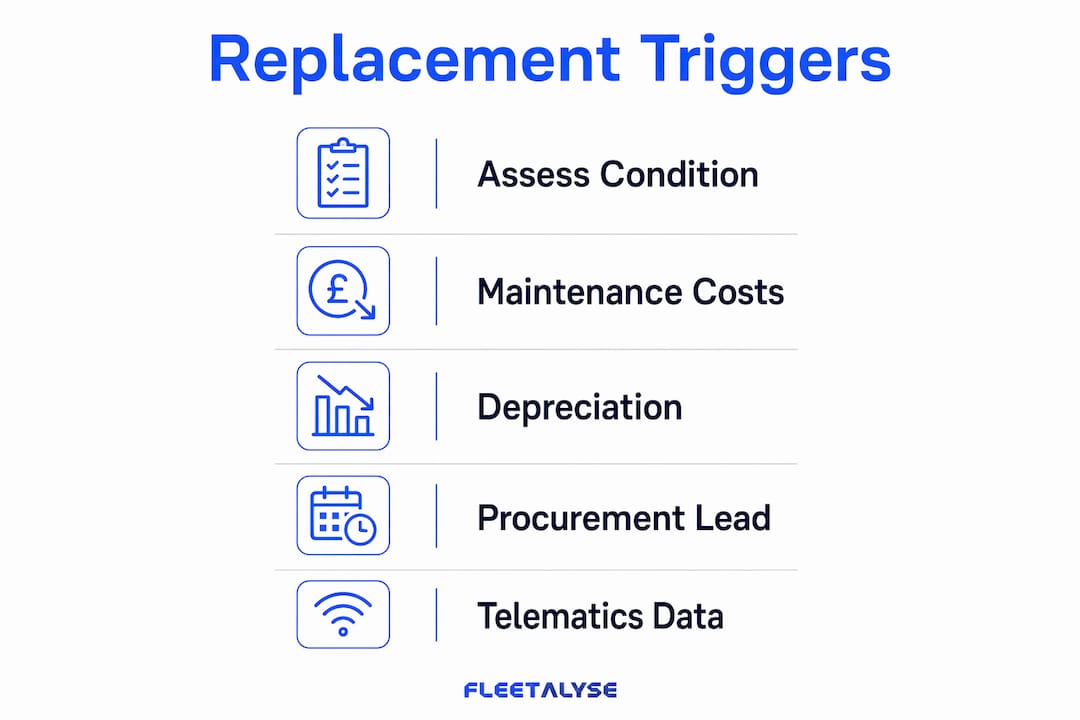
What are the key triggers for HGV fleet replacement planning?
The economic crossover point is the single most useful concept in any HGV replacement strategy. It is the moment when annual maintenance costs exceed the financial benefit of keeping a vehicle rather than replacing it. For most heavy goods vehicles, that crossover arrives between 7 and 9 years of operation, after which maintenance costs rise sharply. The practical implication is clear: waiting until a truck fails completely is always the more expensive choice.
Three categories of trigger signal that a vehicle is approaching or past that crossover:
- Age and mileage. Most HGVs reach the economic crossover between 7 and 9 years. High annual mileage accelerates wear on the drivetrain, brakes, and suspension, compressing that window further.
- Maintenance cost ratio. Planned replacement is justified when annual repair costs exceed 50% of the vehicle’s annual depreciation value. That ratio is a widely used trigger in fleet finance.
- Downtime frequency. A £2,000 repair sounds manageable until you add five days of lost revenue. Downtime costs add 35–45% on top of direct repair expenses, which means the true cost of that repair is closer to £4,500 or more.
- Repair frequency. A vehicle requiring three or more unplanned repairs in a 12-month period is a strong signal that the chassis is approaching end of economic life.
Total Cost of Ownership (TCO) is the framework that ties these triggers together. TCO captures purchase price, fuel consumption, tyres, servicing, insurance, downtime, and residual value in a single per-asset figure. Without TCO data, repair versus replace decisions rely on gut feeling, which rarely survives a CFO’s scrutiny. Using a diesel fuel cost calculator alongside your maintenance records gives you the fuel component of TCO with minimal effort.
Pro Tip: Set a maintenance cost alert at 40% of annual depreciation, not 50%. That 10% buffer gives you time to procure a replacement before the crossover hits, rather than reacting to it.
How does lifecycle cost analysis compare to refurbishment?
Lifecycle cost analysis maps two curves against each other: depreciation, which falls steeply in the early years, and maintenance costs, which rise gradually then sharply. The point where those curves intersect is your replacement signal. Understanding this curve means you stop treating replacement as a one-off decision and start treating it as a scheduled event.

Refurbishment sits between full replacement and routine repair. Refurbishing a sound chassis costs a fraction of a new unit and can extend vehicle life by several years, particularly for custom-upfitted trucks with long lead times. The key word is “sound.” If the chassis, cab structure, and main drivetrain components are in good condition, refurbishment is a legitimate financial decision. If corrosion, frame fatigue, or repeated drivetrain failures are present, refurbishment simply delays the inevitable at significant cost.
A practical decision framework looks like this:
| Scenario | Recommended action |
|---|---|
| Chassis sound, maintenance costs below 40% of depreciation | Refurbish and extend life by 2–3 years |
| Chassis sound, maintenance costs at 40–50% of depreciation | Evaluate refurbishment cost vs. new unit TCO |
| Chassis sound, maintenance costs above 50% of depreciation | Replace, even if refurbishment is possible |
| Chassis compromised or repeated drivetrain failures | Replace immediately |
Tracking per-asset TCO data is what makes this framework work in practice. Without it, you are comparing averages rather than the actual cost profile of each vehicle. A road freight management system that integrates maintenance records with operational data gives you that per-asset visibility without manual spreadsheet work.
Pro Tip: When evaluating refurbishment, get a written structural assessment from a certified HGV engineer before committing. A visual inspection alone misses frame fatigue and hidden corrosion that will surface within 18 months.
What operational factors affect replacement planning in 2026?
Four factors make 2026 a more complex year for fleet renewal than most. Each one affects either the cost of replacement or the time available to plan it.
-
Procurement lead times. Lead times for new HGVs now exceed 12 months in many cases. If you identify a vehicle approaching its crossover point today, ordering a replacement immediately still means operating that vehicle for over a year. Start your replacement trigger monitoring at the 6-year mark, not the 8-year mark.
-
Tariff-related price increases. New Class 8 trucks carry a significant price premium in 2026 due to tariff pressures. That increase changes the TCO calculation for new vehicles and makes refurbishment more attractive in borderline cases. Factor the current purchase price into your TCO model, not last year’s figures.
-
Electrification readiness. Electric HGVs fit certain duty cycles well, but grid connections and charging infrastructure take longer to arrange than the vehicles themselves. A grid connection can take over a year to commission. If electrification is part of your 3-year plan, the depot infrastructure work needs to start now, before you order a single vehicle.
-
Driver involvement. Including drivers in vehicle selection improves retention and reduces on-road incidents. The ergonomic and safety preferences of experienced drivers translate directly into lower insurance costs and fewer at-fault incidents. That is a measurable financial benefit, not a soft one.
Staggering replacements across a rolling schedule also matters. Replacing five vehicles in one quarter strains both capital budgets and workshop capacity. Spreading replacements across the year keeps cash flow predictable and gives your maintenance team time to commission each new vehicle properly.
How does telematics data improve replacement decisions?
Telematics turns replacement planning from a calendar exercise into a data-driven process. GPS tracking and onboard diagnostics capture utilisation rates, idle time, fuel consumption, and fault codes in real time. That data feeds directly into TCO calculations and removes the guesswork from replacement timing.
The most useful data points for replacement decisions include:
- Repair cost per kilometre. This metric rises steadily as a vehicle ages. When it crosses a defined threshold, the vehicle moves into active replacement consideration regardless of its age.
- Unplanned downtime hours. Telematics logs every period a vehicle is off the road. Aggregating that data per asset reveals which vehicles are consuming disproportionate workshop time.
- Fault code frequency. Repeated fault codes for the same system, particularly the engine management or transmission, indicate a vehicle approaching structural unreliability.
- Fuel consumption trend. A gradual increase in fuel consumption on the same routes signals engine wear. Fuel is often the largest single operating cost for an HGV, so a 5% consumption increase has a material effect on TCO.
Fleetalyse captures all of these data streams through its GPS tracking and telematics platform, giving fleet managers a live view of each vehicle’s cost profile. The platform’s maintenance scheduling and driver behaviour monitoring features mean you are not waiting for a breakdown to identify a problem. HGV GPS trackers with tachograph support add compliance data to the picture, so your replacement proposals carry both operational and regulatory weight when presented to stakeholders.
Predictive analytics built on this data can flag vehicles likely to cross the economic threshold in the next 6–12 months. That forward visibility is what allows you to order replacements before lead times become a crisis.
Key takeaways
Effective HGV fleet replacement planning requires TCO data, defined cost triggers, and a rolling forecast that accounts for procurement lead times and 2026 market conditions.
| Point | Details |
|---|---|
| Use the economic crossover point | Replace when annual maintenance exceeds 50% of annual depreciation, not when a vehicle fails. |
| Track TCO per asset | Aggregate fuel, repair, downtime, and depreciation data for each vehicle to make defensible decisions. |
| Plan for 12-month lead times | Start replacement procurement at year 6, not year 8, given current supply constraints. |
| Evaluate refurbishment on chassis condition | Refurbishment is cost-effective only when the chassis and drivetrain are structurally sound. |
| Use telematics for early warning | Fault code frequency and repair cost per kilometre signal replacement need before breakdown occurs. |
Why most fleets replace vehicles at least a year too late
Fleet managers I have worked alongside consistently make the same mistake: they wait for a vehicle to become a problem before they treat it as a replacement candidate. By that point, the economic crossover passed 18 months ago, the procurement queue is already long, and the business is absorbing downtime costs it could have avoided entirely.
The fix is not complicated, but it requires discipline. A rolling 3–5 year replacement forecast updated annually forces you to treat replacement as a scheduled capital event rather than a reactive one. It also gives your finance director the visibility they need to approve spend without a crisis driving the conversation.
The electrification question adds a layer of complexity that most operators are not yet taking seriously enough. Electric HGVs are not a future consideration. They are a present procurement decision for operators running urban or regional routes. The mistake I see repeatedly is operators assuming they can order an electric truck and then sort out the depot charging. The depot work takes longer than the truck order. Sequence it correctly or the vehicle arrives before the infrastructure is ready.
Driver involvement is the most underused lever in replacement planning. Drivers who feel consulted about vehicle choices stay longer and drive more carefully. That is not sentiment. It translates into lower turnover costs and fewer insurance claims. Any replacement plan that ignores driver input is leaving measurable value on the table.
My honest view is that the operators who will manage costs best over the next three years are those who build replacement planning into their monthly data review, not their annual budget meeting. The data is available. The question is whether you are using it.
— Vytautas
How Fleetalyse supports your replacement planning
Fleetalyse gives you the per-asset data that makes replacement decisions defensible rather than instinctive. The platform’s GPS tracking captures utilisation, fuel consumption, and fault activity in real time, feeding the TCO calculations your finance team needs to approve capital spend.
The Teltonika FMC650 HGV tracker integrates directly with tachograph systems, giving you compliance data alongside operational metrics in a single dashboard. Maintenance alerts flag vehicles approaching cost thresholds before they become breakdowns. If you are building or refreshing your fleet replacement programme, the Fleetalyse solutions page outlines how the platform supports every stage of the process, from live tracking through to scheduled maintenance and driver behaviour reporting.
FAQ
When should you replace an HGV?
The optimal replacement window for most HGVs is between 7 and 9 years of operation. Replace sooner if annual maintenance costs exceed 50% of the vehicle’s annual depreciation value.
What is Total Cost of Ownership in fleet management?
Total Cost of Ownership (TCO) is the sum of all costs associated with operating a vehicle, including purchase price, fuel, tyres, servicing, insurance, downtime, and residual value. TCO gives a complete financial picture for each asset, making repair versus replace decisions defensible.
How do procurement lead times affect replacement planning?
New HGV lead times currently exceed 12 months in many cases. Fleet managers should begin replacement procurement at year 6 of a vehicle’s life to avoid operating ageing trucks while waiting for new units to arrive.
Is refurbishment a viable alternative to replacement?
Refurbishment is cost-effective when the chassis and main drivetrain are structurally sound. It is not viable when corrosion, frame fatigue, or repeated drivetrain failures are present, as it delays replacement costs without resolving the underlying problem.
How does telematics help with fleet replacement decisions?
Telematics captures repair cost per kilometre, unplanned downtime, fault code frequency, and fuel consumption trends per vehicle. That data identifies which assets are approaching the economic crossover point before a breakdown forces the decision.