

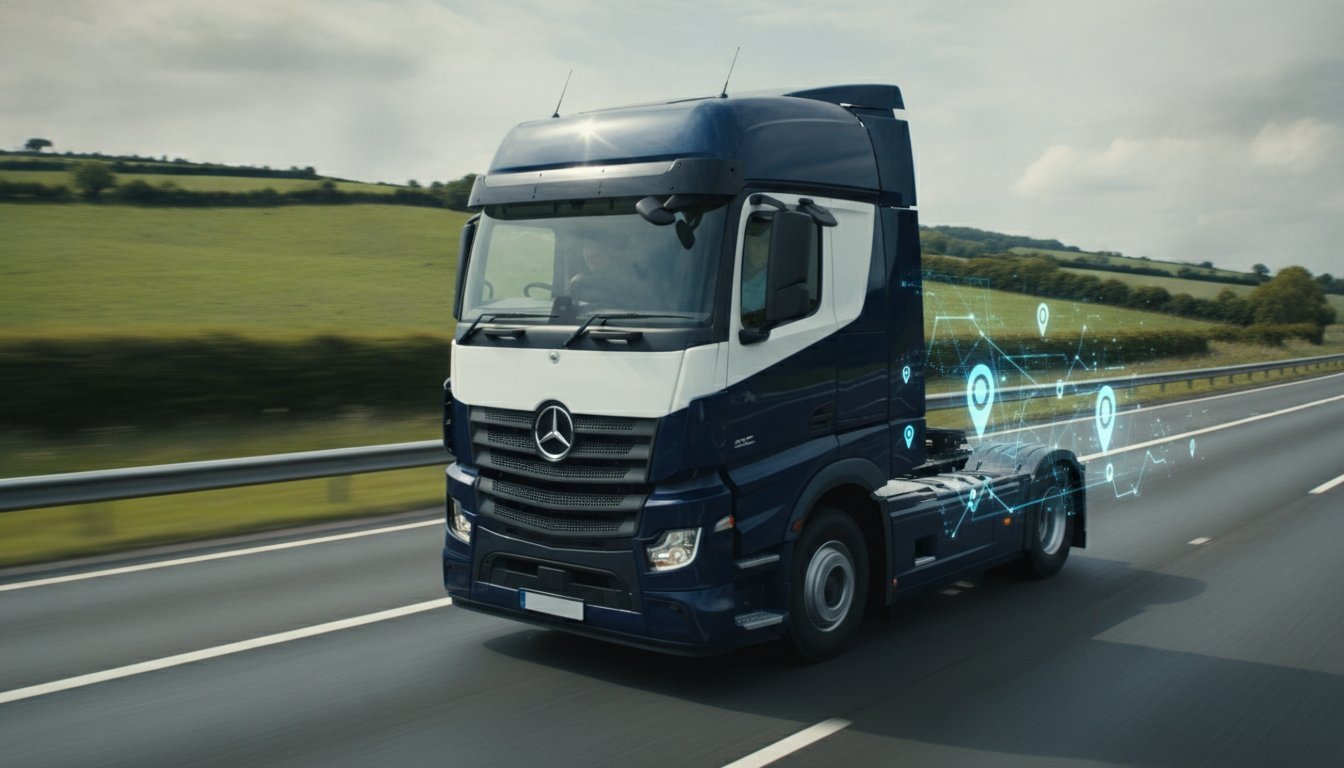
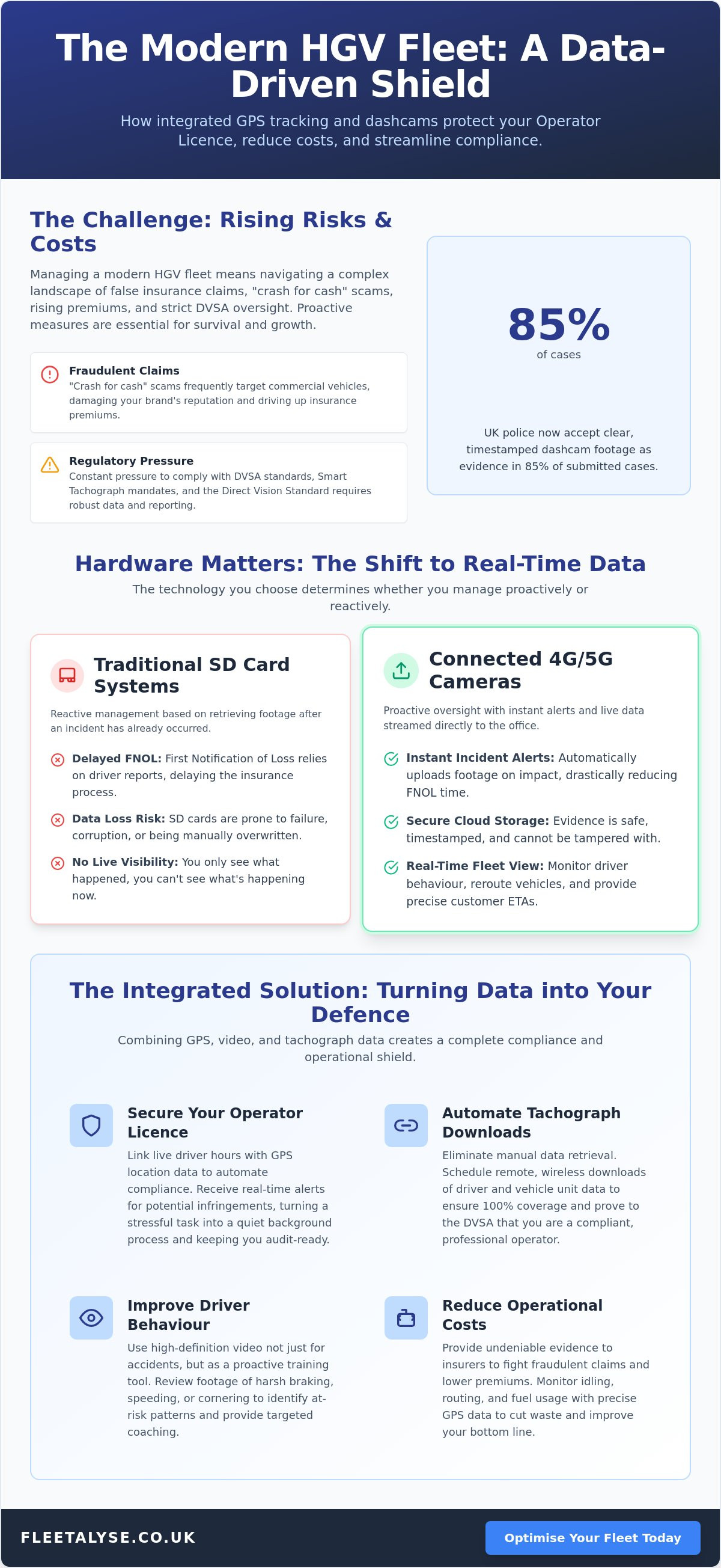
Did you know that UK police now accept dashcam footage in 85% of cases when it is properly timestamped and clear? For a transport manager, that isn't just a statistic; it's a vital shield against the rising tide of false insurance claims and "crash for cash" scams. Managing a modern fleet often feels like a constant battle against rising premiums and the strict oversight of the DVSA. You're likely already feeling the pressure of the Smart Tachograph Version 2 mandate or the ongoing complexities of the Direct Vision Standard.
We understand that your priority is keeping your vehicles moving safely whilst keeping costs under control. Integrating GPS tracking and dashcams for HGV fleets doesn't have to be another administrative headache. It's about turning raw data into a reliable tool for protecting your drivers and your bottom line. This guide explores how combining live tracking with high-definition video creates an automated compliance shield, reduces fuel waste, and provides the full visibility you need to manage trailers and assets across the UK.
Key Takeaways
- Secure your Operator Licence by linking live driver hours with location data to automate your compliance reporting.
- Understand why 4G and 5G connected cameras are superior to SD-card systems for real-time fleet management and incident response.
- Discover the financial impact of GPS tracking and dashcams for HGV fleets, including reduced insurance premiums and lower fuel costs.
- Use high-definition video as a pragmatic training tool to improve driver behaviour and provide evidence against false claims.
- Learn how to implement a transparent data privacy policy that protects your drivers whilst maintaining full visibility of your assets.
The Role of GPS Tracking and Dashcams in Modern HGV Operations
HGV operations are no longer just about moving goods from point A to point B. They are about managing complex data streams to ensure safety and efficiency. Integrated telematics represents the convergence of live GPS location data with high-definition video footage. This is a significant step up from a standard Vehicle tracking system found in a typical van or car. For heavy goods vehicles, the hardware must be more robust. It needs to handle the vibrations of long-haul travel and integrate with other critical systems like tachographs.
The industry is shifting. We're moving away from reactive management where you only retrieve footage after a collision. Instead, GPS tracking and dashcams for HGV fleets allow for proactive oversight. You can monitor driver behaviour in real time and identify risks before they turn into accidents. This level of visibility transforms your dispatch office. It allows for precise customer service updates and instant rerouting when traffic conditions change. It's about having a clear, live window into every aspect of your mobile operation.
The Business Case for Integrated Systems
Speed is vital when dealing with insurance. Reducing the "First Notification of Loss" (FNOL) time is a primary advantage of integrated hardware. When an incident occurs, the system automatically alerts the office and uploads the relevant video clip. This allows your insurer to settle claims faster and more accurately. GPS data adds the essential context that video alone lacks. It provides verified speed, precise coordinates, and the exact direction of travel. This evidence is your best defence against "crash for cash" scams that frequently target commercial operators. It protects your brand's reputation and helps prevent your premiums from spiralling due to fraudulent claims.
Meeting UK Transport Standards
Operating an HGV fleet in the UK requires strict adherence to DVSA standards. Modern tracking systems provide the digital evidence needed to prove you are managing your fleet responsibly. Whilst monitoring driver behaviour is necessary for safety, you must balance this with GDPR requirements. A transparent data policy ensures you remain compliant with privacy laws whilst using telematics to improve road safety scores. Integrated HGV telematics is the union of location, video, and compliance data into a single, actionable platform. By choosing GPS Fleet Tracking designed for the UK market, you ensure your business stays ahead of regulatory changes and operational challenges.
How Integrated Telematics Protect Your Operator Licence
Your Operator Licence is the most valuable asset your business owns. Losing it means your fleet stops moving. To manage your vehicle operator licence effectively, you need a system that does more than just track locations. Modern GPS tracking and dashcams for HGV fleets must link directly to live driver hours. This connection provides a real-time view of remaining driving time for every person in your team. It's the most effective way to prevent infringements before they occur.
Real-time alerts act as your first line of defence. If a driver approaches their limit or misses a mandatory rest period, the system notifies the office immediately. You can intervene whilst there is still time to correct the course. This proactive approach simplifies the process of staying audit-ready. Instead of chasing paperwork at the end of the month, you have a continuous stream of verified data. It turns compliance from a stressful monthly task into a quiet, automated background process.
Synergy with Remote Tachograph Download
Automation is the key to operational efficiency. By integrating GPS tracking with remote tachograph downloads, you eliminate the need for manual data retrieval from the cab. You no longer have to wait for a vehicle to return to the depot to download driver card data. The system handles this wirelessly and on a schedule. This ensures 100% data coverage for every vehicle in your fleet, regardless of their location in the UK. It removes the administrative burden and ensures you never miss a download deadline. This level of transparency shows the DVSA that you are a professional, compliant operator.
Monitoring Driver Behaviour and Safety
Dashcams are far more than just "accident recorders"; they are vital training tools. By reviewing footage of harsh braking, speeding, or sudden cornering, you can identify "at-risk" driving patterns. You can then use these clips to coach drivers and improve safety scores across the entire fleet. This builds a culture of accountability and transparency amongst your staff. When a non-fault accident occurs, high-definition video provides the definitive proof needed to exonerate your drivers. It protects their professional record and your business's insurance standing. If you want to simplify your compliance today, you can explore our integrated solutions here.
Evaluating Hardware: Connected Dashcams vs Traditional SD Storage
SD cards are the single biggest point of failure in vehicle recording. In a heavy-duty HGV environment, these cards are subject to constant vibration, extreme temperature fluctuations, and high write-cycles. They fail frequently. A transport manager often only discovers a card has corrupted when they go to retrieve footage after an accident. By then, it's too late. Relying on manual retrieval is a reactive strategy that leaves your business vulnerable. Professional GPS tracking and dashcams for HGV fleets bypass this risk by using 4G or 5G connectivity to upload incident data to the cloud instantly.
Connected systems provide a level of data integrity that traditional storage cannot match. When an event occurs, the hardware automatically transmits a video clip to your management portal. This ensures you have the evidence you need, even if the camera is damaged in a collision. High-specification GNSS and LTE modules are essential for UK-wide coverage. You need hardware that maintains a lock on satellites and a cellular signal whether the vehicle is in a congested city centre or on a remote Highland road. This reliable connectivity is how you Improve Fleet Productivity With Telematics, as it allows for real-time decision-making based on accurate, live data.
Multi-Camera Systems for Full HGV Coverage
A single forward-facing camera is rarely enough for a large goods vehicle. Blind spots are a significant risk, particularly during urban deliveries. Multi-camera configurations often include side-view and rear-view lenses to provide a 360-degree view of the vehicle's surroundings. Dual-vision cameras, which include a driver-facing lens, are also becoming standard for managing fatigue and distracted driving. Integrating trailer-mounted cameras is a pragmatic choice for fleets involved in complex loading or reversing manoeuvres. This total visibility protects the driver and reduces the likelihood of costly low-speed bumps and scrapes.
The Importance of Professional Installation
"Plug-and-play" dashcams are designed for domestic cars, not 44-tonne lorries. They are easily unplugged, frequently vibrate loose, and often fail the rigours of heavy-duty use. Professional hardwiring is essential. It ensures the system remains powered and tamper-proof at all times. Expert installers position cameras to maximise the field of view whilst ensuring they do not obstruct the driver's vision or violate windscreen regulations. By integrating the hardware with the vehicle's CAN bus, the system can pull granular engine data. This provides deeper telematics insights into fuel consumption and mechanical health, which are far more valuable than simple location tracking alone.
Implementation Strategy: Best Practices for HGV Deployment
Successful deployment of GPS tracking and dashcams for HGV fleets begins with a thorough audit of your current assets. You need to identify which vehicles require simple Asset Tracking and which need full multi-camera setups. A phased rollout is often the most sensible approach for regional operators. It allows you to test the hardware on a small group of vehicles first, minimising operational downtime across the wider fleet. This ensures that any technical adjustments are made before the full system goes live.
Privacy is a major concern for drivers and a legal priority for the business. You must develop a clear, written policy for data usage before any cameras are fitted. This should outline exactly who has access to the footage and under what circumstances it will be reviewed. Under UK GDPR, you must also register with the Information Commissioner's Office (ICO) and pay the annual data protection fee of £52. Transparency here is not just a legal requirement; it is the foundation of trust between management and the driving team. Choosing a platform that integrates with your existing tachograph analysis software ensures that all your compliance data sits in one place.
Driver Engagement and Training
Drivers often view new technology with suspicion. Focus on the benefits to them. Explain how the system provides definitive evidence to protect their professional reputation in the event of an incident. Organise training sessions that show them how to use SOS alerts and report near-misses. When drivers see the technology as a shield rather than a spy, adoption becomes much smoother. Addressing "big brother" concerns through honest, transparent communication is the only way to ensure long-term success.
Setting Up Alerts and Reporting
Don't drown in data. Configure real-time notifications only for critical events like high-G impacts or extreme speeding. This allows you to react instantly to genuine emergencies without being overwhelmed by minor alerts. Weekly automated reports allow you to track safety trends and calculate your ROI without spending hours in the management portal. The most effective implementation begins with clear driver communication and ends with data-driven coaching. If you are ready to upgrade your fleet's security, you can order your tracking hardware here.
Optimising Fleet Productivity with Fleetalyse Tracking Solutions
Fleetalyse offers a straightforward and transparent approach to telematics. We don't hide behind complex jargon or aggressive marketing tactics. Instead, we provide a reliable service built for the actual needs of UK regional operators. Choosing GPS tracking and dashcams for HGV fleets from a local specialist means you get hardware and software designed specifically for domestic transport regulations. It's about providing quiet confidence that your fleet is protected and your data is accurate.
Working with a UK-based partner provides a distinct advantage. We understand the specific challenges of regional infrastructure and the strict oversight of the DVSA. Our support team is grounded in industry expertise, ready to help you navigate the complexities of fleet management without the typical hyperbole. We focus on delivering a service that is deeply practical and efficient, ensuring your vehicles stay on the road and your business stays profitable.
The Fleetalyse Advantage for HGV Operators
Our platform integrates live driver hours and remote tachograph downloads into a single, efficient interface. You don't have to jump between different systems to see where your vehicles are and how much driving time your team has left. This unified view allows for faster dispatch decisions and more accurate customer updates. We use hardware that is built to withstand the UK's climate and road conditions, ensuring consistent performance from Cornwall to the Highlands. We believe in operational clarity. That's why we provide full financial and contractual details upfront, ensuring there are no hidden fees or unexpected rate hikes.
Beyond HGVs: Asset and Van Tracking
Total fleet visibility must extend beyond the tractor unit. Fleetalyse provides specialised trailer tracking to ensure you never lose sight of your most valuable assets, even when they are uncoupled. By extending your visibility to vans and mobile plant machinery, you create a complete digital map of your entire operation. This unified view of all mobile assets improves dispatch planning and reduces the time spent searching for specific trailers or equipment.
- Secure high-value cargo with custom geofencing and instant movement alerts if an asset leaves a designated area.
- Monitor the usage patterns of trailers and vans to optimise your maintenance schedules and reduce downtime.
- Protect against the rising trend of tool and equipment theft with dedicated asset tracking hardware.
This structured approach to fleet management moves your business toward a frictionless decision-making point. You gain the granular data needed to reduce fuel costs and insurance premiums whilst maintaining absolute compliance. We act as a pragmatic expert partner, valuing your time and resources by focusing on functional utility over flashy, unnecessary features.
Secure Your Fleet’s Future with Integrated Telematics
Protecting your transport business requires more than just knowing where your lorries are. It's about combining live location data with high-definition video to create an unshakeable record of compliance and safety. By moving away from unreliable SD-card systems and embracing 4G-connected GPS tracking and dashcams for HGV fleets, you ensure that vital evidence is always available when you need it most. This integration doesn't just protect your vehicles; it safeguards your Operator Licence and your professional reputation.
Fleetalyse provides a pragmatic, benefit-first approach to fleet management. Our systems offer seamless tachograph analysis integration and UK-based expert support to keep your operation moving without the administrative headache. We focus on transparent pricing and functional utility, helping you reduce insurance premiums and fuel waste whilst keeping your drivers protected on the road. You can count on a partner that understands the rigours of the UK transport sector.
Ready to streamline your compliance and secure your assets? Request a transparent quote for HGV tracking and dashcams from Fleetalyse today. Let's work together to build a safer, more efficient transport operation.
Frequently Asked Questions
Do HGV dashcams record audio inside the cab?
Most professional dashcams have the capability to record audio, but it is often disabled by default to ensure privacy. If you choose to record audio inside the cab, you must clearly state this in your driver policy and display a notice within the vehicle. Many operators prefer to leave audio recording off to maintain a better relationship with their drivers whilst still capturing vital road evidence.
How does GPS tracking help with DVSA compliance?
GPS tracking provides a digital breadcrumb trail that cross-references with your tachograph data. This allows you to prove exactly where a vehicle was during a recorded driving period. It helps you identify unauthorised vehicle use and ensures that your driver hours records are accurate and tamper-proof. This level of transparency is vital for maintaining a strong safety record during DVSA audits.
Can I see my drivers’ hours in real-time with these systems?
Yes, by integrating GPS tracking and dashcams for HGV fleets with your vehicle's digital tachograph, you can view live driver hours. This gives you an instant overview of remaining driving time, break status, and daily limits for every driver. It allows your dispatch team to plan routes more effectively and prevents accidental infringements of EU and UK driving rules.
What happens to the footage if the HGV is involved in a serious collision?
In a serious collision, connected 4G dashcams use G-sensor technology to detect the impact and automatically upload the preceding and following footage to the cloud. This ensures the evidence is safe even if the camera or SD card is destroyed. You can then access this footage instantly from your management portal to begin the insurance claim process or provide evidence to the police.
Is it legal to have a driver-facing camera in the UK?
Driver-facing cameras are legal in the UK provided you have a legitimate business reason, such as monitoring for fatigue or distracted driving. You must comply with UK GDPR by conducting a Data Protection Impact Assessment (DPIA) and being completely transparent with your staff. Clear signage and a robust data privacy policy are essential to ensure the use of these cameras remains lawful and ethical.
How much data does a connected 4G dashcam use per month?
Data usage varies depending on how often you live-stream video. For most fleets using event-based uploading, where only clips of harsh braking or incidents are sent to the cloud, usage typically ranges between 500MB and 2GB per month per vehicle. If you frequently use live-view features to monitor road conditions or driver behaviour, your data consumption will be significantly higher.
Can GPS tracking and dashcams help reduce my HGV insurance premiums?
Many UK insurers offer reduced premiums or lower excesses for fleets that install GPS tracking and dashcams for HGV fleets. This is because the technology drastically reduces the time and cost of settling claims. With police accepting dashcam footage in 85% of cases as of 2026, having clear video evidence is your best defence against fraudulent claims and disputed liability.
What is the difference between a standard vehicle tracker and HGV telematics?
A standard vehicle tracker typically only provides basic GPS location and speed data. In contrast, HGV telematics integrates with the vehicle's CAN bus and tachograph to provide much deeper insights. This includes live driver hours, fuel consumption, engine diagnostics, and remote tachograph downloads. It's a comprehensive tool designed for the specific regulatory and operational demands of the heavy haulage industry.
Frequently asked questions
The Business Case for Integrated Systems
Speed is vital when dealing with insurance. Reducing the "First Notification of Loss" (FNOL) time is a primary advantage of integrated hardware. When an incident occurs, the system automatically alerts the office and uploads the relevant video clip. This allows your insurer to settle claims faster and more accurately. GPS data adds the essential context that video alone lacks. It provides verified speed, precise coordinates, and the exact direction of travel. This evidence is your best defence against "crash for cash" scams that frequently target commercial operators. It protects your brand's reputation and helps prevent your premiums from spiralling due to fraudulent claims.
Meeting UK Transport Standards
Operating an HGV fleet in the UK requires strict adherence to DVSA standards. Modern tracking systems provide the digital evidence needed to prove you are managing your fleet responsibly. Whilst monitoring driver behaviour is necessary for safety, you must balance this with GDPR requirements. A transparent data policy ensures you remain compliant with privacy laws whilst using telematics to improve road safety scores. Integrated HGV telematics is the union of location, video, and compliance data into a single, actionable platform. By choosing GPS Fleet Tracking designed for the UK market, you ensure your business stays ahead of regulatory changes and operational challenges. Your Operator Licence is the most valuable asset your business owns. Losing it means your fleet stops moving. To manage your vehicle operator licence effectively, you need a system that does more than just track locations. Modern GPS tracking and dashcams for HGV fleets must link directly to live driver hours. This connection provides a real-time view of remaining driving time for every person in your team. It's the most effective way to prevent infringements before they occur. Real-time alerts act as your first line of defence. If a driver approaches their limit or misses a mandatory rest period, the system notifies the office immediately. You can intervene whilst there is still time to correct the course. This proactive approach simplifies the process of staying audit-ready. Instead of chasing paperwork at the end of the month, you have a continuous stream of verified data. It turns compliance from a stressful monthly task into a quiet, automated background process.
Synergy with Remote Tachograph Download
Automation is the key to operational efficiency. By integrating GPS tracking with remote tachograph downloads, you eliminate the need for manual data retrieval from the cab. You no longer have to wait for a vehicle to return to the depot to download driver card data. The system handles this wirelessly and on a schedule. This ensures 100% data coverage for every vehicle in your fleet, regardless of their location in the UK. It removes the administrative burden and ensures you never miss a download deadline. This level of transparency shows the DVSA that you are a professional, compliant operator.
Monitoring Driver Behaviour and Safety
Dashcams are far more than just "accident recorders"; they are vital training tools. By reviewing footage of harsh braking, speeding, or sudden cornering, you can identify "at-risk" driving patterns. You can then use these clips to coach drivers and improve safety scores across the entire fleet. This builds a culture of accountability and transparency amongst your staff. When a non-fault accident occurs, high-definition video provides the definitive proof needed to exonerate your drivers. It protects their professional record and your business's insurance standing. If you want to simplify your compliance today, you can explore our integrated solutions here. SD cards are the single biggest point of failure in vehicle recording. In a heavy-duty HGV environment, these cards are subject to constant vibration, extreme temperature fluctuations, and high write-cycles. They fail frequently. A transport manager often only discovers a card has corrupted when they go to retrieve footage after an accident. By then, it's too late. Relying on manual retrieval is a reactive strategy that leaves your business vulnerable. Professional GPS tracking and dashcams for HGV fleets bypass this risk by using 4G or 5G connectivity to upload incident data to the cloud instantly. Connected systems provide a level of data integrity that traditional storage cannot match. When an event occurs, the hardware automatically transmits a video clip to your management portal. This ensures you have the evidence you need, even if the camera is damaged in a collision. High-specification GNSS and LTE modules are essential for UK-wide coverage. You need hardware that maintains a lock on satellites and a cellular signal whether the vehicle is in a congested city centre or on a remote Highland road. This reliable connectivity is how you Improve Fleet Productivity With Telematics, as it allows for real-time decision-making based on accurate, live data.
Multi-Camera Systems for Full HGV Coverage
A single forward-facing camera is rarely enough for a large goods vehicle. Blind spots are a significant risk, particularly during urban deliveries. Multi-camera configurations often include side-view and rear-view lenses to provide a 360-degree view of the vehicle's surroundings. Dual-vision cameras, which include a driver-facing lens, are also becoming standard for managing fatigue and distracted driving. Integrating trailer-mounted cameras is a pragmatic choice for fleets involved in complex loading or reversing manoeuvres. This total visibility protects the driver and reduces the likelihood of costly low-speed bumps and scrapes.
The Importance of Professional Installation
"Plug-and-play" dashcams are designed for domestic cars, not 44-tonne lorries. They are easily unplugged, frequently vibrate loose, and often fail the rigours of heavy-duty use. Professional hardwiring is essential. It ensures the system remains powered and tamper-proof at all times. Expert installers position cameras to maximise the field of view whilst ensuring they do not obstruct the driver's vision or violate windscreen regulations. By integrating the hardware with the vehicle's CAN bus, the system can pull granular engine data. This provides deeper telematics insights into fuel consumption and mechanical health, which are far more valuable than simple location tracking alone. Successful deployment of GPS tracking and dashcams for HGV fleets begins with a thorough audit of your current assets. You need to identify which vehicles require simple Asset Tracking and which need full multi-camera setups. A phased rollout is often the most sensible approach for regional operators. It allows you to test the hardware on a small group of vehicles first, minimising operational downtime across the wider fleet. This ensures that any technical adjustments are made before the full system goes live. Privacy is a major concern for drivers and a legal priority for the business. You must develop a clear, written policy for data usage before any cameras are fitted. This should outline exactly who has access to the footage and under what circumstances it will be reviewed. Under UK GDPR, you must also register with the Information Commissioner's Office (ICO) and pay the annual data protection fee of £52. Transparency here is not just a legal requirement; it is the foundation of trust between management and the driving team. Choosing a platform that integrates with your existing tachograph analysis software ensures that all your compliance data sits in one place.
Driver Engagement and Training
Drivers often view new technology with suspicion. Focus on the benefits to them. Explain how the system provides definitive evidence to protect their professional reputation in the event of an incident. Organise training sessions that show them how to use SOS alerts and report near-misses. When drivers see the technology as a shield rather than a spy, adoption becomes much smoother. Addressing "big brother" concerns through honest, transparent communication is the only way to ensure long-term success.
Setting Up Alerts and Reporting
Don't drown in data. Configure real-time notifications only for critical events like high-G impacts or extreme speeding. This allows you to react instantly to genuine emergencies without being overwhelmed by minor alerts. Weekly automated reports allow you to track safety trends and calculate your ROI without spending hours in the management portal. The most effective implementation begins with clear driver communication and ends with data-driven coaching. If you are ready to upgrade your fleet's security, you can order your tracking hardware here. Fleetalyse offers a straightforward and transparent approach to telematics. We don't hide behind complex jargon or aggressive marketing tactics. Instead, we provide a reliable service built for the actual needs of UK regional operators. Choosing GPS tracking and dashcams for HGV fleets from a local specialist means you get hardware and software designed specifically for domestic transport regulations. It's about providing quiet confidence that your fleet is protected and your data is accurate. Working with a UK-based partner provides a distinct advantage. We understand the specific challenges of regional infrastructure and the strict oversight of the DVSA. Our support team is grounded in industry expertise, ready to help you navigate the complexities of fleet management without the typical hyperbole. We focus on delivering a service that is deeply practical and efficient, ensuring your vehicles stay on the road and your business stays profitable.
The Fleetalyse Advantage for HGV Operators
Our platform integrates live driver hours and remote tachograph downloads into a single, efficient interface. You don't have to jump between different systems to see where your vehicles are and how much driving time your team has left. This unified view allows for faster dispatch decisions and more accurate customer updates. We use hardware that is built to withstand the UK's climate and road conditions, ensuring consistent performance from Cornwall to the Highlands. We believe in operational clarity. That's why we provide full financial and contractual details upfront, ensuring there are no hidden fees or unexpected rate hikes.
Beyond HGVs: Asset and Van Tracking
Total fleet visibility must extend beyond the tractor unit. Fleetalyse provides specialised trailer tracking to ensure you never lose sight of your most valuable assets, even when they are uncoupled. By extending your visibility to vans and mobile plant machinery, you create a complete digital map of your entire operation. This unified view of all mobile assets improves dispatch planning and reduces the time spent searching for specific trailers or equipment. This structured approach to fleet management moves your business toward a frictionless decision-making point. You gain the granular data needed to reduce fuel costs and insurance premiums whilst maintaining absolute compliance. We act as a pragmatic expert partner, valuing your time and resources by focusing on functional utility over flashy, unnecessary features. Protecting your transport business requires more than just knowing where your lorries are. It's about combining live location data with high-definition video to create an unshakeable record of compliance and safety. By moving away from unreliable SD-card systems and embracing 4G-connected GPS tracking and dashcams for HGV fleets, you ensure that vital evidence is always available when you need it most. This integration doesn't just protect your vehicles; it safeguards your Operator Licence and your professional reputation. Fleetalyse provides a pragmatic, benefit-first approach to fleet management. Our systems offer seamless tachograph analysis integration and UK-based expert support to keep your operation moving without the administrative headache. We focus on transparent pricing and functional utility, helping you reduce insurance premiums and fuel waste whilst keeping your drivers protected on the road. You can count on a partner that understands the rigours of the UK transport sector. Ready to streamline your compliance and secure your assets? Request a transparent quote for HGV tracking and dashcams from Fleetalyse today. Let's work together to build a safer, more efficient transport operation.
Do HGV dashcams record audio inside the cab?
Most professional dashcams have the capability to record audio, but it is often disabled by default to ensure privacy. If you choose to record audio inside the cab, you must clearly state this in your driver policy and display a notice within the vehicle. Many operators prefer to leave audio recording off to maintain a better relationship with their drivers whilst still capturing vital road evidence.
How does GPS tracking help with DVSA compliance?
GPS tracking provides a digital breadcrumb trail that cross-references with your tachograph data. This allows you to prove exactly where a vehicle was during a recorded driving period. It helps you identify unauthorised vehicle use and ensures that your driver hours records are accurate and tamper-proof. This level of transparency is vital for maintaining a strong safety record during DVSA audits.
Can I see my drivers’ hours in real-time with these systems?
Yes, by integrating GPS tracking and dashcams for HGV fleets with your vehicle's digital tachograph, you can view live driver hours. This gives you an instant overview of remaining driving time, break status, and daily limits for every driver. It allows your dispatch team to plan routes more effectively and prevents accidental infringements of EU and UK driving rules.
What happens to the footage if the HGV is involved in a serious collision?
In a serious collision, connected 4G dashcams use G-sensor technology to detect the impact and automatically upload the preceding and following footage to the cloud. This ensures the evidence is safe even if the camera or SD card is destroyed. You can then access this footage instantly from your management portal to begin the insurance claim process or provide evidence to the police.
Is it legal to have a driver-facing camera in the UK?
Driver-facing cameras are legal in the UK provided you have a legitimate business reason, such as monitoring for fatigue or distracted driving. You must comply with UK GDPR by conducting a Data Protection Impact Assessment (DPIA) and being completely transparent with your staff. Clear signage and a robust data privacy policy are essential to ensure the use of these cameras remains lawful and ethical.
How much data does a connected 4G dashcam use per month?
Data usage varies depending on how often you live-stream video. For most fleets using event-based uploading, where only clips of harsh braking or incidents are sent to the cloud, usage typically ranges between 500MB and 2GB per month per vehicle. If you frequently use live-view features to monitor road conditions or driver behaviour, your data consumption will be significantly higher.
Can GPS tracking and dashcams help reduce my HGV insurance premiums?
Many UK insurers offer reduced premiums or lower excesses for fleets that install GPS tracking and dashcams for HGV fleets. This is because the technology drastically reduces the time and cost of settling claims. With police accepting dashcam footage in 85% of cases as of 2026, having clear video evidence is your best defence against fraudulent claims and disputed liability.
What is the difference between a standard vehicle tracker and HGV telematics?
A standard vehicle tracker typically only provides basic GPS location and speed data. In contrast, HGV telematics integrates with the vehicle's CAN bus and tachograph to provide much deeper insights. This includes live driver hours, fuel consumption, engine diagnostics, and remote tachograph downloads. It's a comprehensive tool designed for the specific regulatory and operational demands of the heavy haulage industry.