


HGV payload management: a complete guide for UK fleets

HGV payload management is defined as the process of calculating, monitoring, and controlling how cargo weight is loaded across a heavy goods vehicle to maintain legal compliance, safety, and operational efficiency. For UK transport managers, getting this right sits at the intersection of DVSA regulations, Operator Licence obligations, and the daily pressure to move freight profitably. Fail to manage it, and you face overload fines, vehicle damage, and potential licence revocation. Get it right, and you reduce fuel costs, protect your drivers, and run a tighter operation. This guide covers the full picture, from weight calculations to load distribution and practical fleet processes.
What is HGV payload management and how is it calculated?
HGV payload management is the active practice of ensuring each vehicle carries the maximum legal load without breaching gross vehicle weight or individual axle limits. The industry term for the legal ceiling is Maximum Authorised Mass (MAM), which sets the upper boundary for the combined weight of the vehicle, its fuel, its driver, and all cargo.
Legal payload capacity is calculated by subtracting the vehicle’s tare weight from its MAM. The formula is straightforward: MAM minus tare weight equals net legal payload. For a typical 5-axle articulated combination, the gross vehicle weight is 40,000 kg, the tractor tare sits between 7,500 kg and 9,500 kg, and the trailer tare runs from 6,500 kg to 8,500 kg. That leaves a net payload of approximately 22,000 kg to 26,000 kg.
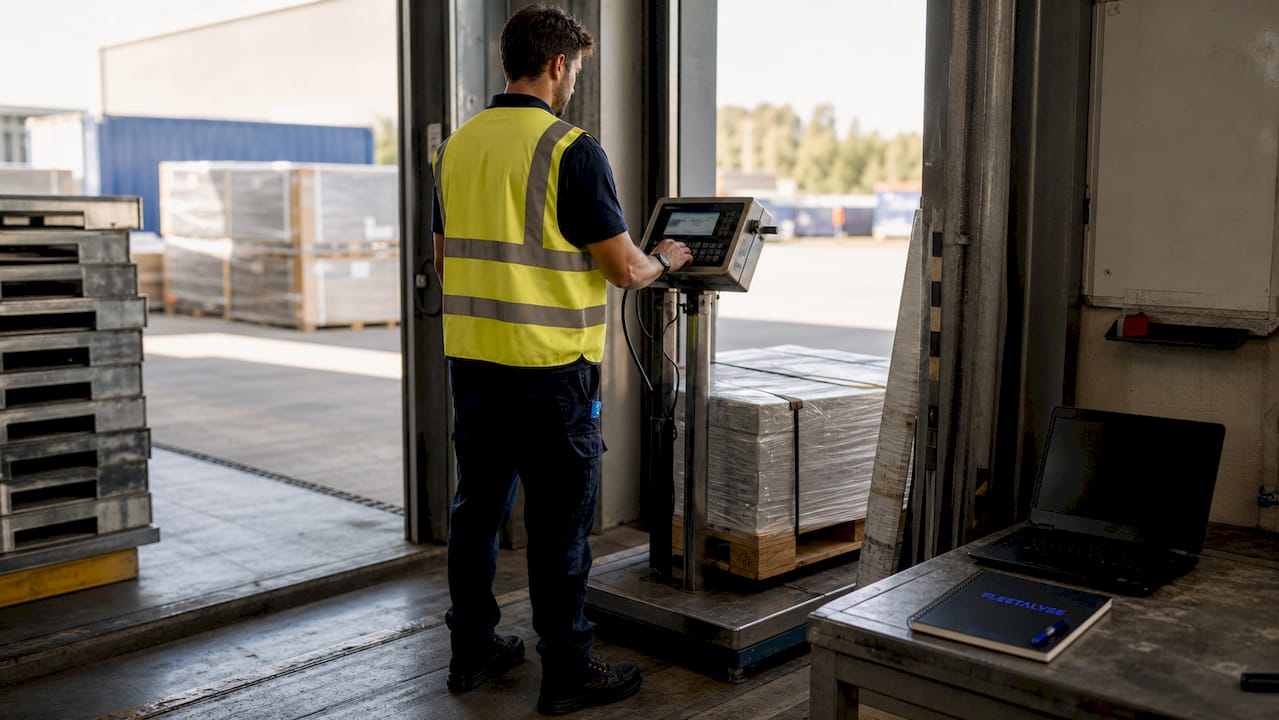
Tare weight is not simply the unladen vehicle. Operators often underestimate tare weight because it includes fuel, AdBlue, any fitted equipment, and the driver’s weight. Ignoring these variables can push a vehicle over its axle limits even when the total GVW appears compliant.
UK axle weight limits vary by configuration. Key thresholds include:
- Single non-driving axle: up to 10,000 kg
- Single driving axle: up to 11,500 kg
- Tandem axle group: up to 18,000 kg (with air suspension)
- Tri-axle group: up to 24,000 kg depending on spacing
Pro Tip: Apply a 3–5% safety margin to your net payload figure. Scale inaccuracies and variable cargo weights are common, and loading exactly to the legal maximum leaves no room for error.
Why does weight distribution matter in HGV load management?
Weight distribution is often more critical than total GVW in preventing violations. Axle overloading is more common than total GVW breaches and can lead to severe fines and out-of-service orders. A vehicle may sit within its overall weight limit and still face penalties if a single axle carries too much.
The centre of gravity determines how a vehicle handles under braking, cornering, and emergency manoeuvres. A high centre of gravity increases rollover risk. A load shifted to one side creates uneven tyre wear and unpredictable steering. Both conditions put drivers and other road users at risk.
Poor load distribution produces a cascade of operational problems:
- Premature tyre wear on overloaded axles
- Increased braking distances due to uneven weight transfer
- Suspension and chassis damage from concentrated stress points
- Higher likelihood of load shift during transit, particularly on motorway braking
- DVSA prohibition notices and potential Operator Licence review
Best practice for loading places heavy items low in the trailer and as close to the centre as possible. Left-to-right balance should be checked before departure. Effective payload management keeps the centre of gravity low and central to maintain stability and compliance throughout the journey.
Pro Tip: Use axle-specific weighing at a portable weighbridge or on-board scale system before departure. Checking total GVW alone is not sufficient to confirm legal compliance.
What are the financial and environmental costs of poor payload management?
The financial case for rigorous HGV load management is clear. Fuel consumption increases by 1.9–7.0% per extra tonne of payload, and overload citations can cost fleets over £11,500 per event when fines, delays, and insurance impacts are combined. That figure does not include the administrative cost of managing an infringement or the reputational risk to an Operator Licence.
Payload management is not just a compliance exercise. It is a direct lever on profitability. Every unnecessary kilogram carried costs fuel. Every overload citation costs multiples of what a proper weighing process would have taken. The fleets that treat payload as a financial metric, not just a legal one, consistently outperform those that treat it as a box-ticking exercise.
Beyond direct costs, there is a growing business case for payload management as part of corporate sustainability commitments. Better payload management delivers a net decarbonisation benefit estimated at 2.60–9.03 gCO2 per tonne-kilometre. For fleets with ESG reporting obligations, that figure is material.
Reducing empty running compounds the benefit. When each trip carries the maximum legal and safe payload, fewer journeys are needed to move the same volume of freight. Fewer journeys mean lower fuel spend, lower emissions, and less driver time. Fleetalyse’s fleet solutions include fuel consumption reporting that helps operators identify where payload inefficiencies are costing them most. Improving fuel efficiency across your fleet also depends on consistent load discipline, not just vehicle maintenance.
How can transport managers implement effective payload management?
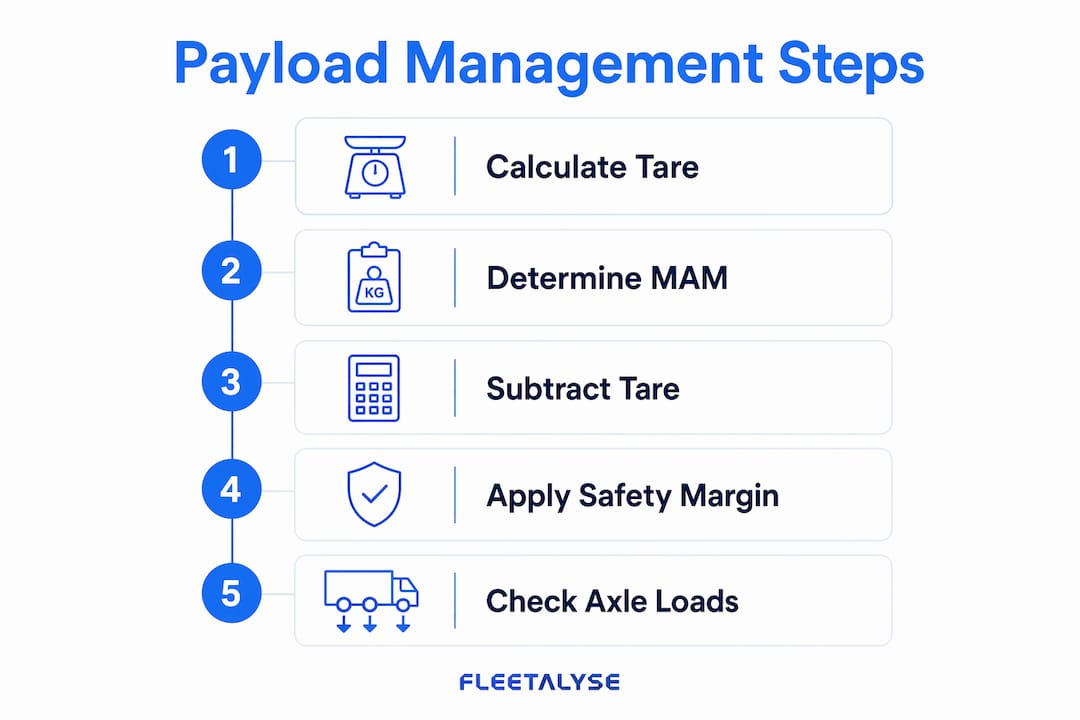
Effective payload management requires a defined process, not just good intentions. The following steps give transport managers a practical framework to apply across their fleet.
-
Verify weight before departure. Use on-board scales, portable weighbridges, or static weighbridge facilities to confirm both total GVW and individual axle weights. Do not rely on shipper-declared weights alone.
-
Check cargo documentation. Accurate cargo weight declarations are a legal requirement. For international movements, CMR waybills must reflect actual weights. Discrepancies between documentation and actual load are a common trigger for DVSA roadside checks.
-
Apply a safety margin. A 3–5% safety margin on net payload protects against scale inaccuracies and variable cargo weights. Never load exactly to the legal maximum.
-
Integrate telematics for real-time monitoring. Telematics platforms that connect to on-board weight sensors can alert drivers and fleet managers when a load approaches or exceeds limits. Fleetalyse’s HGV GPS trackers support real-time vehicle data monitoring to help operators stay ahead of compliance issues.
-
Train drivers and loaders together. Load distribution is a shared responsibility. Drivers need to understand axle weight limits and be empowered to refuse or reposition loads that do not meet distribution requirements.
-
Re-check loads during transit. Load shift during transit is a major cause of instability. Drivers should verify load security after heavy braking, partial deliveries, or significant route changes. Straps and securing methods should be inspected at each stop.
-
Record and review. Keep a log of pre-trip weight checks and any load adjustments made. This documentation supports your defence in the event of a DVSA inspection and helps identify patterns of non-compliance across your fleet.
Pro Tip: Establish a written payload management procedure as part of your transport manager’s standing instructions. A documented process is far easier to audit and defend than an informal one.
Key takeaways
Effective HGV payload management requires accurate tare weight calculation, axle-specific weight checks, and a documented pre-trip process to prevent overloads and reduce costs.
| Point | Details |
|---|---|
| Calculate net payload correctly | Subtract full tare weight (including fuel, AdBlue, and driver) from MAM to find your legal limit. |
| Monitor axle weights individually | Total GVW compliance does not prevent axle violations; check each axle before departure. |
| Apply a 3–5% safety margin | Never load to the exact legal maximum; scale inaccuracies and variable cargo weights are common. |
| Re-check loads during transit | Load shift after braking or partial deliveries can create axle imbalances mid-journey. |
| Use telematics to support compliance | Real-time vehicle data from systems like Fleetalyse reduces the risk of undetected overloads. |
The blind spot most transport managers still have
Most transport managers I speak with understand GVW. They know their 44-tonne limit. What they consistently underestimate is how quickly individual axle weights can creep into violation territory while the total weight looks fine on paper.
I have seen fleets with solid compliance records receive prohibition notices because a loader stacked heavy pallets at the rear of a trailer without thinking about the drive axle. The total weight was legal. The rear axle was not. That is the kind of violation that does not show up in a pre-trip check unless you are specifically weighing axles, not just the whole vehicle.
The other blind spot is tare weight drift. Vehicles accumulate weight over time. A toolbox added here, a spare part stored in the cab there. These additions are rarely logged, and they quietly erode your legal payload capacity. Experienced operators treat axle weight distribution as a pre-trip priority, not an afterthought.
My advice is to treat payload management as a continuous process, not a one-time calculation. Build it into your daily departure checks, your driver training, and your telematics reporting. The fleets that do this consistently avoid the fines, the downtime, and the licence risk that catch others out.
— Vytautas
How Fleetalyse supports HGV payload compliance
Real-time visibility is the difference between catching a payload issue before departure and dealing with a DVSA prohibition notice on the roadside.
The Teltonika FMC650 is a 4G HGV GPS tracker built for heavy commercial vehicles and paired with the Fleetalyse PAYG platform. It provides live vehicle data, driver behaviour monitoring, and integration with fleet management workflows, giving transport managers the visibility they need to support pre-trip weight verification and ongoing load compliance. Fleetalyse is UK-based, with local support for setup and troubleshooting. Book a demo to see how the platform fits your fleet’s compliance requirements.
FAQ
What is the difference between GVW and payload?
Gross vehicle weight (GVW) is the total weight of the vehicle including its load, fuel, driver, and equipment. Payload is the weight of the cargo alone, calculated by subtracting the vehicle’s tare weight from its MAM.
Can a vehicle be overloaded on an axle but legal on total weight?
Yes. A vehicle can comply with its overall GVW limit and still exceed individual axle weight limits. Axle overloading is more common than total GVW breaches and carries the same penalties, including fines and out-of-service orders.
What is a safe payload margin for HGV operators?
A 3–5% safety margin below the net legal payload is standard practice. This accounts for scale inaccuracies, variable cargo weights, and consumables that may not be fully reflected in pre-trip calculations.
How does payload management affect fuel consumption?
Fuel consumption increases by 1.9–7.0% per extra tonne of payload carried. Carrying unnecessary weight or running with poorly distributed loads increases fuel spend and emissions on every trip.
What documents are required for HGV payload compliance in the UK?
Operators must carry accurate cargo weight declarations and, for international movements, CMR waybills reflecting actual load weights. DVSA inspectors check these documents at roadside stops, and discrepancies can trigger further investigation or prohibition notices.