

What if your next DVSA audit wasn't a source of anxiety, but a chance to prove your fleet's excellence? For many regional operators, the fear of a public inquiry or a plummeting OCRS score is a constant weight. You likely feel that manual tachograph errors and rising insurance premiums are an unavoidable part of the job. It's an exhausting way to manage a business; especially with the 2026 tightenings on brake performance and load security standards.
Securing your transport operator licence compliance UK shouldn't depend on luck or a mountain of paperwork. You can protect your hard earned reputation by moving from reactive filing to a real-time data ecosystem. This article explains how AI video dashcams and automated monitoring systems help you maintain a perfect OCRS score whilst slashing administrative overhead. We'll look at how remote tachograph downloads and live driver hours data turn compliance into a streamlined, automated process that keeps your vehicles on the road and your business protected.
Key Takeaways
- Understand the role of the Traffic Commissioner and how to maintain transport operator licence compliance UK through consistent, real-time data monitoring.
- Identify core obligations for vehicle safety inspections and learn how to digitise driver walkaround checks for a more reliable audit trail.
- Compare the efficiency of manual tachograph downloads against remote solutions that capture data without pulling vehicles off the road.
- Discover how GPS trailer tracking and asset visibility act as essential pillars for protecting your permission to trade and reducing risk.
- Implement a practical compliance strategy for 2026 by conducting a thorough gap analysis and automating your mandatory reporting systems.
Understanding Transport Operator Licence Compliance in the UK
An operator licence is more than a certificate on your office wall. It's your fundamental permission to trade. Without it, your fleet stops. If you operate vehicles over 3.5 tonnes, or light goods vehicles over 2.5 tonnes for international work, this licence is a legal necessity. Maintaining transport operator licence compliance UK is a continuous operational challenge. It requires strict adherence to safety, maintenance, and administrative standards every single day.
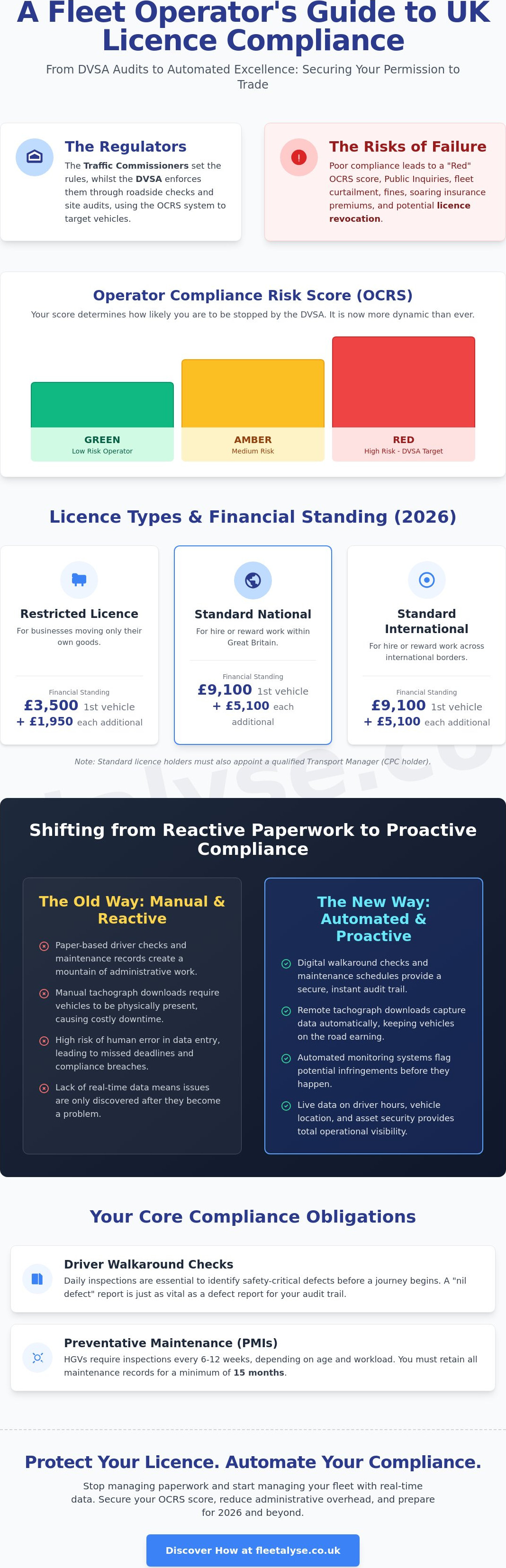
The Traffic Commissioners for Great Britain act as the independent regulators for the industry. They're responsible for granting licences and taking action against those who fail to meet their obligations. Whilst the Commissioners set the rules, the DVSA enforces them through roadside stops and site audits. They use the Operator Compliance Risk Score (OCRS) to decide which vehicles to pull over. This score is a rolling calculation based on your historical data. In 2026, the OCRS system is more dynamic than ever. A single missed tachograph entry or a lighting fault at the roadside can push your score into the danger zone immediately.
Operators must choose from three licence types based on their business model:
- Restricted: For businesses moving only their own goods.
- Standard National: For carrying goods for hire or reward within Great Britain.
- Standard International: For hire or reward work across international borders.
Each type carries specific financial standing requirements. As of 2026, Standard licence holders must prove they have £9,100 for the first vehicle and £5,100 for each additional vehicle. Restricted licence holders require £3,500 for the first vehicle and £1,950 for others. Failing to maintain these funds is a direct breach of your licence terms.
The Consequences of Non-Compliance
Poor management leads to a "Red" OCRS score. This makes your vehicles a constant target for the DVSA, causing delivery delays and driver frustration. Serious or repeated failures trigger a public inquiry. This is a formal legal hearing where a Traffic Commissioner examines your conduct. The outcomes are severe. They can curtail your fleet size, suspend your operations, or revoke your licence entirely. Beyond the legal risk, the financial impact is huge. Fines are increasing, and a poor safety record will cause your insurance premiums to skyrocket.
The Role of the Transport Manager
Standard licence holders must name a qualified Transport Manager. This individual holds a Certificate of Professional Competence (CPC) and bears legal responsibility for the fleet. Their duty is to provide "continuous and effective management" of all transport activities. They aren't just administrators; they're the gatekeepers of safety. They must oversee driver hours, schedule preventative maintenance, and ensure every vehicle is roadworthy. Modern software assists Transport Managers by automating mandatory data collection and flagging risks before they become legal liabilities.
Core Obligations for HGV and Van Operators
Compliance is a live process. It requires a meticulous paper trail that proves every vehicle in your fleet is roadworthy and every driver is working within legal limits. The burden of proof rests entirely with you. If the DVSA requests an audit, you must produce evidence of your management systems immediately. Maintaining transport operator licence compliance UK depends on your ability to demonstrate a clear, unbroken audit trail for every asset under your control.
Effective management starts before the engine even turns over. Robust driver walkaround check procedures are essential. These daily inspections identify safety-critical defects like tyre wear or lighting faults before the vehicle hits the public highway. A "nil defect" report is just as important as a defect report; it proves the check was actually conducted. Without these records, you cannot prove you have a system in place to prevent unroadworthy vehicles from being used.
Maintenance and Safety Standards
The Goods vehicle operator licensing guide sets out clear expectations for vehicle upkeep. Most HGVs require Preventative Maintenance Inspections (PMIs) every 6 to 12 weeks. The exact frequency depends on the age of the vehicle and the nature of the work. You must select competent maintenance providers who understand the rigours of heavy goods transport. Whilst digital records are rapidly replacing traditional paper filing, the core responsibility remains the same. You must keep these maintenance records for at least 15 months to stay within the law. This proactive approach is the cornerstone of transport operator licence compliance UK.
Driver Conduct and Record Keeping
Operators are legally responsible for their drivers' behaviour. This includes monitoring for speeding, harsh braking, and tachograph infringements. You must ensure drivers take their required rest periods and never exceed driving hour limits. Infringements must be identified, discussed with the driver, and documented as part of your internal training process. You're required to keep these driver records for at least 12 months. Managing this manually is a significant administrative burden that often leads to errors. Many regional operators now find that Fleetalyse simplifies record keeping through automation, ensuring nothing slips through the cracks. It's a pragmatic way to move away from spreadsheets and toward a more reliable, data-driven system.
Mitigating Risk with Remote Tachograph Data
Manual tachograph downloads are a relic of a reactive era. Waiting for a vehicle to return to the yard just to extract data is inefficient; it creates a dangerous lag between a driver's actions and your ability to review them. If a driver commits an infringement on day one of a three-week trip, you won't know until they return. By then, the habit may have set in. Remote download solutions eliminate this delay by pulling data directly from the vehicle's head unit and driver card regardless of where they are in the country. This ensures 100% data capture and removes the need for vehicle downtime just to meet administrative deadlines.
The real power of this technology lies in live driver hours monitoring. Instead of looking at what happened last month, you see exactly what's happening now. You can see remaining driving time, upcoming rest requirements, and weekly totals in real time. This visibility is a cornerstone of transport operator licence compliance UK. It allows you to intervene before a breach occurs, rather than issuing a warning after the damage is done. Integrating this data with tachograph analysis software helps you identify systemic risks. If multiple drivers are making the same error, it suggests a training gap or a scheduling flaw that requires management action.
Eliminating Manual Data Gaps
Missing mileage is a major red flag during any DVSA inspection. It often happens when vehicles are moved in the yard without a card or when manual downloads fail to sync correctly. Automated schedules remove the human element. They ensure you never miss a 28-day driver card or 90-day vehicle unit deadline. By maintaining a constant, automated stream of data, remote tacho downloads act as a digital shield during DVSA audits; they provide immediate, undeniable proof that your fleet is operating within the law.
Proactive Infringement Management
You can't manage what you can't see. Real-time data allows you to conduct evidence-based driver debriefs whilst the events are still fresh in the driver's mind. This is far more effective than discussing a minor speeding event or a shortened rest period weeks after it happened. It also helps you identify patterns of fatigue. If a driver is consistently pushing their limits, you can adjust their schedule before it leads to a serious incident. Implementing a remote tachograph download system is a primary compliance tool for any operator serious about protecting their licence. It moves your business from a state of constant worry to one of controlled, data-driven safety management.
Asset Security and Trailer Tracking as Compliance Pillars
Operator licence obligations extend far beyond the cab of the tractor unit. The Traffic Commissioner expects you to maintain "continuous and effective control" over every asset in your fleet. This includes trailers that spend days or weeks uncoupled in third-party yards. Trailer theft and unauthorised asset use are rising concerns in the UK haulage sector. If an asset is stolen or used for illegal activity because of poor management, your transport operator licence compliance UK is immediately at risk. You must prove you have systems to secure your equipment and monitor its location at all times.
GPS visibility provides the data needed to meet these security mandates. Modern trackers allow you to see exactly where your assets are; even when they aren't connected to a power source. Geofencing adds another layer of protection. You can set digital boundaries for your yard or specific delivery sites. If a trailer moves outside these authorised areas without a scheduled job, the system alerts you instantly. This proactive visibility prevents small security lapses from becoming major regulatory headaches.
Protecting Mobile Assets and Cargo
Independent power sources are vital for long-term visibility. Trackers with high-capacity batteries ensure you don't lose sight of trailers during seasonal peaks or extended storage. This technology also applies to your smaller vehicles. Van tracking prevents the unauthorised use of company assets during weekends or evenings. This isn't just about saving fuel; it's about managing your overall insurance risk profile. Insurers reward operators who can demonstrate tight control over their mobile assets, leading to lower premiums and a cleaner risk score.
Predictive Maintenance for Trailers
Compliance also involves keeping trailers in a roadworthy condition. Using odometer data from trackers allows you to automate service intervals based on actual distance travelled rather than just calendar dates. You can also integrate tyre pressure monitoring and door sensors to mitigate cargo-specific risks. This level of detail proves to the DVSA that your maintenance system is robust and data-driven. Implementing trailer tracking is a pragmatic step toward comprehensive asset management. It ensures every piece of equipment under your licence is safe, secure, and fully accounted for.
Building a Robust Compliance Strategy for 2026
Compliance isn't a "set and forget" task. It's a continuous cycle of monitoring and refinement. To secure your transport operator licence compliance UK, you need a structured approach that replaces manual guesswork with verifiable data. Follow these five steps to build a resilient operation that stands up to DVSA scrutiny.
- Step 1: Conduct a gap analysis. Review your current maintenance logs and tachograph records against the standards discussed in section one. Identify where data is missing or where deadlines are frequently missed.
- Step 2: Implement automated remote tachograph downloads. Stop chasing drivers for their cards. Automating this process ensures you meet the 28-day and 90-day deadlines without fail, even when vehicles are away from the yard.
- Step 3: Integrate live driver hours into daily dispatch. Use real-time data to plan your routes. Don't assign a job to a driver who is nearing their legal limit. This prevents infringements before they happen.
- Step 4: Use GPS tracking. Monitor driver behaviour, such as harsh braking or speeding, and keep a constant eye on asset security. This builds the "continuous and effective control" the Traffic Commissioner expects.
- Step 5: Review OCRS scores monthly. Treat your score as a primary management KPI. If the score dips, find the root cause. Adjust your driver coaching programme to address specific weaknesses identified by the data.
Selecting a Specialist Technology Partner
UK-based support is vital. You need a partner who understands the specific nuances of domestic regulations and the Traffic Commissioner's expectations. Avoid global software providers who lack localized expertise. Look for transparent pricing and scalable solutions that grow with your fleet. Fleetalyse provides a pragmatic, expert-led solution for UK fleets. It's designed for regional operators who value functional utility and straightforward industry expertise over unnecessary, flashy features.
Measuring the ROI of Compliance
Compliance is a commercial advantage, not just a cost. A "Clean" OCRS score acts as a badge of quality that helps you win lucrative commercial contracts. Many blue-chip clients now require proof of a strong safety record before they'll even consider a haulier. You'll also see a direct impact on your bottom line through reduced fuel consumption and vehicle wear-and-tear. Smarter, more compliant driving is naturally more efficient. Finally, track the decrease in administrative hours. By automating manual data management, your team can focus on growing the business rather than filing paperwork.
Future-Proof Your Fleet Compliance Today
Managing a fleet in 2026 requires more than just good intentions. It requires a robust system that removes the risk of human error from your daily operations. By automating remote tachograph downloads and integrating live driver hours into your planning, you shift from reactive firefighting to proactive management. This data-driven approach is the most effective way to guarantee consistent transport operator licence compliance UK whilst maintaining a perfect OCRS score. You protect your business, your drivers, and your hard-earned commercial reputation.
Moving toward digital record-keeping isn't just about avoiding DVSA penalties; it's about building a more efficient, profitable business. Real-time visibility over your mobile assets ensures you remain in total control, whether your trailers are in the yard or on the road. You don't have to manage this transition alone. Specialist UK-based support ensures your technology aligns with local regulations and Traffic Commissioner expectations. Protect your operator licence and simplify compliance with Fleetalyse tracking and tacho solutions. Gain total visibility over your fleet and ensure every mile is accounted for. Take control of your compliance today and secure your fleet's future.
Frequently Asked Questions
How exactly does telematics help reduce insurance premiums for UK fleets?
Insurers use telematics data to assess your fleet's risk profile objectively. By providing evidence of safe driving behaviour and robust asset security, you prove you're a lower-risk client. This transparency allows underwriters to offer more competitive rates based on actual performance rather than industry averages. It also helps speed up claims processing by providing undeniable proof of fault during road traffic incidents.
Can remote tachograph data be used as evidence in a DVSA audit?
Yes; the DVSA accepts digital records as long as they are accurate and complete. Remote downloads provide a tamper-proof audit trail that demonstrates your commitment to transport operator licence compliance UK. These records prove you are monitoring driver hours and rest periods continuously. Having this data readily available during an inspection shows the regulator that your management systems are proactive and transparent.
Is it a legal requirement to have remote tachograph download software?
It isn't a legal requirement; however, you must download driver cards every 28 days and vehicle units every 90 days. Manual downloads often lead to missed deadlines and data gaps, which are legal breaches. Remote software automates this task to ensure you never miss a mandatory deadline. It's a pragmatic tool for maintaining the high standards required by your operator licence without the administrative headache.
What is the most effective way to introduce tracking to drivers who are worried about privacy?
Transparency is the best approach. Explain that tracking is a tool for safety and business efficiency, not a surveillance device. Highlight how it protects them from false insurance claims and helps manage their legal driving hours accurately. Clear policies regarding data use and emphasising the "exoneration" benefit usually resolve most privacy concerns. It's about building a culture of mutual professional respect and safety.
How does geofencing help with fleet asset security and compliance?
Geofencing creates a digital boundary that alerts you the moment a vehicle or trailer leaves an authorised area. This is crucial for preventing unauthorised use and detecting theft early. From a compliance perspective, it helps verify that vehicles are only being operated where they should be. It provides the "continuous and effective control" required by the Traffic Commissioner for every mobile asset under your licence.
What are the most important telematics metrics for reducing accident frequency?
Harsh braking, rapid acceleration, and cornering speeds are the most critical indicators of high-risk driving. These behaviours often precede serious incidents. By monitoring these metrics, you can identify which drivers need additional coaching before an accident occurs. Consistent review of these data points allows you to build a proactive safety culture that reduces vehicle wear, fuel consumption, and insurance claims.
Can telematics help with maintaining my HGV or van service history?
Telematics systems track real-time odometer data to automate service scheduling. Instead of relying on manual mileage checks, the software flags when a vehicle is approaching its next PMI or MOT. This ensures your fleet remains in peak roadworthy condition at all times. It provides a digital record of maintenance intervals, which is a vital part of your transport operator licence compliance UK audit trail.
How long does it take to see a reduction in fleet risk after installing compliance software?
Most operators report a measurable improvement in driver behaviour within the first 30 days. The presence of monitoring systems usually leads to an immediate reduction in speeding and harsh braking events. Long-term risk reduction, such as lower insurance premiums and fewer roadside stops, typically becomes evident after six months of consistent data-led coaching. It's a steady progression toward a safer, more efficient operation.
Frequently asked questions
The Consequences of Non-Compliance
Poor management leads to a "Red" OCRS score. This makes your vehicles a constant target for the DVSA, causing delivery delays and driver frustration. Serious or repeated failures trigger a public inquiry. This is a formal legal hearing where a Traffic Commissioner examines your conduct. The outcomes are severe. They can curtail your fleet size, suspend your operations, or revoke your licence entirely. Beyond the legal risk, the financial impact is huge. Fines are increasing, and a poor safety record will cause your insurance premiums to skyrocket.
The Role of the Transport Manager
Standard licence holders must name a qualified Transport Manager. This individual holds a Certificate of Professional Competence (CPC) and bears legal responsibility for the fleet. Their duty is to provide "continuous and effective management" of all transport activities. They aren't just administrators; they're the gatekeepers of safety. They must oversee driver hours, schedule preventative maintenance, and ensure every vehicle is roadworthy. Modern software assists Transport Managers by automating mandatory data collection and flagging risks before they become legal liabilities. Compliance is a live process. It requires a meticulous paper trail that proves every vehicle in your fleet is roadworthy and every driver is working within legal limits. The burden of proof rests entirely with you. If the DVSA requests an audit, you must produce evidence of your management systems immediately. Maintaining transport operator licence compliance UK depends on your ability to demonstrate a clear, unbroken audit trail for every asset under your control. Effective management starts before the engine even turns over. Robust driver walkaround check procedures are essential. These daily inspections identify safety-critical defects like tyre wear or lighting faults before the vehicle hits the public highway. A "nil defect" report is just as important as a defect report; it proves the check was actually conducted. Without these records, you cannot prove you have a system in place to prevent unroadworthy vehicles from being used.
Maintenance and Safety Standards
The Goods vehicle operator licensing guide sets out clear expectations for vehicle upkeep. Most HGVs require Preventative Maintenance Inspections (PMIs) every 6 to 12 weeks. The exact frequency depends on the age of the vehicle and the nature of the work. You must select competent maintenance providers who understand the rigours of heavy goods transport. Whilst digital records are rapidly replacing traditional paper filing, the core responsibility remains the same. You must keep these maintenance records for at least 15 months to stay within the law. This proactive approach is the cornerstone of transport operator licence compliance UK.
Driver Conduct and Record Keeping
Operators are legally responsible for their drivers' behaviour. This includes monitoring for speeding, harsh braking, and tachograph infringements. You must ensure drivers take their required rest periods and never exceed driving hour limits. Infringements must be identified, discussed with the driver, and documented as part of your internal training process. You're required to keep these driver records for at least 12 months. Managing this manually is a significant administrative burden that often leads to errors. Many regional operators now find that Fleetalyse simplifies record keeping through automation, ensuring nothing slips through the cracks. It's a pragmatic way to move away from spreadsheets and toward a more reliable, data-driven system. Manual tachograph downloads are a relic of a reactive era. Waiting for a vehicle to return to the yard just to extract data is inefficient; it creates a dangerous lag between a driver's actions and your ability to review them. If a driver commits an infringement on day one of a three-week trip, you won't know until they return. By then, the habit may have set in. Remote download solutions eliminate this delay by pulling data directly from the vehicle's head unit and driver card regardless of where they are in the country. This ensures 100% data capture and removes the need for vehicle downtime just to meet administrative deadlines. The real power of this technology lies in live driver hours monitoring. Instead of looking at what happened last month, you see exactly what's happening now. You can see remaining driving time, upcoming rest requirements, and weekly totals in real time. This visibility is a cornerstone of transport operator licence compliance UK. It allows you to intervene before a breach occurs, rather than issuing a warning after the damage is done. Integrating this data with tachograph analysis software helps you identify systemic risks. If multiple drivers are making the same error, it suggests a training gap or a scheduling flaw that requires management action.
Eliminating Manual Data Gaps
Missing mileage is a major red flag during any DVSA inspection. It often happens when vehicles are moved in the yard without a card or when manual downloads fail to sync correctly. Automated schedules remove the human element. They ensure you never miss a 28-day driver card or 90-day vehicle unit deadline. By maintaining a constant, automated stream of data, remote tacho downloads act as a digital shield during DVSA audits; they provide immediate, undeniable proof that your fleet is operating within the law.
Proactive Infringement Management
You can't manage what you can't see. Real-time data allows you to conduct evidence-based driver debriefs whilst the events are still fresh in the driver's mind. This is far more effective than discussing a minor speeding event or a shortened rest period weeks after it happened. It also helps you identify patterns of fatigue. If a driver is consistently pushing their limits, you can adjust their schedule before it leads to a serious incident. Implementing a remote tachograph download system is a primary compliance tool for any operator serious about protecting their licence. It moves your business from a state of constant worry to one of controlled, data-driven safety management. Operator licence obligations extend far beyond the cab of the tractor unit. The Traffic Commissioner expects you to maintain "continuous and effective control" over every asset in your fleet. This includes trailers that spend days or weeks uncoupled in third-party yards. Trailer theft and unauthorised asset use are rising concerns in the UK haulage sector. If an asset is stolen or used for illegal activity because of poor management, your transport operator licence compliance UK is immediately at risk. You must prove you have systems to secure your equipment and monitor its location at all times. GPS visibility provides the data needed to meet these security mandates. Modern trackers allow you to see exactly where your assets are; even when they aren't connected to a power source. Geofencing adds another layer of protection. You can set digital boundaries for your yard or specific delivery sites. If a trailer moves outside these authorised areas without a scheduled job, the system alerts you instantly. This proactive visibility prevents small security lapses from becoming major regulatory headaches.
Protecting Mobile Assets and Cargo
Independent power sources are vital for long-term visibility. Trackers with high-capacity batteries ensure you don't lose sight of trailers during seasonal peaks or extended storage. This technology also applies to your smaller vehicles. Van tracking prevents the unauthorised use of company assets during weekends or evenings. This isn't just about saving fuel; it's about managing your overall insurance risk profile. Insurers reward operators who can demonstrate tight control over their mobile assets, leading to lower premiums and a cleaner risk score.
Predictive Maintenance for Trailers
Compliance also involves keeping trailers in a roadworthy condition. Using odometer data from trackers allows you to automate service intervals based on actual distance travelled rather than just calendar dates. You can also integrate tyre pressure monitoring and door sensors to mitigate cargo-specific risks. This level of detail proves to the DVSA that your maintenance system is robust and data-driven. Implementing trailer tracking is a pragmatic step toward comprehensive asset management. It ensures every piece of equipment under your licence is safe, secure, and fully accounted for. Compliance isn't a "set and forget" task. It's a continuous cycle of monitoring and refinement. To secure your transport operator licence compliance UK, you need a structured approach that replaces manual guesswork with verifiable data. Follow these five steps to build a resilient operation that stands up to DVSA scrutiny.
Selecting a Specialist Technology Partner
UK-based support is vital. You need a partner who understands the specific nuances of domestic regulations and the Traffic Commissioner's expectations. Avoid global software providers who lack localized expertise. Look for transparent pricing and scalable solutions that grow with your fleet. Fleetalyse provides a pragmatic, expert-led solution for UK fleets. It's designed for regional operators who value functional utility and straightforward industry expertise over unnecessary, flashy features.
Measuring the ROI of Compliance
Compliance is a commercial advantage, not just a cost. A "Clean" OCRS score acts as a badge of quality that helps you win lucrative commercial contracts. Many blue-chip clients now require proof of a strong safety record before they'll even consider a haulier. You'll also see a direct impact on your bottom line through reduced fuel consumption and vehicle wear-and-tear. Smarter, more compliant driving is naturally more efficient. Finally, track the decrease in administrative hours. By automating manual data management, your team can focus on growing the business rather than filing paperwork. Managing a fleet in 2026 requires more than just good intentions. It requires a robust system that removes the risk of human error from your daily operations. By automating remote tachograph downloads and integrating live driver hours into your planning, you shift from reactive firefighting to proactive management. This data-driven approach is the most effective way to guarantee consistent transport operator licence compliance UK whilst maintaining a perfect OCRS score. You protect your business, your drivers, and your hard-earned commercial reputation. Moving toward digital record-keeping isn't just about avoiding DVSA penalties; it's about building a more efficient, profitable business. Real-time visibility over your mobile assets ensures you remain in total control, whether your trailers are in the yard or on the road. You don't have to manage this transition alone. Specialist UK-based support ensures your technology aligns with local regulations and Traffic Commissioner expectations. Protect your operator licence and simplify compliance with Fleetalyse tracking and tacho solutions. Gain total visibility over your fleet and ensure every mile is accounted for. Take control of your compliance today and secure your fleet's future.
How exactly does telematics help reduce insurance premiums for UK fleets?
Insurers use telematics data to assess your fleet's risk profile objectively. By providing evidence of safe driving behaviour and robust asset security, you prove you're a lower-risk client. This transparency allows underwriters to offer more competitive rates based on actual performance rather than industry averages. It also helps speed up claims processing by providing undeniable proof of fault during road traffic incidents.
Can remote tachograph data be used as evidence in a DVSA audit?
Yes; the DVSA accepts digital records as long as they are accurate and complete. Remote downloads provide a tamper-proof audit trail that demonstrates your commitment to transport operator licence compliance UK. These records prove you are monitoring driver hours and rest periods continuously. Having this data readily available during an inspection shows the regulator that your management systems are proactive and transparent.
Is it a legal requirement to have remote tachograph download software?
It isn't a legal requirement; however, you must download driver cards every 28 days and vehicle units every 90 days. Manual downloads often lead to missed deadlines and data gaps, which are legal breaches. Remote software automates this task to ensure you never miss a mandatory deadline. It's a pragmatic tool for maintaining the high standards required by your operator licence without the administrative headache.
What is the most effective way to introduce tracking to drivers who are worried about privacy?
Transparency is the best approach. Explain that tracking is a tool for safety and business efficiency, not a surveillance device. Highlight how it protects them from false insurance claims and helps manage their legal driving hours accurately. Clear policies regarding data use and emphasising the "exoneration" benefit usually resolve most privacy concerns. It's about building a culture of mutual professional respect and safety.
How does geofencing help with fleet asset security and compliance?
Geofencing creates a digital boundary that alerts you the moment a vehicle or trailer leaves an authorised area. This is crucial for preventing unauthorised use and detecting theft early. From a compliance perspective, it helps verify that vehicles are only being operated where they should be. It provides the "continuous and effective control" required by the Traffic Commissioner for every mobile asset under your licence.
What are the most important telematics metrics for reducing accident frequency?
Harsh braking, rapid acceleration, and cornering speeds are the most critical indicators of high-risk driving. These behaviours often precede serious incidents. By monitoring these metrics, you can identify which drivers need additional coaching before an accident occurs. Consistent review of these data points allows you to build a proactive safety culture that reduces vehicle wear, fuel consumption, and insurance claims.
Can telematics help with maintaining my HGV or van service history?
Telematics systems track real-time odometer data to automate service scheduling. Instead of relying on manual mileage checks, the software flags when a vehicle is approaching its next PMI or MOT. This ensures your fleet remains in peak roadworthy condition at all times. It provides a digital record of maintenance intervals, which is a vital part of your transport operator licence compliance UK audit trail.
How long does it take to see a reduction in fleet risk after installing compliance software?
Most operators report a measurable improvement in driver behaviour within the first 30 days. The presence of monitoring systems usually leads to an immediate reduction in speeding and harsh braking events. Long-term risk reduction, such as lower insurance premiums and fewer roadside stops, typically becomes evident after six months of consistent data-led coaching. It's a steady progression toward a safer, more efficient operation.