


Mixed asset fleet management guide for UK operators

Mixed asset fleet management is the process of overseeing diverse vehicle and equipment classes within a single unified system to maximise operational efficiency and legal compliance. For UK fleet managers running a combination of HGVs, vans, trailers, electric vehicles, and off-road machinery, the challenge is not simply scale. It is complexity. Each asset class carries different maintenance logic, compliance obligations, and data outputs. Without a coherent strategy, that complexity becomes cost. This guide sets out the fleet management best practices, technology requirements, and operational strategies that make mixed fleet operations genuinely manageable in 2026.
What is mixed asset fleet management and why does it matter?
Mixed asset fleet management covers any operation where a single fleet function is responsible for assets that differ in type, fuel source, regulatory classification, or operational purpose. A typical UK example includes diesel HGVs subject to DVSA tachograph rules, electric vans with battery state-of-health monitoring requirements, and trailers or plant equipment that generate no odometer data at all.
The core difficulty is that no single data format fits all asset types. A diesel vehicle’s service interval is measured in miles. An electric vehicle’s service logic depends on battery duty cycles and charge patterns. A trailer has neither. Unified reporting across assets requires normalising these into common business metrics such as cost per kilometre, cost per delivery, and emissions per route. Without that normalisation, you are comparing apples with engines.

Fleetalyse is built specifically for this environment, supporting HGVs, vans, trailers, and mixed asset types within a single platform. The regulatory stakes are also rising. From 1 july 2026, EU social rules require second-generation smart tachographs for light commercial vehicles above 2.5 tonnes used in international and cabotage transport, with extended driving limit look-back periods. That change affects a significant portion of UK mixed fleets operating cross-border routes.
What technology platforms do mixed asset fleets need?
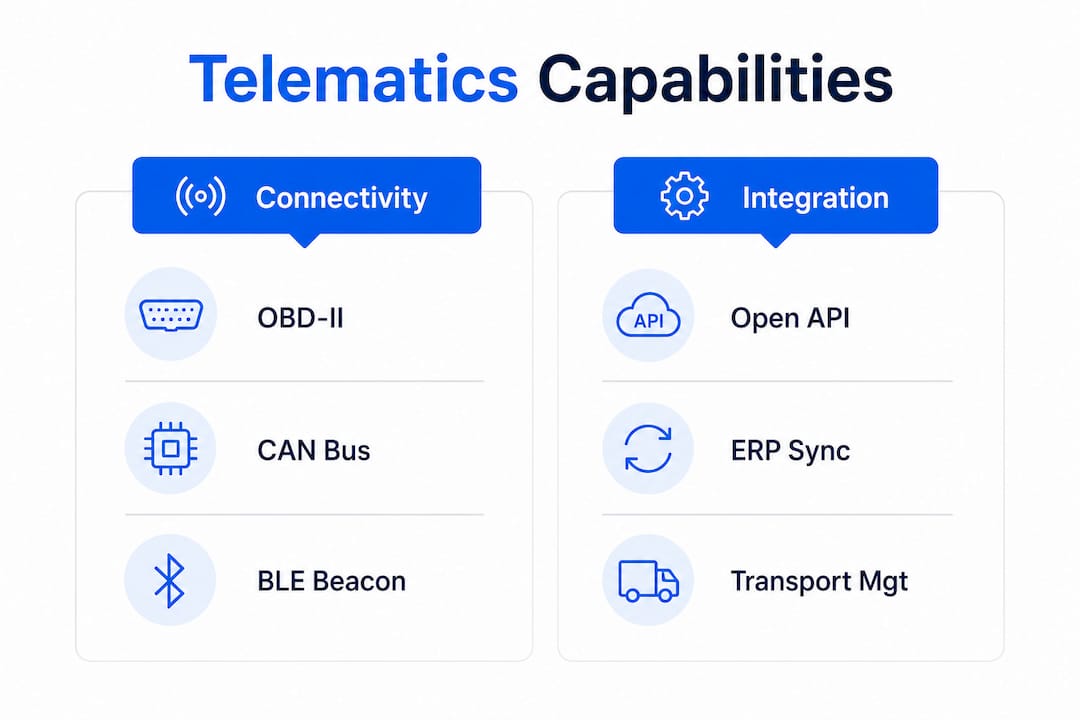
The foundation of any effective mixed fleet operation is a telematics platform that does not treat each asset class as a separate module. A successful platform unifies different connectivity modes into a single data layer: OBD-II ports for standard vehicles, CAN Bus interfaces for HGVs and machinery, and BLE beacons for portable or non-powered assets such as trailers and equipment cages. Siloed modules produce siloed decisions.
Beyond connectivity, the platform must integrate with the wider business. Open API integration with ERP, transport management systems, fuel card providers, and dispatch platforms removes manual data transfer delays. When a vehicle completes a job, the cost, mileage, and fuel data should update automatically across your business systems. Manual transfer is where errors accumulate and reporting lags behind reality.
The table below shows the key capability categories to evaluate when selecting a telematics platform for mixed fleet operations.
| Capability | What to look for |
|---|---|
| Connectivity modes | OBD-II, CAN Bus, BLE beacon, passive trailer hardware |
| Data integration | Open API links to ERP, TMS, fuel cards, and dispatch |
| Reporting metrics | Cost per km, cost per delivery, emissions per route |
| Compliance tools | Tachograph downloads, DVSA reporting, driver hours alerts |
| Asset visibility | Live map view covering all asset types on one screen |
For fleet managers looking at digital trucking solutions, the shift toward integrated data platforms is now the standard expectation rather than a premium feature.
Pro Tip: Before committing to any platform, ask the vendor to demonstrate a live view showing your HGVs, vans, and trailers simultaneously on one map. If they cannot, the platform is not genuinely unified.
How do maintenance schedules differ across asset types in a mixed fleet?
Maintenance logic must be decoupled from mileage when you manage a mixed fleet. Diesel vehicles follow mileage-based service intervals. Electric vehicles require condition-based maintenance focused on battery state-of-health and duty cycles rather than distance. Trailers and plant machinery are typically governed by operational hours or calendar-based inspection schedules. Applying a single mileage trigger across all asset types produces missed services and unnecessary costs.
A practical framework for differentiated maintenance scheduling works as follows:
- Classify each asset by its primary maintenance trigger: mileage, operational hours, calendar date, or condition-based monitoring.
- Set asset-specific service intervals within your fleet management system, rather than using a single global rule.
- Automate alerts so that upcoming services are flagged to the relevant depot or workshop at least two weeks in advance.
- Track on-time completion using the standard formula: (Completed preventive maintenance tasks on time ÷ Total scheduled preventive maintenance tasks) × 100. This metric is the clearest indicator of whether your maintenance programme is functioning or simply scheduled.
- Review tachograph compliance separately for every vehicle above 3.5 tonnes, and from 1 july 2026, for LCVs above 2.5 tonnes on international routes.
Tachograph obligations sit outside standard maintenance scheduling but must be managed within the same system. Remote tachograph downloads, driver hours monitoring, and infringement reporting are compliance functions that require their own automated workflows. Treating them as an afterthought creates DVSA exposure.
Pro Tip: Set your maintenance alerts to trigger at 80% of the service interval, not at 100%. That buffer gives you time to book the vehicle in without disrupting operations.
What operational strategies improve efficiency across a mixed fleet?
The single most impactful strategy for improving fleet efficiency is route-aware vehicle assignment. Route assignment should be based on route characteristics such as distance, number of stops, delivery windows, and charging infrastructure availability, not on driver seniority or habit. An electric van assigned to a long interurban route without charging points is a breakdown waiting to happen. A diesel HGV sent into a low-emission zone unnecessarily generates avoidable penalty costs.
The financial case for proactive maintenance is equally clear. Every £1 invested in proactive maintenance saves operators up to £5 in emergency repair costs and lost productivity. That 5:1 return makes reactive maintenance one of the most expensive habits in fleet management. The cost is not just the repair. It is the vehicle off the road, the missed delivery, and the knock-on effect on driver scheduling.
Total cost of ownership modelling is the strategic tool that ties these decisions together. TCO covers acquisition cost, financing, fuel or energy, maintenance, tyres, insurance, and depreciation. Without a TCO view across all asset types, you cannot make rational decisions about replacement cycles, electrification timing, or asset mix. Most fleet managers who struggle with cost control are optimising individual line items rather than the full lifecycle picture.
The complexity trap is the final risk to address. As fleet size grows, the number of data streams multiplies. The answer is not more reports. Consolidating all asset data into a single live dashboard eliminates the manual intervention and operational lag that erodes decision quality. One screen, all assets, real-time data.
How do you build data-driven performance management for mixed fleets?
Data-driven performance management works only when it is built on a clean, well-governed data foundation. Automating data aggregation before establishing clear KPI governance produces data noise that impairs rather than supports decisions. The sequence matters as much as the technology.
A structured implementation approach follows four steps:
- Centralise your data streams. Connect telematics, fuel card, maintenance records, and dispatch data into one platform. Every data source that remains outside the central system creates a blind spot.
- Define your KPI set before building dashboards. Core metrics for mixed fleet operations include asset utilisation rate, preventive maintenance on-time completion, fuel or energy cost per kilometre, safety event frequency, and tachograph compliance rate.
- Fix operational bottlenecks first. Prioritise resolving maintenance compliance gaps, data entry errors, and missing asset records before deploying automated analytics. Automation amplifies whatever is already in the system, including errors.
- Set up role-based access. Workshop managers need maintenance views. Transport planners need route and utilisation data. Senior management needs cost and compliance summaries. One dashboard with no access control produces information overload for everyone.
The table below shows a practical KPI governance structure for mixed fleet operations.
| KPI | Measurement method | Review frequency |
|---|---|---|
| Asset utilisation rate | Active hours ÷ available hours × 100 | Weekly |
| Maintenance on-time rate | Completed PMs on time ÷ scheduled PMs × 100 | Monthly |
| Fuel cost per km | Total fuel spend ÷ total kilometres | Monthly |
| Safety event frequency | Events per 1,000 km by driver and vehicle | Weekly |
| Tachograph compliance | Infringements per driver per period | Weekly |
Fleet management decisions on acquisition, maintenance, and remarketing should align to total cost of ownership and business goals. That alignment is only possible when your data is trustworthy, current, and accessible to the right people at the right time.
Key takeaways
Effective mixed asset fleet management requires unified data, asset-specific maintenance logic, and TCO-driven operational decisions to control cost and maintain compliance.
| Point | Details |
|---|---|
| Unify your data layer | Connect OBD-II, CAN Bus, and BLE beacon data into one platform to eliminate blind spots. |
| Differentiate maintenance triggers | Apply mileage, hours, calendar, or condition-based intervals depending on each asset type. |
| Assign routes by capability | Match vehicles to routes based on distance, stops, and charging availability, not seniority. |
| Invest in proactive maintenance | Proactive spending returns up to £5 for every £1 invested, compared to reactive repair costs. |
| Govern KPIs before automating | Define and clean your KPI framework before deploying automated analytics to avoid data noise. |
Why mixed fleet management is harder than most operators admit
The honest reality is that most mixed fleet operations are not failing because of bad technology. They are failing because the underlying data is ungoverned and the maintenance logic has never been properly differentiated by asset type. I have seen operators invest in enterprise-grade platforms and still produce unreliable reports, because the data flowing into those platforms was inconsistent from day one.
The lifecycle perspective is the one that most fleet managers reach too late. Fleet management is a lifecycle activity. Decisions made at acquisition, such as which connectivity hardware is fitted, which fuel type is chosen, and which maintenance contract is agreed, determine how manageable that asset will be for the next five to seven years. Retrofitting good data governance onto a poorly specified fleet is expensive and slow.
The 2026 regulatory environment adds urgency to this. The extension of smart tachograph requirements to lighter commercial vehicles is not a minor administrative update. It is a signal that compliance obligations across mixed fleets will continue to expand, not contract. Operators who treat compliance as a separate workstream from operational management will find the administrative burden growing faster than their capacity to handle it.
My recommendation is to start with the maintenance classification exercise described in this guide. It costs nothing, reveals gaps immediately, and creates the asset-specific logic that every other improvement depends on. Get that right before you automate anything.
— Vytautas
How Fleetalyse supports mixed asset fleet operations
Fleetalyse is designed for exactly the kind of operational complexity described in this guide. The platform brings HGVs, vans, trailers, and equipment assets together on a single live dashboard, with GPS tracking, driver behaviour monitoring, and tachograph compliance tools built into one system.
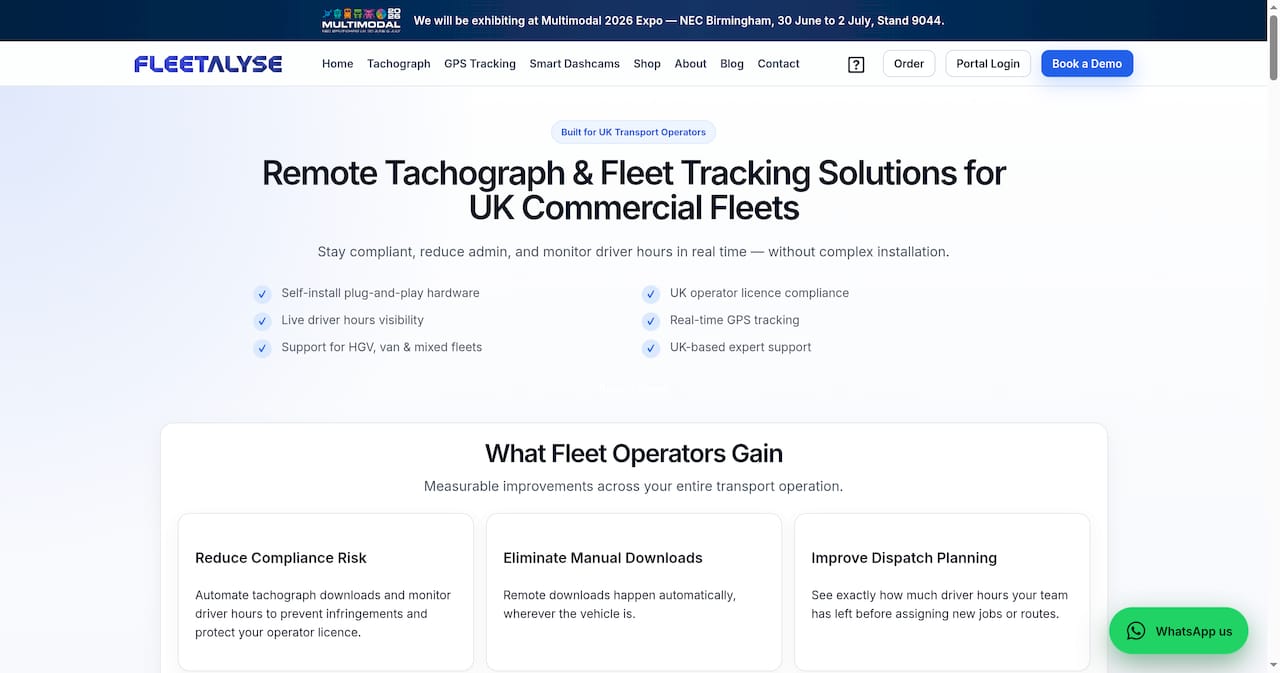
For operators managing diverse asset types, Fleetalyse offers asset and trailer GPS trackers alongside vehicle-fitted units, covering the full range from plug-and-play OBD devices to hardwired HGV solutions. Smart tachograph integration handles remote downloads and driver hours alerts automatically, reducing the administrative load on transport managers. UK-based support means you get practical help from people who understand DVSA requirements and Operator Licence obligations. Explore the full range of Fleetalyse solutions to see how the platform fits your fleet’s specific mix of assets and compliance requirements.
FAQ
What is mixed asset fleet management?
Mixed asset fleet management is the practice of overseeing vehicles and equipment of different types, fuel sources, and regulatory classifications within a single operational system. It requires unified data, asset-specific maintenance logic, and integrated compliance tools.
What tachograph rules apply to mixed fleets in 2026?
From 1 july 2026, second-generation smart tachographs are required for light commercial vehicles above 2.5 tonnes used in international and cabotage transport, extending the driving limit look-back period. Operators with mixed fleets including LCVs on cross-border routes must comply.
How is maintenance effectiveness measured in a mixed fleet?
Maintenance effectiveness is measured using the on-time completion rate: completed preventive maintenance tasks on time divided by total scheduled tasks, multiplied by 100. A rate below 90% indicates systemic scheduling or resource gaps.
Why does proactive maintenance matter more in mixed fleets?
Proactive maintenance delivers up to a 5:1 return compared to reactive repairs, accounting for both repair costs and lost productivity from vehicles off the road. In a mixed fleet, a single unplanned breakdown can disrupt multiple dependent asset types simultaneously.
How do I avoid data noise when managing mixed fleet analytics?
Fix operational bottlenecks such as missing asset records and maintenance compliance gaps before deploying automated analytics. Automating a disorganised data set amplifies errors rather than resolving them.