

Predictive maintenance for fleets: 2026 guide

Predictive maintenance for fleets is defined as the practice of using real-time sensor data, telematics, and machine learning to forecast vehicle faults before they cause a breakdown. Unlike scheduled servicing, it acts on what the data actually shows rather than a calendar date. Fleet operators who adopt this approach save 8–12% over preventive maintenance and up to 40% over reactive maintenance. Those savings compound quickly across large HGV or mixed-asset fleets. Understanding what predictive maintenance means for your fleet is the first step to reducing unplanned downtime and keeping your Operator Licence in good standing.
What is predictive maintenance in fleet management?
Predictive maintenance, known in industry as condition-based maintenance (CBM), uses continuous data from IoT sensors and telematics units to monitor vehicle health in real time. The goal is to catch a developing fault, such as a brake wear anomaly or rising coolant temperature, days or weeks before it becomes a roadside failure. This is fundamentally different from reactive maintenance, which responds only after a breakdown, and from preventive maintenance, which services vehicles on a fixed schedule regardless of their actual condition.
Condition-based maintenance shifts servicing from calendar-driven cycles to data-driven decisions. That shift matters because a vehicle serviced at 10,000 miles regardless of its condition may be over-serviced or, worse, under-serviced if a fault develops at 8,500 miles. Predictive analytics for fleets closes that gap by treating each vehicle as an individual asset with its own wear profile.

The financial case is stark. Every £1 of deferred maintenance can escalate into £4 of capital renewal costs. For a fleet of 50 HGVs, that arithmetic makes predictive maintenance a budget priority, not a nice-to-have.
How does predictive maintenance work in a fleet?
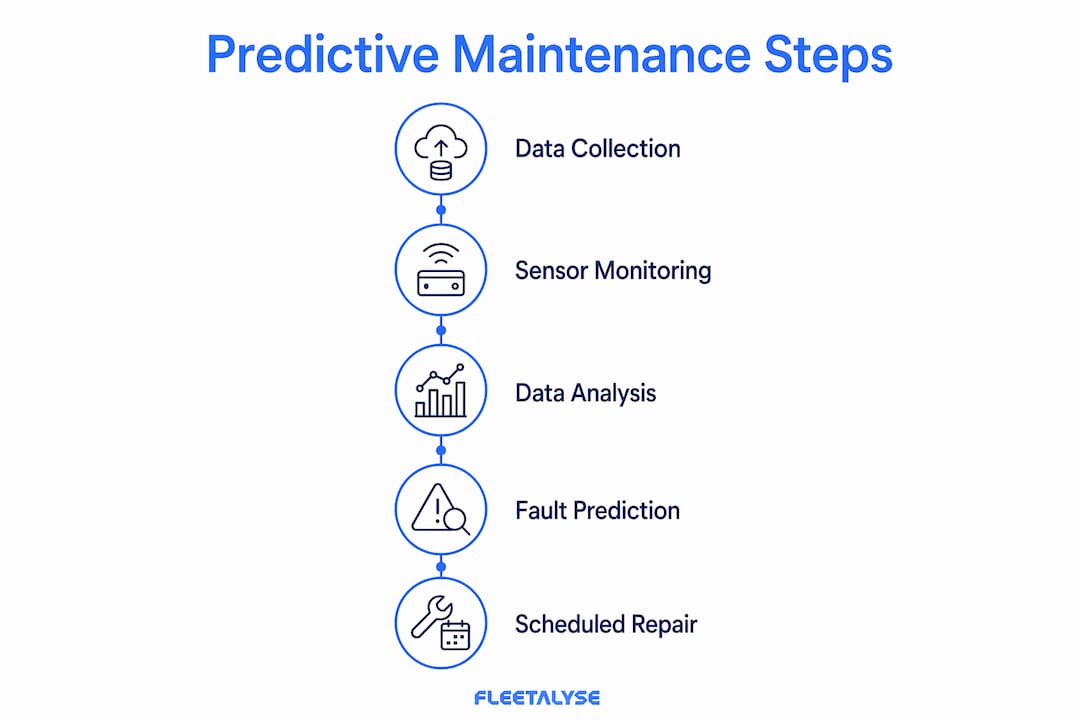
The process follows four distinct steps, each building on the last.
-
Data capture. Telematics units and IoT sensors collect parameters including engine temperature, vibration levels, brake pad thickness, battery voltage, and diagnostic trouble codes (DTCs) from the vehicle’s CAN-bus. Systems monitor critical components such as batteries and brakes, predicting failures days or weeks in advance.
-
Data transmission. The raw sensor data travels via 4G or satellite to a cloud platform. This happens continuously, not just when the vehicle returns to depot. Real-time transmission is what separates predictive maintenance from a post-trip inspection.
-
Analysis. The platform applies either threshold-based rules (for example, alerting when engine temperature exceeds a set limit) or AI-driven anomaly detection models that learn normal operating patterns and flag deviations. Threshold-based alerts often provide immediate ROI and are recommended before complex AI adoption.
-
Alert and scheduling. When the system detects an anomaly, it triggers an alert to the fleet manager or workshop. The maintenance team can then book the vehicle in for a planned repair before the fault worsens, rather than reacting to a breakdown on the A1 at 02:00.
Pro Tip: Start with simple temperature and vibration thresholds on your highest-mileage vehicles. You will see measurable value within weeks, without needing to deploy a full AI analytics stack from day one.
Condition-based maintenance replaces the assumption that all vehicles age at the same rate. A van covering urban stop-start routes wears its brakes far faster than an identical van on motorway runs. Predictive analytics for fleets accounts for that difference automatically, scheduling each vehicle based on its own data rather than a shared calendar.
What are the key benefits of predictive maintenance for fleet operators?
The benefits of predictive maintenance reach well beyond cost savings, though the financial case alone is compelling.
- Reduced unplanned downtime. Planned shop visits replace roadside breakdowns. A vehicle off the road for a scheduled two-hour brake inspection costs far less in lost revenue and recovery fees than an unplanned breakdown.
- Lower parts and labour costs. Replacing a component at the right time, rather than too early or too late, reduces waste. Labour planning also improves because the workshop knows what work is coming.
- Improved safety and compliance. Predictive maintenance reduces the risk of on-road failures and accidents, directly supporting DVSA roadworthiness standards and Operator Licence obligations.
- Smarter budget control. Maintenance spend becomes predictable. Finance teams can forecast parts and labour costs rather than absorbing surprise repair bills.
- Extended vehicle life. Catching faults early prevents the secondary damage that a minor issue causes when left unaddressed.
The safety and compliance benefit deserves particular attention for UK operators. A vehicle that fails a DVSA roadside check due to a preventable fault creates an immediate risk to your Operator Licence. Predictive maintenance creates an auditable record of proactive intervention, which carries weight in any Traffic Commissioner review. Logistics operators can find further context on fleet maintenance strategies in this 2026 fleet management guide.
What are the challenges of implementing predictive maintenance?
Predictive maintenance is not a plug-in solution. Fleet operators encounter several practical obstacles when moving from reactive or preventive approaches.
Data quality comes first. Predictive models depend on accurate, complete historical failure data. If your maintenance records are held in paper job cards or inconsistent spreadsheets, the models will produce unreliable outputs. Cleaning and digitising historical data is unglamorous work, but it must precede any advanced analytics deployment.
Technician resistance is real. Workshops have their own rhythms and expertise built over years. Introducing automated diagnostics can feel like a challenge to that expertise. Adoption success depends on cultural change and the involvement of senior technicians to build trust in automated diagnostics. Framing predictive maintenance as a second set of eyes for the team, rather than a replacement for their judgement, is the most effective way to bring technicians on board.
Technical complexity can stall progress. Fleet managers often expect AI complexity and delay implementation as a result. The reality is that threshold alerts provide fast ROI without requiring a data science team. Start with the data you already have from your telematics units.
Common implementation pitfalls to avoid:
- Deploying across the entire fleet at once before validating the approach on a pilot group
- Neglecting to involve workshop supervisors in the rollout plan
- Choosing hardware that cannot integrate with your existing fleet management software
- Treating data hygiene as a later task rather than a prerequisite
Pro Tip: Run a 90-day pilot on your five highest-risk vehicles. Use that period to validate alert accuracy, build technician confidence, and identify any data gaps before scaling.
How to integrate predictive maintenance with fleet management software
Integration is where predictive maintenance moves from a monitoring exercise to a genuine operational tool. Raw diagnostic codes have limited value unless they connect to workshop scheduling, parts inventory, and maintenance budgets.
Combining real-time data with workshop scheduling improves efficiency and budget control, and prevents asset over-servicing. The table below shows how integration capability varies across different platform types.
| Capability | Basic telematics platforms | Integrated fleet management platforms |
|---|---|---|
| Real-time fault alerts | Limited or manual | Automated, threshold and AI-based |
| Workshop scheduling | Separate system | Linked directly to alert triggers |
| Parts inventory visibility | Not included | Integrated stock management |
| Compliance reporting | Manual export | Automated DVSA-ready reports |
| Driver behaviour data | Basic GPS only | Full CAN-bus and behaviour scoring |
Choosing compatible hardware is the starting point. Plug-and-play telematics units that read CAN-bus data directly from the vehicle remove the need for specialist installation and give you the sensor inputs that predictive models require. Asset and trailer GPS trackers extend that visibility beyond the tractor unit to the full asset base, which matters for mixed fleets running trailers and specialist equipment.
Dashboard visibility is equally important. Maintenance managers need a single view that shows vehicle health status, upcoming scheduled interventions, and outstanding alerts without switching between multiple systems. When that view is connected to parts ordering and workshop capacity, the efficiency gains are substantial. For UK commercial fleets, the practical benefits of this kind of integration are well documented in this overview of GPS trackers and dashcams for commercial operations.
Key takeaways
Predictive maintenance for fleets delivers the greatest cost and safety benefits when real-time telematics data, clean historical records, and integrated workshop scheduling work together as a single system.
| Point | Details |
|---|---|
| Definition and core value | Predictive maintenance uses sensor data and analytics to fix faults before they cause breakdowns. |
| Cost savings are significant | Fleets save 8–12% over preventive maintenance and up to 40% over reactive maintenance. |
| Start simple | Threshold-based alerts on temperature and vibration deliver fast ROI without complex AI. |
| Data quality is a prerequisite | Clean, complete historical records must be in place before advanced predictive models will work reliably. |
| Integration multiplies the benefit | Connecting telematics alerts to workshop scheduling and parts inventory turns data into planned action. |
Predictive maintenance: what I have learned after years in fleet telematics
The most common mistake I see fleet operators make is treating predictive maintenance as a technology project rather than an operational change. They invest in sensors and dashboards, then wonder why the workshop still runs on gut feel and paper job cards. The technology is the easy part. The hard part is getting your senior technician to trust an alert that says a brake calliper is developing a fault three weeks before it would have shown up on a routine inspection.
My honest view is that most fleets are sitting on enough telematics data right now to start condition-based maintenance today. The data is there. What is missing is the process to act on it. A threshold alert for coolant temperature or battery voltage requires no AI, no data science team, and no significant investment. It requires someone to decide that the alert will trigger a workshop booking rather than be dismissed.
The operators I have seen get the most from predictive maintenance are the ones who involved their workshop supervisors from day one. Not as recipients of a new system, but as co-designers of the alert thresholds and scheduling rules. When a technician has helped set the rules, they trust the outputs. That trust is what turns a monitoring tool into a genuine maintenance programme.
One misconception worth addressing: predictive maintenance does not replace skilled technicians. It gives them better information. The early warning system that predictive analytics provides augments expertise rather than replacing it. The best fleets I have worked with treat their telematics platform as a tool that makes their best technicians more effective, not redundant.
— Vytautas
How Fleetalyse supports predictive maintenance for UK fleets
Fleetalyse is built for UK commercial fleet operators who need telematics, compliance, and maintenance visibility in one place. Its GPS vehicle tracking reads live CAN-bus data from HGVs, vans, and trailers, feeding the real-time fault signals that condition-based maintenance depends on.
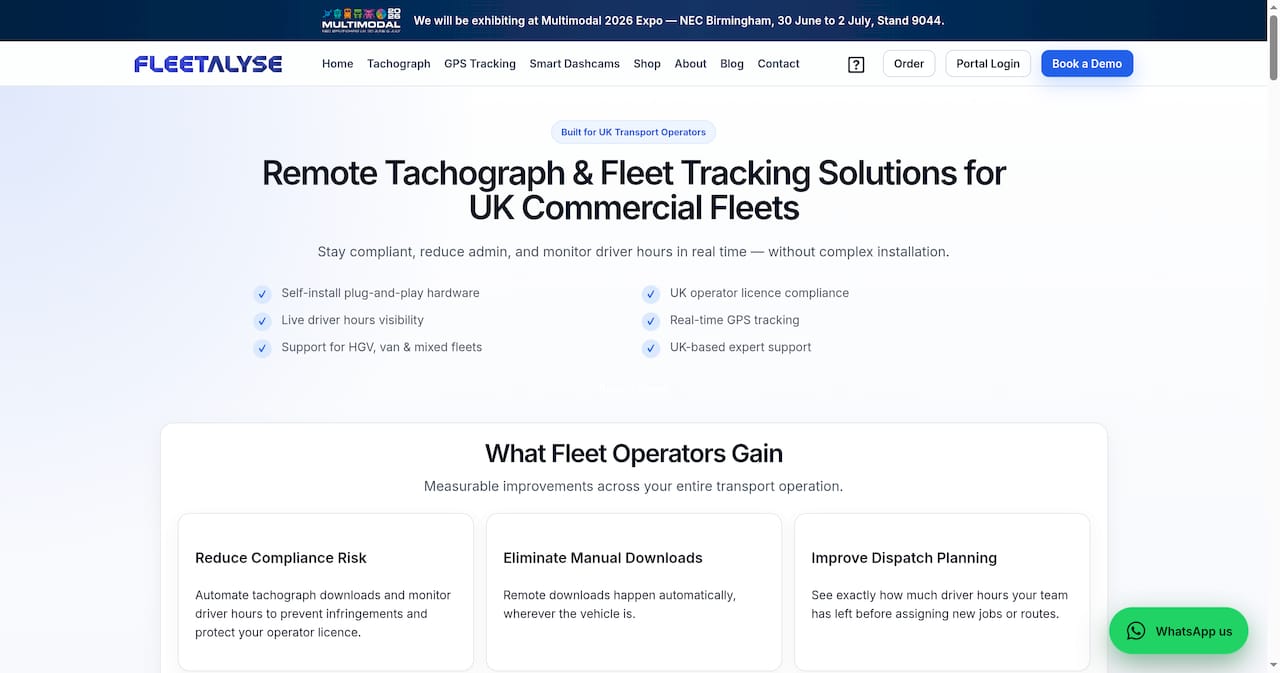
The platform connects GPS tracking, smart AI dashcams, and driver behaviour monitoring into a single dashboard, giving maintenance managers the visibility they need to act on alerts before they become breakdowns. Automated maintenance scheduling and DVSA compliance reporting reduce administrative workload while keeping your Operator Licence obligations covered. Explore the full range of Fleetalyse telematics solutions to see how the platform supports predictive maintenance across mixed UK fleets.
FAQ
What is predictive maintenance in a fleet context?
Predictive maintenance in a fleet is the use of real-time sensor data and analytics to identify developing vehicle faults before they cause a breakdown or roadside failure. It replaces calendar-based servicing with data-driven decisions based on actual vehicle condition.
How much can predictive maintenance save a fleet?
Fleets save roughly 8–12% compared to preventive maintenance and up to 40% compared to reactive maintenance. Deferred maintenance costs escalate further, with every £1 of delayed repair potentially generating £4 in capital renewal costs.
What data does predictive maintenance use?
Predictive maintenance systems capture engine temperature, vibration, brake wear, battery voltage, and diagnostic trouble codes (DTCs) via CAN-bus connected telematics units. This data is transmitted continuously to a cloud platform for analysis.
Do you need AI to start predictive maintenance?
No. Simple threshold-based alerts for parameters such as engine temperature or battery voltage deliver immediate ROI without requiring AI or machine learning. AI models add value later, once clean historical data is available to train them.
How does predictive maintenance support DVSA compliance?
By catching faults early and creating an auditable record of planned interventions, predictive maintenance reduces the risk of vehicles failing DVSA roadside checks. That record also demonstrates proactive maintenance management to the Traffic Commissioner if your Operator Licence is reviewed.