
Real time vehicle tracking explained for fleets
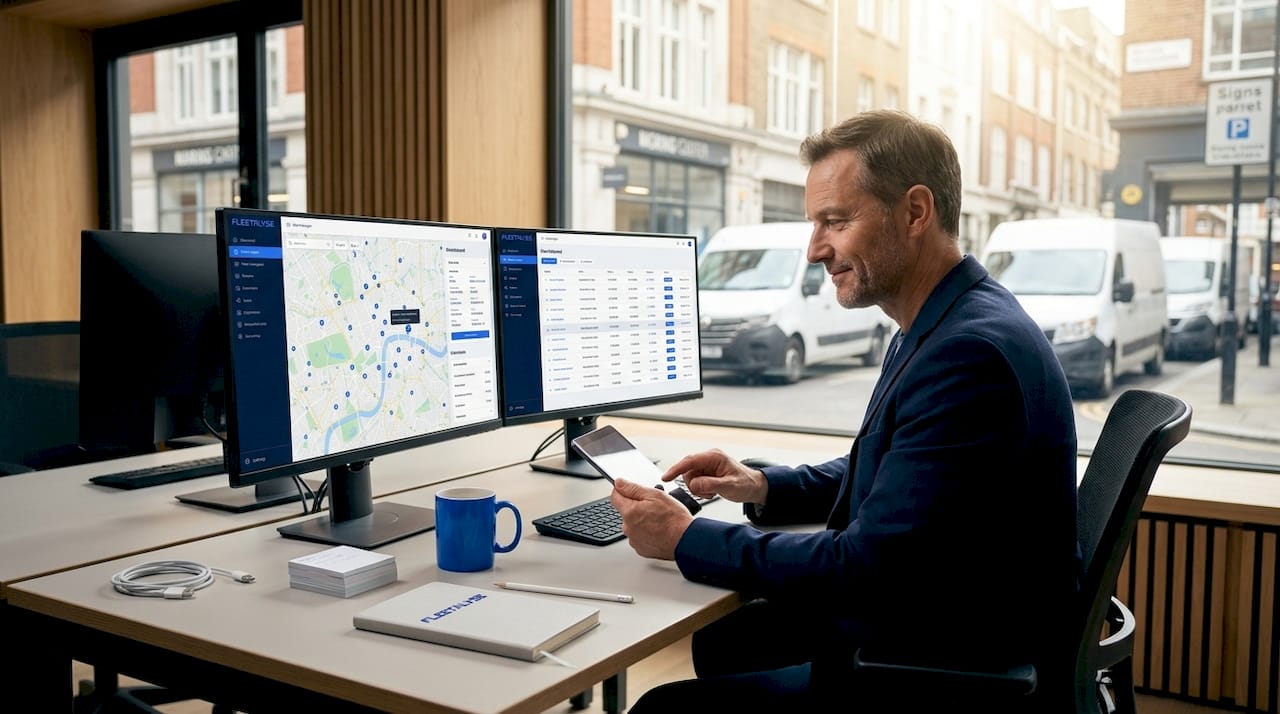
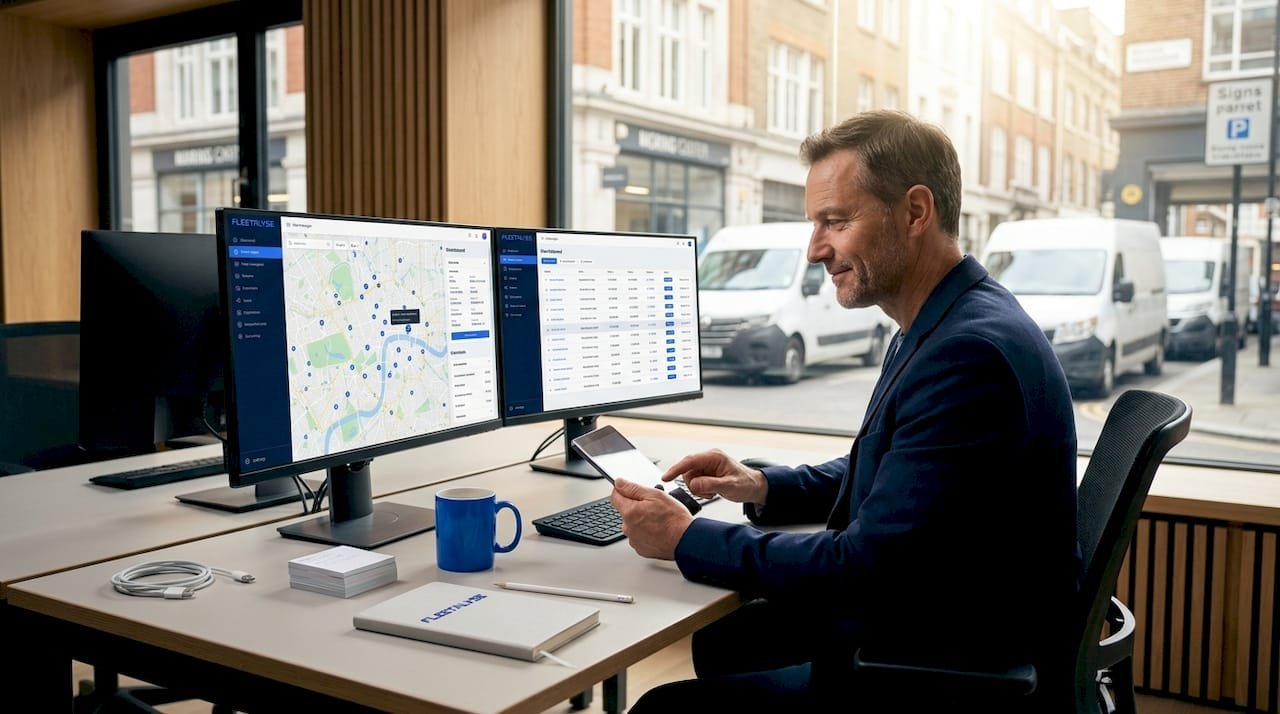
Many fleet managers assume that “real time” means their vehicle tracking dashboard shows live movement with zero delay, like watching a video feed. That assumption leads to confusion when vehicles appear to skip ahead on the map or updates lag during rural stretches. Real time vehicle tracking explained properly reveals a more nuanced picture: a precise, near-instantaneous system built on GPS satellites, cellular networks, and cloud processing that delivers location data within seconds, not milliseconds. Understanding how it actually works, and where its limits lie, helps you make smarter decisions about the technology your fleet depends on.
Table of Contents
- Key takeaways
- How real-time vehicle tracking technology works
- Accuracy, update frequency, and what ‘real time’ means
- Features that make real-time tracking genuinely useful
- Challenges and practical limitations to understand
- My perspective on getting real value from real-time tracking
- See how Fleetalyse puts this into practice
- FAQ
Key takeaways
| Point | Details |
|---|---|
| Not truly instantaneous | Real-time tracking has a typical end-to-end delay of one to two seconds on strong networks, not zero delay. |
| Accuracy varies by environment | GPS accuracy ranges from 3 to 10 metres in open conditions but can degrade to 50 metres in dense urban areas. |
| Update frequency matters | Most fleet systems update every 3 to 60 seconds; shorter intervals improve map smoothness but increase data usage. |
| Features extend beyond location | Geofencing, idle monitoring, driver behaviour, and maintenance alerts deliver far more value than a live map pin. |
| Signal gaps cause buffering | Trackers store data locally during coverage loss and upload it once connection resumes, causing delayed bursts of updates. |
How real-time vehicle tracking technology works
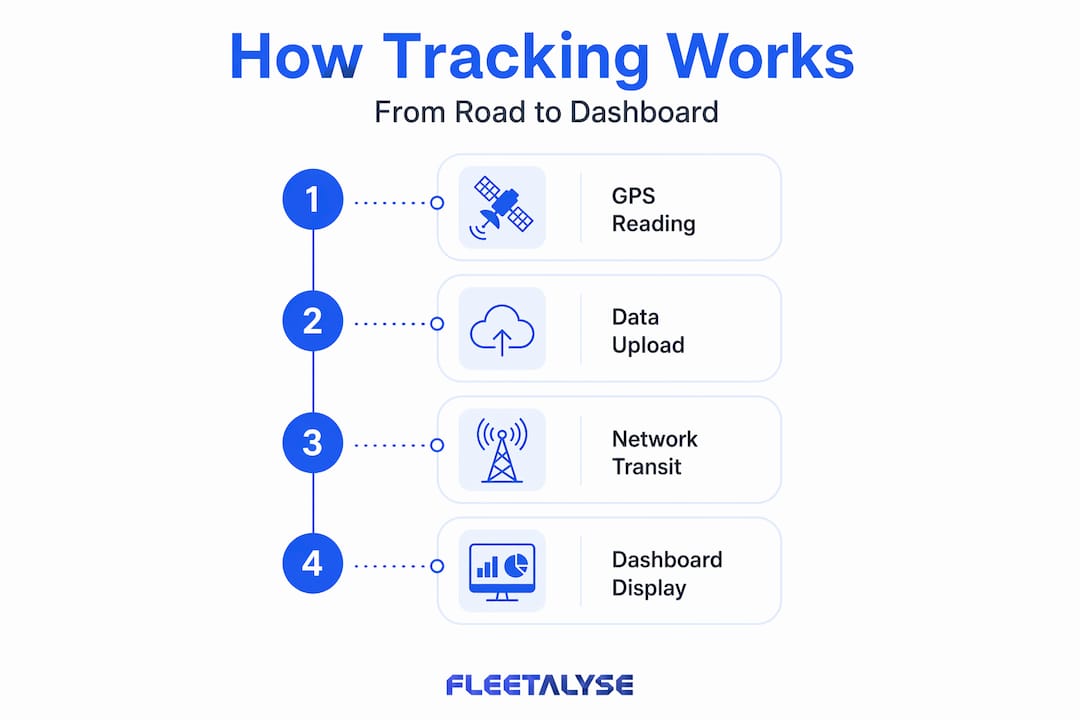
To understand vehicle GPS tracking explained properly, it helps to follow the data from the moment a vehicle moves to the moment it appears on your screen.
Here is the process, step by step:
-
Satellite signal acquisition. Your GPS tracking device receives signals from multiple GNSS satellites orbiting at roughly 20,200 kilometres. Each satellite broadcasts its precise position and an atomic clock timestamp. The receiver on your vehicle picks up signals from at least four satellites simultaneously.
-
Position calculation via trilateration. The device measures the travel time of each satellite signal to calculate its distance from each one. By comparing distances from four or more satellites, the unit triangulates its precise position, speed, and heading. This calculation happens entirely inside the vehicle unit, with no internet connection required.
-
Data packaging. The device bundles the calculated coordinates with speed, heading, a timestamp, and often additional data from the vehicle’s CAN-bus interface, such as fuel consumption or engine status. This forms a compact data packet ready for transmission.
-
Cellular transmission to the cloud. The tracker sends that data packet over a 4G or 5G LTE cellular network to a cloud server. The GPS-to-cellular-to-cloud loop creates an end-to-end tracking cycle operating at seconds-level latency under normal conditions.
-
Cloud processing and storage. The server receives the packet, validates it, and stores the position update. Platforms using efficient architecture, including geospatial indexing and websocket connections, push the update to your real-time vehicle tracking dashboard almost immediately after it arrives at the server.
-
Dashboard display. Your browser or mobile app renders the new vehicle position on the map. The dot moves. The timestamp refreshes. From a driver’s perspective, nothing happened. From yours, you now know where that vehicle is within a few seconds of where it actually is.
Pro Tip: Ask any tracking vendor to confirm the exact update interval their hardware uses, and whether the platform uses websocket connections or polling. Polling-based dashboards introduce additional lag every time your browser requests fresh data, even if the hardware updates frequently.
Typical fleet tracking systems update location every 3 to 10 seconds for near-live movement on dashboards. Some configurable units allow 30 or 60-second intervals when finer granularity is unnecessary, which helps reduce data costs on large fleets.
Accuracy, update frequency, and what ‘real time’ means
These three concepts are often conflated. They are distinct, and confusing them leads to poor purchasing decisions.
GPS accuracy refers to how close the reported position is to the vehicle’s actual physical location. Under open sky conditions, typical accuracy sits between 3 and 10 metres. That is sufficient for confirming route compliance, verifying a vehicle has entered a customer site, or supporting a DVSA audit trail.
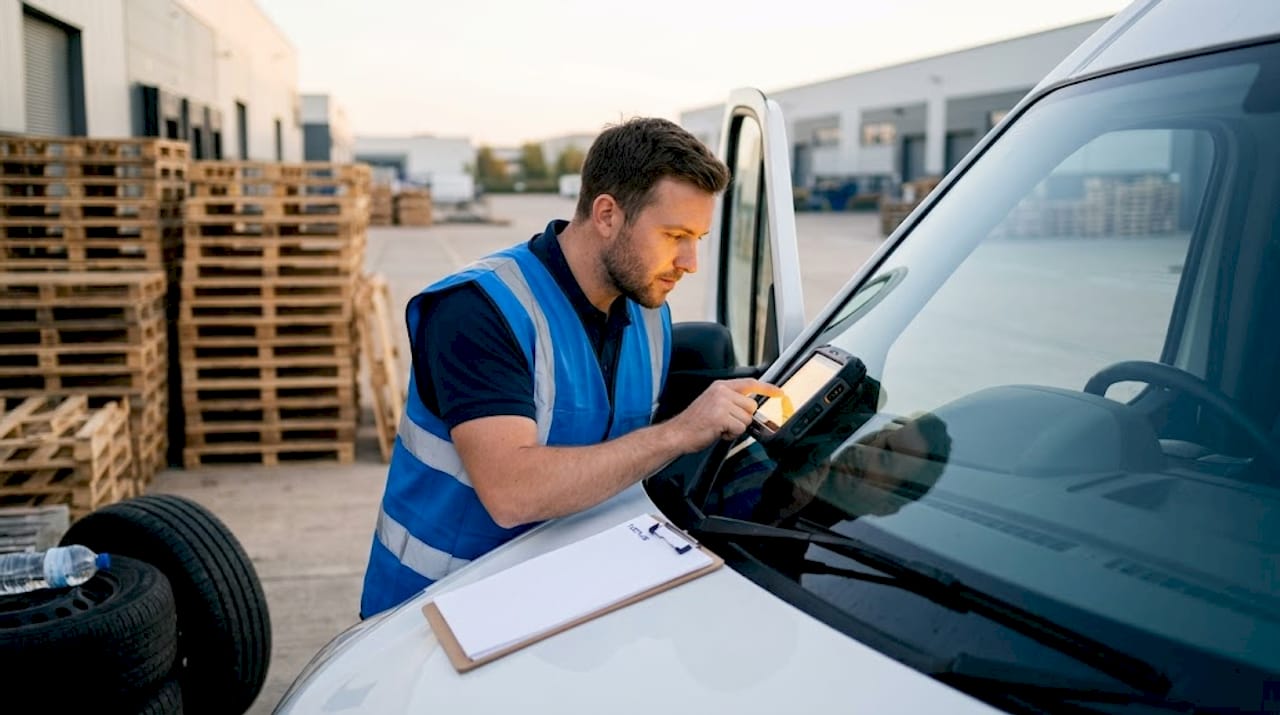
Update frequency refers to how often the device sends a new position report. Critically, update frequency improves map smoothness and alert responsiveness but does not change the accuracy of any individual position fix. A device updating every two seconds is not more accurate than one updating every 30 seconds. It simply gives you more data points.
Latency is the total delay from when the vehicle is at a location to when you see it on screen. This combines three sources:
| Source | Typical delay |
|---|---|
| Tracker update interval | 3 to 60 seconds (configurable) |
| Cellular network uplink | 200 milliseconds to 2 seconds depending on signal strength |
| Server processing and app rendering | Under 500 milliseconds on well-architected platforms |
The practical result is that data transmission delay from vehicle movement to dashboard display typically ranges from one to two seconds on strong LTE networks, once you exclude the tracker’s own update interval. On a 10-second update interval, the maximum age of any displayed position is around 12 seconds. That is entirely sufficient for fleet dispatch decisions, compliance verification, and operational oversight.
Pro Tip: For most fleet operations, a 10-second update interval is the practical sweet spot. It gives you smooth map movement and responsive geofence alerts without the additional data costs that come with 3-second updates across a large fleet.
Features that make real-time tracking genuinely useful
Location pins alone do not justify the investment in a tracking system. The real fleet management value comes from the operational intelligence layers built on top of live position data. Here is where the benefits of real time tracking become tangible for your operation:
-
Geofencing and boundary alerts. Define virtual perimeters around customer sites, depots, or restricted zones. When a vehicle enters or exits, you receive an instant notification. This removes the need to manually monitor vehicle positions and gives you automatic evidence of arrival and departure times.
-
Idle time monitoring. Engines left running at collection points or during driver breaks contribute directly to fuel waste. Real-time tracking captures idle duration per vehicle, per driver, and per location, giving you the data to address the behaviour through driver briefings or route redesign.
-
Driver and vehicle performance monitoring. Harsh braking, excessive speed, and aggressive cornering are visible in real time and logged historically. This supports both safety management and insurance cost reduction. For HGV operators, pairing this with tachograph data gives you a complete picture of driver hours and conduct.
-
Maintenance scheduling based on live usage. Mileage-based service reminders triggered by actual vehicle activity, rather than calendar dates, are far more accurate. A vehicle doing double its planned mileage in a week should not wait until the 12th of next month for its service alert.
-
Route compliance and delivery performance. Compare planned routes against actual GPS paths. Identify drivers deviating from optimised routes, spot recurring delays at specific locations, and provide accurate ETAs to customers based on live vehicle position.
-
Security and theft recovery. In the event of vehicle theft, live tracking data provides the police with a current position and a movement history. Many insurance providers now factor telematics installation into commercial fleet premiums.
-
Regulatory compliance support. For operators under Operator Licence obligations, having a time-stamped record of vehicle movements supports DVSA compliance checks and provides evidence in the event of a road traffic incident or working time dispute.
Integrated operational features like these prevent the common mistake of simply replacing a spreadsheet with a live map, which adds cost without transforming your operation.
Challenges and practical limitations to understand
Real time tracking technology is reliable, but it is not infallible. Knowing where it struggles helps you set realistic expectations and choose solutions that handle these situations gracefully.
-
Urban canyon effect. In dense city centres, GPS signals reflect off tall buildings before reaching the vehicle unit. In urban environments, position errors of 10 to 50 metres are possible, which can place a vehicle on the wrong street on your dashboard map. This is relevant for last-mile delivery operations.
-
Tunnels and underground routes. GPS signals cannot penetrate reinforced concrete. Vehicles travelling through tunnels lose satellite visibility entirely. The device continues to estimate position using last known heading and speed, but accuracy degrades until satellite contact is restored.
-
Cellular dead zones. Rural UK still has pockets of poor 4G coverage. When a vehicle enters a dead zone, trackers store location data locally and upload it once connection resumes, causing a delayed burst of historical points to appear on your dashboard simultaneously.
-
Device placement within the vehicle. A unit mounted low in a cab or inside a metal enclosure receives weaker satellite signals. Placement matters considerably for both GPS fix quality and cellular transmission strength.
-
Update frequency trade-offs. Higher frequency updates improve alerting and visualisation but increase both mobile data consumption and, for battery-powered trailer trackers, drain power reserves faster. This requires careful configuration for mixed fleet assets.
Practitioners test real-time tracking systems under realistic connectivity scenarios, including tunnels and rural coverage gaps, to validate performance before fleet-wide rollout. Testing on your actual routes, not just in a car park, reveals the blind spots that vendor demos never show you.
Understanding vehicle tracking systems means accepting these limitations as manageable constraints rather than dealbreakers. A good platform communicates signal loss clearly on the dashboard and flags gaps in tracking history so you are never falsely reassured by stale data presented as live.
My perspective on getting real value from real-time tracking
I’ve seen fleet managers invest in tracking platforms and walk away disappointed, not because the technology failed, but because they measured success by how smooth the map looked rather than by operational outcomes.
In my experience, the single most important thing to evaluate before you commit to any tracking solution is the update interval and latency under your specific network conditions. Vendor marketing materials rarely specify this clearly. I’ve found that asking for a live demonstration on a route that includes a rural stretch and a tunnel tells you more in 20 minutes than a two-hour product walkthrough.
What most new users overlook is how much leverage sits in the non-location features. Idle time data alone, once fed back into driver briefings, can reduce fuel costs measurably within the first quarter. Geofence alerts for site arrivals remove the need for manual check-in calls. These are the changes that alter how your operation runs day to day.
My honest take is that understanding vehicle tracking systems at a technical level, even just grasping the basics of latency and accuracy, makes you a far better buyer and a more effective manager of the system you choose. The fleet managers who extract the most value are those who treat tracking data as a management tool, not a surveillance feed.
— Vytautas
See how Fleetalyse puts this into practice
If you are ready to move from understanding the technology to deploying it, Fleetalyse gives you a GPS fleet tracking platform built specifically for UK commercial operators.
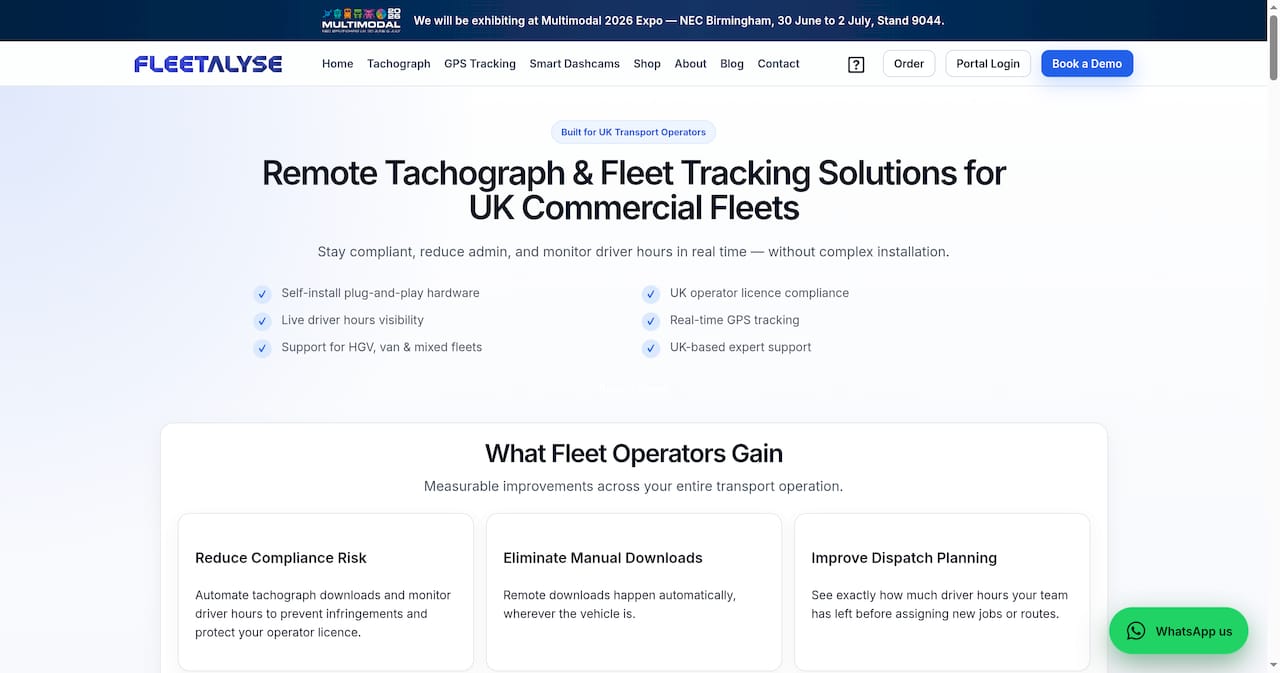
The Fleetalyse tracking platform delivers near real-time GPS updates alongside geofencing alerts, idle time monitoring, driver behaviour reporting, and automated maintenance scheduling, all from a single dashboard. Hardware is plug-and-play, designed for straightforward installation without specialist engineers. Whether you run HGVs, vans, trailers, or a mixed fleet, Fleetalyse scales to your operation with UK-based support on hand for setup and troubleshooting. Explore the full range of tracking solutions and dashcams to see which configuration fits your fleet’s compliance and operational requirements.
FAQ
What is real-time vehicle tracking?
Real-time vehicle tracking is a system where GPS devices in vehicles calculate position and transmit data via cellular networks to a cloud platform, updating your dashboard with the vehicle’s location, speed, and heading within seconds of movement occurring.
How accurate is GPS vehicle tracking?
GPS accuracy under open sky is typically 3 to 10 metres, which is sufficient for route compliance and delivery confirmation. Urban environments with tall buildings can reduce accuracy to 10 to 50 metres due to signal reflection.
How often does a real-time tracker update its position?
Most fleet tracking systems update every 3 to 60 seconds, depending on configuration. A 10-second interval is common for operational fleet use, balancing dashboard responsiveness with data costs.
What happens to tracking data in a mobile signal dead zone?
When a vehicle loses cellular coverage, the GPS tracker stores location data locally and transmits it as a batch once signal is restored. This creates a gap in live tracking followed by a burst of historical position updates.
Is real-time vehicle tracking useful for compliance?
Yes. Time-stamped movement records support DVSA compliance checks, Operator Licence obligations, and working time dispute resolution. When combined with tachograph data and driver behaviour monitoring, tracking data provides a thorough audit trail for transport operators.