

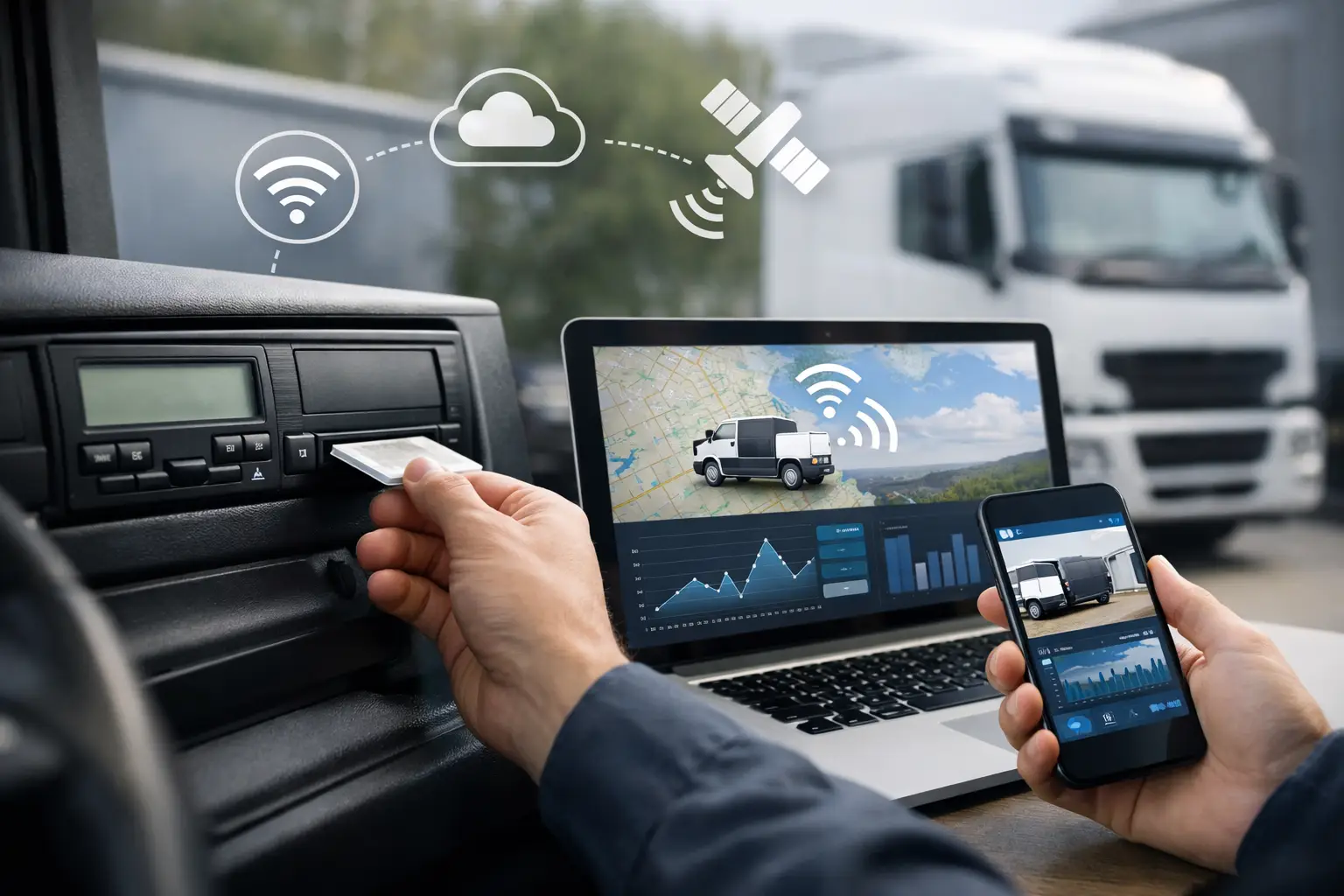

If your depot still relies on drivers bringing vehicles back just to collect tachograph data, you are building delay into a job that already has enough moving parts. Remote tachograph download changes that by pulling driver card and vehicle unit data without waiting for a lorry to return to base, giving transport teams faster access to the records they need to stay compliant and keep work moving.
For UK operators, that matters because tachograph compliance is not just an admin task. It sits close to operator licence protection, driver hours management and day-to-day planning. When downloads are late, missed or dependent on manual routines, the risk is not theoretical. It shows up in infringements, avoidable office time and weaker visibility across the fleet.
What remote tachograph download actually does
At a practical level, remote tachograph download allows fleet operators to collect tachograph data from the vehicle unit and the driver card without physically connecting a download tool on site. The data is transferred over the air through an approved setup, then made available for analysis, storage and compliance review.
That sounds simple, but the operational benefit is bigger than the process itself. Instead of chasing vehicles into the yard, arranging card reads around shift patterns or relying on depot staff to remember deadlines, the system handles regular downloads automatically. The office gets the information it needs, and the vehicle stays where it is needed.
For fleets running multi-drop work, long-distance haulage or mixed operations across depots, this is often the difference between a controlled compliance process and one that depends too heavily on timing and luck.
Why remote tachograph download matters in real fleet operations
The main reason operators move to remote tachograph download is not technology for its own sake. It is because manual collection creates friction in places where transport teams can least afford it.
A vehicle may be out for several days. A driver may swap units. A planner may need to know whether a driver has usable hours left before assigning another job. If tachograph data only becomes available when the vehicle is back in the yard, decisions are being made with a gap in the picture.
That gap affects more than compliance. It affects planning, utilisation and office workload. A transport manager reviewing infringements late is already on the back foot. A depot team trying to line up manual downloads for dozens of vehicles is spending time on collection rather than action. And a business using one system for tracking, another for hours and a spreadsheet for reminders usually ends up duplicating effort.
Remote access reduces those delays. The right platform also turns that data into something usable, so teams can see driver activity, spot approaching issues and respond before a missed download becomes a bigger problem.
How remote tachograph download reduces admin
Manual tachograph routines are rarely just one task. Someone has to keep a schedule, check when each vehicle and driver card is due, make sure the vehicle is available, connect the hardware, save the file, store it correctly and follow up if anything has been missed. Across a larger fleet, that becomes a steady drain on office time.
With remote tachograph download, much of that routine becomes automated. Regular downloads can be scheduled, records are pulled without physical intervention, and files are stored in a consistent way. The gain is not only fewer clicks. It is fewer exceptions to manage.
That has a knock-on effect across the transport office. Compliance managers spend less time collecting data and more time reviewing it. Planners are less likely to be interrupted by avoidable admin. Depot teams do not need to build vehicle movements around download deadlines.
There is a cost to any system, of course. But when measured against admin hours, vehicle disruption and the risk of missed deadlines, remote collection is often easier to justify than businesses expect.
Remote tachograph download and compliance risk
Compliance problems usually come from ordinary operational pressure rather than dramatic failure. A vehicle is away longer than planned. A card is not downloaded on time. A manual reminder is missed during a busy week. One missed step turns into a late download, then into a reporting issue, then into avoidable exposure if records are requested.
Remote tachograph download helps by making the process less dependent on memory and vehicle location. Data can be collected on schedule even when the fleet is spread across different routes, customer sites or depots. That gives operators a more reliable compliance routine and a clearer audit trail.
It also means potential issues can be identified sooner. If driver hours data is available more quickly, transport teams are in a stronger position to investigate infringements, coach drivers and adjust planning before patterns become entrenched.
That said, remote downloading is not a substitute for good compliance management. It improves the reliability of data collection, but operators still need proper review processes, clear responsibility and accurate interpretation of the data. Technology shortens the gap between activity and visibility. It does not remove the need for oversight.
What to look for in a remote tachograph download system
Not every setup delivers the same operational value. Some solutions handle the download itself but leave teams juggling separate platforms for tracking, reporting and hours analysis. That can solve one problem while leaving the wider workflow fragmented.
For most UK fleets, the stronger option is a platform that combines remote tachograph download with live driver hours visibility, vehicle tracking and reporting in one place. That matters because compliance and operations are closely linked. If a planner can see where the vehicle is, how much driving time remains and whether the latest data has been collected, decisions become faster and more reliable.
Ease of installation matters too. If hardware rollout is slow or disruptive, implementation drags on and depot teams lose confidence early. The same applies to pricing. Hidden charges for downloads, storage or support often turn what looked like a tidy monthly service into another awkward supplier relationship.
A practical system should be straightforward to deploy, clear on cost and designed around transport office routines rather than generic telematics dashboards.
Where the biggest gains usually appear
The first gain is usually time. Businesses moving from manual routines often see immediate savings in office admin because download schedules no longer depend on vehicles returning to base.
The second gain is control. When driver card and vehicle unit data are available remotely, transport managers can respond earlier to missing records, approaching issues and patterns in driver hours. That is especially useful in fleets where vehicles operate across multiple sites or spend long periods away from the depot.
The third gain is operational visibility. When remote tachograph download sits inside a wider fleet platform, the data becomes part of dispatch and planning rather than a separate compliance exercise. That means fewer blind spots between the compliance team and the people allocating work.
For mixed fleets, the value can vary by operation. A business with mostly local routes may feel the admin saving more than the planning benefit. A long-haul operator may see the strongest return in reduced disruption and tighter hours management. It depends on how often vehicles are away, how the office is structured and how much of the current process is still manual.
Why integration matters more than another standalone tool
Many operators already have enough software. The problem is that each tool answers only part of the question. One system shows location, another stores tachograph files, and someone still uses a spreadsheet to keep track of deadlines or maintenance dates.
That is where remote tachograph download becomes more valuable as part of an integrated platform. Instead of treating tachograph data as an isolated compliance file, the system connects it with live fleet activity. A dispatcher can make better allocation decisions. A compliance manager can review records without chasing files. A business owner gets clearer oversight without asking three people for three versions of the truth.
This is why platforms built around UK fleet operations tend to deliver more practical value than generic tracking systems with compliance bolted on afterwards. The day-to-day reality is not just knowing where the vehicle is. It is knowing whether the fleet is compliant, available and being used well.
Fleetalyse is built around that operational reality, combining remote tachograph downloads with live fleet visibility so transport teams can reduce admin without losing control.
Is remote tachograph download right for every fleet?
For most HGV operators, yes, but the reason will differ. If your current process is manual and vehicles are frequently away from base, the case is usually clear. If your fleet is smaller and largely returns to the depot every day, the saving may look more modest at first, but it can still be worthwhile when measured against admin time, consistency and compliance confidence.
The real test is simple. If downloads depend on people remembering, vehicles being in the right place, or office staff spending hours collecting data, there is room to improve. And if your tachograph process sits apart from the rest of your fleet data, there is usually an even bigger opportunity to tighten control.
Remote tachograph download is not about adding another layer of technology. It is about removing avoidable effort from a task that has to be done properly. When compliance data arrives on time and in the same place as the rest of your fleet information, the transport office runs with fewer interruptions and better decisions. That is usually where the value becomes obvious.