

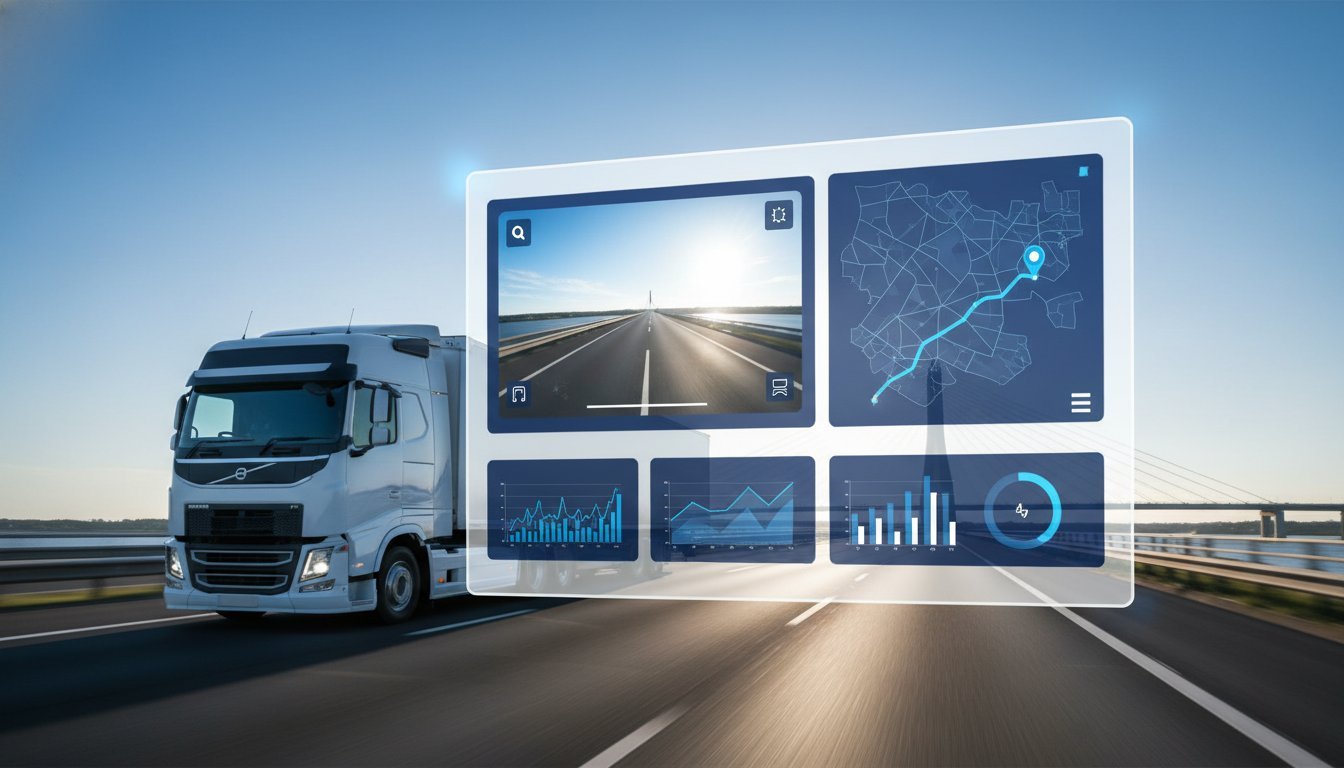
What if you could stop a £10,000 "crash-for-cash" claim before the driver even returns to the yard? For UK fleet operators, the reality of road incidents is often a frustrating game of "he said, she said" followed by weeks of waiting to retrieve grainy footage from an SD card. Installing a Smart 4G Dashcam changes the dynamic entirely. It moves your operation from reactive guesswork to real-time certainty, ensuring you're never left in the dark when an incident occurs on the M6 or a busy London high street. You don't have time to chase vehicles across the country just to check a memory card, and in 2026, you shouldn't have to.
You already know that protecting your HGVs and vans is about more than just recording video; it's about maintaining operational compliance and defending your bottom line against rising insurance premiums. This guide shows you how to leverage 4G connectivity to gain instant visibility, improve driver safety scores, and eliminate the manual hassle of physical data retrieval. We'll explore how these intelligent systems integrate with your existing telematics to provide a complete picture of your fleet's behaviour whilst on the road, turning raw data into actionable decisions for a more efficient transport operation.
Key Takeaways
- Transition from local SD storage to cloud-based connectivity to ensure your fleet has instant, reliable access to critical footage.
- Improve driver behaviour and professionalism using real-time "Live View" visibility across your entire HGV or van fleet.
- Navigate data costs and connectivity challenges by selecting a Smart 4G Dashcam with multi-network SIMs for reliable UK coverage.
- Identify the specific hardware requirements for commercial vehicles, including multi-channel systems for total visibility around the vehicle.
- Strengthen your fleet compliance and protect your Operator Licence by using video evidence to prove safety standards.
What is a Smart 4G Dashcam and Why Does Your Fleet Need One?
A Smart 4G Dashcam is a connected video telematics device that uses LTE networks to stream and upload footage to the cloud in real time. It represents a fundamental shift in how UK transport managers handle road safety. Older systems relied on local storage, which meant you only saw the footage if you physically retrieved a card from the cab. In 2026, that passive approach isn't enough for professional haulage. Modern fleet operations require an "always-on" connection that turns a simple camera into a proactive safety tool. Understanding What is a Smart 4G Dashcam? starts with recognising its role as a live data sensor rather than just a recording loop.
Standard dashcams often fail when you need them most. They lack the security protocols and immediate accessibility required for commercial compliance. Smart systems solve this by prioritising data integrity. They ensure that every second of driving is accounted for, stored securely, and ready for review without the vehicle ever needing to return to the depot. It's about total transparency for your operations.
The Evolution from SD Cards to 4G LTE
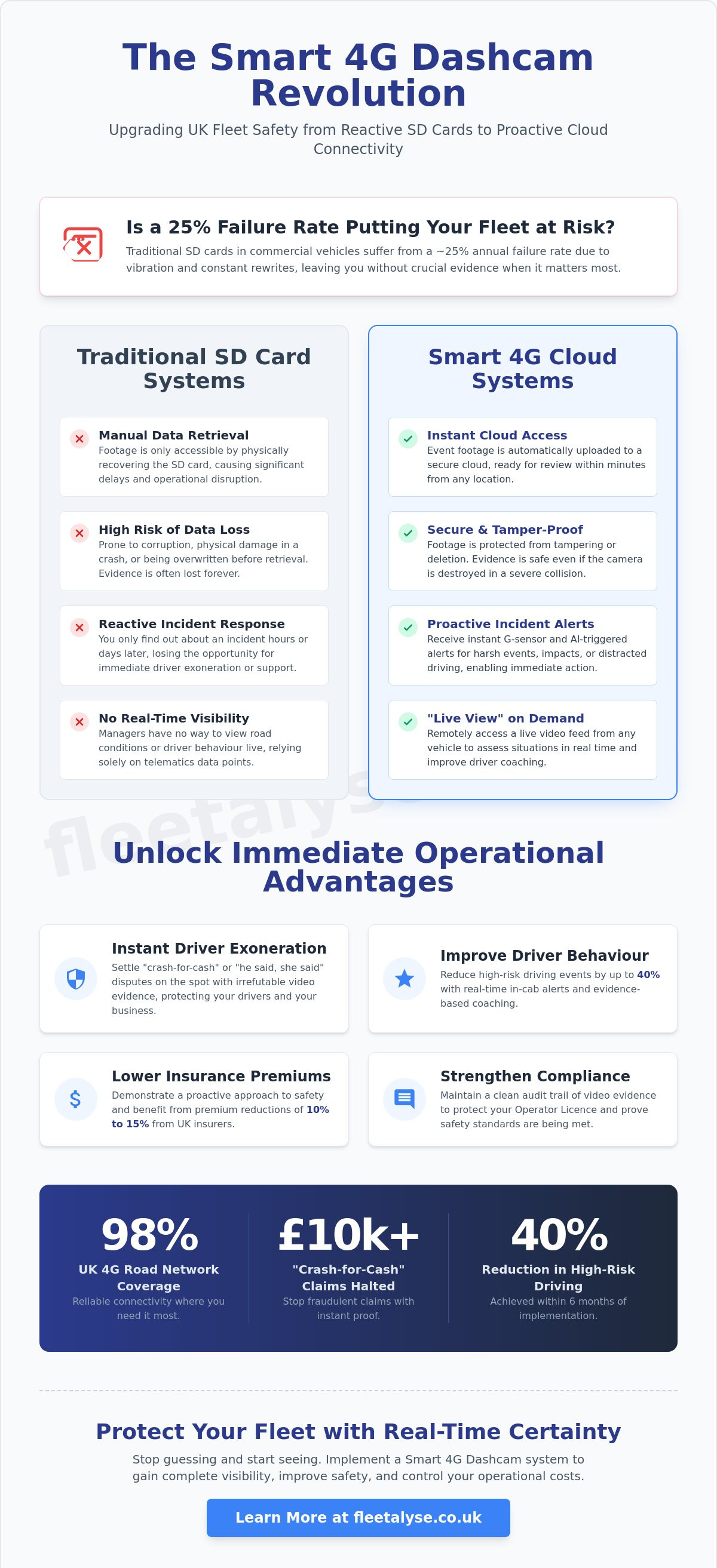
Traditional SD cards are the weakest link in fleet hardware. In commercial environments, high vibration levels and constant rewrite cycles lead to card corruption in roughly 25% of devices annually. If an accident occurs and the card has failed, your evidence is gone. 4G connectivity eliminates this vulnerability. By instantly uploading event-triggered clips, the system ensures footage is safe even if the camera is damaged in a collision. While 5G is growing, 4G remains the backbone of UK transport in 2026. It provides 98% geographic coverage across the UK road network, offering the reliability needed for long-haul routes where 5G signals remain patchy.
Key Benefits for Commercial Operators
The transition to a Smart 4G Dashcam provides immediate operational advantages that go beyond simple recording. You gain a level of control that manual systems can't match. When your drivers are on the road, you need to know they're protected and that your business is shielded from liability.
- Immediate Notifications: Receive instant alerts for G-sensor events like harsh braking, sharp cornering, or impacts. You don't have to guess what happened; you see it as it occurs.
- Driver Exoneration: Clear your drivers on the spot. By accessing live video evidence, you can prove innocence to police or third parties within minutes of an incident.
- Insurance Savings: UK insurers now frequently offer premium reductions of 10% to 15% for fleets that implement connected camera systems with proven safety records.
- Tamper-Proof Data: Direct cloud uploads mean footage can't be deleted or altered by drivers, ensuring a clean audit trail for compliance.
This technology isn't a luxury. It's a necessity for any fleet built for real transport operations. It moves your business from reactive guesswork to data-led decision-making.
Real-Time Visibility: How 4G Connectivity Improves Driver Behaviour
Visibility isn't just about seeing where a vehicle is on a map. It's about understanding how it's being driven in the moment. A Smart 4G Dashcam turns a passive recording device into an active management tool. By providing a constant data link, these devices bridge the gap between the office and the road. This connection creates a culture of accountability. When drivers know their cab is "connected," professionalism naturally increases. It’s a psychological shift that rewards good habits and discourages high-risk manoeuvres.
AI-powered sensors in 2026 models now identify distracted driving or signs of fatigue with high precision. If a driver looks at a mobile phone or begins to yawn repeatedly, the system triggers an in-cab alert. This immediate feedback loop is vital. Recent industry data shows that real-time alerts can reduce high-risk driving incidents by up to 40% within the first six months of implementation. These insights allow managers to move away from guesswork and focus on evidence-based coaching during performance reviews.
Live Streaming and Remote Playback
Remote Live View is a tool for instant operational oversight. Managers can access a live feed from any vehicle via a central dashboard without interrupting the driver. This process is seamless; you simply select the vehicle on your screen to see the road ahead or the internal cab view. It’s particularly useful for confirming delivery conditions or checking driver safety in hazardous weather.
- Instant Access: No need to wait for the vehicle to return to the depot.
- Efficiency: Remote playback allows you to retrieve specific clips over the air.
- Time Saving: This eliminates the hours spent on manual SD card collection and physical data sorting.
Whilst using these tools, operators must remain compliant with privacy laws. Following the UK GDPR guidance for dashcams ensures that your monitoring remains legal and ethical. Transparency with your team about when and why you access live feeds is the foundation of a professional fleet culture.
Automated Incident Uploads
In the event of a collision or a near-miss, every second of footage is critical. Modern Smart 4G Dashcam units use "Guardian Mode" to automatically save and upload footage to the cloud the moment a G-force threshold is exceeded. This happens instantly, ensuring the evidence is safe even if the camera is damaged in the crash.
The most effective systems include "pre-event" recording. This feature captures the 10 to 15 seconds leading up to an incident, providing the full context of why a crash occurred. Whether it was a third-party pulling out unexpectedly or a driver distraction, the cloud-stored video provides the "truth" for insurance providers. If you're ready to protect your drivers and your bottom line, it might be time to view our professional hardware options.
Managing Data, SIM Cards, and Privacy in Commercial Transport
The primary barrier to adopting a Smart 4G Dashcam is often the perceived complexity of data management. UK fleet managers frequently worry about spiralling costs and connectivity gaps. These concerns are valid if you use standard consumer SIM cards. High-street SIMs are designed for single-network use and often throttle data during peak times. Professional transport operations require multi-network SIMs. These cards roam between providers like EE, O2, and Vodafone to find the strongest signal. This ensures your vehicles stay connected in 99% of the UK, even in remote rural corridors where single-network coverage drops out.
Data Plans and Total Transparency
Data usage isn't as high as most operators fear. For typical operations, a Smart 4G Dashcam consumes between 200MB and 500MB per month for GPS tracking and low-resolution thumbnail previews. If you require frequent HD video downloads or live streaming, this might increase to 2GB. Choosing a telematics partner that offers bundled hardware and data is the most efficient way to control costs. This model removes the upfront burden and replaces it with a predictable monthly rate. You can learn more about the perks of 4G dashcams and how they integrate with modern data plans at Fleetalyse. Clear Pricing is essential. It prevents the "bill shock" that occurs when hidden roaming charges or overage fees appear on your statement.
GDPR Compliance for Fleet Managers
Compliance isn't optional. UK GDPR and the Data Protection Act 2018 set strict rules for video surveillance in commercial vehicles. To remain compliant, you must follow these protocols:
- Clear Signage: You must display visible stickers on the vehicle stating that CCTV is in operation.
- Driver Notification: Drivers must be informed in writing about the purpose of the cameras and how the data is handled.
- Data Retention: Standard footage shouldn't be kept longer than necessary. Most UK fleets use a 30-day retention cycle for non-incident data.
- Subject Access Requests (SARs): Individuals have a right to request footage of themselves. You must be able to redact or blur other people's faces and provide the clip within 30 days.
A transparent Driver Privacy Policy is the best way to maintain trust. It turns the camera from a "spy in the cab" into a tool for driver protection. When your team knows the footage is stored in secure, encrypted cloud servers and only accessed during incidents, the culture shifts from suspicion to safety. Professional systems ensure that data is only accessible to authorised personnel, protecting both the driver and the business from data breaches.
Buying Guide: Essential Features for HGV and Van Dashcams
A consumer dashcam won't survive a month in a commercial HGV. You need hardware built for 24-hour cycles and the high-vibration environment of a heavy vehicle. A professional Smart 4G Dashcam must feature multi-channel support. This means front, rear, and side-view cameras working in sync to provide a 360-degree shield around the asset. For HGVs, side cameras aren't just a luxury; they are a requirement for DVS and FORS compliance. These systems eliminate the blind spots that lead to 22% of serious cyclist incidents on UK roads.
Hardware Durability and Professional Fitting
Don't use cigarette lighter mounts. They are unreliable for professional use. Drivers can unplug them, or they vibrate loose on the M6, leading to lost data. Hardwiring is the only professional option. It ensures the camera starts recording the moment the ignition turns. Use tamper-proof covers on SD card slots and power cables. This stops footage being deleted or the device being disabled after a mishap. Professional fitting also include battery protection circuits. These monitor the vehicle's voltage and shut the camera down if it drops below 11.8V, ensuring the van always starts in the morning.
Integration with GPS Fleet Tracking
Context is everything when reviewing an incident. You should view video alongside GPS fleet tracking data. Seeing the speed, braking force, and exact location on a single map interface settles insurance claims faster. It turns raw footage into usable evidence. In the UK, 60% of fleet managers now use integrated telematics to combat "crash-for-cash" scams. This data-driven approach is essential for modern compliance. Side-view cameras also assist with the Direct Vision Standard (DVS) for vehicles over 12 tonnes entering Greater London. Without them, you risk £550 fines per entry.
Logistics doesn't stop at sunset. Night Vision and Wide Dynamic Range (WDR) are non-negotiable for UK winters. WDR prevents glare from oncoming headlights and ensures number plates are legible in low light or heavy rain. Parking Mode protects your assets when the driver is away. If a trailer is hit in a yard at 3 AM, the G-sensor triggers an instant 4G upload. You get the evidence before the driver even returns to the cab.
Ready to upgrade your fleet's security with professional hardware? Secure your hardware today.
Beyond Video: Integrating Dashcams with Fleet Compliance Strategy
A Smart 4G Dashcam shouldn't exist in a vacuum. For UK haulage firms, it's a critical component of a "Real Transport Operation" toolkit. It moves the needle from simple tracking to comprehensive risk management. When integrated correctly, video data works alongside remote tachograph download systems to provide a 360-degree view of driver behaviour and vehicle safety. This unified approach eliminates the friction of jumping between multiple apps or hardware platforms. Fragmented hardware is the enemy of efficiency. If your video sits in one portal and your driver hours sit in another, you're missing the context that prevents fines and protects your profit margins.
Supporting the Operator Licence Audit
During a DVSA enquiry or a full site audit, the burden of proof lies with the operator. High-definition video evidence provides a factual record of vehicle safety and driver conduct that paper logs simply can't match. It’s a vital tool for maintaining a "Green" OCRS (Operator Compliance Risk Score), which is essential for keeping your fleet on the road without constant roadside stops. By capturing near-misses or harsh braking events, you provide the evidence needed to satisfy the "Continuous and Effective" management requirements set by the Traffic Commissioner.
Dashcam data creates a bridge between theoretical safety policies and the actual reality of the road. Use video evidence to:
- Defend drivers against "crash for cash" scams or false insurance claims.
- Identify training gaps before they lead to serious accidents.
- Provide concrete proof of vehicle condition during walk-around check disputes.
- Validate driver actions during emergency manoeuvres.
The link between real-time Smart 4G Dashcam data and "Continuous and Effective" management is the ability to turn raw footage into a structured driver improvement programme that stands up to scrutiny.
The Fleetalyse Approach to Smart 4G Dashcams
We don't do fluff or marketing hyperbole. Our focus is on providing a "No-Nonsense" partnership backed by expert UK-based support. We understand that your time is better spent on logistics than troubleshooting software. Our platform helps you turn raw fleet data into actionable decisions that lower insurance premiums and improve fuel efficiency. We don't just sell hardware; we provide the visibility you need to run a tighter, more profitable operation. Stop managing silos of information and start seeing the full picture of your fleet's performance.
Future-Proof Your Fleet Operations Today
Modern haulage demands more than just basic video recording. Adopting a Smart 4G Dashcam ensures your fleet meets 2026 standards for real-time visibility and driver behaviour monitoring. It's a strategic move that turns raw video into actionable compliance data, protecting your drivers from false claims whilst improving overall road safety. By integrating these systems, you're not just buying a camera; you're investing in a comprehensive compliance strategy that scales with your business.
At Fleetalyse, we focus on what actually works for UK operators on British roads. Our systems are built for real transport operations, supported by UK-based compliance experts who value total transparency on pricing. You won't find hidden fees or complex jargon here. We provide reliable, professional hardware designed to protect your HGV and van assets from day one. It's time to simplify your fleet management and secure your operational future with a partner who understands the logistics industry inside out.
Optimise your fleet with professional 4G dashcams and tracking
Take the next step toward a safer, more efficient fleet today.
Frequently Asked Questions
How much data does a 4G dashcam use per month?
A standard smart 4G dashcam typically consumes between 2GB and 5GB of data each month for basic telematics and incident uploads. If your fleet requires frequent live streaming or remote video downloads, usage can increase to 20GB or more per vehicle. Most UK operators find that a 10GB monthly plan provides a safe buffer for high-definition evidence without risking overage charges.
Can I see a live feed of my drivers at any time?
You can access a live video feed instantly through your fleet management platform. This feature gives you real-time visibility into the cabin or the road ahead to verify driver safety and cargo security. It's a tool built for real transport operations, though most managers only use it for specific spot checks or during emergencies to keep data costs manageable and respect driver privacy.
Are 4G dashcams legal under UK GDPR rules?
Smart 4G dashcams are entirely legal in the UK if you follow Information Commissioner's Office (ICO) guidelines. You must complete a Data Protection Impact Assessment and display clear window stickers to inform the public and staff that recording is taking place. It's also vital to have a clear data retention policy, typically deleting non-essential footage after 30 days to remain compliant with privacy laws.
Do 4G dashcams work in areas with poor mobile signal?
The cameras continue to record high-quality footage to an internal SD card even when the mobile signal fails. Once the vehicle moves back into a 4G or 5G coverage area, the device automatically synchronises and uploads any flagged incidents to the cloud. You won't lose vital evidence in remote parts of the UK; the system simply waits for a stable connection to update your dashboard.
Will a smart dashcam drain my vehicle battery?
A professionally installed smart 4G dashcam won't drain your battery because it features built-in voltage protection. The device monitors the vehicle's power levels and automatically shuts down if the battery drops below a set limit, such as 11.6V for vans or 23.2V for HGVs. This ensures the engine always has enough power to start, even after the vehicle has been parked over a weekend.
Can dashcam footage be used as evidence in a UK court?
UK courts and insurance providers accept 4G dashcam footage as objective evidence in legal proceedings. High-resolution video can prove liability quickly, often reducing the time spent on insurance claims by 40% or more. For the footage to be admissible, it must be clear, timestamped, and include GPS data to verify the exact location and speed of the vehicle during the incident.
What is the difference between 4G and 5G dashcams in 2026?
By 2026, the primary difference is the speed of video retrieval and network latency. While 5G offers faster downloads for large files, a Smart 4G dashcam remains the industry standard for its reliable coverage across the entire UK road network. 4G provides more than enough bandwidth for real-time alerts and GPS tracking, making it the most cost-effective choice for the majority of commercial haulage fleets.
Do I need a separate SIM card for every camera in my fleet?
Every standalone camera usually requires its own SIM card to maintain a direct connection to the cloud. However, if you're using a multi-camera system with a central hub, you only need one SIM for the entire vehicle. Many UK providers now offer pooled data contracts. This means your total data allowance is shared across the whole fleet, so one high-usage vehicle won't result in unexpected individual bills.
Frequently asked questions
The Evolution from SD Cards to 4G LTE
Traditional SD cards are the weakest link in fleet hardware. In commercial environments, high vibration levels and constant rewrite cycles lead to card corruption in roughly 25% of devices annually. If an accident occurs and the card has failed, your evidence is gone. 4G connectivity eliminates this vulnerability. By instantly uploading event-triggered clips, the system ensures footage is safe even if the camera is damaged in a collision. While 5G is growing, 4G remains the backbone of UK transport in 2026. It provides 98% geographic coverage across the UK road network, offering the reliability needed for long-haul routes where 5G signals remain patchy.
Key Benefits for Commercial Operators
The transition to a Smart 4G Dashcam provides immediate operational advantages that go beyond simple recording. You gain a level of control that manual systems can't match. When your drivers are on the road, you need to know they're protected and that your business is shielded from liability. This technology isn't a luxury. It's a necessity for any fleet built for real transport operations. It moves your business from reactive guesswork to data-led decision-making. Visibility isn't just about seeing where a vehicle is on a map. It's about understanding how it's being driven in the moment. A Smart 4G Dashcam turns a passive recording device into an active management tool. By providing a constant data link, these devices bridge the gap between the office and the road. This connection creates a culture of accountability. When drivers know their cab is "connected," professionalism naturally increases. It’s a psychological shift that rewards good habits and discourages high-risk manoeuvres. AI-powered sensors in 2026 models now identify distracted driving or signs of fatigue with high precision. If a driver looks at a mobile phone or begins to yawn repeatedly, the system triggers an in-cab alert. This immediate feedback loop is vital. Recent industry data shows that real-time alerts can reduce high-risk driving incidents by up to 40% within the first six months of implementation. These insights allow managers to move away from guesswork and focus on evidence-based coaching during performance reviews.
Live Streaming and Remote Playback
Remote Live View is a tool for instant operational oversight. Managers can access a live feed from any vehicle via a central dashboard without interrupting the driver. This process is seamless; you simply select the vehicle on your screen to see the road ahead or the internal cab view. It’s particularly useful for confirming delivery conditions or checking driver safety in hazardous weather. Whilst using these tools, operators must remain compliant with privacy laws. Following the UK GDPR guidance for dashcams ensures that your monitoring remains legal and ethical. Transparency with your team about when and why you access live feeds is the foundation of a professional fleet culture.
Automated Incident Uploads
In the event of a collision or a near-miss, every second of footage is critical. Modern Smart 4G Dashcam units use "Guardian Mode" to automatically save and upload footage to the cloud the moment a G-force threshold is exceeded. This happens instantly, ensuring the evidence is safe even if the camera is damaged in the crash. The most effective systems include "pre-event" recording. This feature captures the 10 to 15 seconds leading up to an incident, providing the full context of why a crash occurred. Whether it was a third-party pulling out unexpectedly or a driver distraction, the cloud-stored video provides the "truth" for insurance providers. If you're ready to protect your drivers and your bottom line, it might be time to view our professional hardware options. The primary barrier to adopting a Smart 4G Dashcam is often the perceived complexity of data management. UK fleet managers frequently worry about spiralling costs and connectivity gaps. These concerns are valid if you use standard consumer SIM cards. High-street SIMs are designed for single-network use and often throttle data during peak times. Professional transport operations require multi-network SIMs. These cards roam between providers like EE, O2, and Vodafone to find the strongest signal. This ensures your vehicles stay connected in 99% of the UK, even in remote rural corridors where single-network coverage drops out.
Data Plans and Total Transparency
Data usage isn't as high as most operators fear. For typical operations, a Smart 4G Dashcam consumes between 200MB and 500MB per month for GPS tracking and low-resolution thumbnail previews. If you require frequent HD video downloads or live streaming, this might increase to 2GB. Choosing a telematics partner that offers bundled hardware and data is the most efficient way to control costs. This model removes the upfront burden and replaces it with a predictable monthly rate. You can learn more about the perks of 4G dashcams and how they integrate with modern data plans at Fleetalyse. Clear Pricing is essential. It prevents the "bill shock" that occurs when hidden roaming charges or overage fees appear on your statement.
GDPR Compliance for Fleet Managers
Compliance isn't optional. UK GDPR and the Data Protection Act 2018 set strict rules for video surveillance in commercial vehicles. To remain compliant, you must follow these protocols: A transparent Driver Privacy Policy is the best way to maintain trust. It turns the camera from a "spy in the cab" into a tool for driver protection. When your team knows the footage is stored in secure, encrypted cloud servers and only accessed during incidents, the culture shifts from suspicion to safety. Professional systems ensure that data is only accessible to authorised personnel, protecting both the driver and the business from data breaches. A consumer dashcam won't survive a month in a commercial HGV. You need hardware built for 24-hour cycles and the high-vibration environment of a heavy vehicle. A professional Smart 4G Dashcam must feature multi-channel support. This means front, rear, and side-view cameras working in sync to provide a 360-degree shield around the asset. For HGVs, side cameras aren't just a luxury; they are a requirement for DVS and FORS compliance. These systems eliminate the blind spots that lead to 22% of serious cyclist incidents on UK roads.
Hardware Durability and Professional Fitting
Don't use cigarette lighter mounts. They are unreliable for professional use. Drivers can unplug them, or they vibrate loose on the M6, leading to lost data. Hardwiring is the only professional option. It ensures the camera starts recording the moment the ignition turns. Use tamper-proof covers on SD card slots and power cables. This stops footage being deleted or the device being disabled after a mishap. Professional fitting also include battery protection circuits. These monitor the vehicle's voltage and shut the camera down if it drops below 11.8V, ensuring the van always starts in the morning.
Integration with GPS Fleet Tracking
Context is everything when reviewing an incident. You should view video alongside GPS fleet tracking data. Seeing the speed, braking force, and exact location on a single map interface settles insurance claims faster. It turns raw footage into usable evidence. In the UK, 60% of fleet managers now use integrated telematics to combat "crash-for-cash" scams. This data-driven approach is essential for modern compliance. Side-view cameras also assist with the Direct Vision Standard (DVS) for vehicles over 12 tonnes entering Greater London. Without them, you risk £550 fines per entry. Logistics doesn't stop at sunset. Night Vision and Wide Dynamic Range (WDR) are non-negotiable for UK winters. WDR prevents glare from oncoming headlights and ensures number plates are legible in low light or heavy rain. Parking Mode protects your assets when the driver is away. If a trailer is hit in a yard at 3 AM, the G-sensor triggers an instant 4G upload. You get the evidence before the driver even returns to the cab. Ready to upgrade your fleet's security with professional hardware? Secure your hardware today.
Supporting the Operator Licence Audit
During a DVSA enquiry or a full site audit, the burden of proof lies with the operator. High-definition video evidence provides a factual record of vehicle safety and driver conduct that paper logs simply can't match. It’s a vital tool for maintaining a "Green" OCRS (Operator Compliance Risk Score), which is essential for keeping your fleet on the road without constant roadside stops. By capturing near-misses or harsh braking events, you provide the evidence needed to satisfy the "Continuous and Effective" management requirements set by the Traffic Commissioner. Dashcam data creates a bridge between theoretical safety policies and the actual reality of the road. Use video evidence to: The link between real-time Smart 4G Dashcam data and "Continuous and Effective" management is the ability to turn raw footage into a structured driver improvement programme that stands up to scrutiny.
The Fleetalyse Approach to Smart 4G Dashcams
We don't do fluff or marketing hyperbole. Our focus is on providing a "No-Nonsense" partnership backed by expert UK-based support. We understand that your time is better spent on logistics than troubleshooting software. Our platform helps you turn raw fleet data into actionable decisions that lower insurance premiums and improve fuel efficiency. We don't just sell hardware; we provide the visibility you need to run a tighter, more profitable operation. Stop managing silos of information and start seeing the full picture of your fleet's performance. Ready to take control? Get a transparent quote for your fleet today. Modern haulage demands more than just basic video recording. Adopting a Smart 4G Dashcam ensures your fleet meets 2026 standards for real-time visibility and driver behaviour monitoring. It's a strategic move that turns raw video into actionable compliance data, protecting your drivers from false claims whilst improving overall road safety. By integrating these systems, you're not just buying a camera; you're investing in a comprehensive compliance strategy that scales with your business. At Fleetalyse, we focus on what actually works for UK operators on British roads. Our systems are built for real transport operations, supported by UK-based compliance experts who value total transparency on pricing. You won't find hidden fees or complex jargon here. We provide reliable, professional hardware designed to protect your HGV and van assets from day one. It's time to simplify your fleet management and secure your operational future with a partner who understands the logistics industry inside out. Optimise your fleet with professional 4G dashcams and tracking Take the next step toward a safer, more efficient fleet today.
How much data does a 4G dashcam use per month?
A standard smart 4G dashcam typically consumes between 2GB and 5GB of data each month for basic telematics and incident uploads. If your fleet requires frequent live streaming or remote video downloads, usage can increase to 20GB or more per vehicle. Most UK operators find that a 10GB monthly plan provides a safe buffer for high-definition evidence without risking overage charges.
Can I see a live feed of my drivers at any time?
You can access a live video feed instantly through your fleet management platform. This feature gives you real-time visibility into the cabin or the road ahead to verify driver safety and cargo security. It's a tool built for real transport operations, though most managers only use it for specific spot checks or during emergencies to keep data costs manageable and respect driver privacy.
Are 4G dashcams legal under UK GDPR rules?
Smart 4G dashcams are entirely legal in the UK if you follow Information Commissioner's Office (ICO) guidelines. You must complete a Data Protection Impact Assessment and display clear window stickers to inform the public and staff that recording is taking place. It's also vital to have a clear data retention policy, typically deleting non-essential footage after 30 days to remain compliant with privacy laws.
Do 4G dashcams work in areas with poor mobile signal?
The cameras continue to record high-quality footage to an internal SD card even when the mobile signal fails. Once the vehicle moves back into a 4G or 5G coverage area, the device automatically synchronises and uploads any flagged incidents to the cloud. You won't lose vital evidence in remote parts of the UK; the system simply waits for a stable connection to update your dashboard.
Will a smart dashcam drain my vehicle battery?
A professionally installed smart 4G dashcam won't drain your battery because it features built-in voltage protection. The device monitors the vehicle's power levels and automatically shuts down if the battery drops below a set limit, such as 11.6V for vans or 23.2V for HGVs. This ensures the engine always has enough power to start, even after the vehicle has been parked over a weekend.
Can dashcam footage be used as evidence in a UK court?
UK courts and insurance providers accept 4G dashcam footage as objective evidence in legal proceedings. High-resolution video can prove liability quickly, often reducing the time spent on insurance claims by 40% or more. For the footage to be admissible, it must be clear, timestamped, and include GPS data to verify the exact location and speed of the vehicle during the incident.
What is the difference between 4G and 5G dashcams in 2026?
By 2026, the primary difference is the speed of video retrieval and network latency. While 5G offers faster downloads for large files, a Smart 4G dashcam remains the industry standard for its reliable coverage across the entire UK road network. 4G provides more than enough bandwidth for real-time alerts and GPS tracking, making it the most cost-effective choice for the majority of commercial haulage fleets.
Do I need a separate SIM card for every camera in my fleet?
Every standalone camera usually requires its own SIM card to maintain a direct connection to the cloud. However, if you're using a multi-camera system with a central hub, you only need one SIM for the entire vehicle. Many UK providers now offer pooled data contracts. This means your total data allowance is shared across the whole fleet, so one high-usage vehicle won't result in unexpected individual bills.