

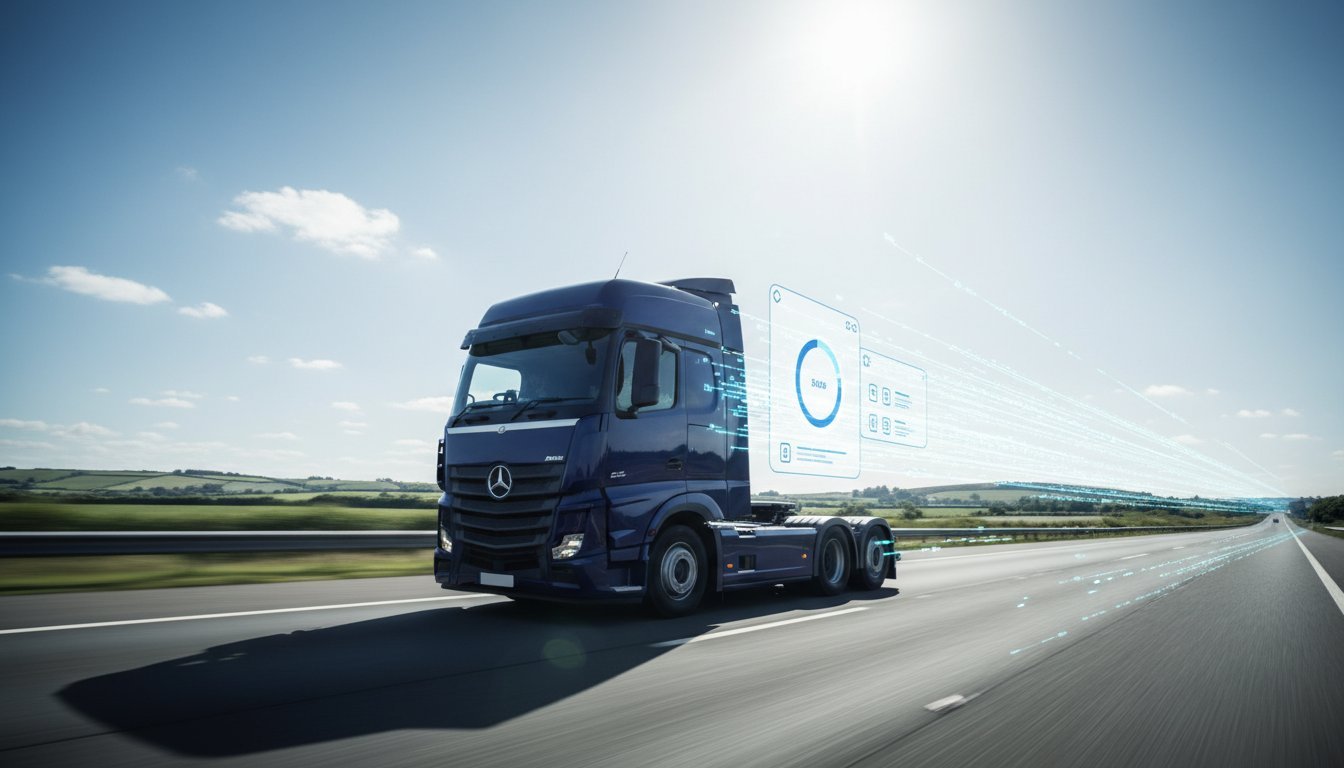
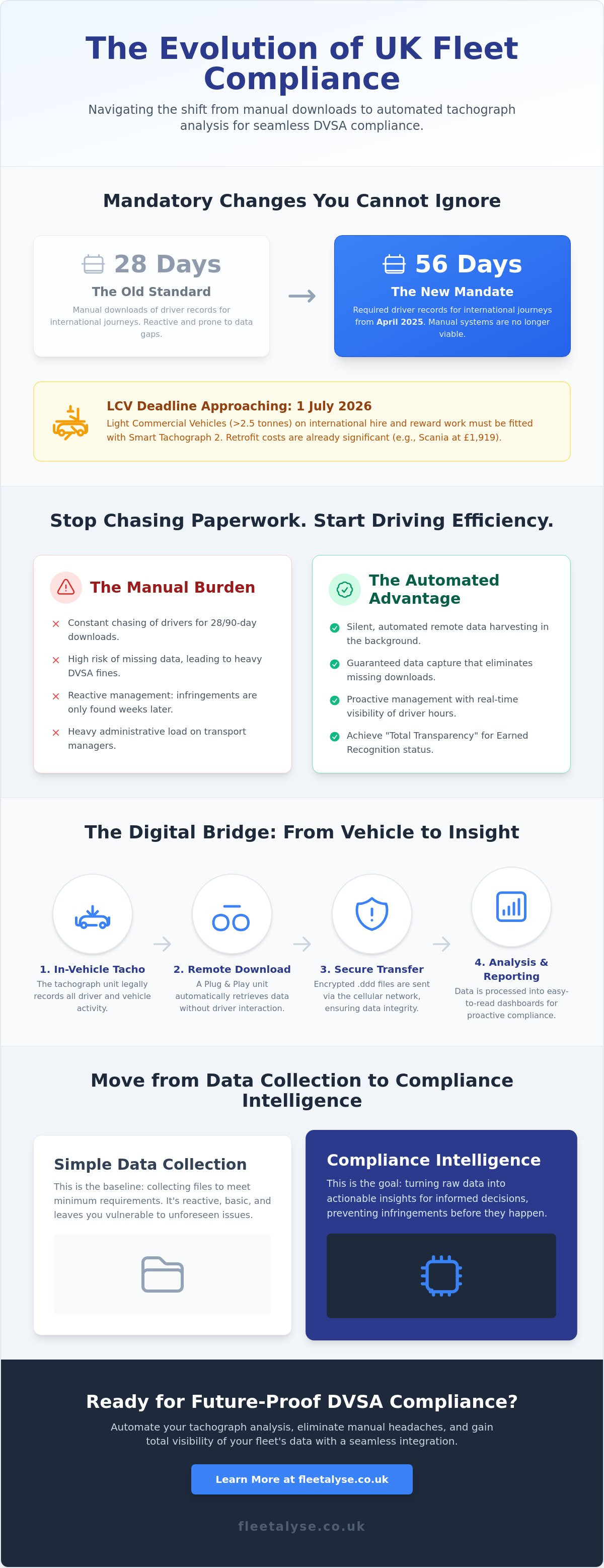
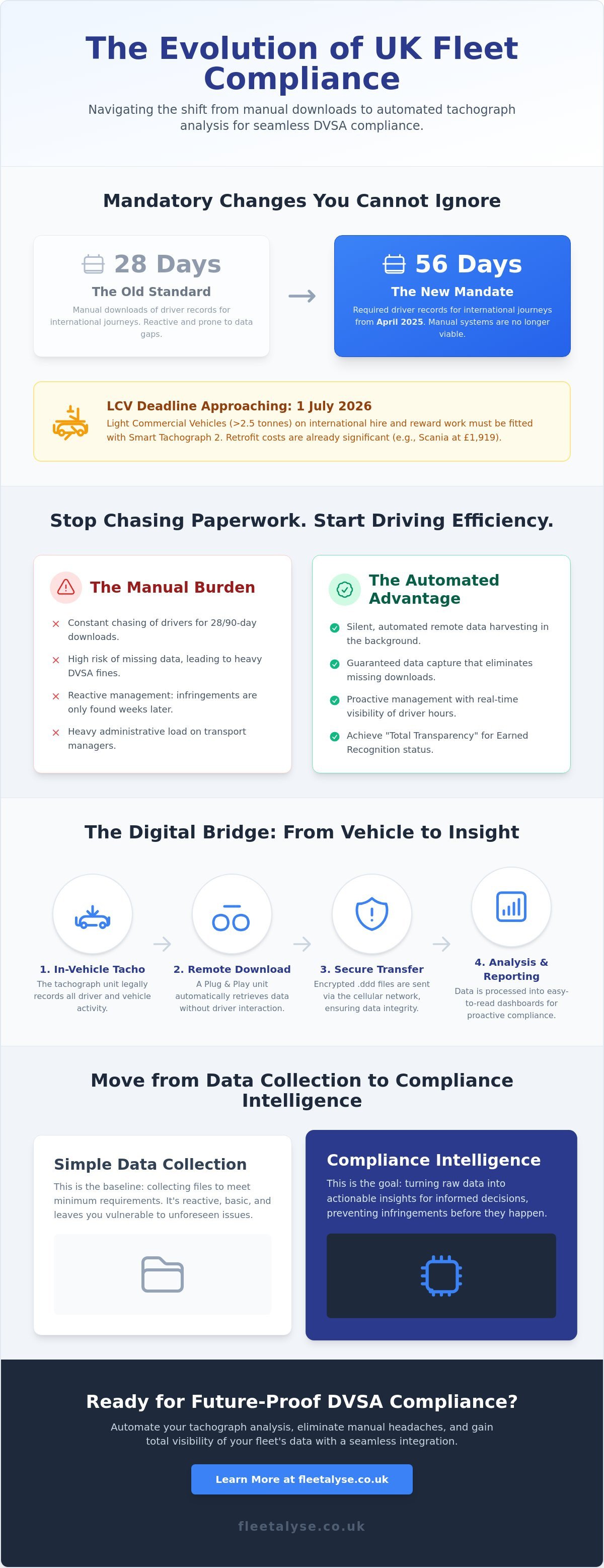
What if your next DVSA inspection required double the records you're currently prepared to provide? Since April 2025, operators on international journeys must produce 56 days of driver records, which is a sharp increase from the old 28-day rule. If you're still relying on manual downloads, you're likely already falling behind. Adopting a professional tachograph analysis software integration UK system is no longer optional for those who want to stay compliant. This is especially critical as light commercial vehicles over 2.5 tonnes must be fitted with Smart Tachograph 2 technology by 1 July 2026 for international hire and reward work, with retrofit costs like Scania's £1919.00 package already setting the market standard.
You're likely tired of the administrative burden that comes with missing 90-day vehicle download windows and the constant fear of missing data. We agree that fleet management should be about moving goods, not chasing paper. This guide explains how seamless tachograph analysis integration automates your DVSA compliance and eliminates manual data headaches entirely. We'll walk you through the 2026 hardware mandates, compare the real costs of analysis software, and show you how to gain real-time visibility of driver hours without the typical software contract traps.
Key Takeaways
- Streamline your DVSA compliance by shifting from manual card reading to automated, remote data harvesting that works silently in the background.
- Understand how tachograph analysis software integration UK bridges the gap between vehicle telematics and professional compliance reporting for total operational visibility.
- Learn the practical steps for setting up remote downloads to eliminate missing download windows and avoid the risk of heavy fines.
- Distinguish between simple "data collection" and the "compliance intelligence" needed to make informed decisions during real-world transport operations.
- Find out how to achieve live visibility of driver hours through transparent, UK-focused pricing models that avoid hidden software fees and complex contracts.
The Evolution of UK Tachograph Analysis and Software Integration
The landscape of UK haulage has shifted. For decades, transport managers spent hours every month physically chasing driver cards and vehicle units to meet 28-day and 90-day download deadlines. This manual approach was reactive and left operators vulnerable to missing data gaps. Today, the industry has moved toward automated remote data harvesting. This transition is driven by a fundamental understanding of what a tachograph is and its role as a legal safeguard rather than just a recording device. The DVSA now expects hauliers to maintain a higher standard of digital record-keeping, moving away from periodic checks toward real-time compliance monitoring.
Implementing a robust tachograph analysis software integration UK solution is the most efficient way to meet these rising expectations. Integration provides "Total Transparency" in data flow, which is a prerequisite for any fleet aiming for Earned Recognition status. By automating the transfer of data from the vehicle directly to the analysis platform, you eliminate the risk of human error. This constant stream of information ensures that operator licence infringements are caught and rectified immediately, protecting your business from the severe penalties associated with non-compliance.
From Manual Downloads to Real-Time Visibility
Chasing drivers for card downloads every 28 days is a logistical nightmare that often leads to missing windows. Integrated systems change this dynamic by providing a live view of driver hours and rest periods. Instead of waiting for a manual download to see if a driver exceeded their limit two weeks ago, you can see their current status on a dashboard. This shift from reactive to proactive management allows you to plan routes more effectively. You'll know exactly how much driving time is left before a break is required, preventing infringements before they happen. It's about turning raw data into operational intelligence that keeps your fleet moving safely.
Why Integration is Mandatory for Modern UK Fleet Operators
The administrative burden on transport managers has never been higher, especially with the April 2025 requirement to produce 56 days of driver records for international journeys. Manual systems simply can't keep up with this volume of data whilst maintaining 100% accuracy. Integration is now a necessity for maintaining a healthy O-Licence. It ensures that every second of driving time is accounted for and analysed against current regulations. As we approach the July 2026 deadline for light commercial vehicles (LCVs) used in international hire and reward to fit Smart Tachograph 2 units, having a system that can handle these new data sets is vital. Modern integration ensures your digital record-keeping is future-proof, accurate, and ready for any DVSA audit.
How Tachograph Analysis Software Integration Works
Effective tachograph analysis software integration UK acts as the digital bridge between the physical tachograph head in your vehicle and the compliance reporting engine in your office. It is the infrastructure that allows data to flow without human intervention. Most modern setups use a Plug & Play connection. A small telematics device or Remote Download Unit (RDU) connects directly to the rear of the tachograph unit. It communicates using standard protocols, ensuring that the hardware doesn't interfere with the vehicle's primary functions whilst maintaining a constant link to the cloud.
Data security is a non-negotiable part of this process. Sensitive driver records are protected using advanced encryption during transmission. Secure transfer protocols ensure that the .ddd files remain tamper-proof from the moment they leave the vehicle until they reach the analysis server. This level of protection is vital for maintaining the integrity of your legal records. You also need to understand the difference between real-time syncing and scheduled downloads. Live driver hours provide an immediate snapshot for daily planning, whilst scheduled remote downloads handle the heavy lifting of legal file archiving to meet DVSA requirements.
The Data Flow: From Vehicle to Analysis Platform
The process begins when the RDU "wakes up" the tachograph remotely for data retrieval. This happens without the driver needing to press a single button. The unit pulls the encrypted .ddd file and sends it via the cellular network to a secure cloud server. This journey is monitored by automated verification systems. These systems check that no data packets are lost or corrupted during the transfer. If a connection drops in a poor signal area, the RDU simply retries once the signal returns, ensuring your 28-day and 90-day windows are always met. This silent automation is what eliminates the administrative burden of manual card reading.
API Connectivity and Third-Party Compatibility
Modern haulage businesses often use multiple software tools to manage their operations. API integration is the standardized method of allowing your fleet management software to "talk" to your compliance platform, ensuring that driver hours and vehicle data are synced automatically without manual exports. This "Open Integration" approach is essential for future-proofing your business. It allows you to choose the best tools for tracking and analysis without being locked into a single, restrictive provider. If you are ready to move away from manual headaches, you can explore our integrated hardware options to start automating your data flow today.
By focusing on the technical bridge between hardware and software, you gain a level of "compliance intelligence" that generic tracking tools cannot provide. It's about more than just seeing a vehicle on a map. It's about knowing that every second of that vehicle's operation is being legally recorded, transferred, and analysed with total accuracy.
Remote Tachograph Download: The Engine of Integration
Remote downloading is the practical heartbeat of any tachograph analysis software integration UK strategy. It transforms a manual, error-prone chore into a background process that runs whilst your fleet is on the road. Implementing this engine across a national fleet follows a clear, logical path. Without this automation, transport managers are forced to spend hours every week physically connecting to vehicles, a process that is both costly and inefficient.
Setting up an integrated system involves five specific steps. First, you must install a compatible remote download unit (RDU) into the tachograph head. Second, you authenticate your company card via a secure card reader at your office. This acts as the digital "key" that allows the RDU to access data remotely. Third, you schedule your automated download windows. We recommend daily downloads for driver cards and weekly for vehicle units. Fourth, you configure the software to automatically push these files to your chosen analysis provider. Finally, you monitor your central dashboard for "Missing Data" alerts. This ensures you catch hardware issues or signal gaps before a legal deadline passes.
Automating the 28-Day and 90-Day Legal Requirements
Chasing vehicles back to the depot for manual downloads is a drain on resources. Integration ensures you never miss a 28-day driver card or 90-day vehicle unit deadline again. Since the April 2025 update requires operators on international journeys to produce 56 days of records, daily downloads have become essential for maintaining an accurate audit trail. This is particularly vital for managing unattended assets and trailers amongst a national fleet. Even if an asset is parked at a remote site for weeks, the RDU continues to harvest data, keeping your records complete without a single mile of unnecessary travel.
Eliminating Manual Error and Infringements
The cost of human error in manual data entry is a significant risk to your operator licence. A single lost file or a mistyped date can lead to an "unsatisfactory" DVSA rating during an inspection. Automated systems remove this variable by flagging driver hours violations in real-time. This proactive approach keeps your fleet "Audit-Ready" at all times. Instead of fearing a surprise check, you can present a clean, digital trail of compliance. It's about moving away from reactive damage control and toward a model of constant, verified accuracy. Built for real transport operations, these systems ensure that your compliance data is as reliable as your tracking data.
Evaluating Integration Options: Beyond Basic Tracking
Generic GPS tracking is often insufficient for the rigours of real transport operations. Whilst a basic tracker might show you where a vehicle is on a map, it cannot tell you if the driver behind the wheel is legally compliant. This is the fundamental difference between simple "data collection" and true "compliance intelligence." Professional tachograph analysis software integration UK systems bridge this gap by interpreting raw telematics data through the lens of DVSA regulations. You need a platform that understands the nuances of haulage, not just a tool that pins a location on a screen.
Choosing the right integration model requires a look at your long-term operational goals. Some operators prefer standalone software, whilst others seek a fully integrated telematics platform. The decision usually comes down to how much time you want to spend moving data between different screens. Total transparency in pricing is also a vital indicator of a reliable partner. In an industry where hidden "integration fees" are common, finding a provider that offers a straightforward, all-in-one cost structure is essential for protecting your margins.
Standalone Software vs. Integrated Compliance Platforms
Using separate vendors for tracking and tachograph analysis often leads to data silos. Your transport manager has to log into one system for location data and another for driver hours. This is inefficient. An integrated "Single Pane of Glass" approach brings all fleet data into one dashboard. This simplifies reporting for multi-vehicle fleets significantly. When your tracking and analysis tools talk to each other, you can cross-reference GPS locations with tachograph activity. This makes it easy to spot discrepancies, such as "unaccounted driving" or vehicle movements without a card inserted, which are common red flags during audits.
Hidden Costs: Hardware Leases vs. Upfront Purchases
The financial side of compliance is more than just a monthly software fee. You must consider the hardware logistics. For example, a Smart Tachograph 2 retrofit can cost £1919.00 per vehicle according to Scania's 2026 pricing. Beyond the initial purchase, you have to account for maintenance and the eventual move to 5G networks. Some providers, like Tachomaster, charge £1 per driver per week, whilst Smartanalysis offers pre-pay subscriptions ranging from £50 to £52 per year. However, these figures rarely include the remote download hardware. A "fee-free lease" model for hardware is often more sustainable for long-term ROI as it removes the heavy capital expenditure and ensures you always have up-to-date, 4G-compatible units. To avoid the headache of hidden costs, you can view our transparent pricing and hardware options to see exactly what your fleet requires.
Ultimately, the best integration partner is one that values your time and money. Look for "Total Transparency" in their contract terms and a "Plug & Play" approach to hardware. If a system requires expensive, bespoke installation or locks you into a five-year contract with no upgrade path, it isn't built for the fast-paced reality of British roads.
Streamlining Your Fleet with Fleetalyse Integration
Fleetalyse is built for real transport operations. We aren't a distant, global software provider; we are a localised UK specialist. Our tachograph analysis software integration UK is designed specifically for the challenges of British roads and the rigours of domestic and international haulage. We don't just provide tracking. We provide a bridge between your vehicles and the compliance engines that protect your operator licence. Our voice is one of quiet confidence, grounded in the practical reality of logistics rather than marketing hyperbole.
Our platform offers seamless integration with leading tachograph analysis software providers. This means you don't have to change the tools you already use and trust. We simply automate the data flow. By utilising live driver hours tracking, you can optimise your dispatch process instantly. You'll know exactly which driver is available for an extra drop and who is approaching their legal limit. This proactive approach prevents violations and keeps your fleet moving efficiently without the need for constant manual checks.
No-Nonsense Compliance for UK Operators
Navigating UK transport regulations shouldn't be a full-time job for your transport manager. The industry is currently facing significant shifts, such as the 1 July 2026 deadline for light commercial vehicles (2.5 to 3.5 tonnes) to fit Smart Tachograph 2 units for international work. We understand these pressures. Our platform simplifies the complex world of compliance by automating the harvest of .ddd files. You get the benefit of a UK-based expert partner that values your time and money. You can visit Fleetalyse to see our transparent pricing model and learn how we support UK commercial fleets.
Ready to Take Control of Your Data?
The operational gains from automated tacho integration are clear. You eliminate the 28-day and 90-day download headaches whilst gaining real-time visibility of your entire operation. Migrating your fleet to an integrated system is a logical step toward future-proofing your business. We make the transition easy with our "Plug & Play" hardware and fee-free lease models. This approach puts the operator first by removing the need for heavy upfront capital expenditure. It’s about total transparency and clear pricing. If you are ready to take control of your data, you can get started with Fleetalyse today. We help you turn raw fleet data into informed, profitable decisions.
Future-Proof Your Fleet Compliance Today
The shift toward automated compliance is no longer a luxury for UK hauliers. With the 1 July 2026 deadline for LCV smart tachographs fast approaching and the existing 56-day record requirement, manual data harvesting is a liability you can't afford. Professional tachograph analysis software integration UK provides the "Single Pane of Glass" visibility needed to turn raw telematics into actionable compliance intelligence. It's about moving your business beyond basic tracking and into a model of constant, verified accuracy. This proactive approach protects your operator licence whilst streamlining your daily workflow.
Fleetalyse is Built for Real Transport Operations. We provide a localised, no-nonsense partnership that values your time and your budget. Clear Pricing. Total Transparency. By choosing our fee-free hardware lease model, you eliminate hidden costs and expensive upfront capital expenditure. You gain a reliable ally that understands the specific pressures of British roads and the logistics industry. We help you stay ahead of the regulations so you can focus on the road ahead.
Ready to automate your compliance? Start your Fleetalyse integration here. Taking control of your data today ensures your fleet remains audit-ready and profitable for years to come.
Frequently Asked Questions
Is tachograph analysis software integration legal in the UK?
Yes, it's fully legal and actively supported by the DVSA. Automated remote downloading helps you stay within the mandatory 28-day driver card and 90-day vehicle unit download windows. It provides a robust digital audit trail that is significantly more reliable than manual card reading or physical data collection at a depot.
How much does it cost to integrate tachograph analysis with my fleet tracking?
Software costs vary by provider. For example, Tachomaster charges £1 per driver per week, whilst Smartanalysis offers annual subscriptions between £50 and £52. You must also consider hardware; a Smart Tachograph 2 retrofit can cost £1919.00 per vehicle based on Scania's 2026 pricing. We recommend a fee-free lease model to avoid these high upfront costs.
Can I use Fleetalyse with my existing tachograph analysis provider?
Yes, Fleetalyse is designed to be a flexible partner. Our platform uses secure APIs to push data directly to leading analysis providers. This ensures your tachograph analysis software integration UK remains future-proof, allowing you to keep your preferred analysis engine whilst automating the hardware data flow.
What happens if the remote download fails whilst the vehicle is abroad?
The remote download unit will simply retry the transfer once it establishes a stable cellular connection. It stores the data locally until it can be sent securely to the cloud. Since the April 2025 regulation change requires 56 days of records for international journeys, this automated retry is critical for maintaining a complete legal record.
Do I need to upgrade my tachograph head to use integrated software?
You only need to upgrade if your current head is an analogue or early digital model that doesn't support remote downloading. However, if you operate LCVs between 2.5 and 3.5 tonnes for international hire and reward work, you must install a G2V2 smart tachograph by the 1 July 2026 deadline.
How often should I schedule remote downloads for my HGVs?
We recommend scheduling driver card downloads every 24 hours and vehicle units every 7 days. This frequency allows you to spot infringements as they happen. Waiting for the legal 28-day limit is a reactive approach that leaves your operator licence vulnerable to patterns of non-compliance that could have been corrected earlier.
Can I monitor driver hours in real-time with integrated software?
Yes, real-time visibility is a primary gain of tachograph analysis software integration UK. You can view a live dashboard showing remaining driving time and required rest periods for every driver in your fleet. This allows transport managers to make informed dispatch decisions without the risk of exceeding legal hours limits.
Is there a minimum fleet size required for tachograph integration?
No minimum fleet size is required to benefit from this technology. Whether you're an owner-operator with one vehicle or a national carrier with hundreds, the automation saves time and eliminates human error. Even for small fleets, the cost of a single DVSA fine far outweighs the investment in an integrated compliance system.
Frequently asked questions
From Manual Downloads to Real-Time Visibility
Chasing drivers for card downloads every 28 days is a logistical nightmare that often leads to missing windows. Integrated systems change this dynamic by providing a live view of driver hours and rest periods. Instead of waiting for a manual download to see if a driver exceeded their limit two weeks ago, you can see their current status on a dashboard. This shift from reactive to proactive management allows you to plan routes more effectively. You'll know exactly how much driving time is left before a break is required, preventing infringements before they happen. It's about turning raw data into operational intelligence that keeps your fleet moving safely.
Why Integration is Mandatory for Modern UK Fleet Operators
The administrative burden on transport managers has never been higher, especially with the April 2025 requirement to produce 56 days of driver records for international journeys. Manual systems simply can't keep up with this volume of data whilst maintaining 100% accuracy. Integration is now a necessity for maintaining a healthy O-Licence. It ensures that every second of driving time is accounted for and analysed against current regulations. As we approach the July 2026 deadline for light commercial vehicles (LCVs) used in international hire and reward to fit Smart Tachograph 2 units, having a system that can handle these new data sets is vital. Modern integration ensures your digital record-keeping is future-proof, accurate, and ready for any DVSA audit. Effective tachograph analysis software integration UK acts as the digital bridge between the physical tachograph head in your vehicle and the compliance reporting engine in your office. It is the infrastructure that allows data to flow without human intervention. Most modern setups use a Plug & Play connection. A small telematics device or Remote Download Unit (RDU) connects directly to the rear of the tachograph unit. It communicates using standard protocols, ensuring that the hardware doesn't interfere with the vehicle's primary functions whilst maintaining a constant link to the cloud. Data security is a non-negotiable part of this process. Sensitive driver records are protected using advanced encryption during transmission. Secure transfer protocols ensure that the .ddd files remain tamper-proof from the moment they leave the vehicle until they reach the analysis server. This level of protection is vital for maintaining the integrity of your legal records. You also need to understand the difference between real-time syncing and scheduled downloads. Live driver hours provide an immediate snapshot for daily planning, whilst scheduled remote downloads handle the heavy lifting of legal file archiving to meet DVSA requirements.
The Data Flow: From Vehicle to Analysis Platform
The process begins when the RDU "wakes up" the tachograph remotely for data retrieval. This happens without the driver needing to press a single button. The unit pulls the encrypted .ddd file and sends it via the cellular network to a secure cloud server. This journey is monitored by automated verification systems. These systems check that no data packets are lost or corrupted during the transfer. If a connection drops in a poor signal area, the RDU simply retries once the signal returns, ensuring your 28-day and 90-day windows are always met. This silent automation is what eliminates the administrative burden of manual card reading.
API Connectivity and Third-Party Compatibility
Modern haulage businesses often use multiple software tools to manage their operations. API integration is the standardized method of allowing your fleet management software to "talk" to your compliance platform, ensuring that driver hours and vehicle data are synced automatically without manual exports. This "Open Integration" approach is essential for future-proofing your business. It allows you to choose the best tools for tracking and analysis without being locked into a single, restrictive provider. If you are ready to move away from manual headaches, you can explore our integrated hardware options to start automating your data flow today. By focusing on the technical bridge between hardware and software, you gain a level of "compliance intelligence" that generic tracking tools cannot provide. It's about more than just seeing a vehicle on a map. It's about knowing that every second of that vehicle's operation is being legally recorded, transferred, and analysed with total accuracy. Remote downloading is the practical heartbeat of any tachograph analysis software integration UK strategy. It transforms a manual, error-prone chore into a background process that runs whilst your fleet is on the road. Implementing this engine across a national fleet follows a clear, logical path. Without this automation, transport managers are forced to spend hours every week physically connecting to vehicles, a process that is both costly and inefficient. Setting up an integrated system involves five specific steps. First, you must install a compatible remote download unit (RDU) into the tachograph head. Second, you authenticate your company card via a secure card reader at your office. This acts as the digital "key" that allows the RDU to access data remotely. Third, you schedule your automated download windows. We recommend daily downloads for driver cards and weekly for vehicle units. Fourth, you configure the software to automatically push these files to your chosen analysis provider. Finally, you monitor your central dashboard for "Missing Data" alerts. This ensures you catch hardware issues or signal gaps before a legal deadline passes.
Automating the 28-Day and 90-Day Legal Requirements
Chasing vehicles back to the depot for manual downloads is a drain on resources. Integration ensures you never miss a 28-day driver card or 90-day vehicle unit deadline again. Since the April 2025 update requires operators on international journeys to produce 56 days of records, daily downloads have become essential for maintaining an accurate audit trail. This is particularly vital for managing unattended assets and trailers amongst a national fleet. Even if an asset is parked at a remote site for weeks, the RDU continues to harvest data, keeping your records complete without a single mile of unnecessary travel.
Eliminating Manual Error and Infringements
The cost of human error in manual data entry is a significant risk to your operator licence. A single lost file or a mistyped date can lead to an "unsatisfactory" DVSA rating during an inspection. Automated systems remove this variable by flagging driver hours violations in real-time. This proactive approach keeps your fleet "Audit-Ready" at all times. Instead of fearing a surprise check, you can present a clean, digital trail of compliance. It's about moving away from reactive damage control and toward a model of constant, verified accuracy. Built for real transport operations, these systems ensure that your compliance data is as reliable as your tracking data. Generic GPS tracking is often insufficient for the rigours of real transport operations. Whilst a basic tracker might show you where a vehicle is on a map, it cannot tell you if the driver behind the wheel is legally compliant. This is the fundamental difference between simple "data collection" and true "compliance intelligence." Professional tachograph analysis software integration UK systems bridge this gap by interpreting raw telematics data through the lens of DVSA regulations. You need a platform that understands the nuances of haulage, not just a tool that pins a location on a screen. Choosing the right integration model requires a look at your long-term operational goals. Some operators prefer standalone software, whilst others seek a fully integrated telematics platform. The decision usually comes down to how much time you want to spend moving data between different screens. Total transparency in pricing is also a vital indicator of a reliable partner. In an industry where hidden "integration fees" are common, finding a provider that offers a straightforward, all-in-one cost structure is essential for protecting your margins.
Standalone Software vs. Integrated Compliance Platforms
Using separate vendors for tracking and tachograph analysis often leads to data silos. Your transport manager has to log into one system for location data and another for driver hours. This is inefficient. An integrated "Single Pane of Glass" approach brings all fleet data into one dashboard. This simplifies reporting for multi-vehicle fleets significantly. When your tracking and analysis tools talk to each other, you can cross-reference GPS locations with tachograph activity. This makes it easy to spot discrepancies, such as "unaccounted driving" or vehicle movements without a card inserted, which are common red flags during audits.
Hidden Costs: Hardware Leases vs. Upfront Purchases
The financial side of compliance is more than just a monthly software fee. You must consider the hardware logistics. For example, a Smart Tachograph 2 retrofit can cost £1919.00 per vehicle according to Scania's 2026 pricing. Beyond the initial purchase, you have to account for maintenance and the eventual move to 5G networks. Some providers, like Tachomaster, charge £1 per driver per week, whilst Smartanalysis offers pre-pay subscriptions ranging from £50 to £52 per year. However, these figures rarely include the remote download hardware. A "fee-free lease" model for hardware is often more sustainable for long-term ROI as it removes the heavy capital expenditure and ensures you always have up-to-date, 4G-compatible units. To avoid the headache of hidden costs, you can view our transparent pricing and hardware options to see exactly what your fleet requires. Ultimately, the best integration partner is one that values your time and money. Look for "Total Transparency" in their contract terms and a "Plug & Play" approach to hardware. If a system requires expensive, bespoke installation or locks you into a five-year contract with no upgrade path, it isn't built for the fast-paced reality of British roads. Fleetalyse is built for real transport operations. We aren't a distant, global software provider; we are a localised UK specialist. Our tachograph analysis software integration UK is designed specifically for the challenges of British roads and the rigours of domestic and international haulage. We don't just provide tracking. We provide a bridge between your vehicles and the compliance engines that protect your operator licence. Our voice is one of quiet confidence, grounded in the practical reality of logistics rather than marketing hyperbole. Our platform offers seamless integration with leading tachograph analysis software providers. This means you don't have to change the tools you already use and trust. We simply automate the data flow. By utilising live driver hours tracking, you can optimise your dispatch process instantly. You'll know exactly which driver is available for an extra drop and who is approaching their legal limit. This proactive approach prevents violations and keeps your fleet moving efficiently without the need for constant manual checks.
No-Nonsense Compliance for UK Operators
Navigating UK transport regulations shouldn't be a full-time job for your transport manager. The industry is currently facing significant shifts, such as the 1 July 2026 deadline for light commercial vehicles (2.5 to 3.5 tonnes) to fit Smart Tachograph 2 units for international work. We understand these pressures. Our platform simplifies the complex world of compliance by automating the harvest of .ddd files. You get the benefit of a UK-based expert partner that values your time and money. You can visit Fleetalyse to see our transparent pricing model and learn how we support UK commercial fleets.
Ready to Take Control of Your Data?
The operational gains from automated tacho integration are clear. You eliminate the 28-day and 90-day download headaches whilst gaining real-time visibility of your entire operation. Migrating your fleet to an integrated system is a logical step toward future-proofing your business. We make the transition easy with our "Plug & Play" hardware and fee-free lease models. This approach puts the operator first by removing the need for heavy upfront capital expenditure. It’s about total transparency and clear pricing. If you are ready to take control of your data, you can get started with Fleetalyse today. We help you turn raw fleet data into informed, profitable decisions. The shift toward automated compliance is no longer a luxury for UK hauliers. With the 1 July 2026 deadline for LCV smart tachographs fast approaching and the existing 56-day record requirement, manual data harvesting is a liability you can't afford. Professional tachograph analysis software integration UK provides the "Single Pane of Glass" visibility needed to turn raw telematics into actionable compliance intelligence. It's about moving your business beyond basic tracking and into a model of constant, verified accuracy. This proactive approach protects your operator licence whilst streamlining your daily workflow. Fleetalyse is Built for Real Transport Operations. We provide a localised, no-nonsense partnership that values your time and your budget. Clear Pricing. Total Transparency. By choosing our fee-free hardware lease model, you eliminate hidden costs and expensive upfront capital expenditure. You gain a reliable ally that understands the specific pressures of British roads and the logistics industry. We help you stay ahead of the regulations so you can focus on the road ahead. Ready to automate your compliance? Start your Fleetalyse integration here. Taking control of your data today ensures your fleet remains audit-ready and profitable for years to come.
Is tachograph analysis software integration legal in the UK?
Yes, it's fully legal and actively supported by the DVSA. Automated remote downloading helps you stay within the mandatory 28-day driver card and 90-day vehicle unit download windows. It provides a robust digital audit trail that is significantly more reliable than manual card reading or physical data collection at a depot.
How much does it cost to integrate tachograph analysis with my fleet tracking?
Software costs vary by provider. For example, Tachomaster charges £1 per driver per week, whilst Smartanalysis offers annual subscriptions between £50 and £52. You must also consider hardware; a Smart Tachograph 2 retrofit can cost £1919.00 per vehicle based on Scania's 2026 pricing. We recommend a fee-free lease model to avoid these high upfront costs.
Can I use Fleetalyse with my existing tachograph analysis provider?
Yes, Fleetalyse is designed to be a flexible partner. Our platform uses secure APIs to push data directly to leading analysis providers. This ensures your tachograph analysis software integration UK remains future-proof, allowing you to keep your preferred analysis engine whilst automating the hardware data flow.
What happens if the remote download fails whilst the vehicle is abroad?
The remote download unit will simply retry the transfer once it establishes a stable cellular connection. It stores the data locally until it can be sent securely to the cloud. Since the April 2025 regulation change requires 56 days of records for international journeys, this automated retry is critical for maintaining a complete legal record.
Do I need to upgrade my tachograph head to use integrated software?
You only need to upgrade if your current head is an analogue or early digital model that doesn't support remote downloading. However, if you operate LCVs between 2.5 and 3.5 tonnes for international hire and reward work, you must install a G2V2 smart tachograph by the 1 July 2026 deadline.
How often should I schedule remote downloads for my HGVs?
We recommend scheduling driver card downloads every 24 hours and vehicle units every 7 days. This frequency allows you to spot infringements as they happen. Waiting for the legal 28-day limit is a reactive approach that leaves your operator licence vulnerable to patterns of non-compliance that could have been corrected earlier.
Can I monitor driver hours in real-time with integrated software?
Yes, real-time visibility is a primary gain of tachograph analysis software integration UK. You can view a live dashboard showing remaining driving time and required rest periods for every driver in your fleet. This allows transport managers to make informed dispatch decisions without the risk of exceeding legal hours limits.
Is there a minimum fleet size required for tachograph integration?
No minimum fleet size is required to benefit from this technology. Whether you're an owner-operator with one vehicle or a national carrier with hundreds, the automation saves time and eliminates human error. Even for small fleets, the cost of a single DVSA fine far outweighs the investment in an integrated compliance system.