

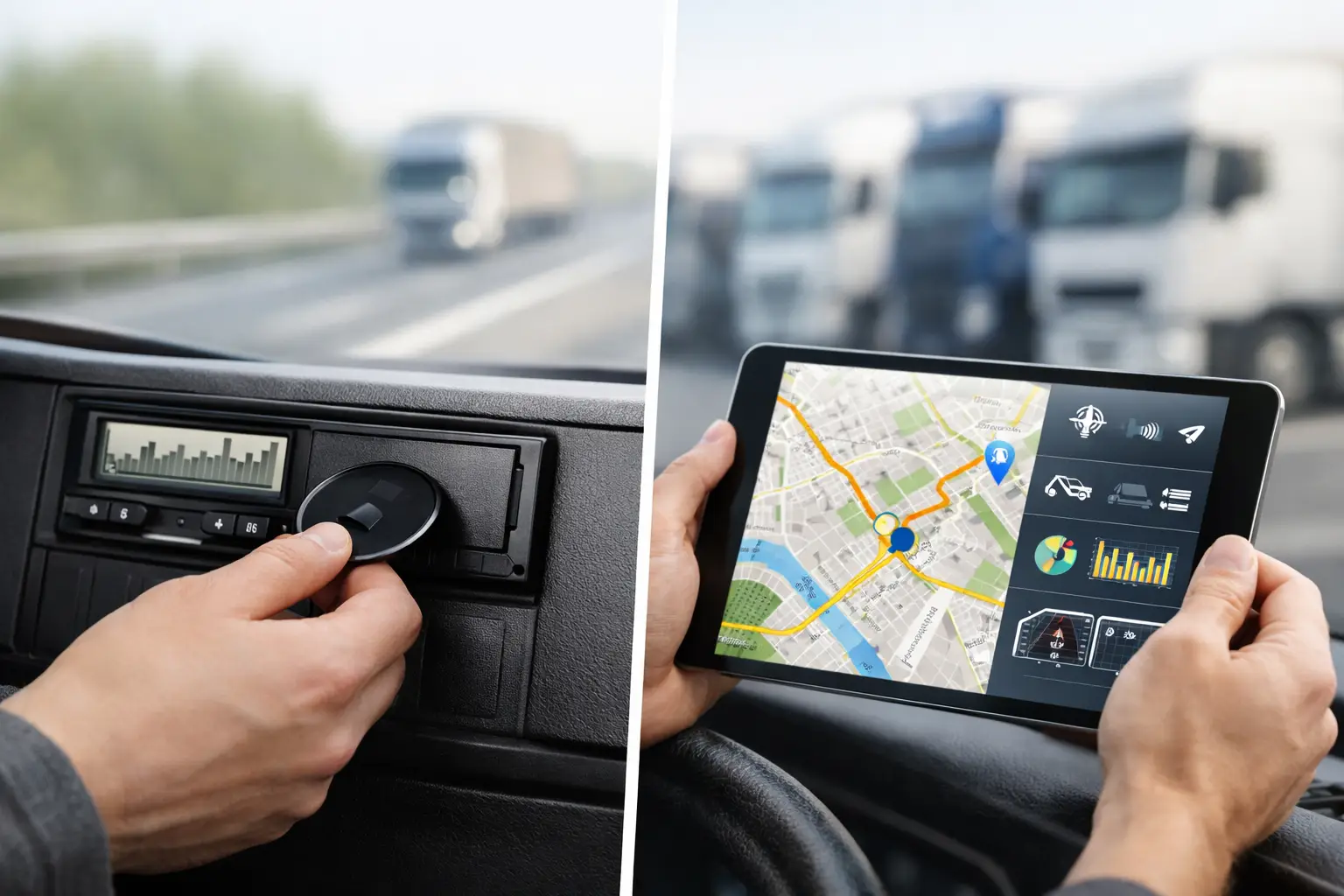
If you run HGVs or a mixed commercial fleet, the tachograph vs telematics question usually comes up when admin starts piling up or visibility starts slipping. A transport manager might have driver hours covered but still be chasing vehicles by phone. Or they may have live tracking in place and still be handling tachograph downloads and infringement checks manually. The confusion is understandable because both systems deal with drivers, vehicles and operations, but they do very different jobs.
The simplest way to look at it is this: a tachograph is primarily about legal compliance, while telematics is about operational control. One records regulated driving activity. The other shows you what is happening across the fleet and helps you act on it.
That distinction matters because many UK operators do not need to choose one or the other. They need to understand where each fits, where the gaps are, and why a disconnected setup often creates more work than it saves.
Tachograph vs telematics: the core difference
A tachograph records driver activity in line with legal requirements. It captures driving time, other work, breaks, rest periods and vehicle speed data. For operators running vehicles in scope of drivers' hours rules, that data is central to demonstrating compliance and protecting the operator licence.
Telematics is broader. It typically combines GPS tracking, vehicle location, journey history, driver behaviour data, alerts, utilisation reporting and, in some systems, maintenance scheduling or trailer tracking. It is designed to help you see the fleet in real time and manage it more effectively.
So if your question is which one tells you whether a driver is close to an infringement, that is a tachograph function. If your question is which one tells you where the vehicle is, whether it has been idling for 25 minutes, or which asset is nearest to the next job, that is telematics.
The overlap comes when operators start asking practical day-to-day questions. Can this driver legally take another job this afternoon? Which vehicle is available now? Why is fuel spend rising? Why are manual downloads still taking so much time? At that point, compliance data and live operational data need to work together.
What a tachograph actually does
For UK transport operators, the tachograph is not optional where regulations require it. Its role is to record statutory data that supports compliance with drivers' hours and working time rules. That includes the activity recorded on the driver card and vehicle unit, which then needs to be downloaded, stored, analysed and reviewed.
On its own, a tachograph does not solve the full compliance process. The data still has to be managed properly. If downloads are missed, if reports are reviewed late, or if driver hours are only checked after the fact, the operator is still exposed. That is why many fleets move from manual collection to remote download and live driver hours monitoring. The tachograph remains the source of regulated activity data, but the way that data is accessed and acted on makes a major difference.
A basic tachograph setup can keep you technically compliant if the process around it is strong enough. The problem is that many fleets are still relying on depot visits, spreadsheets and manual reminders. That approach can work for a small operation with stable routes and a lot of discipline. It becomes harder to sustain when the fleet grows, vehicles stay away from base, or planners need faster decisions.
What telematics actually does
Telematics gives transport teams visibility that a tachograph alone cannot provide. It shows where vehicles are, where they have been, how they are being driven and how efficiently they are being used. That can support dispatch planning, customer updates, fuel control, driver coaching and maintenance scheduling.
For a haulage business, that often means fewer phone calls between planners and drivers, less guesswork around ETA updates, and faster decisions when jobs change during the day. For van and mixed fleets, it can also highlight underused vehicles, unnecessary idling, poor routing and wasted mileage.
Telematics is not a substitute for tachograph compliance. A GPS breadcrumb trail does not replace regulated driver hours records, and a speeding alert is not the same as a legal tachograph analysis report. But telematics does make the operation easier to run because it turns live fleet activity into something visible and measurable.
This is where many operators get caught out. They buy tracking first because they want visibility, then realise compliance still sits in a separate system with different logins, different reports and manual work in between. Or they start with tachograph software and later add telematics, only to find planners and compliance teams are looking at different data sets.
Why the choice is not really either-or
In practice, tachograph vs telematics is often the wrong framing. For most regulated commercial fleets, the real question is whether the two systems work together well enough to reduce risk and admin at the same time.
If you only invest in tachograph management, you may stay on top of downloads and infringements but still lack live visibility across vehicles, trailers and jobs. Planning remains reactive. Driver calls still take up time. Fleet utilisation is harder to measure.
If you only invest in telematics, you gain that live visibility but still leave a major compliance workload in place. Driver hours checks may still be retrospective. Download schedules still need managing. Paperwork and spreadsheet processes continue to sit around the edges.
For UK operators under O-licence obligations, that split can be costly. Compliance is one team’s problem until an issue affects the whole business. A driver without enough available hours can disrupt a delivery plan just as quickly as a vehicle breakdown or a missed allocation. When compliance and operations sit in separate silos, decisions slow down and risk increases.
Where integrated systems make the biggest difference
The strongest case for combining tachograph data with telematics is not technical. It is operational.
Take dispatch planning. Knowing where a vehicle is matters, but knowing whether the driver has legal hours left matters just as much. If you can see both in one place, planners can allocate work with more confidence and fewer calls. If those checks happen in separate systems, the process becomes slower and easier to get wrong.
The same applies to admin. Remote tachograph downloads remove the need to bring vehicles back simply to collect data. Live driver hours monitoring reduces surprises. Telematics fills in the rest by showing location, route progress, idle time and asset availability. Together, those functions replace a lot of manual checking and chasing.
There is also a licence protection angle. Operators are expected not just to hold data, but to manage compliance actively. If your systems help identify issues earlier and make reporting easier, that is far more useful than having data scattered across different tools and spreadsheets.
For many fleets, this is where a platform built around UK transport operations stands apart from generic tracking software. The value is not just dots on a map. It is being able to manage compliance and fleet activity as part of one daily workflow.
When one matters more than the other
There are cases where one system takes priority.
If you operate vehicles that fall within tachograph rules and your current download and analysis process is weak, tachograph compliance should come first. There is little value in improving visibility if you still face avoidable infringements, missed downloads or poor audit readiness.
If your compliance process is already tight but dispatch is inefficient, vehicles are underused and planners lack live information, telematics may deliver the quickest operational gains. That can show up in fuel savings, better route decisions and stronger customer communication.
But for many HGV fleets, both issues sit side by side. That is why a phased approach often works best. Start by fixing the compliance workload and manual processes, then extend that visibility into live planning and performance management. Or choose a system that already brings those functions together so you do not have to rework the process later.
What to ask before you invest
Before comparing suppliers, it helps to be clear on the real problem. If the issue is missed downloads, driver hours uncertainty and too much compliance admin, ask how the system handles remote downloads, reporting and live hours visibility. If the issue is poor planning and low asset visibility, ask how it handles real-time tracking, trailer management and utilisation reporting.
Then ask the harder question: will your planners, compliance team and managers still need separate tools and spreadsheets to get through the day? That is usually where hidden cost sits. Not just in software spend, but in duplicated effort, delayed decisions and avoidable risk.
A system that looks cheaper at first can become expensive if it still leaves staff piecing information together manually. For most operators, simplicity matters just as much as feature depth.
Fleetalyse is built around that reality. The goal is not to add another platform to the stack. It is to give operators one place to manage tachograph compliance, live fleet visibility and the day-to-day decisions that sit between the two.
The useful way to think about tachograph vs telematics is not which one wins. It is whether your current setup gives you enough control over compliance and enough visibility to run the fleet properly. If it does not, the answer is usually not more software. It is fewer gaps.