

Telematics data employee policy setup: UK compliance guide

A telematics data employee policy is a formal governance document that sets out exactly how your fleet collects, stores, accesses, and acts on vehicle tracking data, while protecting employee privacy rights under UK law. Without one, you are exposed to Information Commissioner’s Office (ICO) enforcement, employee grievances, and the kind of mistrust that makes telematics technology work against you rather than for you. Get it right, and the same data that flags unsafe driving also becomes your strongest defence in a dispute.
The core elements every compliant policy must address:
- Lawful basis for processing — identifying whether you rely on legitimate interests, legal obligation, or another GDPR ground
- Data types collected — location, speed, idling, harsh braking, and any supplementary video or biometric capture
- Employee notification — written confirmation that drivers know what is collected and why, before monitoring begins
- Access controls — who can view telematics data, at what level of detail, and under what circumstances
- Data Subject Access Requests (DSAR) — a clear route for employees to request their own data
- Retention limits — how long data is kept and when it is deleted or anonymised
- Disciplinary use — which data types can inform disciplinary proceedings and what due process applies
- Review schedule — when the policy is revisited and how changes are communicated
What UK law requires for telematics data employee policies
Telematics data is classified as personal data under both the UK GDPR and the Data Protection Act 2018, which means the full weight of data protection law applies the moment a GPS unit starts transmitting. That is not a technicality. A vehicle’s location history, combined with a driver’s name and shift pattern, can reveal where someone lives, their daily routine, and their performance record. Courts and the ICO treat that combination as personal data, full stop.
The GDPR principles that govern fleet telematics
Six principles from UK GDPR shape every decision you make about telematics data:
- Lawfulness, fairness, and transparency — employees must know what is collected and why before monitoring starts
- Purpose limitation — data gathered for safety cannot later be repurposed for, say, marketing analysis without a fresh lawful basis
- Data minimisation — collect only what you genuinely need for the stated purpose
- Accuracy — records must be kept up to date; a driver has the right to challenge inaccurate data
- Storage limitation — data cannot be held indefinitely; retention periods must be defined and enforced
- Integrity and confidentiality — appropriate technical and organisational measures must protect the data from unauthorised access or loss
The Data Protection Act 2018 sits alongside UK GDPR, providing the UK-specific enforcement framework administered by the ICO. The ICO has the power to issue fines and enforcement notices, so treating these obligations as optional is a significant operational risk.
Lawful basis: legitimate interests versus consent
Most UK fleet operators process telematics data under the legitimate interests basis, which allows processing where the business need is genuine, necessary, and not overridden by employee privacy rights. Health and safety monitoring, asset protection, and route efficiency all typically qualify. However, legitimate interests is not a blanket permission. You must carry out a Legitimate Interests Assessment (LIA) to document the balance between your operational needs and the privacy impact on drivers.
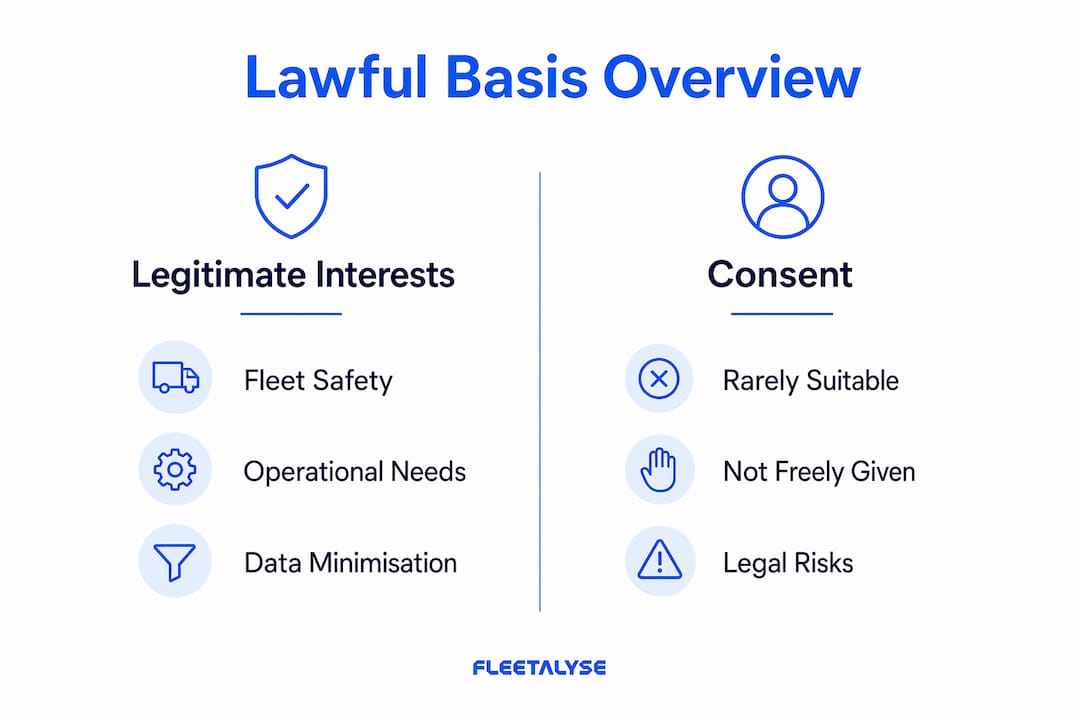
Consent is rarely the right basis for workplace telematics. Employees are rarely in a position to give freely given consent to their employer, which is a requirement under GDPR. Relying on consent also creates problems when an employee withdraws it. Legitimate interests, properly documented, is the more defensible ground for most fleets.
Privacy Impact Assessments
Privacy Impact Assessments (PIAs) are not a one-off box-ticking exercise. They should be completed before any new data type is introduced, before a new telematics system is deployed, and whenever the purpose of data collection changes. A PIA forces you to identify privacy risks, assess their likelihood and severity, and document the controls you have put in place. The ICO expects to see this documentation if a complaint or breach investigation arises.
Key regulatory body: The Information Commissioner’s Office (ICO) is the UK’s independent authority for data protection. Any employee who believes their data has been mishandled can complain directly to the ICO, which can investigate and impose sanctions on the organisation.
What rights do employees have over their telematics data?
Employees hold several statutory rights under UK GDPR and the Data Protection Act 2018 that your policy must explicitly acknowledge and support. Ignoring these rights is not just a legal risk. It is one of the fastest ways to generate grievances and erode the trust that makes telematics data genuinely useful.
The right to be informed
Before a telematics device is activated in any vehicle a driver operates, that driver must receive clear, plain-language information covering: what data is collected, the lawful basis for processing, how long it is retained, who can access it, and how they can exercise their rights. Burying this in a lengthy employment contract is not sufficient. A standalone telematics policy document, acknowledged in writing by the driver, is the standard approach.
Data Subject Access Requests
A DSAR gives any employee the right to obtain a copy of all personal data held about them, including telematics records. DSAR requests should route through line managers or a designated DSAR inbox to maintain a clear audit trail. You have one calendar month to respond, with a possible two-month extension for complex requests. Your policy should name the DSAR contact point, describe the process, and confirm that no charge applies for a standard request.
Further rights your policy must address
- Right to rectification — if a driver believes their telematics record is inaccurate, they can request a correction; your policy should set out how you investigate and respond
- Right to object — employees can object to processing based on legitimate interests; you must consider the objection and respond, though you are not automatically required to stop processing
- Right to complain — beyond your internal grievance procedure, employees can escalate to the ICO at any point; your policy should signpost this route clearly
- Due process in disciplinary matters — employees have the right to be informed of any proposed disciplinary action affecting their employment and to respond before a decision is finalised; appeals must be available
Pro Tip: Publish a one-page summary of employee rights alongside the full policy. Drivers are far more likely to read a single page than a twelve-page document, and a well-informed workforce generates fewer formal complaints.
How to draft and introduce a compliant telematics policy
The drafting process starts well before anyone opens a word processor. Scoping sessions with fleet managers, HR, legal counsel, and driver representatives surface the operational goals and the privacy risks simultaneously, which saves significant rework later. Trying to craft a policy in isolation, without input from the people who will live with it daily, is one of the most common reasons telematics rollouts stall.
Core drafting elements
Every compliant UK telematics policy should contain the following clauses:
- Purpose statement — the specific operational reasons for using telematics (safety, compliance, scheduling, fuel management)
- Data inventory — an explicit list of data types collected: GPS location, speed, idling duration, harsh braking events, engine diagnostics, and any video or audio capture
- Lawful basis declaration — the GDPR ground relied upon, with a summary of the LIA findings
- Access matrix — which roles can access which data, at what level of granularity, and for what purpose
- Retention schedule — defined periods for each data category, with a process for deletion or anonymisation at the end of the retention window
- Disciplinary use clause — which data types can be used in disciplinary proceedings, the threshold for action, and the appeals process
- DSAR procedure — the contact point, timescales, and format for responding to access requests
- Consent withdrawal clause — what happens if an employee objects to processing, and how the organisation will respond
- Policy review date — when the policy will next be reviewed and who is responsible
Incorporating Privacy Impact Assessments into drafting
The PIA should inform the policy, not follow it. Run the assessment during the scoping phase, before data collection begins, so that the controls you identify feed directly into the policy clauses. If you are introducing dashcams or in-cab audio recording, a separate PIA for those data types is advisable given their greater intrusiveness.
Communicating the policy to drivers
Introducing telematics through group meetings is consistently more effective than sending a document by email and hoping for the best. A group setting allows drivers to ask questions, hear the same answers at the same time, and reduces the rumour mill that often surrounds new monitoring technology. Where group meetings are not practical, a structured written communication covering the same ground is the minimum standard.
Written acknowledgement from every driver is not optional. Employees should confirm in writing that they have been made aware of tracking and understand how data will be used. This acknowledgement form becomes part of the compliance record and is valuable evidence if a dispute arises later.
Pro Tip: Pilot the policy with a small group of senior drivers or driver mentors before the full rollout. Their questions will shape your briefing materials, and their endorsement carries weight with colleagues who are sceptical about monitoring technology.
Common policy clauses worth including
- A clause confirming that telematics data will not be used to create individual league tables or publicly rank drivers against colleagues
- A clause limiting off-hours monitoring, or clearly stating the circumstances under which location data outside working hours may be accessed
- A clause confirming that data used for analytical or planning purposes will be anonymised before being shared beyond the fleet management team
- An appeals clause giving drivers a right to challenge disciplinary decisions based on telematics data, including the right to union representation
Best practices for telematics data collection, storage, and processing
Responsible data handling is not just about legal compliance. It is the practical foundation that makes your telematics investment defensible and trustworthy. The gap between collecting everything technically possible and collecting only what you genuinely need is where most privacy problems originate.

Data minimisation in practice
Selective capture of ‘must-have’ safety data is the starting point. Must-have data includes location, speed, harsh braking, and rapid acceleration events, because these directly support safety monitoring and DVSA compliance. Nice-to-have data, such as detailed cabin recordings or granular idling analysis beyond fuel management, carries a higher privacy burden and should only be collected where a specific operational purpose justifies it. Every data point in your collection scope should map to a defined objective in the policy.
Secure storage and access controls
Encryption and authentication measures protect stored telematics data from unauthorised access, which is a baseline requirement under UK GDPR. In practice, this means:
- Universal encryption for data at rest and in transit
- Multi-factor authentication for all telematics platform logins
- Unique login credentials for every user; shared accounts are not permitted
- Automatic access revocation on the day an employee leaves the organisation
- A documented access matrix showing which roles can view which data categories
Access should be limited on a strict need-to-know basis, with different permission tiers for fleet administrators, line managers, and HR. A line manager reviewing a driver’s weekly score does not need the same access level as the fleet data controller who manages system-wide reporting.
Retention and anonymisation
Define a retention period for each data category and enforce it. Raw GPS location data is typically retained for a shorter period than aggregated safety scores, which may be needed for longer-term performance management. Data used for analytical or planning purposes should be fully anonymised before it is shared beyond the core fleet team, removing any identifiers that could link records back to an individual driver.
Designate a named data steward or controller who is accountable for telematics data governance. This person owns the access matrix, manages retention schedules, and is the first point of contact for DSARs and data breach responses. Without a named owner, accountability diffuses and compliance gaps appear.
Balancing monitoring with operational efficiency
Telematics monitoring should be proportionate to the risk. Constant, granular surveillance of every driver movement is rarely justified and almost always counterproductive. A tiered approach, where automated alerts flag genuine safety events and managers review aggregated scores rather than individual trips, keeps the monitoring proportionate and the data volume manageable. For fleet managers looking at GPS tracking hardware that supports this kind of tiered data capture, plug-and-play units that integrate directly with your fleet management platform reduce both setup complexity and the risk of collecting data you did not intend to.
How should you review and update your telematics policy?
A telematics policy is not a document you file and forget. UK data protection law evolves, ICO guidance updates, and your own fleet operations change. A policy that was compliant at launch can become a liability within twelve months if it is not actively maintained.
Triggers for a policy review
Not every review needs to be scheduled. Certain events should trigger an immediate review regardless of the calendar:
- A change in UK GDPR guidance or ICO enforcement decisions relating to workplace monitoring
- Introduction of a new data type, such as dashcam footage or in-cab audio
- A change in telematics hardware or platform provider
- A data breach or near-miss involving telematics data
- A formal employee complaint or DSAR that reveals a gap in the policy
- Significant changes to fleet composition, such as adding HGVs or trailers to a previously van-only operation
Scheduled review cycles
Beyond event-triggered reviews, a minimum annual review cycle is good practice for most UK fleets. Larger operations or those using more intrusive data types should review every six months. Each review should include:
- A check against current ICO guidance on employee monitoring and vehicle tracking
- A refresh of the Privacy Impact Assessment if data types or purposes have changed
- A review of the access matrix to confirm it reflects current roles and personnel
- An audit of retention schedules to confirm data is being deleted or anonymised on time
- A check of the disciplinary use clause against any recent employment tribunal decisions
Policy reviews must incorporate employee feedback to remain credible. Anonymous feedback channels, focus groups with driver representatives, and a transparent record of how feedback has shaped policy changes all contribute to the kind of trust that makes telematics data work as intended.
Version control and communication of changes
Version tracking and revision justifications should be documented in a policy change log, accessible to HR and legal teams. When a material change is made, drivers must be notified before the change takes effect, not after. A brief written summary of what has changed and why, accompanied by an updated acknowledgement form, is the minimum standard. Treating policy updates as a communication exercise, rather than an administrative task, signals to drivers that the organisation takes its obligations seriously.
Data breach readiness
Your policy should include a data breach response protocol covering telematics data specifically. Under UK GDPR, a personal data breach that is likely to result in a risk to individuals must be reported to the ICO within 72 hours of discovery. Your protocol should identify who is responsible for breach detection, who makes the ICO notification decision, and how affected employees are informed. Running a tabletop exercise against a simulated telematics breach scenario once a year is a practical way to test whether the protocol actually works.
For fleet managers exploring breakdown and operational resilience planning alongside their telematics policy work, integrating data breach response into broader fleet continuity planning is a logical step.
How can you improve employee acceptance of telematics policies?
The most legally compliant telematics policy in the UK will still fail operationally if drivers view it as a surveillance tool rather than a safety framework. Acceptance is not automatic. It is built through consistent communication, fair management practice, and a genuine commitment to using data constructively.
Frame telematics as a safety and coaching tool
Presenting telematics as a tool for safety, driver coaching, and operational efficiency rather than surveillance significantly improves employee acceptance. This framing needs to be consistent across every touchpoint: the initial briefing, manager conversations, and the way data is actually used day to day. If drivers see telematics data used exclusively to trigger disciplinary action, the safety framing loses credibility quickly. If they see it used to recognise improvement and support development, the technology becomes something they can engage with rather than resent.
Differentiating between must-have safety data and nice-to-have optimisation data matters here too. Punitive use of telematics should be restricted to genuine safety and compliance violations, not extended to minor efficiency metrics that carry no safety risk. Drivers notice when the threshold for disciplinary action feels arbitrary, and that perception damages trust faster than almost anything else.
Supervisory training for coaching, not punishment
Manager and supervisor training programmes are critical to ensure telematics data is used for coaching rather than immediate disciplinary measures. A manager who jumps straight to a written warning every time a score dips will generate grievances and, eventually, tribunal claims. A manager trained to hold a structured coaching conversation, using specific data reports to identify patterns and set improvement goals, achieves better safety outcomes and fewer formal disputes.
Ongoing supervisory training ensures managers possess the skills to use telematics data responsibly. This is not a one-day induction topic. It requires follow-up sessions as the system matures and as new data types are introduced. Coaching sessions should be documented, with agreed improvement targets and a follow-up date, creating a record that demonstrates fair process if a disciplinary matter does eventually arise.
Transparent communication and feedback channels
Anonymous feedback channels give drivers a route to raise concerns about monitoring without fear of identification. Publishing responses to common concerns, without attributing them to individuals, demonstrates that feedback is genuinely considered rather than filed away. A dynamic FAQ document, updated as new questions emerge, is a practical tool for maintaining this transparency over time.
Recognising drivers who demonstrate consistent safe behaviour is at least as important as addressing those who do not. A scoring system that only ever surfaces negative events creates a one-sided relationship with the data. Acknowledging improvement, whether through a manager conversation, a team briefing, or a formal recognition scheme, reinforces the message that telematics is there to support drivers, not catch them out.
Pro Tip: Hold an initial manager meeting before launch, then a follow-up session two to three weeks after tracking begins. Use the follow-up to review early data with managers, address concerns that have emerged from drivers, and demonstrate how the coaching process should work in practice. This two-stage approach, recommended by fleet safety specialists, significantly improves consistent policy application across management teams.
Leveraging Fleetalyse for compliant policy management
Fleetalyse’s fleet compliance platform is built around exactly this kind of structured, transparent data use. Driver behaviour monitoring, automated alerts, and detailed reporting give fleet managers the specific data they need for coaching conversations, while the platform’s access controls support the need-to-know principles your policy requires. UK-based support means that when your team has questions about setup or compliance configuration, the answers come from people who understand the DVSA and ICO context you are operating in.
Whether you are equipping a van fleet with plug-and-play OBD trackers or managing a mixed HGV and trailer operation, Fleetalyse’s hardware range, including the Teltonika FMB920 and asset and trailer GPS trackers, integrates directly with the platform to give you the data your policy is built around, without the complexity of managing multiple systems.
Key takeaways
A compliant telematics data employee policy setup requires a lawful basis under UK GDPR, a completed Privacy Impact Assessment, explicit employee notification, defined retention limits, and a structured process for handling Data Subject Access Requests.
| Point | Details |
|---|---|
| Lawful basis is mandatory | Most UK fleets rely on legitimate interests, supported by a documented Legitimate Interests Assessment, rather than employee consent. |
| PIAs must precede data collection | Complete a Privacy Impact Assessment before deploying any new data type or telematics system, not after. |
| DSAR process must be named | Your policy must identify a specific contact point and confirm the one-month response window for employee data requests. |
| Supervisory training drives acceptance | Managers trained to coach rather than discipline using telematics data generate fewer grievances and better safety outcomes. |
| Policy reviews cannot be passive | Schedule annual reviews as a minimum, and trigger immediate reviews after any breach, new data type, or regulatory update. |