
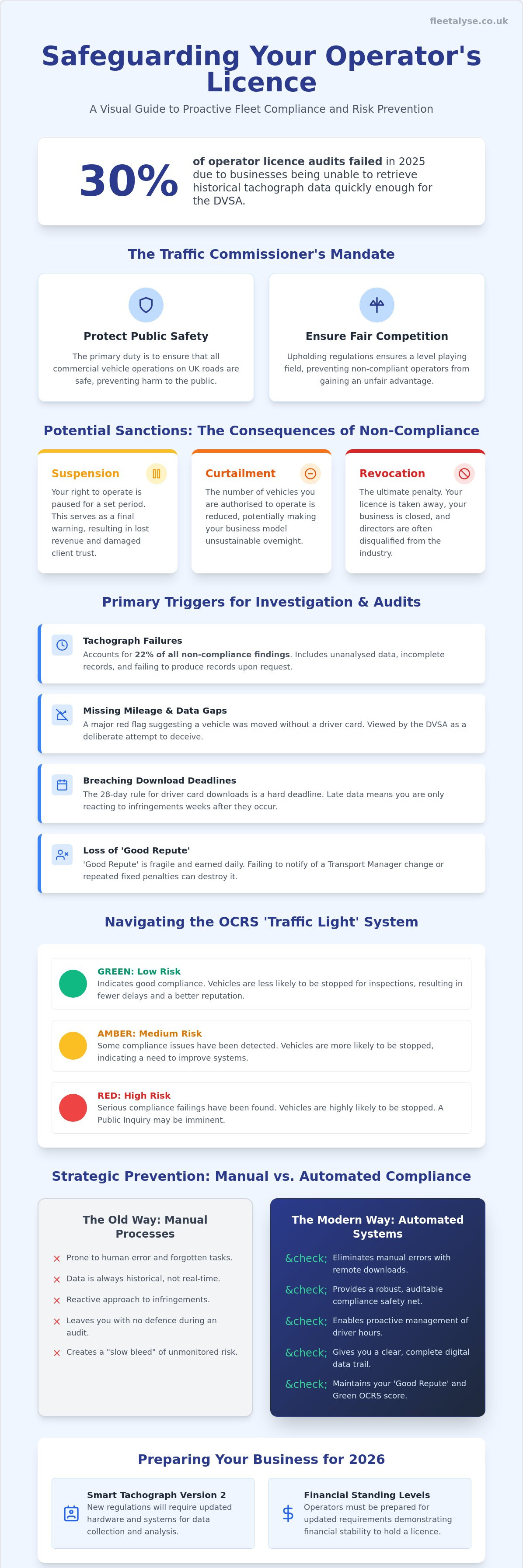
Did you know that 30% of operator licence audits in 2025 failed simply because businesses couldn't retrieve historical tachograph data quickly enough for the DVSA? The risk of losing operator's licence rarely stems from a single catastrophic event. Instead, it's usually the result of a "slow bleed" of unmonitored infringements and routine maintenance failures that eventually triggers a Public Inquiry. You've invested years into your transport business, and the constant pressure of evolving regulations can feel overwhelming.
We understand the anxiety that comes with staying on the right side of the Traffic Commissioner. This guide outlines the critical triggers for licence revocation in 2026, including the new Smart Tachograph Version 2 requirements and updated financial standing levels. You'll learn how to safeguard your business through proactive compliance management. We'll show you how to maintain a 'Green' OCRS score and ensure your driver hours are always legally compliant. By the end of this article, you'll have a clear plan to avoid the stress and cost of regulatory intervention.
Key Takeaways
- Protect your 'Good Repute' by understanding the Traffic Commissioner's primary focus on public safety and fair competition.
- Recognise the common tachograph failures and missing mileage patterns that lead to immediate DVSA audits.
- Master the OCRS 'Traffic Light' system to lower the risk of losing operator's licence and maintain a consistent Green rating.
- Discover how automated remote tachograph downloads eliminate manual errors and provide a robust compliance safety net.
- Prepare your business for 2026 regulatory changes, including Smart Tachograph Version 2 requirements and updated financial standing levels.
The Gravity of the Situation: Why Licences are Revoked
The Traffic Commissioner acts as the gatekeeper of the UK transport industry. Their mandate is clear: they must protect public safety and ensure fair competition. This authority is derived from the Goods Vehicles (Licensing of Operators) Act 1995, which provides the legal framework for all haulage activities. Many operators view getting their licence as the finish line. In reality, it's just the beginning of a lifelong commitment to compliance. Complacency is the single biggest threat to your business. The risk of losing operator's licence increases the moment you stop treating your compliance systems as a priority.
When standards slip, the consequences are tiered but always severe. You need to understand the three main sanctions:
- Suspension: Your right to operate is paused for a set period. It's a final warning that costs you revenue and client trust.
- Curtailment: The Commissioner reduces the number of vehicles you are allowed to run. This often makes your business model unsustainable overnight.
- Revocation: The ultimate penalty. Your licence is taken away, your business is closed, and directors are often disqualified from holding a licence in the future.
The Role of the Traffic Commissioner
Commissioners monitor standards through DVSA reports and roadside inspections. They don't just look for isolated incidents. They search for systemic failure. If your records show a pattern of missed vehicle inspections or late tachograph downloads, the Commissioner will likely call you to a Public Inquiry. This is a formal court proceeding where you must prove you are still fit to operate. The Commissioner prioritises the safety of the road-using public over your profit margins. They have little patience for operators who claim they were "too busy" to check their data.
Loss of 'Good Repute' and Professional Competence
'Good Repute' is the most fragile part of your licence. It's not a permanent status; it's a condition you must earn every day. If your Transport Manager resigns and you fail to notify the Commissioner, you've breached your requirements. Similarly, criminal convictions or even repeated fixed penalties can destroy your repute. Professional competence is a continuous obligation, not a certificate you hang on the wall and forget. You must demonstrate that you have active, effective management of your fleet. Relying on manual, error-prone systems significantly heightens the risk of losing operator's licence because it leaves you with no defence during an audit. Expert partners like Fleetalyse help maintain this repute by providing the transparency and data accuracy the DVSA demands.
Primary Triggers: Driver Hours and Tachograph Failures
Tachograph data is the primary evidence the DVSA uses to assess your operation. It's the "black box" of your business. If your records are incomplete, the Traffic Commissioner assumes you are hiding something. Tachograph non-compliance accounts for approximately 22% of all operator licence non-compliance findings during audits. The risk of losing operator's licence often starts with a single missing driver card download or a failure to explain "ghost" driving. Missing mileage is a major red flag. It suggests a vehicle was moved without a card inserted to hide driving hours. The DVSA views this as a deliberate attempt to deceive, which strikes at the heart of your good repute.
The 28-day rule for driver card downloads is a hard deadline. You cannot afford to wait until the last minute. Delayed data collection means you are reacting to infringements that happened weeks ago. By then, the damage is done. Section 26 of the Act outlines the official grounds for revocation, and failing to produce records is high on that list. Driver fatigue is a safety critical issue. If your drivers regularly exceed their limits, you are putting lives at risk. Ignoring these infringements is seen as 'wilful blindness'. The Commissioner expects you to be a proactive manager, not a passive observer.
Tachograph Compliance and Data Gaps
Unanalysed data is a ticking time bomb. You might have the files, but if you haven't checked them for infringements, you aren't compliant. Manual download schedules are prone to human error. Drivers forget. Cards get lost. Office staff get busy. These gaps in your data make it impossible to prove you are managing your fleet. Ensure you have a robust 'lock-in' process for your digital tachographs to protect your data ownership. Without a clear digital trail, you have no defence during a roadside check. You can automate your compliance monitoring to ensure you never miss a download deadline again.
Managing Driver Behaviour and Infringements
You must demonstrate a consistent system for debriefing drivers. Simply handing a driver a printout of their infringements isn't enough. You need to show that you've discussed the error, provided training, and monitored for improvement. Repeat offenders are a liability. If the same driver keeps breaking the law, the Commissioner will ask why they are still behind the wheel of your vehicle. Systemic failure occurs when an operator lacks the procedures to identify, record, and rectify recurring compliance breaches across the entire fleet. This lack of oversight is a fast track to a Public Inquiry and a significant risk of losing operator's licence.
Navigating the OCRS System and Public Inquiries
The DVSA does not select vehicles for roadside inspections at random. They use a data-driven mechanism called the Operator Compliance Risk Score (OCRS). This system calculates a score based on your performance over a rolling three-year period. If your score is poor, your vehicles are far more likely to be pulled over. Frequent roadside stops increase the likelihood of finding faults, which creates a downward spiral for your compliance rating. Maintaining a high score is the most effective way to reduce the risk of losing operator's licence.
The 'Traffic Light' system categorises your fleet into three levels: Green, Amber, and Red. A Green rating indicates a low-risk operator, often resulting in fewer interruptions to your daily business. Amber suggests some concerns, while a Red rating flags you as a high-priority target for enforcement. Your score is fed by two main data streams. Roadworthiness covers your MOT pass rates and any vehicle prohibitions issued at the roadside. Traffic compliance focuses on your tachograph records, driver hours, and weighing checks. You can monitor your current standing through the operator licence login portal to ensure you aren't slipping into the danger zone.
Understanding Your OCRS Score
To move from Red to Green, you must systematically address the root causes of your points. Roadworthiness scores often suffer due to poor pre-use checks or inadequate maintenance providers. Traffic scores usually drop because of unmanaged tachograph infringements. The DVSA expects you to be proactive. If you see your score moving towards Amber, you must audit your internal processes immediately. Monitoring these scores weekly allows you to catch trends before they become permanent stains on your record.
The Public Inquiry: A Business Crossroads
A Public Inquiry (PI) is a formal hearing before the Traffic Commissioner. It is not a casual meeting; it is a legal proceeding that determines if you can stay in business. The Commissioner will review your OCRS history, maintenance records, and tachograph audits. Section 26 of the 1995 Act details the grounds for licence revocation, and the Commissioner has the power to shut you down on the spot.
Preparation is vital. You must show 'positive change' before you walk into the hearing room. This might include investing in new compliance software or retraining your entire driver pool. Claiming you didn't know about the rules is never a valid defence. The Commissioner assumes you are a professional who understands your obligations. If you cannot prove you have control over your fleet, the risk of losing operator's licence becomes a reality. Outcomes range from a formal warning to total revocation and disqualification of the directors.
Strategic Prevention: Moving from Manual to Automated Compliance
Most operators focus on legal defence only after receiving a summons. This is a reactive and dangerous strategy. The most effective way to reduce the risk of losing operator's licence is to build a system that makes compliance failure impossible. Manual tachograph management is inherently flawed. It relies on human memory and physical proximity to the vehicle. If a driver is away for several weeks and forgets to download their card, you have a compliance gap. These gaps are exactly what the DVSA looks for during an audit. They view missing data not as an oversight, but as a lack of professional control.
Automation changes the relationship between the operator and the regulator. Instead of hoping your records are correct, you know they are. Digital systems create an 'audit-ready' environment where data is captured, analysed, and stored without manual intervention. This level of transparency acts as a shield. It demonstrates to the Traffic Commissioner that you have total control over your fleet. By integrating tracking with compliance, you gain a holistic view of your fleet health. You can spot trends, identify training needs, and prove your commitment to road safety with the click of a button.
The Benefits of Remote Tachograph Downloads
Remote technology removes the logistical headache of data collection. Vehicles no longer need to return to a specific depot just to plug into a download tool. This is vital for long-haul assets or remote trailers that rarely visit the main centre. Automated schedules ensure you never miss the mandatory 28-day driver card or 90-day vehicle unit deadlines. You get 100% data retrieval across your entire fleet, regardless of where the vehicles are located. This eliminates the time lag between an infringement occurring and you finding out about it.
Real-Time Visibility and Live Driver Hours
Live telematics allow you to see exactly how much driving time remains for every driver in your fleet. This isn't just about record-keeping; it's about proactive dispatching. You can avoid the 'run out of hours' trap by assigning jobs based on actual, live data rather than guesswork. Using remote tachograph download services provides a continuous digital audit trail that is easily retrievable during an inspection. This proactive approach significantly lowers the risk of losing operator's licence by stopping infringements before they occur.
Don't leave your business's survival to chance. You can secure your fleet's compliance by automating your tachograph downloads today.
Securing Your Fleet's Future with Fleetalyse
Compliance is not a static goal. It is a continuous process of monitoring and improvement. As we have explored throughout this guide, the risk of losing operator's licence is a constant pressure for UK hauliers. The DVSA's move towards data-driven enforcement means your digital records are now your strongest asset or your greatest liability. Fleetalyse provides the tools to ensure they remain an asset. We don't just offer software; we provide a robust framework that protects your repute and your livelihood.
Our approach is built on transparency and efficiency. Many generic competitors offer tracking as a standalone feature. We integrate compliance into the very fabric of your fleet management. This means your tachograph data, driver hours, and asset locations are visible in one place. It removes the need for multiple, disconnected systems that increase the chance of human error. By centralising your data, you create a clear, undeniable record of professional competence that stands up to the closest scrutiny.
Integrated Compliance Solutions
Real security comes from seamless integration. Our hardware connects directly to your vehicle's tachograph, enabling automatic remote tachograph downloads. This data flows directly into your analysis software without any manual steps. This covers your entire fleet, including HGVs, vans, and trailers. By centralising this information, you significantly reduce administrative overhead. Your staff can spend less time chasing driver cards and more time managing operational efficiency. This high-level visibility ensures that your compliance is proactive rather than reactive.
A Partner in Your Success
We position ourselves as a pragmatic expert partner for regional operators. Being a UK-based specialist means we understand the specific nuances of local infrastructure and DVSA expectations. Our live driver hours monitoring empowers Transport Managers with real-time data. You can see exactly who is approaching their limits and intervene before a breach occurs. This level of control is essential for maintaining a permanent 'Green' OCRS rating and avoiding the stress of a Public Inquiry.
We believe in straightforward pricing and operational clarity. There are no hidden complexities in our service. We build our solutions for the rigours of real-world application, ensuring your fleet remains audit-ready at all times. Don't wait for a Red OCRS score to trigger a change in your business. Take the first step toward a more secure future today. Contact Fleetalyse for a compliance review and see how our automated systems can protect your business from the risk of losing operator's licence.
Secure Your Fleet’s Standing for 2026 and Beyond
The landscape of UK transport regulation is shifting towards stricter, data-driven enforcement. Managing your fleet manually in this environment is no longer sustainable. We've discussed how routine failures in tachograph downloads and unmonitored driver hours create a systemic risk of losing operator's licence. By moving away from manual collection, you remove the human error that often triggers a Public Inquiry. It's about being proactive rather than reactive.
Fleetalyse provides the specialised UK transport compliance expertise you need to maintain a Green OCRS score. Our automated remote tachograph downloads and real-time visibility of driver hours give you the transparency needed to defend your repute. You don't have to face the Traffic Commissioner alone when your systems are built to be audit-ready every day. We're here to help you turn compliance from a burden into a competitive advantage.
Protect your licence with Fleetalyse remote compliance solutions
Taking control of your data today is the best way to ensure your business continues to thrive for years to come. Your fleet's future is worth the investment in professional, reliable systems.
Frequently Asked Questions
Can I lose my operator's licence for a single driver's mistake?
It is unlikely that a single minor mistake will lead to revocation, but serious offences like tachograph tampering or gross negligence can trigger immediate action. The Traffic Commissioner focuses on whether you have robust systems in place. If one driver's mistake reveals a total lack of management control, your repute is at risk. The risk of losing operator's licence is more often tied to a pattern of unmanaged errors rather than one isolated human mistake.
How often should I download my tachograph data to stay compliant?
You must download driver card data at least every 28 days and vehicle unit data every 90 days. These are the absolute legal limits. To maintain a high standard of compliance, we recommend downloading data weekly. This allows you to identify and address infringements whilst the events are still fresh in the driver's mind. Frequent downloads prove proactive oversight to the DVSA during an audit.
What happens if my Transport Manager leaves the business unexpectedly?
You must inform the Traffic Commissioner within 28 days if your Transport Manager resigns. Operating without a qualified person in place is a breach of your licence conditions. You can apply for a Period of Grace, which typically lasts up to six months, to find a replacement. Failing to notify the authorities is a major risk of losing operator's licence as it suggests a lack of transparency and professional control.
How can I improve my OCRS score if it is currently Red?
Improving a Red OCRS score requires a systematic approach to maintenance and tachograph management. Start by auditing your pre-use check procedures to increase your MOT pass rate. Simultaneously, ensure all driver infringements are debriefed and recorded. As you accumulate more "clean" roadside encounters and successful inspections, your score will gradually transition through Amber to Green over the rolling three-year period. Consistency is the only way to repair a poor rating.
Is remote tachograph downloading legally accepted by the DVSA?
Yes, remote tachograph downloading is fully recognised and encouraged by the DVSA. It provides a reliable, automated method for meeting your legal data collection deadlines without vehicles needing to return to base. By removing the need for manual intervention, it ensures a complete and accurate digital audit trail. The key requirement remains that the data must be analysed and any identified infringements must be acted upon promptly.
What is a 'Period of Grace' and how do I apply for one?
A Period of Grace is a temporary allowance granted by the Traffic Commissioner when you fail to meet a mandatory requirement, such as financial standing or professional competence. You must apply for this through the Vehicle Operator Licensing (VOL) system, providing a clear timeline for rectification. It usually lasts between three and six months. It is a discretionary tool, not an automatic right, so your application must be professional and well-evidenced.
Do I need an operator's licence for vans or just HGVs?
You need an operator's licence for any vehicle over 3.5 tonnes GVW used for business. However, since May 2022, vehicles between 2.5 and 3.5 tonnes used for hire or reward on international journeys also require a Standard International Licence. For domestic van operations, a licence is not currently required, but you must still ensure vehicles are roadworthy and drivers comply with UK domestic hours rules to avoid regulatory scrutiny.
What are the most common reasons for being called to a Public Inquiry?
The most frequent triggers for a Public Inquiry include poor maintenance records, high OCRS scores, and repeated tachograph infringements. Traffic Commissioners are particularly concerned by "wilful blindness," where an operator ignores clear signs of non-compliance. Other common reasons include failing to notify the authorities of changes in your business structure or professional competence. These failures suggest the operator has lost control of their fleet, directly impacting their good repute.
Frequently asked questions
Can I lose my operator's licence for a single driver's mistake?
It is unlikely that a single minor mistake will lead to revocation, but serious offences like tachograph tampering or gross negligence can trigger immediate action. The Traffic Commissioner focuses on whether you have robust systems in place. If one driver's mistake reveals a total lack of management control, your repute is at risk. The risk of losing operator's licence is more often tied to a pattern of unmanaged errors rather than one isolated human mistake.
How often should I download my tachograph data to stay compliant?
You must download driver card data at least every 28 days and vehicle unit data every 90 days. These are the absolute legal limits. To maintain a high standard of compliance, we recommend downloading data weekly. This allows you to identify and address infringements whilst the events are still fresh in the driver's mind. Frequent downloads prove proactive oversight to the DVSA during an audit.
What happens if my Transport Manager leaves the business unexpectedly?
You must inform the Traffic Commissioner within 28 days if your Transport Manager resigns. Operating without a qualified person in place is a breach of your licence conditions. You can apply for a Period of Grace, which typically lasts up to six months, to find a replacement. Failing to notify the authorities is a major risk of losing operator's licence as it suggests a lack of transparency and professional control.
How can I improve my OCRS score if it is currently Red?
Improving a Red OCRS score requires a systematic approach to maintenance and tachograph management. Start by auditing your pre-use check procedures to increase your MOT pass rate. Simultaneously, ensure all driver infringements are debriefed and recorded. As you accumulate more "clean" roadside encounters and successful inspections, your score will gradually transition through Amber to Green over the rolling three-year period. Consistency is the only way to repair a poor rating.
Is remote tachograph downloading legally accepted by the DVSA?
Yes, remote tachograph downloading is fully recognised and encouraged by the DVSA. It provides a reliable, automated method for meeting your legal data collection deadlines without vehicles needing to return to base. By removing the need for manual intervention, it ensures a complete and accurate digital audit trail. The key requirement remains that the data must be analysed and any identified infringements must be acted upon promptly.
What is a 'Period of Grace' and how do I apply for one?
A Period of Grace is a temporary allowance granted by the Traffic Commissioner when you fail to meet a mandatory requirement, such as financial standing or professional competence. You must apply for this through the Vehicle Operator Licensing (VOL) system, providing a clear timeline for rectification. It usually lasts between three and six months. It is a discretionary tool, not an automatic right, so your application must be professional and well-evidenced.
Do I need an operator's licence for vans or just HGVs?
You need an operator's licence for any vehicle over 3.5 tonnes GVW used for business. However, since May 2022, vehicles between 2.5 and 3.5 tonnes used for hire or reward on international journeys also require a Standard International Licence. For domestic van operations, a licence is not currently required, but you must still ensure vehicles are roadworthy and drivers comply with UK domestic hours rules to avoid regulatory scrutiny.
What are the most common reasons for being called to a Public Inquiry?
The most frequent triggers for a Public Inquiry include poor maintenance records, high OCRS scores, and repeated tachograph infringements. Traffic Commissioners are particularly concerned by "wilful blindness," where an operator ignores clear signs of non-compliance. Other common reasons include failing to notify the authorities of changes in your business structure or professional competence. These failures suggest the operator has lost control of their fleet, directly impacting their good repute.