


Van fleet mileage tracking setup: a UK guide

Getting your van fleet mileage tracking setup right is one of those operational decisions that pays dividends in every direction. Done well, it keeps you HMRC-compliant, reduces fraudulent or inaccurate claims, and gives you the fleet intelligence to cut fuel costs and improve route planning. Done poorly, it creates audit exposure, driver disputes, and administrative chaos. This guide walks you through every stage, from the preparatory steps before you buy a single piece of hardware, to configuring your system for full compliance and long-term operational value.
Table of Contents
- Key takeaways
- What to sort before your van fleet mileage tracking setup
- Choosing and installing your tracking technology
- Configuring your setup for compliance and operations
- Troubleshooting and optimising your mileage tracking
- My take on van fleet mileage tracking in the UK
- How Fleetalyse supports your mileage tracking setup
- FAQ
Key takeaways
| Point | Details |
|---|---|
| Prepare before you buy | Assess fleet size, trip types, and legal obligations before selecting any tracking technology. |
| HMRC logs need six fields | Every journey record must include date, start point, destination, business purpose, and miles driven. |
| GDPR applies to GPS data | Legitimate interests is the preferred lawful basis; document your justification and brief your drivers. |
| Technology choice shapes ROI | Integrated telematics outperforms manual logs and basic apps for fleets larger than five vans. |
| Ongoing review is non-negotiable | Mileage policies and tracking configurations need regular audits to stay accurate and legally sound. |
What to sort before your van fleet mileage tracking setup
Before you spend a penny on hardware or software, you need a clear picture of what you are actually tracking and why. This preparatory stage is where most fleet managers either lay a solid foundation or create problems they spend months unpicking later.
What HMRC requires you to record
A valid mileage log must record the date, the start point, the end point or destination, the business purpose of each journey, and the miles driven. These are not optional fields. If any one of them is missing during an HMRC inspection, the claim becomes disallowable. Records should be contemporaneous, meaning logged at the time of travel rather than reconstructed at month end from memory.
Understanding this requirement shapes every technology decision that follows. A system that records GPS data beautifully but does not capture business purpose is not HMRC-compliant on its own. You need both the distance data and the context.
Deciding which tracking method suits your fleet
The three main options are manual paper logs, spreadsheet-based recording, and GPS or app-based tracking. For fleets of one or two vans, a well-maintained spreadsheet may be adequate. For anything larger, manual methods introduce too much risk: driver error, missing entries, and the near impossibility of verifying accuracy after the fact.
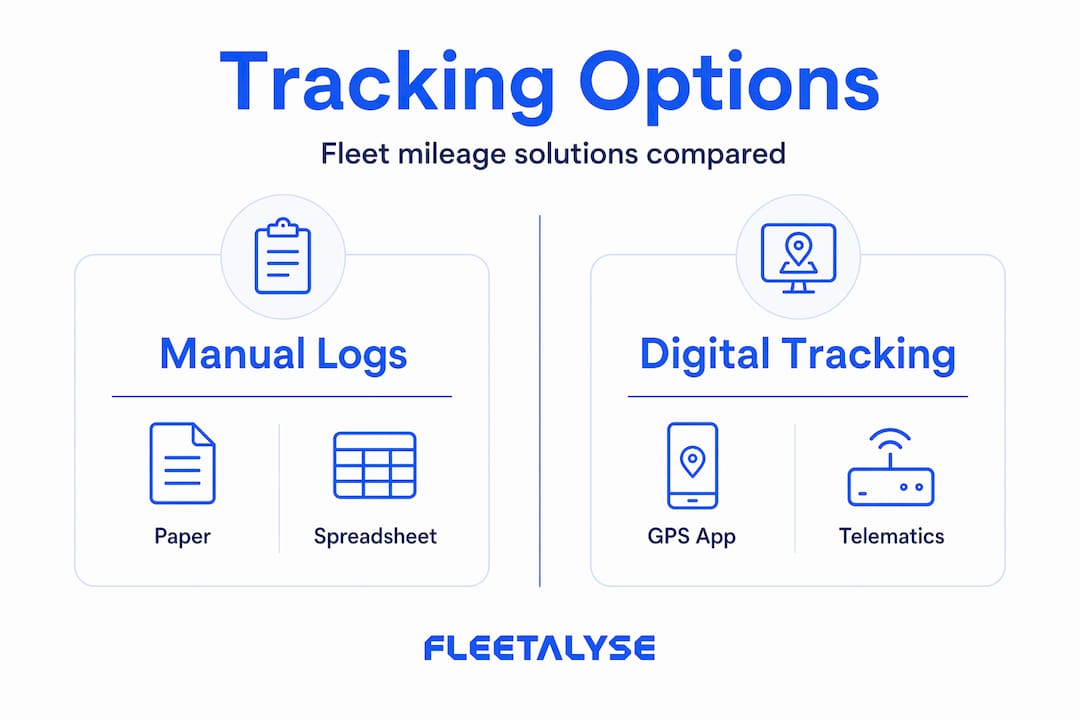
Mileage tracking apps such as those with automatic GPS trip logging and business/personal classification can work well for smaller fleets or self-employed drivers. For commercial van fleets, an integrated vehicle tracking system that ties mileage data directly to your fleet management platform is the most reliable approach.
Key questions to answer at this stage:
- How many vans are in your fleet, and do drivers take vehicles home overnight?
- Do your vans operate fixed routes or variable ones?
- How much private mileage occurs, and do drivers need to log their own journeys?
- Will the data be used solely for tax purposes, or also for operational optimisation?
Legal considerations you cannot skip
UK GDPR requires that any fleet tracking data be managed under a legitimate lawful basis, with clear communication to employees about what is being collected, why, and for how long. Legitimate interests is generally the preferred basis for commercial fleet tracking, but it requires documented justification.
You must also define business versus private mileage clearly in your written policy before deployment. GPS data alone is insufficient if the business purpose or policy conditions are not clearly articulated. Drivers need to understand what qualifies as a business journey and how to classify their trips.
Pro Tip: Draft a one-page mileage policy before deploying any tracking system. It should define business trips, private trips, commuting exclusions, and how disputes are handled. Share it with drivers and get signed acknowledgement.
Choosing and installing your tracking technology
With your groundwork in place, you can now select and install the right system. This is where the investment decisions happen, and where cutting corners tends to be most costly.
Comparing your technology options
| Option | Best for | Key limitations |
|---|---|---|
| Mileage tracking app | Small fleets, self-employed drivers | Relies on driver to open app; no passive tracking |
| Standalone GPS tracker | Small to medium fleets needing basic location data | Limited reporting; may not integrate with fleet software |
| Integrated telematics platform | Medium to large van fleets | Higher upfront cost; requires configuration |
Modern telematics platforms reduce mileage disputes through accurate, automatic logging and provide fleet managers with analytics for optimisation. If you are running more than five vans, the administrative time saved by automatic journey detection alone justifies the step up from a basic app.
Steps to select and install your system
- Define your must-have software features. Look for automatic journey detection, business/personal classification, HMRC-compliant report export, and integration with your expense or accounting system.
- Evaluate hardware installation requirements. Plug-and-play OBD port devices require no professional installation and cause zero vehicle downtime. Hardwired units offer more data depth but require a fitter.
- Shortlist two or three providers and request a trial or demonstration with your actual fleet type. Van telematics can behave differently to HGV-focused systems.
- Set up driver accounts and permissions. Each driver should have individual login credentials. Permissions should reflect their role, whether that is journey classification only, or full access to their own mileage history.
- Run a parallel-tracking period. For the first two to four weeks, run your new system alongside your existing method. This surfaces discrepancies early and gives drivers time to adjust.
Pro Tip: When evaluating GPS tracking solutions, ask specifically whether the system can produce a report formatted to HMRC mileage log requirements. Many platforms produce usage reports that look useful but do not meet the precise data fields inspectors expect.
Training is not a one-off event. Schedule a brief refresher after the first month of live use. Driver behaviour around journey classification tends to drift without reinforcement.
Configuring your setup for compliance and operations
Getting the technology installed is only half the job. Configuration determines whether your data is actually useful and legally defensible.
HMRC and data retention requirements
Companies must retain mileage and tracking data for six years to comply with HMRC and legal requirements. Your fleet mileage monitoring system should be configured to archive records in an unaltered, accessible format for that full period. Cloud-based platforms typically handle this automatically, but verify the retention settings in your account configuration rather than assuming the default is sufficient.
VAT road fuel scale charges
If your business reclaims VAT on fuel used in company vans where private use occurs, you must apply VAT Road Fuel Scale Charges. Updated scales from May 2026 apply to accounting periods of one, three, or twelve months and are based on vehicle CO2 emissions. Accurate CO2 data integration is therefore not a nice-to-have. Your tracking system should store or link to each vehicle’s CO2 rating so that fuel scale charges can be calculated correctly each period.
Key configuration points to cover
- Journey classification rules. Configure automatic classification where possible, with driver override capability for edge cases. Commuting must be excluded from business mileage per HMRC rules.
- Geofencing for site arrivals and departures. Setting geofences around depots, client sites, and home postcodes helps automate journey type detection and reduces driver input burden.
- Data minimisation settings. Under UK GDPR, you should only collect data proportionate to your stated purpose. Systematic GPS monitoring at high intensity may require a Data Protection Impact Assessment before deployment.
- Employee communication records. Store evidence that drivers were briefed on the tracking system, including what data is collected, how it is used, and how long it is retained. Transparency reduces tribunal risk if GPS data is later used in a disciplinary context.
- Mixed mileage separation. For vans used for both business and private trips, configure the system to flag and separately total each category. Mixed mileage must be handled carefully to maintain tax-allowable claims.
Data table: compliance configuration checklist
| Configuration item | Requirement | Action |
|---|---|---|
| Journey log fields | HMRC: date, start, end, purpose, miles | Verify all fields captured automatically |
| Data retention period | Six years minimum | Check archive settings in platform |
| VAT fuel scale charges | CO2-based, updated May 2026 | Link vehicle CO2 data to fuel records |
| GDPR lawful basis documentation | Legitimate interests justification | Draft and store written record |
| DPIA completion | Required for high-intensity monitoring | Conduct before full deployment |
| Driver briefing records | Evidence of transparency | Store signed acknowledgements |
Troubleshooting and optimising your mileage tracking
Even a well-configured system will encounter issues. Knowing what to look for, and how to fix it, keeps your data reliable and your drivers on side.
Common issues and how to address them
GPS inaccuracy is the most frequent complaint. In urban areas with tall buildings, satellite signal bounce can add phantom mileage or misplace journey start points. Choose a provider whose hardware uses multi-constellation GPS (combining GPS, GLONASS, and Galileo signals) for better accuracy in dense environments.
Missing journey data usually points to one of two causes: hardware connectivity problems, such as a loose OBD connection, or driver behaviour, such as unplugging the device. Set up automated alerts for device disconnection so you can address these immediately rather than discovering gaps at month end.
Driver non-compliance is a people problem, not a technology problem. The solution is not more surveillance. It is clearer communication about why the data matters and what it is used for. When drivers understand that accurate mileage records protect their reimbursements as much as they protect the business from HMRC scrutiny, compliance rates improve significantly.
Improving data quality and fleet insight
- Audit mileage reports monthly against fuel card records and vehicle odometer readings. Significant discrepancies flag either hardware issues or classification errors.
- Use automated mileage reports to identify vehicles with unusually high private mileage, which may indicate policy misuse or a need to reconfigure journey classification rules.
- Review routing data quarterly. Effective fleet management software combines GPS tracking with analytics and route optimisation, which can surface repeating inefficiencies such as drivers taking significantly longer routes between the same two points.
- Update your mileage policy annually. HMRC approved mileage rates, VAT fuel scale charges, and GDPR guidance all change. A policy that was compliant eighteen months ago may not reflect current requirements.
Pro Tip: Set up a brief quarterly check-in with drivers where you share anonymised fleet mileage data. Showing drivers the aggregate picture, such as total business miles logged or average journey length, builds buy-in and surfaces concerns before they become compliance problems.
My take on van fleet mileage tracking in the UK
I have worked alongside fleet managers who treat mileage tracking as a pure compliance exercise and others who see it as operational intelligence. The ones who get the most value are firmly in the second camp.
Here is the uncomfortable truth: many fleets get tracking in place, tick the compliance box, and then never look at the data again beyond processing reimbursements. That is a significant missed opportunity. The same data that satisfies HMRC also tells you which routes are consistently over-long, which vehicles are clocking disproportionate private mileage, and where your fuel costs are creeping upward without explanation.
In my experience, the biggest failure point is not technology. It is the gap between deploying a system and actually embedding it into daily operations. Drivers need to understand why the system exists. Managers need to check reports consistently, not just when an audit looms. And policies need to be living documents, not something written at setup and forgotten.
The regulatory picture in the UK is also not static. VAT road fuel scale charges update annually. GDPR enforcement guidance evolves. HMRC’s expectations around contemporaneous records are being applied more strictly as digital audit trails become standard. Proactive operators build review cycles into their calendar rather than reacting when something goes wrong.
Sustained success with mileage tracking comes from treating it as an ongoing management discipline, not a one-time installation.
— Vytautas
How Fleetalyse supports your mileage tracking setup
If you are ready to move beyond spreadsheets and basic apps, Fleetalyse offers a UK-built telematics platform designed specifically for commercial van and mixed fleets. The system provides real-time GPS vehicle tracking, automatic journey logging, and fleet compliance tools that align with HMRC mileage log requirements and UK GDPR obligations.
Hardware installation is designed for zero downtime. Plug-and-play telematics units connect without specialist fitting, and UK-based support is available throughout setup and beyond. Automated mileage reports are generated without manual input, reducing administrative workload and giving you audit-ready records at any point.
You can explore the full range of GPS trackers and dashcams available through Fleetalyse, or browse the fleet tracking solutions to find the configuration that suits your fleet size and operational needs. Once your hardware arrives, register your tracker to activate live monitoring immediately.
FAQ
What data must a mileage log contain for HMRC?
Every entry must include the date, journey start point, destination, business purpose, and miles driven. Records must be contemporaneous and retained for at least six years.
Is GPS tracking of company vans legal in the UK?
Yes, provided it is conducted under a legitimate lawful basis such as legitimate interests, employees are clearly informed, and data is handled in line with UK GDPR. A Data Protection Impact Assessment may be required for high-intensity monitoring.
How do I separate business and private mileage in a tracking system?
Configure your vehicle tracking system to classify journeys by type, using geofencing and driver input to flag private trips. Mixed mileage must be separated clearly to maintain tax-allowable claims under HMRC rules.
What are VAT road fuel scale charges and how do they affect my setup?
These are fixed VAT charges applied when a business reclaims VAT on fuel where private use also occurs. From May 2026, charges are based on vehicle CO2 emissions and accounting period length, so your tracking system should store CO2 data for each vehicle.
How long should I retain fleet mileage tracking records?
Retain mileage and tracking records for a minimum of six years to satisfy HMRC inspection requirements. Digital records are accepted provided they are unaltered and accessible.