


Van fleet safety policy explained for UK fleet managers

A van fleet safety policy is defined as an integrated operational framework that governs every safety-related decision across a commercial van fleet, from driver screening to vehicle maintenance and incident response. Fleet managers and safety officers in the UK operate under obligations set by the Department for Transport and the Health and Safety Executive, making a documented policy a legal and operational necessity. With commercial auto insurance premiums rising up to 30% and regulatory scrutiny intensifying, a well-structured fleet safety policy is the clearest line between controlled risk and costly liability. This guide covers van fleet safety policy explained in full, including its core components, technology integration, common pitfalls, and compliance benefits.
What are the essential components of a van fleet safety policy?
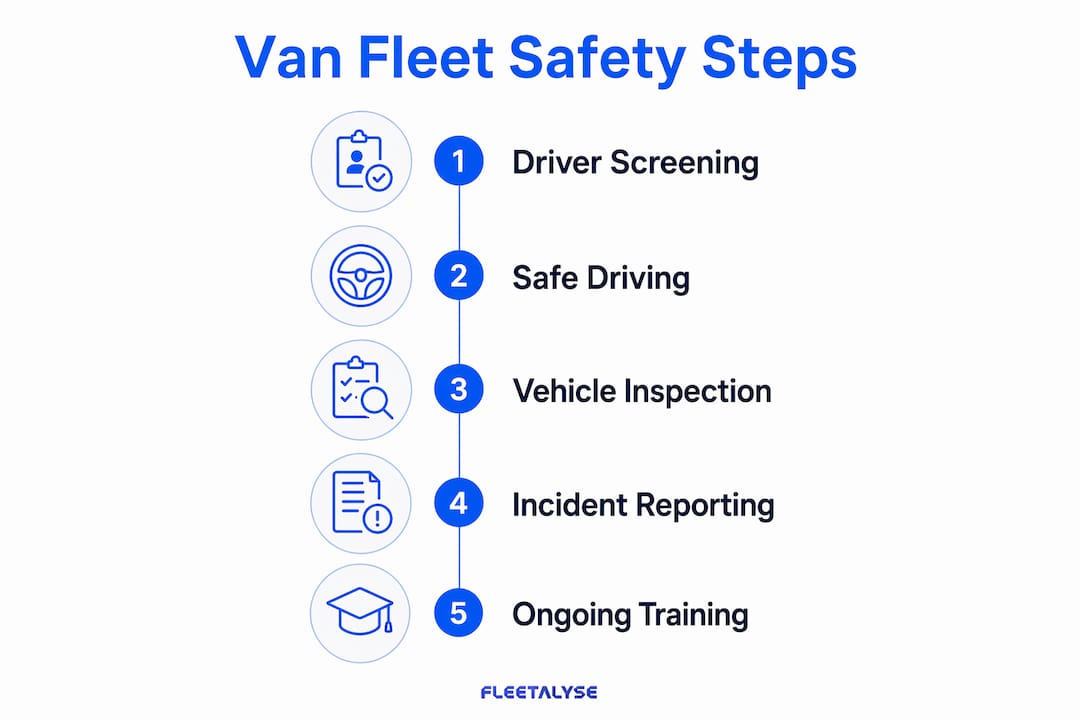
A van fleet safety policy works only when it covers every operational layer, not just broad intentions. The industry term for this structured approach is a fleet safety management system, and the policy document is its written foundation. Each component below carries a specific function and connects directly to compliance with UK vehicle safety guidelines.
Driver qualification and screening
Every policy must define minimum driver standards before a driver operates a company van. This includes DVLA licence verification, endorsement checks, and minimum experience thresholds. Defining disqualified drivers by licence points and specific violations gives fleet managers the authority to remove high-risk drivers before an incident occurs. Without this criterion written into the policy, enforcement becomes subjective and legally exposed.
Safe driving standards
The policy must state non-negotiable behavioural rules in plain language. Zero tolerance on handheld phone use while driving is the clearest example of a standard that must be enforced consistently. Seatbelt compliance, speed limit adherence, and rules on fatigue management all belong in this section. Vague language here creates gaps that drivers and their legal representatives will exploit after an incident.
Vehicle maintenance and inspection
Van fleets must comply with Department for Transport requirements including annual MOT, documented pre-use checks, and scheduled maintenance records. The policy should specify who is responsible for each check, the frequency, and what happens when a vehicle fails an inspection. A vehicle taken off the road for a defect must have a documented trail to demonstrate due diligence.

Incident reporting and corrective action
Incident reports must be submitted within 24 hours and supported by photographs, driver statements, and telematics data. That 24-hour rule matters because evidence degrades quickly and insurers require prompt notification. Corrective action must be linked directly to investigation findings, ranging from retraining to formal discipline.
Driver training and ongoing education
New drivers require a baseline training course covering company policy, vehicle familiarisation, safety practices, and the consequences of violations. Training should not stop at onboarding. Refresher sessions tied to telematics data, near-miss events, or regulatory changes keep safety culture active rather than theoretical.
How do modern technologies enhance van fleet safety policies?
Technology transforms fleet safety from a reactive compliance exercise into a proactive risk management system. As of early 2026, 80% of fleet professionals use GPS tracking, yet many still lack the structured risk management processes to act on the data they collect. The gap between data collection and data use is where most fleets lose value.
GPS tracking gives fleet managers real-time visibility into vehicle location, speed, and route compliance. Telematics goes further by capturing driver behaviour metrics such as harsh braking, rapid acceleration, and cornering force. These metrics are leading indicators of risk, meaning they predict incidents before they happen rather than simply recording them after the fact.
Video telematics adds a critical layer of context. 46% of fleets now use video telematics, and among those users, 74% report improved safety outcomes. Collision reductions of up to 80% have been recorded in the first year of deployment. That figure reflects what happens when drivers receive immediate, evidence-based feedback rather than a generic monthly report.
Real-time in-cab alerts notify drivers the moment a threshold is breached, whether that is a speed limit, a seatbelt sensor, or a harsh braking event. This closes the feedback loop instantly rather than waiting for a weekly manager review. Van GPS trackers from Fleetalyse are built specifically for commercial van fleets and integrate directly with driver behaviour monitoring dashboards.
Pro Tip: Use telematics data trends for proactive coaching sessions rather than reactive investigations. Reviewing the top five highest-risk drivers each week and addressing behaviour before an incident occurs reduces incident rates far more effectively than post-event discipline.
What are the key challenges and pitfalls in implementing a van fleet safety policy?
The most common failure in fleet safety policy implementation is treating the document as a static HR file rather than an operational manual. A policy filed in a drawer and reviewed once a year does not change driver behaviour. It simply creates a paper trail that may not hold up under scrutiny from the Health and Safety Executive or an insurer.
The following pitfalls account for the majority of policy failures across UK van fleets:
- No defined disqualification criteria. Without explicit licence point thresholds and violation categories written into the policy, managers lack the authority to remove unsafe drivers. Ambiguity protects the driver, not the fleet.
- Weak leadership commitment. An effective fleet safety policy requires active leadership buy-in. When senior managers ignore the policy or grant exceptions, drivers notice immediately and compliance drops across the board.
- Inconsistent incident reporting. Policies that require reporting but do not enforce the 24-hour submission rule produce incomplete records. Incomplete records undermine both corrective action and insurance claims.
- Under-utilisation of technology. Collecting telematics data without acting on it is a missed opportunity. Fleets that generate reports but never conduct coaching sessions gain no safety benefit from the investment.
- Failure to update the policy. Regulations change, vehicle types change, and driver populations change. A policy written in 2022 and never revised may already be non-compliant with current Department for Transport standards.
Pro Tip: Schedule a formal policy review every six months, not annually. Tie the review date to your insurance renewal so that updated documentation is always ready for underwriters.
The risks in commercial vehicle operation extend well beyond road incidents. Cargo security, driver fatigue, and vehicle roadworthiness all feed into the same risk register. A policy that addresses only driving behaviour misses a significant portion of the liability exposure your fleet carries.
How does a van fleet safety policy support compliance and financial risk mitigation?
A documented safety policy is the primary evidence that a fleet operator has met its duty of care under UK law. The Health and Safety Executive and the Department for Transport both expect operators to demonstrate active safety management, not just intent. Without documentation, a fleet has no defence when an incident leads to investigation or prosecution.
The financial case for a well-maintained policy is equally direct. Documented safety policies influence insurance premiums and risk evaluations, with insurers increasingly requiring evidence of telematics use, driver screening, and incident reporting procedures before offering competitive rates. A fleet with a strong safety record and documented processes negotiates from a position of strength at renewal.
A van fleet safety policy is not a compliance cost. It is a financial instrument. Fleets that treat it as operational infrastructure consistently pay lower premiums, face fewer claims, and recover faster from incidents because their documentation is already in order.
The table below maps the key compliance and financial benefits of a structured safety policy:
| Policy element | Compliance benefit | Financial benefit |
|---|---|---|
| Driver screening and disqualification criteria | Meets HSE duty of care requirements | Reduces high-risk driver exposure and claim frequency |
| Documented vehicle inspections | Satisfies DfT roadworthiness standards | Prevents costly enforcement penalties and off-road downtime |
| Incident reporting within 24 hours | Supports legal defence and audit readiness | Accelerates insurance claim resolution |
| Telematics and behaviour monitoring | Demonstrates active safety management | Provides evidence for premium negotiation |
| Regular policy reviews | Maintains alignment with current regulations | Reduces liability from outdated procedures |
Audit readiness is a practical benefit that fleet managers often underestimate. When the DVSA conducts a roadside check or an insurer requests documentation after a claim, the fleet that produces complete records within hours is treated very differently from one that cannot locate its inspection logs.
Key takeaways
A van fleet safety policy is the operational backbone of compliant, cost-controlled commercial van operations, and its value depends entirely on active implementation, not just documentation.
| Point | Details |
|---|---|
| Define disqualification criteria | Write explicit licence point thresholds into the policy to give managers authority to remove unsafe drivers. |
| Use telematics proactively | Act on driver behaviour data weekly through coaching, not just after incidents occur. |
| Document everything | Inspection records, incident reports, and training logs are your legal defence and insurance leverage. |
| Commit leadership visibly | Safety culture collapses without senior managers modelling and enforcing the policy consistently. |
| Review every six months | Align policy reviews with insurance renewals to keep documentation current and audit-ready. |
Why most van fleet safety policies fail before they start
Fleet managers often ask me what separates the fleets that genuinely improve their safety record from those that simply accumulate paperwork. The answer is almost always the same: leadership behaviour in the first 90 days after a policy is introduced.
I have seen well-written policies collapse within weeks because a senior manager granted an exception for a high-mileage driver with three points on his licence. That single decision signals to every driver that the policy is negotiable. From that point, enforcement becomes a battle rather than a standard.
The fleets that succeed treat the policy as a living document tied to real operational data. They hold monthly reviews of telematics reports, they conduct coaching conversations based on evidence, and they update the policy when regulations or fleet composition changes. The document itself is almost secondary. What matters is the habit of using it.
Technology is the enabler, not the solution. A GPS tracking and dashcam platform gives you the data to have credible conversations with drivers. Without that data, coaching is opinion. With it, coaching is fact-based and far harder to dismiss.
My strongest advice to any fleet manager implementing or revising a van safety policy is this: start with the disqualification criteria. Write them down, get sign-off from HR and legal, and communicate them to every driver on day one. That single act of clarity does more for safety culture than any amount of general guidance about “driving responsibly.”
— Vytautas
How Fleetalyse supports your van fleet safety policy
Putting a safety policy into practice requires more than good intentions. Fleetalyse gives UK fleet managers the tools to monitor, enforce, and evidence every element of their safety framework in real time.
From van GPS trackers that capture live location and driver behaviour data, to smart dashcams that provide video evidence for incident investigations, Fleetalyse integrates hardware and software into a single compliance platform. Automated driver behaviour reports, maintenance scheduling alerts, and DVSA-aligned documentation tools mean your policy stays operational rather than theoretical. Fleet managers across the UK use Fleetalyse to negotiate better insurance terms, pass DVSA audits, and build the kind of safety culture that holds up under scrutiny. Visit Fleetalyse to see how the platform supports your fleet’s safety and compliance needs.
FAQ
What is a van fleet safety policy?
A van fleet safety policy is a documented operational framework that defines driver standards, vehicle maintenance requirements, safe driving rules, and incident reporting procedures for commercial van fleets. It serves as both a legal compliance document and a practical management tool.
What regulations govern van fleet safety in the UK?
UK van fleets must comply with Department for Transport requirements, including annual MOT and documented inspections, as well as Health and Safety Executive duty of care obligations for employers operating vehicles at work.
How does telematics improve fleet safety policy enforcement?
Telematics captures driver behaviour data such as harsh braking and speeding, giving fleet managers evidence-based grounds for coaching and corrective action. Fleets using video telematics report safety improvements in 74% of cases.
How often should a van fleet safety policy be reviewed?
A van fleet safety policy should be reviewed at least every six months, with updates triggered by regulatory changes, fleet composition changes, or insurance renewal requirements.
Can a safety policy reduce commercial vehicle insurance premiums?
Yes. Documented safety policies, telematics records, and incident reporting procedures give insurers evidence of active risk management, which supports premium negotiation and can offset the rising cost of commercial auto cover.