


Vehicle tracking features checklist for UK fleets

Choosing the right vehicle tracking features for your fleet is rarely straightforward. The market has matured considerably, and what was once a simple question of “does it show me where my vehicles are?” has become a far more layered decision involving compliance obligations, driver safety, fuel accountability, and software usability. With UK transport regulations tightening and telematics platforms in 2026 shifting from passive trackers to active performance engines, this vehicle tracking features checklist will give you a practical framework for evaluating what your fleet actually needs.
Table of Contents
- Key takeaways
- Your vehicle tracking features checklist: core evaluation criteria
- 1. Real-time GPS location tracking
- 2. Geofencing and virtual boundary management
- 3. Driver behaviour monitoring
- 4. Vehicle maintenance alerts and predictive diagnostics
- 5. Fuel consumption and idling monitoring
- 6. Emergency SOS and panic button integration
- 7. Tamper detection and device disconnection alerts
- 8. Historical trip playback and detailed reporting
- 9. Integration with compliance and fleet management systems
- Comparing vehicle tracking platforms in 2026
- Tailoring your checklist to your fleet’s operational profile
- My honest take on selecting vehicle tracking features
- How Fleetalyse supports your vehicle tracking checklist
- FAQ
Key takeaways
| Point | Details |
|---|---|
| Start with installation type | Your hardware choice affects data reliability, tamper resistance, and long-term cost. |
| Compliance is non-negotiable | UK public transport vehicles must now carry mandatory location tracking and panic buttons. |
| Match features to fleet profile | Delivery fleets and asset-heavy fleets need different core features to maximise return on investment. |
| Software usability matters as much as features | A poorly designed dashboard wastes time and undermines data-driven decisions. |
| AI features require careful evaluation | Predictive maintenance and driver coaching add genuine value, but only when implemented with clear data governance. |
Your vehicle tracking features checklist: core evaluation criteria
Before you compare individual features, you need a foundation for assessment. The best feature set in the world is worthless if the underlying system is unreliable or difficult to use.
Installation type is your first decision. Hardwired GPS trackers offer continuous power, ignition sensing, and tamper alert capabilities, making them the preferred choice for permanent fleet deployments. OBD-II plug-in units are quicker to install but are visible and easily removed, which limits their suitability for higher-security or HGV operations. Battery-powered trackers work well for assets and trailers where no power source is available.
Reporting frequency varies significantly between providers. Some platforms update location every 30 seconds; others update every two to five minutes. For urban delivery fleets, frequent updates matter. For long-haul HGVs operating on motorways, a two-minute interval is usually sufficient.
Here are the core criteria to assess before moving to individual features:
- Network compatibility: 4G/5G and satellite hybrid networks maintain coverage across rural UK terrain and urban dead zones
- Software interface: dashboards should surface actionable data without requiring a data analyst to interpret them
- Data ownership: confirm in any contract that you own your fleet data, not the vendor
- Compliance readiness: UK public service vehicles now require mandatory location tracking devices and panic buttons, with retrofitting required for vehicles registered before late 2018
Pro Tip: Ask any prospective vendor to demonstrate the dashboard live using a sample dataset similar to your fleet size. How quickly can you answer “where is vehicle X and what has it done today?” If it takes more than three clicks, the interface will slow your team down.
1. Real-time GPS location tracking
The foundation of any fleet management checklist is live location visibility. Modern GPS tracking features go well beyond dots on a map. You should expect accurate positioning with updates frequent enough to reflect actual vehicle movement, combined with map overlays that show road-level detail, traffic conditions, and points of interest relevant to your routes.

For mixed fleets running HGVs and vans, ensure the platform distinguishes between vehicle types on the map view. It sounds basic, but many operators discover too late that their tracking system treats a 44-tonne artic and a Transit van as identical assets.
2. Geofencing and virtual boundary management
Geofencing creates virtual boundaries around defined zones, triggering alerts when vehicles enter or exit. This is critical for security, site access management, and verifying delivery compliance. A vehicle that should not leave a depot overnight but does is a theft risk. A vehicle that departs a customer site without completing a delivery is a service failure.
The best platforms allow you to set multiple geofences with different alert rules. An overnight boundary for your depot is very different from a customer arrival notification, and your system should handle both without manual workarounds.
3. Driver behaviour monitoring
Driver behaviour data gives you measurable insight into how your vehicles are actually being operated. Look for monitoring of harsh braking, rapid acceleration, sharp cornering, seatbelt non-use, and excessive idling. Real-time alerts for harsh driving and tampering allow you to address problems before they become accidents or insurance claims.
Scoring systems that rank drivers over time are particularly useful for coaching conversations. Rather than reacting to individual incidents, you can identify patterns. A driver who consistently brakes hard on a particular route may be dealing with a timing issue, not carelessness.
4. Vehicle maintenance alerts and predictive diagnostics
Reactive maintenance is expensive. A tracking platform that reads diagnostic fault codes and flags upcoming service intervals turns your vehicles from unpredictable assets into managed ones. AI-driven predictive maintenance analyses real-time engine data to pre-empt faults before they cause breakdowns, reducing unplanned downtime considerably.
For HGV operators, integration with tachograph data adds a further layer. Knowing that a vehicle is approaching a service interval at the same time as a driver approaches their hours limit allows you to plan both in a single scheduling decision.
5. Fuel consumption and idling monitoring
Fuel is consistently one of the largest controllable costs in fleet operations. A good system will show fuel consumption per vehicle, per route, and per driver. Idling data is particularly revealing. Drivers who idle for 20 minutes at a collection point every day across a 50-vehicle fleet represent a significant and entirely avoidable cost.
Pro Tip: When reviewing a vehicle tracking software comparison, ask vendors for sample fuel reports from fleets similar in size and vehicle type to yours. Generic demo data rarely reflects the reporting depth you will actually need.
6. Emergency SOS and panic button integration
For passenger transport, lone workers, and high-risk delivery environments, emergency functionality is not optional. The SOS or panic button allows a driver to signal distress without making a voice call. The platform should immediately alert your control room with the vehicle’s live location and recent route history.
As noted earlier, compliance for public service vehicles in the UK now mandates panic button installation. Even if your fleet operates outside that specific regulation, the feature carries clear duty-of-care value for any operation involving lone drivers.
7. Tamper detection and device disconnection alerts
If a driver or third party disconnects your tracking device, you need to know immediately. Tamper detection alerts are standard on hardwired units but often absent from OBD plug-in trackers, which are easily removed and lack discretion in higher-security contexts. Your vehicle tracking essentials list should include this feature as non-negotiable for any fleet where vehicle misuse or theft is a realistic risk.
Disconnection alerts should reach your operations team within seconds, not minutes, and include the last known location before signal loss.
8. Historical trip playback and detailed reporting
Live tracking tells you where vehicles are. Historical playback tells you what actually happened. Trip history with full route replay, stop durations, speed profiles, and driver identification gives you the evidence base for everything from customer disputes to insurance claims to DVSA compliance checks.
Fleet management software features including route optimisation and delivery confirmation integrate most effectively when underpinned by solid historical data. Reporting should be schedulable and exportable, not something your transport manager has to manually compile each week.
9. Integration with compliance and fleet management systems
A tracking system that operates in isolation from your tachograph data, vehicle inspections, and driver licence checks creates more administrative work, not less. Look for platforms that offer open API connectivity or pre-built integrations with your existing transport management system. This is the difference between a tracking tool and a genuine fleet operations platform.
For UK operators working under DVSA oversight and Operator Licence conditions, the ability to pull tracking data into compliance records is a substantial time saver during audits.
Comparing vehicle tracking platforms in 2026
The vehicle tracking software comparison process has become more nuanced as platforms specialise. The table below outlines the key differentiators you should assess:
| Feature area | What to look for | Why it matters |
|---|---|---|
| AI driver coaching | In-cab voice feedback, real-time scoring | Reduces incidents without manager intervention |
| Predictive maintenance | CAN-bus integration, fault code reading | Cuts unplanned downtime and repair costs |
| Video telematics | Front and driver-facing cameras, event triggers | Provides evidence for insurance and coaching |
| Network coverage | 4G/5G plus satellite fallback | Maintains tracking across rural UK routes |
| Analytics depth | Custom reports, KPI dashboards, data export | Supports compliance and operational decisions |
Beyond the feature comparison, pricing structures vary widely. Some vendors charge per vehicle per month with all features included; others use modular pricing where you pay separately for video, analytics, and compliance tools. For mixed fleets, modular pricing can work in your favour. For smaller operators wanting simplicity, a flat-rate model is usually preferable.
The transport industry professionals who work closest with telematics implementations consistently flag integration capability as the feature most often overlooked during procurement. A system that cannot talk to your existing tools will create data silos rather than resolving them.
Tailoring your checklist to your fleet’s operational profile
Not every feature belongs on every fleet’s priority list. Tailoring your approach saves budget and reduces implementation complexity.
- Delivery fleets should prioritise real-time tracking, geofencing, electronic proof of delivery integration, and route optimisation tools that improve drop efficiency
- Asset-heavy fleets benefit most from maintenance scheduling, fuel management, and asset-specific trackers for trailers and non-powered equipment
- Passenger transport operators need panic buttons, passenger counting integration, and compliance-ready location data for regulatory submissions
- Small fleets should focus on simplicity: real-time tracking, driver behaviour scoring, and basic maintenance alerts before considering advanced analytics
- Large mixed fleets require scalable platforms with multi-user access, role-based permissions, and integration with enterprise transport management systems
Pro Tip: Before finalising your vehicle tracking essentials list, map out every report your operations team currently produces manually. If a tracking platform cannot automate at least half of them, you are not getting full value from the investment.
Regulatory compliance sits across all fleet types. UK operators must account for DVSA inspection readiness, Operator Licence conditions, Working Time Directive monitoring for drivers, and, where applicable, mandatory location device requirements for public transport vehicles.
My honest take on selecting vehicle tracking features
I’ve worked with fleet operators at every scale, and the pattern I see most often is this: managers spend 80% of their evaluation time comparing GPS accuracy and feature lists, and almost no time assessing whether the software is actually usable by their operations team.
A platform with 40 features that requires a specialist to extract useful reports is worth less in practice than a simpler system that your transport clerk can interrogate in two minutes. Dashboard usability and data clarity are genuinely undervalued in most procurement processes.
On the hardwired versus OBD debate: I lean strongly towards hardwired for any fleet vehicle that is on the road daily. The tamper risk with plug-in units is real, and the data continuity you get from a hardwired unit pays for the slightly higher installation cost within months.
My caution around AI features is not that they lack value. It is that they require good underlying data to function well. If your driver records are incomplete or your vehicles have inconsistent CAN-bus coverage, AI coaching and predictive alerts will generate noise rather than insight. Get your data foundations right first.
The telematics industry in 2026 is producing genuinely impressive tools. But the best vehicle tracking tools are the ones your team will actually use consistently, not the ones with the longest feature catalogue.
— Vytautas
How Fleetalyse supports your vehicle tracking checklist
If you have worked through this checklist and realised your current system is leaving gaps, particularly around compliance, driver behaviour, and maintenance visibility, Fleetalyse is worth a close look.
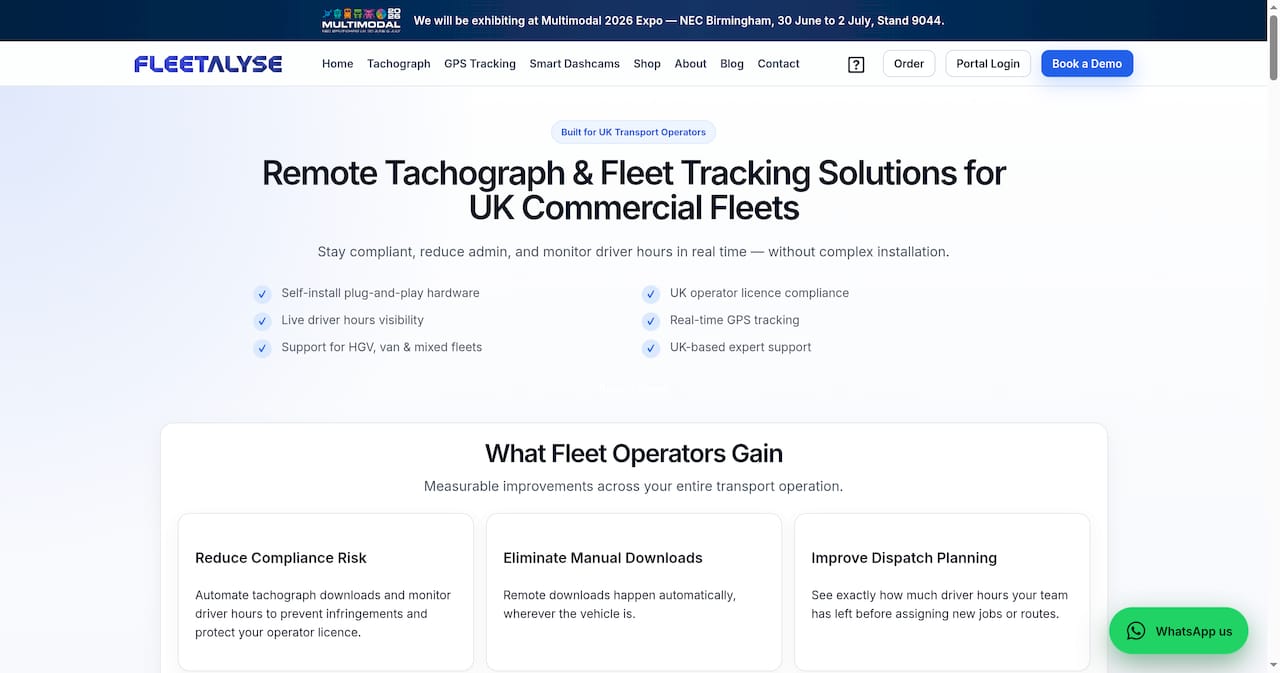
Fleetalyse is a UK-based telematics platform built specifically for commercial fleet operators. It covers GPS fleet tracking alongside remote tachograph downloads, driver behaviour monitoring, and smart dashcam integration. The platform supports HGVs, vans, trailers, and mixed assets, with plug-and-play hardware that does not require a specialist for installation. Whether you manage 10 vehicles or 500, the system scales to your operational profile.
You can explore the full range of vehicle GPS trackers and fleet tracking solutions directly on the Fleetalyse website. UK-based support is available for setup, troubleshooting, and compliance queries, so you are never left trying to interpret a continental support script for a UK regulatory problem.
FAQ
What are the most important features on a vehicle tracking checklist?
Real-time GPS location, geofencing, driver behaviour monitoring, maintenance alerts, and tamper detection form the core of any fleet management checklist. Compliance-related features such as panic buttons are mandatory for UK public service vehicles.
Should I choose a hardwired or OBD tracker for my fleet?
Hardwired trackers are preferred for permanent fleet deployments because they offer continuous power, tamper alerts, and ignition sensing. OBD plug-in trackers are convenient but easier to remove, making them less suitable for high-security or heavy-duty fleet use.
How does geofencing work in vehicle tracking systems?
Geofencing sets virtual boundaries around defined locations and triggers instant alerts when a vehicle enters or exits those zones. It is widely used for depot security, customer arrival confirmation, and out-of-hours movement detection.
What should I look for in vehicle tracking software?
Prioritise usability, data clarity, and integration capability alongside the core GPS tracking features. A system that your operations team can use daily without specialist knowledge will deliver far more value than a complex platform that rarely gets fully utilised.
Are there UK-specific compliance requirements for vehicle tracking?
Yes. UK public service vehicles must now carry mandatory location tracking devices and panic buttons, with retrofitting required for older vehicles. Commercial operators must also account for DVSA regulations and Operator Licence conditions when selecting tracking systems.