

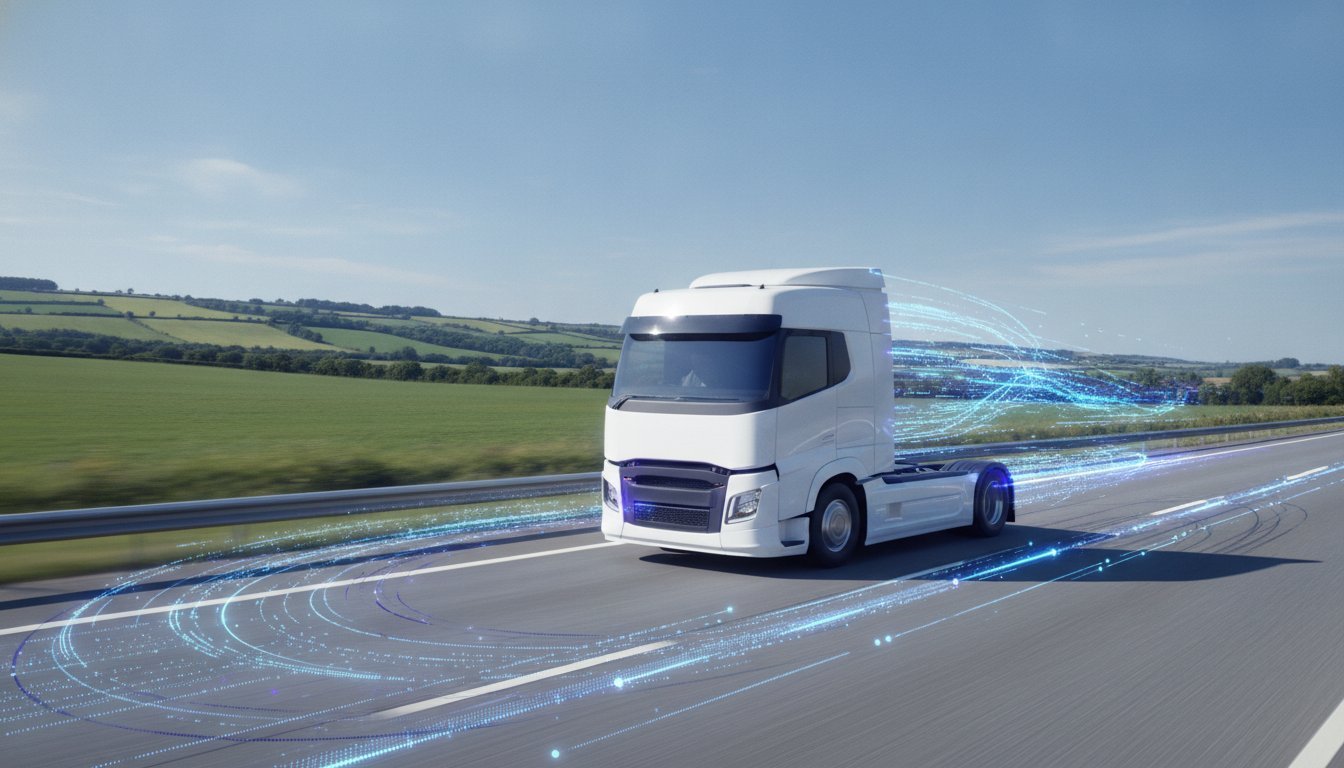
By mid-2026, the complete shutdown of UK 3G networks has turned traditional dashcams into a significant operational risk. Relying on manual SD card retrieval isn't just inefficient; it's a gamble with your business reputation. You've likely experienced the stress of defending a "crash-for-cash" scam only to find the footage is missing or the card is corrupted. These delays don't just cost money. They threaten your operator licence compliance and push insurance premiums higher.
This article explains why UK fleets need 4G dashcams in 2026 to bridge the gap between simple recording and live asset management. Upgrading to connected hardware is now essential to secure your fleet and maintain your standing with the ICO and FORS. We'll explore how instant evidence retrieval lowers insurance costs by up to 15% and protects your drivers on the road. You'll see how 4G video integrates with remote tachograph downloads to create a seamless, compliant operation that saves time and reduces accident rates.
Key Takeaways
- Understand the operational risks of the UK 3G sunset and why legacy hardware now creates critical data gaps for transport operators.
- Discover why UK fleets need 4G dashcams in 2026 to facilitate instant First Notification of Loss (FNOL) and reduce insurance costs.
- Learn how to integrate video evidence with remote tachograph downloads and live driver hours to strengthen your operator licence compliance.
- Explore how AI-powered Driver Monitoring Systems (DMS) identify fatigue and distraction to improve safety and protect vulnerable road users.
- Eliminate the inefficiencies of manual SD card retrieval by moving to automated, cloud-based data storage for instant incident access.
The 2026 Connectivity Shift: Why 4G Dashcams Are Now Mandatory
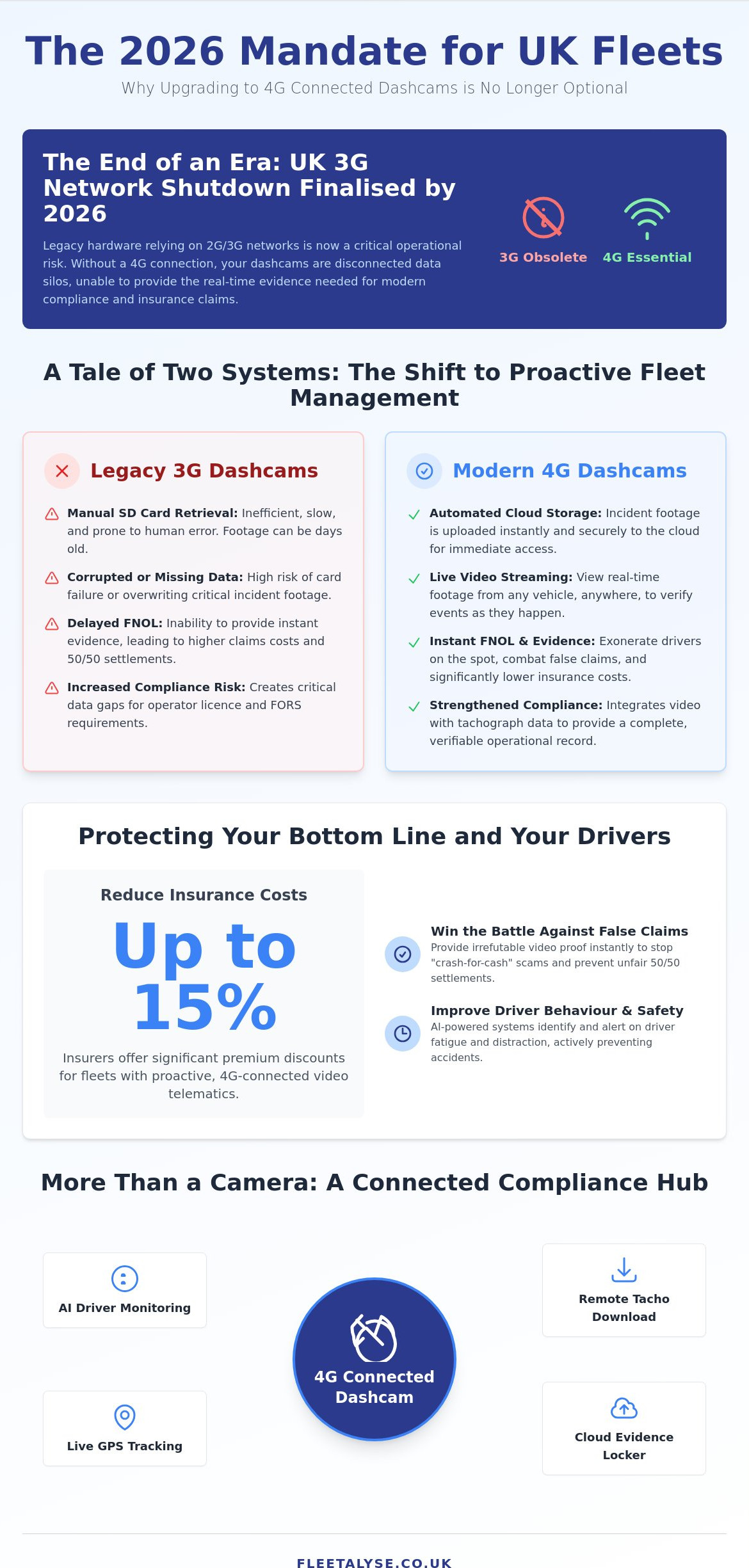
2026 marks a final deadline for UK transport operators. Legacy hardware that relied on 2G or 3G signals is now effectively obsolete. The UK's major network providers have completed their spectrum reallocation, leaving older devices disconnected. This is exactly why UK fleets need 4G dashcams in 2026. Without a modern connection, a dashcam is just a silent observer. It cannot alert you to an incident. It cannot stream footage. It becomes a liability rather than a tool for protection.
Modern hardware has evolved beyond simple recording. We no longer view these devices as isolated cameras. Instead, they are sophisticated IoT endpoints within a broader fleet telematics system. They provide the bandwidth required for high-definition cloud uploads and real-time AI processing. Moving from reactive SD card retrieval to proactive streaming ensures you have evidence before the vehicle even returns to the depot. By choosing 4G, you're investing in a stable infrastructure that supports GPS fleet tracking and remote data access simultaneously.
The Death of the 3G Network in the UK
The phase-out of 3G wasn't a sudden event, but its completion by 2026 has left many operators exposed. Vodafone, EE, and Three finalised their shutdowns to make room for more efficient 4G and 5G services. When the signal disappears, older dashcams lose their ability to transmit GPS data or "event" clips. You are left with a device that might be recording to an internal card, but you won't know if it has failed until it's too late. The 3G sunset means that any fleet hardware lacking 4G capability is now a disconnected island, unable to provide the real-time oversight required for modern compliance.
Reliability Amongst National Infrastructure
4G is the backbone of UK transport logistics. Whilst 5G offers incredible speeds in urban centres, 4G LTE-M and Cat-M1 provide the deep, consistent coverage needed on national trunk roads and rural routes. It is the "always-on" nature of 4G that matters most for HGVs. You need to know that if a driver brakes harshly on the M6, the footage is available instantly. 5G is not yet the primary requirement because 4G handles 1080p video streaming perfectly well without the higher hardware costs or the current coverage gaps of 5G networks.
- Consistent Coverage: 4G reaches the corners of the UK that 5G hasn't touched yet.
- Stability: 4G protocols are mature and reliable for high-speed moving assets.
- Cost Efficiency: 4G hardware provides the necessary speed for AI safety features without unnecessary expense.
This connectivity is the foundation of why UK fleets need 4G dashcams in 2026. It ensures that your safety data is never more than a few seconds away, regardless of where your vehicles are operating.
Protecting the Bottom Line: Insurance and Claims Management
Insurance premiums represent one of the largest fixed costs for any transport business. In 2026, the ability to control these costs hinges on speed. 4G dashcams facilitate First Notification of Loss (FNOL) within seconds of an impact. This immediate alert allows fleet managers to contact insurers before third-party credit hire and legal fees begin to spiral. It's a proactive approach to risk that legacy hardware simply cannot match. This financial safeguard is a primary reason why UK fleets need 4G dashcams in 2026.
Relying on manual SD card retrieval is no longer a viable business strategy. If a vehicle is involved in a collision hundreds of miles from the depot, you cannot wait days to verify the footage. By the time the card is in your hands, the third party may have already filed a claim. Connected technology ensures you have the evidence immediately. This removes the administrative burden of physically chasing cameras and allows your team to focus on core operations.
Winning the Battle Against False Claims
False claims and "crash-for-cash" scams remain a persistent threat to UK operators. Without clear video evidence, insurers often default to "50/50" settlements to avoid protracted legal battles. These settlements are a silent killer for your premiums. Instant video retrieval prevents the build-up of legal costs by providing irrefutable proof at the earliest possible stage. You can exonerate your drivers on the spot. This protects your claims history and your reputation with insurers.
Lowering Premiums Through Data-Driven Safety
Risk assessors now prioritise connected telematics over static safety policies. Insurers often offer discounts ranging from 8% to 15% for vehicles equipped with active dashcams. These systems provide the data needed to validate safe operating centres and verify that drivers are following approved routes. This transparency builds trust. It aligns your fleet with evolving UK government vehicle safety standards, positioning you as a low-risk partner for underwriters.
Modern insurance policies are increasingly making connected hardware a mandatory requirement. They want to see live driver behaviour and incident alerts integrated into your GPS fleet tracking software. This is why UK fleets need 4G dashcams in 2026 to remain insurable at competitive rates. If you're looking to upgrade your compliance and lower your overheads, you can explore our integrated hardware options to secure your fleet's future.
Improving Driver Behaviour and Safety Standards
Safety on the road is built on consistent, daily habits rather than occasional training days. This shift toward continuous improvement is exactly why UK fleets need 4G dashcams in 2026. By moving away from a "blame culture" and toward constructive coaching, operators can use high-definition footage to develop their team's skills. Video provides an objective truth that removes the friction from performance reviews. It allows transport managers to identify high-risk habits, such as tailgating or lane drifting, before they lead to a costly insurance claim or a mark against your operator licence.
The presence of a connected camera acts as a "silent witness" on every journey. It naturally encourages more professional behaviour amongst drivers, reducing instances of aggressive acceleration and harsh braking. However, we understand that privacy remains a concern for many long-haul professionals. Addressing this requires a transparent policy. Modern 4G systems often include physical privacy toggles for driver-facing lenses, ensuring that monitoring is only active during operational hours. This pragmatic approach respects the driver whilst protecting the business.
In-Cab Coaching and Real-Time Alerts
4G connectivity enables Advanced Driver Assistance Systems (ADAS) to function at their full potential. These systems provide immediate audible alerts for fatigue or distraction, acting as a second pair of eyes for the driver. Because the hardware is connected, these events are flagged to the office in real-time. This allows managers to provide support whilst the driver is still on the road, rather than waiting for an end-of-week download. It balances automated safety with the driver's autonomy, ensuring they stay focused on the road ahead.
Promoting a Culture of Safety
A safe fleet is a more efficient fleet. By integrating dashcam footage with GPS fleet tracking data, you can create comprehensive driver scorecards. These shouldn't just be used for discipline. Smart operators use "favourite" examples of defensive driving to incentivise the whole team. Recognising safe behaviour builds a positive culture where cameras are seen as a tool for protection rather than surveillance. This transparent communication is vital when introducing new technology to a regional workforce.
Investing in these standards is a proactive way to lower accident rates and maintain high compliance levels. It's another practical reason why UK fleets need 4G dashcams in 2026 to remain competitive in a demanding industry.
AI and Advanced Telematics: The 2026 Tech Standard
The role of a dashcam has changed. It's no longer just a digital witness to an accident that has already happened. In 2026, the standard for UK transport operators is proactive prevention. This shift toward intelligent analysis is a core reason why UK fleets need 4G dashcams in 2026. These devices act as powerful edge-computing hubs, using artificial intelligence to process visual data in real-time. Without the high-speed "pipe" provided by 4G, these safety features would be limited to local alerts, leaving the transport office in the dark until the vehicle returns.
Connected AI allows for a level of oversight that was previously impossible. It bridges the gap between raw video and actionable data. By processing information locally and uploading critical clips via 4G, these systems ensure that your management team only sees what matters. This reduces "alert fatigue" and ensures that genuine risks are addressed immediately. It's an efficient, practical way to manage a modern regional fleet.
Detecting Fatigue and Distraction
Driver Monitoring Systems (DMS) are now a critical component of fleet safety. These AI-powered sensors track eye movement and head position to identify the earliest signs of drowsiness or phone use. When a risk is detected, the 4G connection sends an immediate red-flag alert to your management platform. Advanced AI in 2026 can now distinguish between a standard blink and the onset of a micro-sleep with sub-second precision by analysing eyelid closure duration and frequency. This level of detail allows for immediate intervention, potentially saving lives and protecting your company's reputation.
Beyond the cab, object detection algorithms focus on vulnerable road users. This technology is vital for complying with the Direct Vision Standard (DVS) in Greater London. By identifying cyclists and pedestrians in blind spots, the system provides an extra layer of security that traditional mirrors cannot match. The 4G connection ensures that these "near-miss" events are automatically tagged and uploaded to the cloud, providing a clear audit trail of your fleet's safety performance.
Automated Compliance Reporting
Manual review of hours of footage is a thing of the past. Modern cloud platforms use AI to organise video files based on searchable metadata. You can filter for specific behaviours like harsh cornering or tailgating across your entire fleet in seconds. This automation is essential for maintaining the high standards required for FORS and CLOCS accreditation. It turns raw data into actionable insights for health and safety audits without requiring extra administrative staff.
The true power of this technology lies in its synergy with GPS fleet tracking. By overlaying video evidence with location data, you gain a complete picture of every journey. This integrated approach is why UK fleets need 4G dashcams in 2026 to stay ahead of regulatory changes and rising operational costs. To equip your vehicles with the latest AI-driven safety hardware, you can order your connected dashcam systems here to begin protecting your assets today.
Integrating Video with Fleetalyse Compliance Solutions
Compliance is about more than just ticking boxes. It's about having a complete, irrefutable record of your operations. Whilst tachograph data provides a precise timeline of a driver's day, it often lacks the visual context needed to defend against unfair infringements. This integrated oversight is exactly why UK fleets need 4G dashcams in 2026. By centralising video, GPS tracking, and tachograph data into a single platform, you move away from fragmented systems that create unnecessary admin for your office team.
Linking a harsh braking event directly to live driver hours allows you to perform instant fatigue assessments. If a driver reacts slowly, you can check their remaining driving time immediately. If they perform an emergency manoeuvre to avoid a collision, the video provides the evidence needed to justify the event during an audit. This synergy turns a standalone camera into a vital component of your operator licence protection strategy. It ensures that every data point serves a practical purpose in maintaining your safety standards.
Contextualising Tachograph Events
An infringement on a tachograph report often requires a detailed written explanation. Without video, you're relying on driver memory or guesswork. 4G dashcams allow you to pull the relevant clip alongside the tacho event in seconds. This creates a robust audit trail that satisfies DVSA requirements and FORS standards. Having a single pragmatic expert partner for all your data ensures that your remote tachograph downloads and video evidence are always synchronised. It's an efficient way to handle investigations without the vehicle ever needing to return to the depot.
Streamlining Fleet Management
Managing multiple software subscriptions is inefficient and costly. A unified dashboard that covers HGVs, vans, and trailers simplifies your workflow. You can monitor vehicle health, track assets, and review safety footage without switching between different tabs. This centralisation reduces training time for new staff and ensures that no critical alerts are missed. Choosing a solution that scales with your business means you can add trailers or new vans to the system with minimal friction as your fleet grows.
Ready to see the benefits for yourself? You can organise a demo of Fleetalyse integrated tracking and compliance solutions to discover how we can secure your fleet's future. This level of integration is why UK fleets need 4G dashcams in 2026. It's the only way to maintain a competitive edge whilst staying fully compliant in an increasingly regulated industry.
Securing Your Fleet for the Future
The transition to connected technology is now a necessity for any professional transport operator. Relying on disconnected hardware in a 4G-standard environment creates blind spots in your compliance and exposes your business to avoidable financial risks. By integrating live video with your existing data, you gain a transparent view of every incident. This operational shift is why UK fleets need 4G dashcams in 2026 to stay ahead of regulatory demands and rising insurance costs.
At Fleetalyse, we provide more than just hardware. We offer a pragmatic, transparent approach to fleet technology that includes expert UK-based support and seamless tachograph analysis integration. Our platform centralises your tracking and compliance data, allowing you to focus on your core business whilst we handle the technical complexities. It's an efficient way to protect your operator licence and your drivers on the road. We move quickly from identifying your operational gaps to offering a detailed, stable solution that works in the real world.
Take control of your data today. Secure your fleet and simplify compliance with Fleetalyse. We look forward to helping you build a safer, more efficient operation.
Frequently Asked Questions
Do I really need 4G dashcams if I already have GPS tracking?
Yes. GPS tracking provides location and speed data, but it cannot explain the context behind a harsh braking event or a sudden swerve. 4G dashcams provide the visual evidence needed to exonerate drivers and understand the "why" behind telematics alerts. This integrated view is a primary reason why UK fleets need 4G dashcams in 2026 to maintain full operational oversight.
How much data do 4G dashcams use on a monthly basis?
Data usage depends on your specific configuration and how often you request live streams or HD downloads. Most systems are optimised to only upload short "event" clips when a g-sensor trigger occurs, which keeps data consumption efficient. Standard standby pings for GPS location use minimal data, whilst frequent live video monitoring will naturally increase your monthly throughput.
Can 4G dashcams help with my DVSA operator licence compliance?
Connected dashcams are a vital tool for protecting your operator licence. They allow you to demonstrate to the DVSA that you are actively monitoring driver behaviour and investigating all road safety incidents. This proactive approach to risk management provides a robust audit trail that supports your standing as a compliant and responsible transport operator.
What happens to the video footage if the 4G signal is lost in a remote area?
Your data remains secure. The camera continues to record all footage to its internal industrial-grade storage card even when a signal is unavailable. Once the vehicle enters an area with 4G coverage, the system automatically resumes its connection and uploads any flagged event clips to the cloud. You won't lose critical evidence due to temporary "dead zones" on rural routes.
Are driver-facing cameras legal for UK fleets in 2026?
Driver-facing cameras are legal provided you follow UK GDPR and the Data Use and Access Act. You must have a lawful basis for processing the data, such as road safety or insurance requirements. It's essential to display clear signage in the cab, maintain a written privacy policy, and pay the annual ICO data protection fee, which is £52 for most small businesses.
How do 4G dashcams integrate with remote tachograph download software?
Modern telematics platforms like Fleetalyse centralise both video and tachograph data in a single dashboard. When a driver has a tacho infringement, you can immediately pull the corresponding video footage to see if an emergency manoeuvre caused the break in compliance. This integration is another reason why UK fleets need 4G dashcams in 2026 to simplify complex administrative tasks.
What is the typical ROI for a UK fleet upgrading to 4G dashcams?
Return on investment is usually seen through a combination of lower insurance premiums and reduced accident rates. Insurers often offer discounts of 8% to 15% for fleets with connected cameras. You also save significant staff time by eliminating the need for manual SD card retrieval and by resolving insurance claims much faster through instant First Notification of Loss (FNOL).
Can I use 4G dashcams for both HGVs and light commercial vans?
The technology is suitable for all commercial vehicle types. Using the same hardware across your HGVs and vans allows you to standardise your safety policies and driver coaching programmes. A unified system makes it easier for your transport office to manage compliance and track assets across a diverse fleet without switching between different software providers.
Frequently asked questions
Do I really need 4G dashcams if I already have GPS tracking?
Yes. GPS tracking provides location and speed data, but it cannot explain the context behind a harsh braking event or a sudden swerve. 4G dashcams provide the visual evidence needed to exonerate drivers and understand the "why" behind telematics alerts. This integrated view is a primary reason why UK fleets need 4G dashcams in 2026 to maintain full operational oversight.
How much data do 4G dashcams use on a monthly basis?
Data usage depends on your specific configuration and how often you request live streams or HD downloads. Most systems are optimised to only upload short "event" clips when a g-sensor trigger occurs, which keeps data consumption efficient. Standard standby pings for GPS location use minimal data, whilst frequent live video monitoring will naturally increase your monthly throughput.
Can 4G dashcams help with my DVSA operator licence compliance?
Connected dashcams are a vital tool for protecting your operator licence. They allow you to demonstrate to the DVSA that you are actively monitoring driver behaviour and investigating all road safety incidents. This proactive approach to risk management provides a robust audit trail that supports your standing as a compliant and responsible transport operator.
What happens to the video footage if the 4G signal is lost in a remote area?
Your data remains secure. The camera continues to record all footage to its internal industrial-grade storage card even when a signal is unavailable. Once the vehicle enters an area with 4G coverage, the system automatically resumes its connection and uploads any flagged event clips to the cloud. You won't lose critical evidence due to temporary "dead zones" on rural routes.
Are driver-facing cameras legal for UK fleets in 2026?
Driver-facing cameras are legal provided you follow UK GDPR and the Data Use and Access Act. You must have a lawful basis for processing the data, such as road safety or insurance requirements. It's essential to display clear signage in the cab, maintain a written privacy policy, and pay the annual ICO data protection fee, which is £52 for most small businesses.
How do 4G dashcams integrate with remote tachograph download software?
Modern telematics platforms like Fleetalyse centralise both video and tachograph data in a single dashboard. When a driver has a tacho infringement, you can immediately pull the corresponding video footage to see if an emergency manoeuvre caused the break in compliance. This integration is another reason why UK fleets need 4G dashcams in 2026 to simplify complex administrative tasks.
What is the typical ROI for a UK fleet upgrading to 4G dashcams?
Return on investment is usually seen through a combination of lower insurance premiums and reduced accident rates. Insurers often offer discounts of 8% to 15% for fleets with connected cameras. You also save significant staff time by eliminating the need for manual SD card retrieval and by resolving insurance claims much faster through instant First Notification of Loss (FNOL).
Can I use 4G dashcams for both HGVs and light commercial vans?
The technology is suitable for all commercial vehicle types. Using the same hardware across your HGVs and vans allows you to standardise your safety policies and driver coaching programmes. A unified system makes it easier for your transport office to manage compliance and track assets across a diverse fleet without switching between different software providers.