

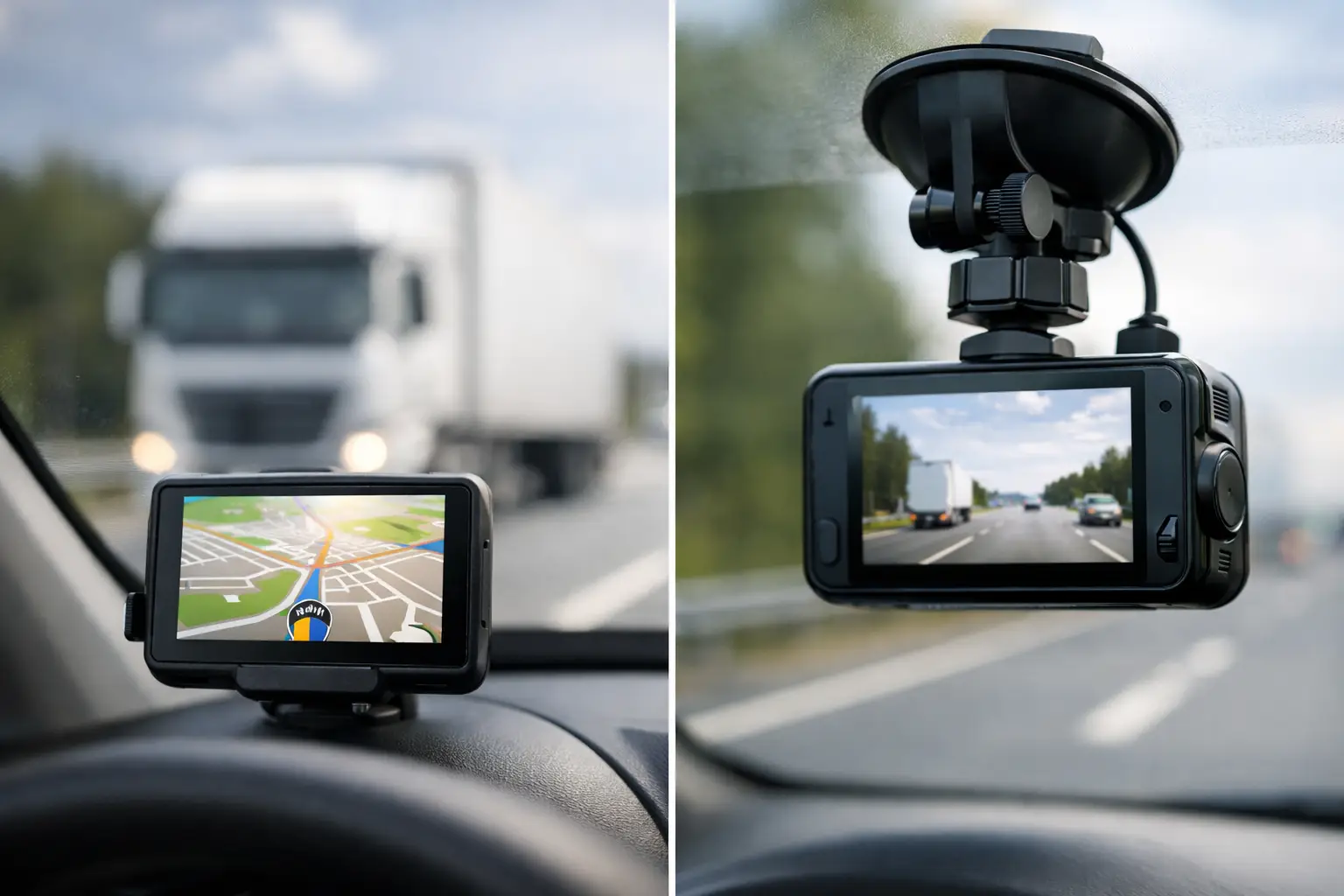
A vehicle leaves the depot on time, but by mid-morning nobody is quite sure where it is, whether the driver is delayed, or what actually happened when a customer claims the van clipped a gate. That is where the GPS tracking vs dashcam question stops being a product comparison and becomes an operational one.
For most UK fleet operators, these systems solve different problems. One gives you live visibility and a usable record of movement. The other gives you video evidence of what the driver saw on the road. If you are managing HGVs, vans or mixed fleets under real commercial pressure, the right choice depends less on features in isolation and more on what you need to control each day.
GPS tracking vs dashcam: the real difference
GPS tracking is built around location, movement and vehicle activity. It tells you where the vehicle is, where it has been, whether it is moving, idling or stopped, and often how it is being driven. In a fleet setting, that can support dispatch decisions, utilisation reporting, route review, maintenance planning and driver behaviour management.
A dashcam is built around recorded footage. Its primary role is to capture events on the road, usually through forward-facing video and, in some cases, driver-facing or rear-facing cameras as well. That footage is useful for incident review, insurance disputes, driver protection and coaching.
So the short version is simple. GPS tracking answers where, when and how a vehicle moved. A dashcam helps answer what happened.
That distinction matters because many operators start by asking which one is better, when the more useful question is which problem is costing you time, money or risk right now.
What GPS tracking gives a transport operation
If you are running daily routes, timed deliveries or reactive jobs, GPS tracking gives operational control that a camera on its own cannot. Dispatch planners can see the nearest available vehicle. Depot teams can check if a job has genuinely been delayed by traffic or if a vehicle has been stationary for too long. Managers can review route efficiency rather than relying on guesswork or driver recollection.
For operator licence businesses, the value often goes beyond live maps. A proper fleet tracking system can support maintenance scheduling, asset visibility and utilisation reporting across vehicles and trailers. It can also help identify excessive idling, wasted fuel and poor route planning.
The benefit is not just more data. It is less chasing. Instead of ringing drivers for updates or piecing together movements from spreadsheets and phone calls, the office can see what is happening in real time.
That is especially important when tracking is part of a wider telematics and compliance platform. In that setup, location data is not sitting in a separate system with limited value. It contributes to better planning, fewer blind spots and stronger day-to-day control.
Where dashcams earn their place
Dashcams are strongest when evidence matters. If one of your drivers is involved in a collision, accused of harsh driving by a third party, or challenged over an incident on site, video can be the fastest way to establish what actually happened.
For many fleets, that is reason enough to invest. Claims handling can become more straightforward, drivers can be protected against false allegations, and managers have something objective to review rather than relying on conflicting accounts.
Dashcams can also support driver coaching. Footage linked to harsh braking, speeding or distracted driving events gives managers a clearer basis for conversations with drivers. It moves the discussion away from opinion and towards specific moments that can be reviewed properly.
Still, dashcams have limits. Video without context can be hard to manage at scale. If you do not know where the vehicle was, how long it had been on the road, what route it was following, or whether the event fits a wider pattern, the footage helps with one incident but not necessarily with the bigger operational picture.
GPS tracking vs dashcam for compliance and licence protection
This is where the choice becomes more practical for UK operators.
A dashcam can support safety management and incident defence, but it is not a compliance system. It will not monitor driver hours, help with remote tachograph downloads, flag maintenance schedules or show whether assets are being used efficiently. It may contribute to safer driving, but it does not reduce transport admin on its own.
GPS tracking is also not a complete compliance answer by itself, but it sits much closer to the day-to-day control that compliance teams need. When tracking is integrated with tachograph management, driver hours visibility and maintenance reminders, it becomes part of a stronger operational framework. You are not just seeing dots on a map. You are reducing the chances of missed deadlines, poor vehicle utilisation and avoidable admin gaps.
That is why the GPS tracking vs dashcam decision often leans towards tracking first for commercial fleets, especially where transport managers are under pressure to manage both service performance and operator licence risk.
When GPS tracking should come first
If your main problems are late jobs, poor vehicle visibility, unnecessary mileage, fuel waste, or too much time spent phoning drivers for updates, GPS tracking should usually be the first investment.
The same applies if your fleet is still relying on separate systems or manual processes to manage movements, usage and planning. Tracking creates a live operational layer that the whole team can use, from dispatch through to management reporting.
For HGV operators, it becomes even more valuable when tied into tachograph and driver hours management. A transport office that can see location, activity and compliance status in one place is in a much stronger position than one bouncing between maps, download tools and spreadsheets.
When a dashcam should come first
If you have already got live fleet visibility but are still exposed when incidents happen, a dashcam may be the more urgent next step. That is often the case for urban delivery fleets, high-mileage van operations, or businesses seeing frequent claims, near misses or customer disputes.
It can also make sense if driver welfare is a major concern. Some fleets want the reassurance of objective footage to support drivers who regularly work in high-risk traffic conditions or on busy delivery schedules.
The key point is that dashcams solve a narrower but very important problem. They are excellent when the question is about proving what happened. They are less effective when the question is about running the fleet more efficiently every day.
Why many fleets need both
For a growing fleet, this is rarely an either-or decision forever. The strongest setup is often GPS tracking and dashcam working together.
Tracking shows that a vehicle stopped sharply at 10:42 on the A14 and had been idling for six minutes beforehand. The dashcam shows that a car cut across the cab just before the brake event. One gives the operational timeline, the other gives the visual evidence. Together they create a much clearer account.
The same combined value applies beyond incidents. Tracking identifies patterns across routes, hours and utilisation. Dashcam footage helps explain specific risky behaviours or road events within those patterns. When the two systems are joined up in a single platform, managers spend less time switching between tools and more time acting on what they see.
That joined-up view matters. Fragmented systems create admin, and admin is usually where useful data goes to waste.
What to ask before you choose
Before buying either system, it helps to be honest about the real operational pressure point. If your office lacks live visibility, a dashcam will not fix dispatch confusion. If your claims costs are climbing, location pings alone may not protect the business or the driver when a dispute lands.
It is also worth looking at how the technology will be used after installation. A low-cost camera that nobody reviews properly has limited value. The same is true of tracking data that sits unused because it is too awkward to access or disconnected from the rest of your fleet processes.
For that reason, many operators are better served by a platform that turns data into something practical: alerts, reports, driver coaching, maintenance scheduling and compliance oversight. Fleetalyse is built around that kind of day-to-day usability rather than tracking for its own sake.
Price matters as well, but so does clarity. Hidden costs, complicated fitting and multiple separate subscriptions can wipe out the apparent savings of a basic system. Commercial fleets usually benefit more from transparent monthly pricing and technology that can be deployed without adding friction to the working day.
The better question than GPS tracking vs dashcam
If you are choosing between the two, ask which gap is hurting the operation most. Is it lack of visibility, weak planning and too much admin? Or is it claims exposure, disputed incidents and limited evidence when something goes wrong?
That answer will usually tell you where to start. For many UK fleet operators, GPS tracking has the broader operational impact because it improves planning, utilisation and control every day. Dashcams are highly valuable too, particularly where safety events and claims are a regular concern, but they tend to be most effective when layered onto a fleet that already has strong visibility.
The smartest decision is the one that removes pressure from the transport office, protects the operator licence and gives your team clearer information when they need it. When technology does that without adding more admin, it stops being another system to manage and starts earning its place.