

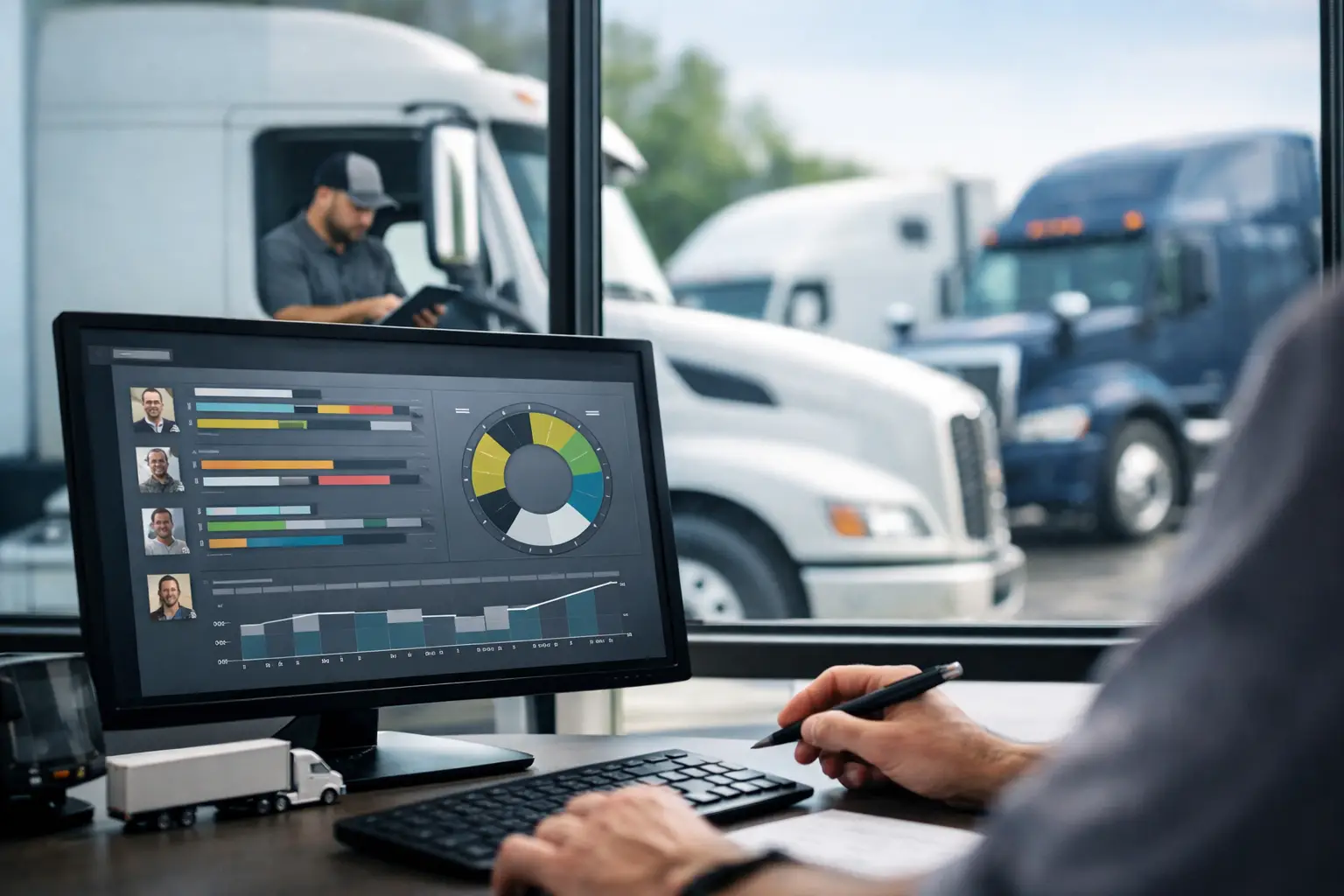
At 15:40, a planner gets a late collection request and has two obvious options nearby. One vehicle is closer. The other driver has more legal driving time left and enough working time to complete the job without creating a problem for tomorrow’s shift. That is where a useful driver hours visibility example stops being a dashboard feature and starts becoming an operational advantage.
For UK fleet operators, live visibility of driver hours is not just about avoiding infringements after the event. It affects whether jobs can be accepted, how vehicles are allocated, how depot staff respond to delays, and how much manual checking the transport office has to do. When hours data sits in one place and vehicle tracking sits somewhere else, decisions are slower and riskier than they need to be.
A practical driver hours visibility example
Take a mixed HGV fleet running regional deliveries from a Midlands depot. The traffic office receives an urgent customer request at short notice. The collection point is 35 minutes from Vehicle A and 50 minutes from Vehicle B. If you are working from location alone, Vehicle A looks like the obvious choice.
But live driver hours tell a different story. Driver A has 52 minutes of driving time remaining before a break is due, plus a limited working time window left for the day. Driver B has 2 hours 40 minutes of driving time available and enough remaining duty time to complete the collection and return leg comfortably. On paper, the nearer vehicle is available. In reality, it is the wrong decision.
With proper visibility, the planner can see both location and legal availability at the same time. The job goes to Driver B. Driver A continues on the existing route, takes a break as required, and avoids a rushed final leg that could create an infringement or force an awkward handover. One dispatch decision prevents extra admin, protects the schedule, and reduces the chance of a compliance issue landing on someone’s desk later.
That is the real value of driver hours visibility. It gives the office a live picture of what is operationally possible, not just what looks close on a map.
Why driver hours visibility matters beyond compliance
Most operators first look at driver hours data because they need to stay compliant. Fair enough. But once that visibility is live and easy to use, the benefits quickly move into planning, customer service and resource control.
A transport manager does not want to wait until a card download is reviewed to discover that a driver was tight on time during the afternoon run. By then, the decision has already been made and the issue is already in the records. Visibility during the day changes that. It gives planners a chance to act while there are still options.
That might mean reallocating a stop, delaying a collection by 20 minutes so a break can be taken properly, or assigning a different driver altogether. None of those decisions are dramatic, but they are the small choices that keep a fleet running cleanly. When hours visibility is poor, teams fall back on phone calls, rough estimates and memory. That is where avoidable risk creeps in.
There is also a clear admin benefit. If the office can see likely issues building in real time, there is less chasing after the event, fewer explanations to gather, and less time spent reconciling spreadsheets against tachograph records. For operators managing several depots or a mixed fleet, that reduction in friction matters just as much as the compliance improvement.
What good visibility looks like in practice
A useful driver hours view should answer a planner’s questions quickly. How much driving time is left? Is a break due soon? How much duty time remains? Is there a reduction or extension in play? Can this driver legally and realistically take on another job?
If those answers are buried in separate systems or require someone with specialist compliance knowledge to interpret them every time, the tool is not doing enough. Good visibility translates technical data into practical decisions. It should be clear enough for daily planning while still supporting proper compliance oversight.
This is where integrated platforms make a difference. When tachograph data, live vehicle location and driver information sit together, the office does not have to piece the picture together manually. A planner can look at one screen and understand both where a vehicle is and whether assigning another task is sensible. That is much more useful than seeing a pin on a map with no context around the driver’s legal availability.
The trade-off between live decisions and perfect certainty
There is an important point here. Live driver hours visibility improves decision-making, but it does not remove the need for judgement. Traffic, loading delays, driver changes and manual entries can all affect the picture. A live estimate is there to support decisions, not replace transport management experience.
That matters because some operators expect hours monitoring to behave like a simple fuel gauge. It is not quite that neat. The data can be highly valuable and still require context. If a driver has just arrived on site and the unloading delay is unknown, the planner still needs to think beyond the number on screen.
The right approach is to use live visibility to narrow risk and improve confidence. It helps the office make better decisions more often. It does not mean every route change is automatic or every edge case disappears.
Where operators usually struggle without it
The common problem is fragmentation. Vehicle tracking may sit with one supplier, tachograph compliance with another, maintenance reminders somewhere else, and planning decisions in spreadsheets or on whiteboards. Each part may function on its own, but the transport office ends up doing the integration manually.
In that setup, driver hours visibility becomes reactive. A planner knows where the lorry is, but not whether the driver has enough legal time left. The compliance team can review records later, but that does not help with a same-day collection decision. Depot staff ring the driver, the driver estimates, and the office makes the best call it can.
Sometimes that works. Sometimes it leads to rushed breaks, avoidable infringements, missed ETAs, or jobs being declined because nobody is confident enough to commit. The cost is not only legal risk. It is also lost utilisation and more office time spent checking what should already be clear.
Using driver hours visibility example data to improve planning
One strong use of a driver hours visibility example is post-job review. If a planner can look back at how decisions were made during a busy day, patterns start to emerge. Perhaps late afternoon collections repeatedly go to the nearest vehicle instead of the most suitable one. Perhaps one depot tends to cut things too fine on break timing. Perhaps some routes leave no margin when traffic builds.
That kind of review turns hours data into planning improvement. It helps operators redesign routes, adjust cut-off times, or change how they allocate standby work. Over time, the result is fewer last-minute problems and less dependence on individual memory in the traffic office.
It also supports better conversations with customers. If a collection cannot be done legally within the requested window, the office can explain that with confidence and offer a realistic alternative. That is better than overpromising and then managing a preventable delay.
Why this matters for operator licence protection
For UK operators, compliance is never just a back-office concern. Repeated infringements and weak management controls can have wider consequences. That is why visibility matters so much. It shows that the business is not only recording hours, but actively managing them.
A transport operation that can demonstrate live oversight, timely intervention and consistent use of driver hours data is in a stronger position than one relying on retrospective checks alone. The point is not to create extra complexity. It is to give the team practical control over the day’s work while reducing the chance of preventable issues building up unnoticed.
That is also why an integrated approach tends to work better in practice. If compliance data is too detached from daily operations, it becomes a monthly tidy-up exercise instead of a management tool. A platform built around both compliance and visibility, such as Fleetalyse, is far more useful to a busy operator than a tracking system that stops at dots on a map.
For transport teams, the best systems are not the ones with the longest feature lists. They are the ones that make the next decision easier, clearer and safer. If your office can see not just where vehicles are, but what drivers can legally do next, planning becomes more controlled and a lot less reactive. That is where real operational improvement starts.