
How much of your working week is lost to the 28-day chase for driver cards and the 90-day scramble for vehicle units? With the DVSA conducting 31,824 targeted checks in the 2024-25 period, the margin for error in your records has never been smaller. You're likely familiar with the stress of missing a download deadline or finding inaccuracies in manual data entry that lead to costly infringements. It's a relentless administrative cycle that drains resources and keeps your team reactive rather than proactive.
Implementing a reliable automated tachograph download system eliminates manual data collection and ensures your fleet remains 100% compliant. This guide explains how to reclaim hundreds of administrative hours annually by automating .ddd file retrieval and securing audit-ready reports. We'll examine the transition to full automation, the benefits of real-time visibility for driver hours, and how these systems integrate with your existing analysis software to simplify your transport operation. You can finally stop chasing paperwork and start focusing on the road ahead.
Key Takeaways
- Understand how an automated tachograph download system replaces physical download keys with remote, over-the-air data retrieval to eliminate manual card reading.
- Learn to satisfy the "Continuous and Effective" management requirements of your O-Licence by removing the risk of missing 28-day and 90-day download deadlines.
- Identify the hidden costs of manual data collection, including driver downtime and administrative labour, to improve your fleet's overall operational efficiency.
- Discover how secure "card hotels" and scheduled retrievals ensure seamless .ddd file transfers without requiring drivers to return to the depot.
- Explore the benefits of combining remote downloads with live driver hours and GPS tracking for more accurate dispatch planning and real-time visibility.
The Evolution of Fleet Compliance: What is an Automated Tachograph Download System?
An automated tachograph download system is a remote, "over-the-air" solution that retrieves data from digital tachographs without manual intervention. For decades, fleet operators used physical download keys and card readers. This process forced drivers to return to a central depot or required managers to post hardware between locations. To understand the baseline requirements of these devices, it's helpful to review What is a Tachograph? and how it records driver activity. Modern technology has moved beyond these physical constraints. It establishes a wireless connection that pulls data directly from the vehicle unit and driver card.
The UK transport sector is undergoing a fundamental shift. We're moving from reactive compliance to proactive data management. In the old manual model, you only saw infringements weeks after they happened. By then, the risk to your Operator Licence was already established. The DVSA now expects a digital-first approach to record-keeping. They want to see that you have "continuous and effective" control over your fleet. Using an automated system ensures you aren't just reacting to old data; you're managing your fleet in real-time.
The Core Components of a Remote System
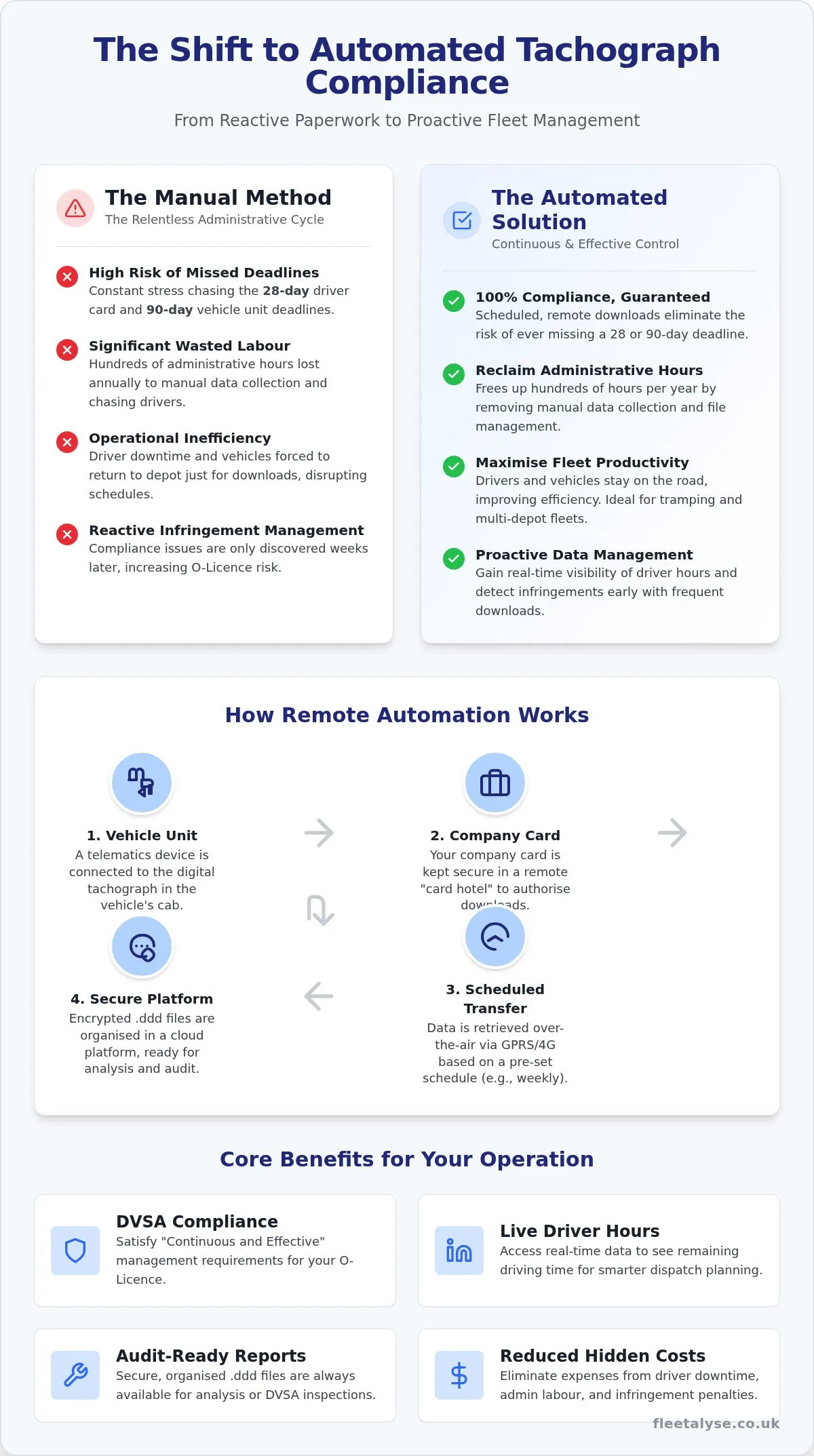
A reliable remote setup isn't just a single piece of software. It's a coordinated technical stack. A vehicle-mounted telematics unit serves as the hardware bridge. This device connects to the back of the tachograph and communicates with the server. Data travels via secure GPRS or 4G protocols. These encrypted transfers protect sensitive .ddd files from corruption or unauthorised access. Finally, the files land in a cloud-based platform. Here, they're organised and ready for immediate analysis. It's a seamless loop that requires zero input from the driver.
Who Benefits Most from Automation?
Efficiency gains apply to any size of operation, but some fleets see an immediate transformation. Haulage companies with "tramping" drivers are the primary beneficiaries. If your drivers are away for two weeks at a time, you can't wait for them to return to download their cards. Multi-depot operations also benefit by centralising their data without needing hardware at every site. Operators striving for DVSA Earned Recognition status find that an automated tachograph download system provides the consistent data streams necessary for the scheme. Whether you manage HGVs or mixed fleets with vans and trailers, automation removes the administrative burden of manual chasing.
Behind the Technology: How Remote Data Retrieval Streamlines Operations
An automated tachograph download system functions through a sophisticated digital handshake between the vehicle and your office. Unlike manual downloads that require physical access to the cab, remote retrieval uses a telematics unit to trigger data transfers based on pre-set schedules. This process relies on a company card kept in a secure "card hotel" or server at your headquarters. When the system requests data, the server authenticates the request using this card. The vehicle unit (VU) then releases the encrypted files over the air. It's a hands-off operation that ensures your office always has the latest records without ever bothering the driver.
Real-time visibility is where the biggest operational gains happen. While historical .ddd files are essential for compliance audits, "live driver hours" provide a snapshot of a driver's current shift status. You can see exactly how much driving time remains before a break is required. This data stream is separate from the formal file download but uses the same hardware. It allows dispatchers to plan routes based on actual remaining hours rather than guesswork. Ensuring data integrity is a core part of this technology. Automated systems use verification protocols to prevent file corruption. They also flag missing data gaps immediately. You won't discover a "Missing Mile" weeks later during an inspection.
Scheduling and Frequency
Managing the 28-day driver card and 90-day vehicle unit cycles is mandatory for UK operators. However, waiting until the legal deadline is risky. Most operators customise their automated tachograph download system to pull data weekly or even daily. Frequent downloads allow for early infringement detection. If a driver commits a minor error on Monday, you can address it by Tuesday. This proactive approach aligns with DVSA's Guide to Maintaining Roadworthiness, which emphasises the importance of robust monitoring systems. You can set different intervals for different vehicle types to suit your specific operational patterns.
Data Security and Storage
Security is paramount when handling sensitive driver data. Encrypted .ddd files are protected during transit across GPRS or 4G networks using secure protocols. Once received, these files must be stored for at least 12 months on secure, UK-compliant cloud servers. The best systems offer seamless integration with third-party tachograph analysis software. This means your data flows directly from the vehicle into your reporting suite without manual uploading. If you're ready to upgrade your compliance workflow, you can explore our remote download solutions to start automating your fleet today.
Manual vs. Automated Downloads: Comparing Efficiency and Compliance Risk
The hidden costs of manual data collection often go unnoticed until they are quantified. When a driver stops their shift to locate a card reader or wait for a download key, you aren't just losing minutes; you're losing productivity. Manual downloads rely on physical hardware that is prone to damage, loss, or technical failure. If a download key fails after a week of collection, that data is often unrecoverable. An automated tachograph download system removes these physical points of failure by transmitting data directly to the cloud. This ensures you never face the "Missing Mile" problem, where vehicle movements aren't accounted for in your records because a manual download was missed or corrupted.
Efficiency isn't just about speed; it's about accuracy and timing. Manual systems identify infringements far too late. If you only review a driver's hours every 28 days, you cannot take corrective action to prevent a repeat offence. Industry experts often highlight the benefits of remote downloading for this very reason. It transforms your compliance workflow from a retrospective "look back" into a proactive daily check. By catching errors early, you protect your business from the cumulative risk of unaddressed driver behaviour.
The Cost of Administrative Overhead
Calculating the true cost of manual compliance requires looking beyond the price of a card reader. Transport managers often spend hours every week chasing drivers to return to the depot. This "vehicle chasing" is particularly expensive for long-haul operations. Bringing an HGV back to base solely for a data download wastes fuel and consumes valuable driver hours. Automation allows your team to focus on strategic asset management rather than the logistics of data retrieval. It turns a manual, repetitive chore into a background process that requires zero human intervention.
Mitigating Legal and Financial Risks
The DVSA carried out 31,824 risk-based targeted checks in 2024-25. If your records are incomplete, fixed penalties typically range from £50 to £300 per offence. Beyond immediate fines, poor compliance records damage your Operator Compliance Risk Score (OCRS). A "Red" or "Amber" score makes your fleet a target for more frequent roadside stops. It also drives up insurance premiums and can disqualify you from lucrative contracts. An automated tachograph download system provides a clear, tamper-proof audit trail. This transparency is vital for maintaining your Operator Licence and securing the long-term financial health of your business.
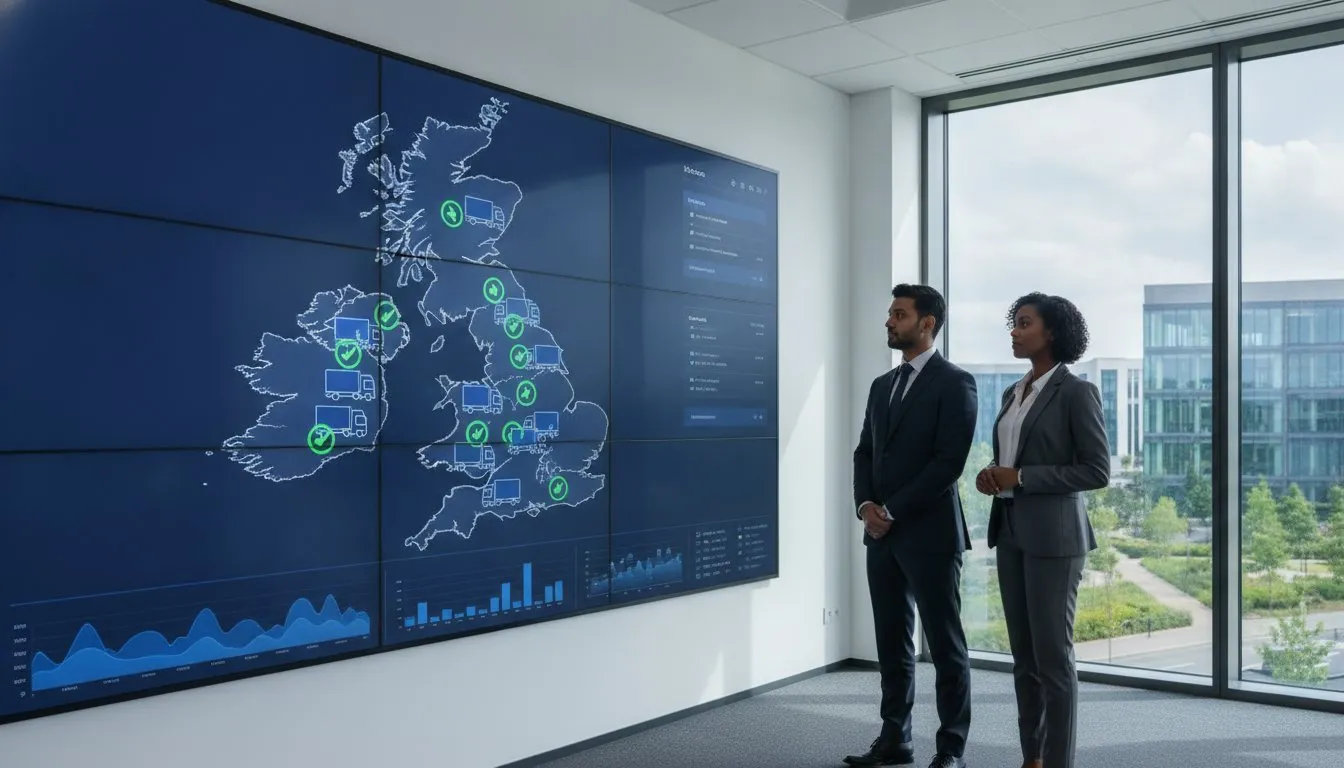
Meeting DVSA Standards: Integrating Automated Systems into Your Operator Licence
Holding a UK Operator Licence carries the heavy responsibility of "Continuous and Effective" management. The Traffic Commissioner expects you to have systems that don't just record data but actively manage it. An automated tachograph download system serves as tangible proof of this control. It demonstrates that you aren't leaving compliance to chance or relying on drivers to remember their 28-day deadlines. By removing the human element from data collection, you provide the DVSA with a clear, untampered record of your fleet's activity. This digital-first approach is becoming the expected standard for any professional transport operation.
Integrating live driver hours with your download schedule helps prevent Working Time Directive (WTD) breaches before they occur. Whilst historical downloads are essential for the record, live visibility allows you to intervene during the shift. This proactive stance is a hallmark of "Professional Competence." It shows the authorities that you use modern technology to maintain road safety standards. During roadside inspections, having immediate access to accurate, up-to-date driver records can be the difference between a quick check and a lengthy, expensive delay.
Audit Readiness and Record Keeping
Organising digital records is often a chaotic task during a surprise DVSA office audit. Automation solves this by centralising .ddd files in a structured, cloud-based environment. You can produce specific records for a Traffic Commissioner inquiry in seconds rather than searching through filing cabinets or old download keys. Crucially, these systems automatically capture and flag "unknown driver" events. Instead of ignoring these gaps, you can identify and explain them immediately. This keeps your Operator Compliance Risk Score (OCRS) in the "Green" zone. Reliable, accessible record-keeping is your best defence against regulatory action.
Earned Recognition and the Future
The DVSA increasingly encourages high-performing fleets to join the Earned Recognition scheme. This involves sharing compliance data with the agency in exchange for fewer roadside stops. A key requirement for this is a robust automated tachograph download system that provides consistent, verifiable data streams. Fleetalyse integration supports these reporting requirements by ensuring your data is always up to date and audit-ready. Moving towards a paperless transport office isn't just about administrative efficiency; it's about meeting the highest legal standards through total data transparency. You can get started with our automated compliance tools to secure your O-Licence today.
Choosing Fleetalyse: Transparent Automation for the Modern UK Fleet
Fleetalyse isn't a distant, global software provider. We are a UK-based specialist focused on the practical needs of regional operators. Our commitment to straightforward, expert-led support means we strip away the marketing fluff. We replace it with a reliable automated tachograph download system that actually works in the field. By choosing a partner that understands the rigours of the UK transport industry, you gain more than just software. You gain a pragmatic ally dedicated to asset management and regulatory adherence.
Transparency is our core value. Unlike generic competitors who often hide costs behind complex contracts, we provide operational clarity from the start. Our platform simplifies the transition from manual entry to total automation. We provide a single dashboard where you can manage remote tacho downloads alongside live GPS fleet tracking for HGVs, vans, and trailers. This unified view eliminates the need for multiple, disconnected systems and ensures you have a single source of truth for your fleet data.
Seamless Integration and Visibility
Data is only useful when it's accessible. Fleetalyse ensures your tachograph files connect directly to your favourite analysis software. This integration allows for immediate reporting and early infringement detection. You gain real-time visibility of driver activity, which transforms your dispatch planning. Instead of guessing, you know exactly who has the legal hours available for the next job. This reduces administrative friction amongst your office staff and drivers, allowing your team to focus on moving goods rather than chasing paperwork.
A Partner in UK Transport Compliance
Being a UK-based technology company gives us a unique perspective on regional infrastructure. We understand the specific challenges of UK regulations and the expectations of the Traffic Commissioner. Our focus is on reliability. We ensure your data is always there when an auditor asks for it. We value your time and resources, prioritising functional utility over flashy, unnecessary features. This pragmatic approach makes Fleetalyse the choice for operators who want a system built for real-world application.
Take the first step towards an audit-proof transport office. Discover how Fleetalyse can automate your compliance today and reclaim the hours you currently lose to manual data collection. Our team is ready to help you transition to a more efficient, transparent way of working.
Future-Proof Your Fleet Compliance
Securing your Operator Licence requires moving away from the reactive nature of manual data chasing. Implementing an automated tachograph download system is the most practical step you can take to eliminate administrative friction. You've seen how remote technology provides the real-time visibility needed for proactive dispatch planning whilst ensuring every mile is accounted for. By removing the physical risks of lost download keys, you guarantee that your fleet remains audit-ready at all times. This digital approach protects your OCRS and strengthens your professional standing with the DVSA.
Fleetalyse offers the expertise of UK-based compliance specialists who understand the rigours of regional transport. Our platform provides seamless integration with major analysis tools and real-time driver hours visibility to keep your operation moving efficiently. You can finally stop chasing paperwork and focus on growing your business with total confidence in your records. Streamline your fleet compliance with Fleetalyse today. It's time to make compliance a background process rather than a daily struggle.
Frequently Asked Questions
Is remote tachograph download legal in the UK?
Remote tachograph downloading is completely legal in the UK and aligns with DVSA standards for robust record-keeping. The agency increasingly supports digital-first approaches that ensure "Continuous and Effective" management of an Operator Licence. By using an automated tachograph download system, you provide a tamper-proof audit trail that satisfies regulatory requirements. This technology is a standard feature for fleets participating in the Earned Recognition scheme, proving its high standing with UK enforcement bodies.
How often should I download my driver card and vehicle unit?
UK law requires driver card data to be downloaded at least every 28 days and Vehicle Unit (VU) data every 90 days. Whilst these are the legal limits, an automated tachograph download system allows you to retrieve data much more frequently, often on a weekly or daily basis. This proactive schedule helps you identify driver infringements almost immediately, allowing for swift corrective action rather than waiting until the end of a month-long cycle.
Will an automated system work with my existing tachograph analysis software?
Yes, our system is designed to integrate seamlessly with major tachograph analysis software providers used across the UK. Once the .ddd files are retrieved remotely, they are automatically pushed to your chosen analysis platform for processing. This eliminates the need for manual file uploads and ensures your compliance reports are always up to date. It creates a frictionless workflow where data moves from the vehicle to your analysis suite without human intervention.
Do I need a second company card for remote downloads to work?
You will need a valid company card to authenticate remote data requests from the vehicle. This card is typically kept in a secure, internet-connected "card hotel" or server at your office or a data centre. When a download is triggered, the system uses this card to verify your authority to access the vehicle's data. This secure handshake ensures that your sensitive fleet information is only accessible to authorised personnel within your organisation.
What happens if a vehicle is out of mobile signal range during a scheduled download?
If a vehicle enters an area with poor mobile coverage during a scheduled download, the system simply pauses the request. The telematics hardware stores the data locally and automatically retries the transfer once a stable GPRS or 4G signal is restored. You don't need to manually restart the process or worry about data gaps. This ensures that your records remain complete and accurate, even when vehicles are operating in remote regional areas.
Can I see live driver hours as well as historical downloads?
Yes, you can monitor live driver hours alongside your scheduled historical downloads. This feature provides a real-time snapshot of a driver's current shift, including remaining driving time and required rest periods. It's a vital tool for dispatchers who need to plan routes based on actual availability rather than estimated logs. This live visibility helps prevent Working Time Directive breaches by giving you the data needed to intervene before an infringement occurs.
Is the automated download system compatible with older digital tachographs?
Most digital tachographs manufactured after 2009 are compatible with remote downloading technology. Specifically, vehicle units must be version 1.3 or higher to support the necessary "remote download" command. If your fleet includes older vehicles, we can help you identify which units require a simple hardware bridge and which might need a tachograph upgrade. This ensures that your entire fleet, regardless of age, can benefit from a unified automated tachograph download system.
How long is tachograph data stored in an automated system?
UK regulations require transport operators to store tachograph data for a minimum of 12 months. Our automated system secures your .ddd files in UK-compliant cloud storage, ensuring they are protected and accessible for the full legal duration. This digital archive is far more secure than physical download keys, which are easily lost or damaged. You can retrieve any file instantly during a DVSA audit or Traffic Commissioner inquiry without searching through manual records.
Frequently asked questions
Who Benefits Most from Automation?
Efficiency gains apply to any size of operation, but some fleets see an immediate transformation. Haulage companies with "tramping" drivers are the primary beneficiaries. If your drivers are away for two weeks at a time, you can't wait for them to return to download their cards. Multi-depot operations also benefit by centralising their data without needing hardware at every site. Operators striving for DVSA Earned Recognition status find that an automated tachograph download system provides the consistent data streams necessary for the scheme. Whether you manage HGVs or mixed fleets with vans and trailers, automation removes the administrative burden of manual chasing. An automated tachograph download system functions through a sophisticated digital handshake between the vehicle and your office. Unlike manual downloads that require physical access to the cab, remote retrieval uses a telematics unit to trigger data transfers based on pre-set schedules. This process relies on a company card kept in a secure "card hotel" or server at your headquarters. When the system requests data, the server authenticates the request using this card. The vehicle unit (VU) then releases the encrypted files over the air. It's a hands-off operation that ensures your office always has the latest records without ever bothering the driver. Real-time visibility is where the biggest operational gains happen. While historical .ddd files are essential for compliance audits, "live driver hours" provide a snapshot of a driver's current shift status. You can see exactly how much driving time remains before a break is required. This data stream is separate from the formal file download but uses the same hardware. It allows dispatchers to plan routes based on actual remaining hours rather than guesswork. Ensuring data integrity is a core part of this technology. Automated systems use verification protocols to prevent file corruption. They also flag missing data gaps immediately. You won't discover a "Missing Mile" weeks later during an inspection.
Is remote tachograph download legal in the UK?
Remote tachograph downloading is completely legal in the UK and aligns with DVSA standards for robust record-keeping. The agency increasingly supports digital-first approaches that ensure "Continuous and Effective" management of an Operator Licence. By using an automated tachograph download system, you provide a tamper-proof audit trail that satisfies regulatory requirements. This technology is a standard feature for fleets participating in the Earned Recognition scheme, proving its high standing with UK enforcement bodies.
How often should I download my driver card and vehicle unit?
UK law requires driver card data to be downloaded at least every 28 days and Vehicle Unit (VU) data every 90 days. Whilst these are the legal limits, an automated tachograph download system allows you to retrieve data much more frequently, often on a weekly or daily basis. This proactive schedule helps you identify driver infringements almost immediately, allowing for swift corrective action rather than waiting until the end of a month-long cycle.
Will an automated system work with my existing tachograph analysis software?
Yes, our system is designed to integrate seamlessly with major tachograph analysis software providers used across the UK. Once the .ddd files are retrieved remotely, they are automatically pushed to your chosen analysis platform for processing. This eliminates the need for manual file uploads and ensures your compliance reports are always up to date. It creates a frictionless workflow where data moves from the vehicle to your analysis suite without human intervention.
Do I need a second company card for remote downloads to work?
You will need a valid company card to authenticate remote data requests from the vehicle. This card is typically kept in a secure, internet-connected "card hotel" or server at your office or a data centre. When a download is triggered, the system uses this card to verify your authority to access the vehicle's data. This secure handshake ensures that your sensitive fleet information is only accessible to authorised personnel within your organisation.
What happens if a vehicle is out of mobile signal range during a scheduled download?
If a vehicle enters an area with poor mobile coverage during a scheduled download, the system simply pauses the request. The telematics hardware stores the data locally and automatically retries the transfer once a stable GPRS or 4G signal is restored. You don't need to manually restart the process or worry about data gaps. This ensures that your records remain complete and accurate, even when vehicles are operating in remote regional areas.
Can I see live driver hours as well as historical downloads?
Yes, you can monitor live driver hours alongside your scheduled historical downloads. This feature provides a real-time snapshot of a driver's current shift, including remaining driving time and required rest periods. It's a vital tool for dispatchers who need to plan routes based on actual availability rather than estimated logs. This live visibility helps prevent Working Time Directive breaches by giving you the data needed to intervene before an infringement occurs.
Is the automated download system compatible with older digital tachographs?
Most digital tachographs manufactured after 2009 are compatible with remote downloading technology. Specifically, vehicle units must be version 1.3 or higher to support the necessary "remote download" command. If your fleet includes older vehicles, we can help you identify which units require a simple hardware bridge and which might need a tachograph upgrade. This ensures that your entire fleet, regardless of age, can benefit from a unified automated tachograph download system.
How long is tachograph data stored in an automated system?
UK regulations require transport operators to store tachograph data for a minimum of 12 months. Our automated system secures your .ddd files in UK-compliant cloud storage, ensuring they are protected and accessible for the full legal duration. This digital archive is far more secure than physical download keys, which are easily lost or damaged. You can retrieve any file instantly during a DVSA audit or Traffic Commissioner inquiry without searching through manual records.