
A driver infringement policy filed away in an office ring binder won't protect your operator licence at a Traffic Commissioner public inquiry. If your system only detects a drivers' hours breach weeks after it occurs, you aren't managing risk; you're just documenting failure. Successfully creating a driver infringement policy requires turning static compliance rules into an active, everyday operational workflow that drivers respect and planners can enforce without friction.
You already know the frustration of chasing missing records, inconsistent debriefs, and recurring rest breaches that slowly degrade your fleet's Operator Compliance Risk Score (OCRS). When manual data collection lags behind real-world operations, debriefing an infringement a fortnight after the event causes unnecessary friction and leaves you exposed during formal DVSA audits. This guide shows you how to build a robust, DVSA-compliant driver infringement policy that protects your operator licence and standardises corrective actions. We examine clear escalation thresholds, fair debrief procedures, and the auditable workflows necessary to prove continuous and effective transport management control.
Key Takeaways
- Understand the statutory expectations Traffic Commissioners hold regarding effective transport governance, audit trails, and licence undertakings.
- Discover the essential structural components needed when creating a driver infringement policy, from driving limits to Working Time Directive rules.
- Implement an objective, four-tier escalation matrix that separates genuine operational anomalies from serious drivers' hours breaches.
- Learn how remote digital capture and live driver hours visibility eliminate administrative lag, enabling timely, evidence-based driver debriefs.
- Establish rigorous internal compliance auditing cycles and meaningful metrics to protect your fleet's Operator Compliance Risk Score.
Why Every UK Fleet Operator Needs a Documented Driver Infringement Policy
An infringement policy isn't a box-ticking exercise. It's the central governance framework that dictates how your business manages statutory drivers' hours rules, working time limits, and road safety legislation. Without a documented system, transport managers cannot prove continuous and effective control over fleet operations. When roadside enforcement officers from the Driver and Vehicle Standards Agency (DVSA) detect breaches, they look directly at your internal response mechanisms. Creating a driver infringement policy establishes explicit operating standards, ensuring every driver understands compliance expectations while protecting the business against vicarious liability under the Health and Safety at Work etc. Act 1974.
Unresolved drivers' hours breaches directly erode your fleet's Operator Compliance Risk Score (OCRS). A degraded OCRS triggers more frequent roadside stops, prolonged mechanical inspections, and inevitable delivery delays. Worse still, a pattern of ignored infringements alerts the DVSA to systemic administrative failure, leading straight to formal investigations.
The Traffic Commissioner's Standard: Continuous and Effective Control
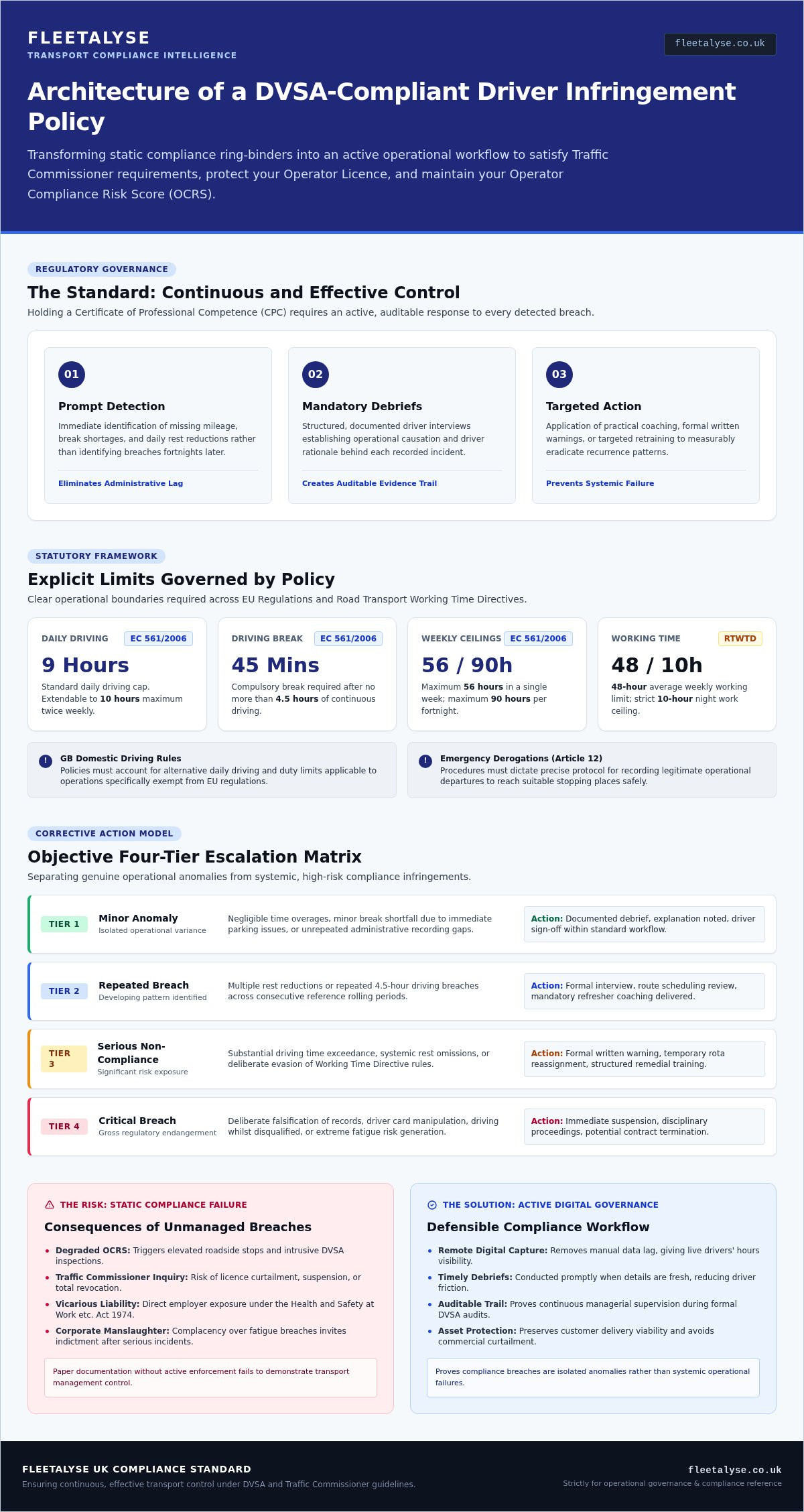
Traffic Commissioners require clear evidence that transport managers actively supervise their workforce. Holding a Certificate of Professional Competence (CPC) means nothing if infringements sit unchecked in analysis software for weeks. Effective governance requires a closed-loop system:
- Prompt detection: Identifying missing mileage, break shortages, and daily rest reductions immediately.
- Mandatory driver debriefs: Conducting documented interviews where drivers explain the cause of the breach.
- Targeted corrective actions: Delivering practical driver coaching, formal written warnings, or targeted training to prevent recurrence.
Neglecting repeat offences leaves transport managers legally vulnerable. If an unaddressed fatigue breach leads to a serious collision, prosecutors look for managerial complacency. Under the Corporate Manslaughter and Corporate Homicide Act 2007, operating without a rigorous, active policy can turn an operational oversight into a criminal indictment.
Protecting Operator Licences and Operational Viability
Your operator licence underpins your business viability. Traffic Commissioners regularly curtail, suspend, or completely revoke Standard National and International licences when operators fail to address persistent compliance failures. Creating a driver infringement policy creates a repeatable audit trail. It proves you don't tolerate dangerous driving behaviour or deliberate falsification.
The commercial fallout from regulatory action is immediate. Vehicle curtailment reduces capacity, damages customer retention, and inflates insurance premiums. A documented, active policy demonstrates that any breach was an isolated operational incident rather than institutional negligence.
Core Components to Include When Creating a Driver Infringement Policy
Generic HR documents won't suffice for commercial transport operations. When creating a driver infringement policy, you must construct an operational framework that directly reflects the daily realities of fleet management. This means going beyond standard misconduct clauses to address precise tachograph behaviours, statutory rest mandates, and internal accountability across your entire hierarchy.
Regulatory Scope: Rules Governed by the Policy
Your policy must explicitly define the separate legal jurisdictions governing your fleet. Drivers often confuse domestic exemptions with EU mandates, so clarity is non-negotiable. Clearly lay out the boundaries for:
- EU Drivers' Hours (Regulation EC 561/2006): Define the 9-hour daily driving limit (extendable to 10 hours twice weekly), the 56-hour weekly ceiling, the 90-hour fortnightly cap, and the mandatory 45-minute break required after 4.5 hours of driving.
- GB Domestic Rules: Clarify daily driving and duty limits for operations exempt from EU regulations.
- Road Transport Working Time Directive (RTWTD): Enforce the 48-hour average weekly limit, rest break rules, and the strict 10-hour night work restriction unless a valid collective agreement applies.
- Emergency Derogations (Article 12): Outline exact procedures for invoking Article 12, requiring drivers to produce a printout at the first suitable stopping place with written justification.
Operational Responsibilities Across the Transport Hierarchy
Accountability must run throughout the transport office, not just fall on drivers. Commercial drivers must perform thorough pre-use walkaround checks as outlined in the DVSA's Guide to Maintaining Roadworthiness, execute proper manual tachograph entries for all other work, and carry their driver card at all times. Transport managers must review analysis reports routinely, conduct debriefs, and arrange targeted retraining. Crucially, dispatch teams must never plan routes with unrealistic transit windows that force drivers into technical infringements.
Record-Keeping Standards and Evidence Retention
UK law dictates vehicle unit (VU) downloads every 56 days and driver cards at least every 28 days. Best-practice transport offices exceed these statutory minimums to catch anomalies before they compound. Retain signed debrief forms, written explanations, printouts, and retraining records for a minimum of 12 months. Implementing modern remote tachograph download hardware automates this entire data collection cycle, providing unalterable, time-stamped proof of ongoing supervision.
Designing a Fair and Scaled Infringement Escalation Matrix
A policy that treats every breach as gross misconduct will alienate drivers. Equally, one that ignores recurring minor faults invites regulatory sanction. When creating a driver infringement policy, your escalation matrix must establish an objective, graduated response. This structure eliminates managerial favouritism, provides transparency, and aligns directly with standard UK employment contracts to withstand tribunal scrutiny.
Classifying Minor, Serious, and Severe Infringements
Classifying breaches ensures proportional disciplinary responses across your fleet:
- Minor Infringements: Isolated rest shortages under 15 minutes, occasional minor mode switch errors, or driving extensions under 15 minutes caused by documented traffic hold-ups.
- Serious Infringements: Recurring daily driving breaches, missing daily rest periods, failure to produce manual entries, or driving without an active driver card inserted.
- Severe or Gross Misconduct: Deliberate falsification of records, interchanging driver cards, driving while suspended, or using defeat devices to bypass tachograph monitoring.
The Four-Stage Corrective Action Framework
Structure corrective steps to prioritise remedial driver coaching before escalating to punitive employment measures:
Stage 1: Informal Debrief and Guidance. Review the tachograph data directly with the driver. Discuss the operational root cause, issue a written note of discussion, and provide clear corrective instruction.
Stage 2: Formal Compliance Interview. Triggered by repeated stage-one breaches within a rolling 90-day window. Issue a formal compliance letter and require completion of a targeted digital training module covering drivers' hours.
Stage 3: Formal Disciplinary Warning. For persistent non-compliance or serious first-time offences. Conduct a formal disciplinary hearing in line with ACAS guidelines. Issue a written warning and mandate practical driving assessments.
Stage 4: Final Hearing and Licence Notification. Reserved for severe breaches or uncorrected patterns. Outcomes include a final written warning or summary dismissal. Serious offences may require formal notification to the Office of the Traffic Commissioner for driver conduct hearings.
Conducting Defensible and Objective Driver Debriefs
Debriefs lose legal standing when delayed. Conduct face-to-face or recorded interviews as soon as analysis confirms an offence. Both parties must sign the debrief form: the driver acknowledges the record, and the transport manager details agreed corrective actions. Include an objective dispute protocol where drivers can submit toll receipts, delivery notes, or dispatch logs if delays stemmed from unforeseen client hold-ups or road closures.

Putting Policy into Practice: Monitoring, Telematics, and Automation
A compliance policy is only as reliable as the data supporting it. When creating a driver infringement policy, operators often stumble by relying on outdated manual download routines. Waiting weeks to insert physical download keys into vehicle units leaves dangerous blind spots. Modern fleets bridge this operational gap by deploying connected fleet compliance tools that feed live data directly into their management workflows.
Moving Beyond Retrospective Manual Downloads
Chasing drivers across yards for manual card downloads burns valuable administrative time. Worse, it delays infringement detection. If an operative commits a serious rest violation on day two of a 28-day cycle, you remain completely unaware for nearly a month. Retrospective discovery makes meaningful debriefing almost impossible; drivers simply won't remember specific roadside circumstances weeks later.
Remote tachograph download hardware completely removes this operational lag. The technology automates scheduled card and vehicle unit downloads over the air while vehicles remain on the road. Data streams straight into your tachograph analysis integration without administrative friction. This creates an auditable, time-stamped paper trail that proves continuous control to visiting enforcement officers.
Leveraging Real-Time Visibility to Pre-empt Breaches
Proactive compliance beats retrospective discipline every time. Integrating live driver hours tracking gives transport planners direct visibility over active driving time, remaining duty availability, and mandatory rest countdowns directly from the traffic desk.
- Intervene before statutory limits breach: Spot drivers running tight against the 4.5-hour driving threshold and instruct them to take a legal break before a violation triggers.
- Dynamic route reallocation: Reroute consignments or assign relief drivers when unforeseen congestion threatens to push an operative past daily driving caps.
- Protect OCRS ratings proactively: Eliminating accidental infringements at the planning stage prevents roadside fixed penalties, which can range up to £300 per offence.
Pairing real-time cab visibility with automated analysis transforms your internal policy from a theoretical manual into an active operational shield. To safeguard your fleet from avoidable breaches and standardise enforcement, equip your vehicles with remote downloading and live compliance tracking today.
Auditing, Reviewing, and Embedding Policy Compliance Culture
Drafting rules is only half the battle. Creating a driver infringement policy requires continuous evaluation to confirm your procedures work in daily operations. Transport managers must actively measure compliance trends, update protocols when regulations evolve, and embed a culture where drivers view rules as vital safety protections rather than bureaucratic hurdles. Ongoing oversight tools from Fleetalyse deliver the steady stream of objective compliance data needed to underpin this audit structure.
Establishing an Internal Compliance Audit Schedule
Routine internal checks uncover systemic risks before DVSA examiners spot them at roadside checkpoints. Structure your review schedule around measurable operational checkpoints:
- Monthly Sample Audits: Cross-reference a random 10% sample of driver infringement reports against signed debrief forms. Check that every breach carries an agreed corrective action.
- Operational Bottleneck Reviews: Monitor route patterns to identify scheduling flaws. If multiple drivers repeatedly breach 4.5-hour driving limits on the same multi-drop run, adjust the planning schedule rather than penalising drivers for logistical delays.
- Annual Independent Audits: Commission a qualified external compliance auditor every 12 months. An outside review benchmarks your internal governance directly against current Traffic Commissioner standards.
Building an Engaged and Cooperative Compliance Culture
Driver resistance fades when operators frame rules around health, road safety, and personal liability. Commercial drivers face fixed roadside penalties reaching up to £300 per offence, making compliance equally vital for their own livelihoods. Incorporate your policy terms directly into new-starter inductions and ongoing Driver CPC modules, grounding legal thresholds in practical operating scenarios.
Reinforce positive behaviour through performance-based recognition. Celebrate clean compliance records and zero-infringement months with driver rewards or performance bonuses. When drivers see that careful tachograph management earns professional recognition, adherence becomes an active fleet goal rather than an enforced mandate.
Review the written policy document annually. Update definitions to cover smart tachograph hardware rollouts, domestic regulatory shifts, and emerging digital licensing rules. When creating a driver infringement policy that lasts, maintaining an evolving document proves continuous and effective transport management across every depot in your fleet.
Protect Your Fleet Licence with Proactive Infringement Governance
Creating a driver infringement policy is the single most effective step a transport manager can take to protect their operator licence. It replaces inconsistent verbal warnings with a defensible, four-stage escalation matrix that treats drivers fairly. Moving compliance from retrospective paperwork to live operational oversight transforms how your traffic office manages risk, keeping your OCRS green and your drivers accountable.
Eliminate manual download delays and compliance blind spots for good. When you pair clear internal policies with automated remote tachograph downloads and live driver hours visibility, your audit trails remain continuously up to date. You can identify emerging fatigue breaches early and conduct prompt, unalterable debriefs that satisfy DVSA examiners and Traffic Commissioners alike.
Take full control of your transport operation today. Upgrade your fleet compliance with Fleetalyse remote tachograph solutions and secure reliable, automated protection for your fleet licence.
Frequently Asked Questions
What is a driver infringement policy in the UK transport industry?
A driver infringement policy is an internal compliance framework that establishes how an operator manages drivers' hours, tachograph usage, and working time rules. It sets clear performance standards for commercial drivers, defines escalation procedures for rule breaches, and details corrective actions. Creating a driver infringement policy gives operators the formal governance required to maintain regulatory road safety standards.
Is an infringement policy legally mandatory for an operator licence holder?
Holding a written infringement policy is an explicit expectation of the Traffic Commissioner, even though the specific document name isn't statutory text. Licence holders undertake to prevent breaches of drivers' hours and tachograph regulations. Without a documented policy and traceable corrective action system, operators cannot satisfy regulatory standards during formal DVSA compliance audits or Public Inquiries.
How quickly must a transport manager debrief a driver after an infringement?
Debriefs should take place as soon as tachograph analysis identifies the violation, ideally before the driver begins their next working shift. Waiting weeks dilutes recall and undermines legal defence. Transport managers must secure an explanation, evaluate root causes, and obtain a signed debrief form without administrative delay to prove effective ongoing management control.
What is the difference between an accidental breach and gross misconduct?
Accidental breaches involve unintentional errors, such as missing a break by several minutes due to severe congestion or minor mode switch oversights. Gross misconduct involves deliberate, fraudulent actions. Using another operative's driver card, falsifying records, pulling fuses, or tampering with vehicle units represent gross misconduct, warranting immediate disciplinary intervention and potential reporting to enforcement authorities.
Can automated remote tachograph downloads replace internal compliance reviews?
Remote downloads automate data collection, but they don't replace management oversight. Hardware delivers raw driver card and vehicle files straight to analysis platforms, eliminating manual collection delays. The transport manager must still actively review the generated infringement reports, conduct timely driver debriefs, and apply the escalation matrix. Automated collection simply supplies the clean data necessary for prompt intervention.
How does a driver infringement policy protect an operator at a Public Inquiry?
A documented policy proves that compliance breaches represent isolated individual errors rather than systemic management negligence. When creating a driver infringement policy, operators build an auditable paper trail of signed debriefs, retraining notes, and tiered warnings. This documentation shows Traffic Commissioners that the transport manager exercises genuine, continuous, and effective control over the entire fleet.
What role does Driver CPC play in reinforcing company infringement policies?
Driver CPC provides a structured training platform to refresh drivers on tachograph mandates and statutory driving limits. Integrating your specific internal infringement escalation matrix into CPC modules ensures commercial drivers understand both legal standards and company rules. Targeted training reframes compliance as a personal safety protection, significantly reducing repeat roadside offences across commercial operations.
Frequently asked questions
What is a driver infringement policy in the UK transport industry?
A driver infringement policy is an internal compliance framework that establishes how an operator manages drivers' hours, tachograph usage, and working time rules. It sets clear performance standards for commercial drivers, defines escalation procedures for rule breaches, and details corrective actions. Creating a driver infringement policy gives operators the formal governance required to maintain regulatory road safety standards.
Is an infringement policy legally mandatory for an operator licence holder?
Holding a written infringement policy is an explicit expectation of the Traffic Commissioner, even though the specific document name isn't statutory text. Licence holders undertake to prevent breaches of drivers' hours and tachograph regulations. Without a documented policy and traceable corrective action system, operators cannot satisfy regulatory standards during formal DVSA compliance audits or Public Inquiries.
How quickly must a transport manager debrief a driver after an infringement?
Debriefs should take place as soon as tachograph analysis identifies the violation, ideally before the driver begins their next working shift. Waiting weeks dilutes recall and undermines legal defence. Transport managers must secure an explanation, evaluate root causes, and obtain a signed debrief form without administrative delay to prove effective ongoing management control.
What is the difference between an accidental breach and gross misconduct?
Accidental breaches involve unintentional errors, such as missing a break by several minutes due to severe congestion or minor mode switch oversights. Gross misconduct involves deliberate, fraudulent actions. Using another operative's driver card, falsifying records, pulling fuses, or tampering with vehicle units represent gross misconduct, warranting immediate disciplinary intervention and potential reporting to enforcement authorities.
Can automated remote tachograph downloads replace internal compliance reviews?
Remote downloads automate data collection, but they don't replace management oversight. Hardware delivers raw driver card and vehicle files straight to analysis platforms, eliminating manual collection delays. The transport manager must still actively review the generated infringement reports, conduct timely driver debriefs, and apply the escalation matrix. Automated collection simply supplies the clean data necessary for prompt intervention.
How does a driver infringement policy protect an operator at a Public Inquiry?
A documented policy proves that compliance breaches represent isolated individual errors rather than systemic management negligence. When creating a driver infringement policy, operators build an auditable paper trail of signed debriefs, retraining notes, and tiered warnings. This documentation shows Traffic Commissioners that the transport manager exercises genuine, continuous, and effective control over the entire fleet.
What role does Driver CPC play in reinforcing company infringement policies?
Driver CPC provides a structured training platform to refresh drivers on tachograph mandates and statutory driving limits. Integrating your specific internal infringement escalation matrix into CPC modules ensures commercial drivers understand both legal standards and company rules. Targeted training reframes compliance as a personal safety protection, significantly reducing repeat roadside offences across commercial operations.