

Driver pay structure explained for UK HGV drivers

UK HGV drivers are typically paid under one of five structures: pence per mile (PPM), percentage of load revenue, hourly rate, fixed salary or weekly guarantee, and per-diem allowance. Most roles include accessorials and bonuses layered on top of the base pay structure. To compare any two offers fairly, calculate the effective hourly rate: total gross weekly pay divided by total hours on duty. That single figure, anchored to Working Time Regulations and checked against HMRC’s guidance on employment status, cuts through headline numbers and shows what you actually earn per hour worked. Fleetalyse’s telematics data can verify the hours and mileage figures that feed that calculation.
Key takeaways
Converting every pay offer to an effective hourly rate (total gross weekly pay divided by total hours on duty) is the single most reliable way to compare driver compensation across different pay structures.
| Point | Details |
|---|---|
| Calculate effective hourly rate | Divide total gross weekly pay by total hours on duty to compare any two offers directly. |
| Get accessorials in writing | Request the full accessorial schedule before accepting a role; stop pay, detention, and tail-lift supplements materially change weekly earnings. |
| Confirm employment status | PAYE employees and self-employed contractors have different tax, NIC, and statutory rights obligations under HMRC rules. |
| Keep tachograph and telematics records | Tachograph downloads and GPS mileage reports provide objective evidence to verify paid miles, detention, and hours on duty. |
| Model low, typical, and peak weeks | Use conservative mileage assumptions; a PPM offer that looks acceptable on average can fall below the National Minimum Wage in a poor week. |
Table of Contents
- The main driver pay structures and what each one actually means
- How to compare pay offers using an effective hourly rate
- Accessorial pay and extras: how they change your total compensation
- Employment status, tax, and legal points every UK driver should check
- How tachograph and telematics records help you verify your pay
- Questions to ask recruiters, negotiation tips, and red flags to avoid
- A fleet professional’s perspective on what actually matters
- Sources
The main driver pay structures and what each one actually means
Understanding driver pay starts with knowing what each structure pays for, and what it quietly leaves out. The main pay models are pence per mile, percentage of revenue, hourly, salary, and hybrid approaches. Aligning the structure to payroll processes is critical because the wrong model creates compliance and audit risk for operators and unpredictable income for drivers.
-
Pence per mile (PPM). You earn a fixed amount for every mile driven. Pro: straightforward to track on long-haul runs where mileage is consistent. Con: waiting time, loading, and dock delays are unpaid, so a high PPM rate can mask a poor effective hourly rate on routes with heavy dwell time. Suits OTR and long-distance trunking roles. Example: 60p per mile over 500 miles = £300 gross for that run, but if you spent three hours waiting at the dock, those hours earned nothing.
-
Percentage of load revenue. You receive a fixed percentage of what the freight bill is worth. Pro: pay rises automatically when rates are strong, aligning your income with the load’s value. Con: revenue fluctuates with market conditions and fuel surcharges, making weekly income hard to predict. Suits owner-operators and subcontractors on spot or contract freight.
-
Hourly rate. You are paid for every hour on duty, including loading, waiting, and driving. Pro: detention and dock time are automatically compensated, giving a transparent link between hours worked and pay received. Con: there is less incentive to run efficiently, and some operators cap weekly hours to control costs. Suits local delivery, multi-drop, and agency work. Example: £15 per hour over a 50-hour duty week = £750 gross before deductions.
-
Salary or weekly guarantee. A fixed amount regardless of miles or hours, sometimes with an overtime threshold above a set number of hours. Pro: predictable income, easier to budget. Con: if actual hours creep above the contracted figure, the effective hourly rate drops. Suits dedicated contract work and drivers who value stability over variable upside. Example: a £40,000 annual salary works out at roughly £769 per week before tax, but if you regularly work 55 hours rather than the contracted 45, your effective rate falls noticeably.
-
Per-diem allowance. A daily subsistence payment covering meals and accommodation when away from home. It is not a standalone pay structure but a supplement. When correctly structured within payroll, per-diem reclassifies part of taxable wages as a reimbursement, which can increase net take-home pay. Con: if misapplied, it creates a tax liability rather than a benefit. Always confirm the tax treatment in writing.
Most real-world offers combine two or more of these. A regional HGV role might offer a weekly salary plus per-diem for nights out, while an owner-operator arrangement might blend percentage pay with accessorial line items. Job type affects expected miles and likely headline rates significantly: OTR roles typically generate higher weekly mileage than local multi-drop work, which changes how a PPM rate translates into weekly earnings.
How to compare pay offers using an effective hourly rate
The formula is simple: total gross weekly earnings ÷ total hours on duty. Hours on duty means all time the contract counts as working time: driving, waiting, loading and unloading, and any rest breaks the contract treats as duty time under the Working Time Regulations.
CPM can mask unpaid waiting time and deadhead miles, so comparing a PPM offer against an hourly offer on headline figures alone is unreliable. Converting both to an effective hourly rate puts them on the same footing.
Worked example: PPM offer vs hourly offer
Offer A (PPM): 62p per mile, average 450 paid miles per week, no detention pay, no deadhead miles paid. Gross pay: 450 × £0.62 = £279 per week Estimated hours on duty: 48 hours (driving + loading + 6 hours unpaid dock time) Effective hourly rate: £279 ÷ 48 = £5.81 per hour
Offer B (Hourly): £14.50 per hour, guaranteed 45 hours per week. Gross pay: 45 × £14.50 = £652.50 per week Hours on duty: 45 hours Effective hourly rate: £652.50 ÷ 45 = £14.50 per hour
Offer A’s 62p headline rate looks competitive until you account for unpaid dock time. Offer B pays more than twice as much per hour actually worked. This kind of gap is common and easy to miss when comparing headline figures.
Modelling choices that matter:
- Use conservative mileage assumptions. Carriers often quote average or peak-week miles; model a low week, a typical week, and a high week.
- Include all hours on duty, not just driving time. Waiting, loading, and pre-trip inspection time all count.
- Treat unpaid detention as a cost. If detention beyond two hours is unpaid, estimate how often that occurs on the route.
- Check whether deadhead (empty return) miles are paid at the same rate or a reduced rate.
Pro Tip: Model three scenarios: a low week (bad weather, fewer loads), a typical week, and a peak week. Use the low-week figure as your floor when deciding whether an offer is acceptable. Offers that look fine on average can fall below the National Minimum Wage in a bad week.
Checklist for modelling a pay offer
- Confirm the exact mileage basis (loaded miles only, or all miles including deadhead).
- Identify which mileage system the carrier uses (GPS/practical miles or hub miles, as these can differ by several percent).
- List every accessorial available and estimate realistic weekly earnings from each.
- Calculate total hours on duty for a typical week, including non-driving time.
- Divide total gross by total hours on duty to get the effective hourly rate.
- Compare that figure against the current National Minimum Wage for your age band.
Accessorial pay and extras: how they change your total compensation
Accessorials are additional payments on top of the base pay structure, triggered by specific tasks or circumstances. Driver pay statements frequently combine mileage, stops, detention, layovers, bonuses and reimbursements, and a label alone does not determine tax treatment. Understanding each category is part of any serious driver pay breakdown.
Common accessorial types in UK HGV work:
- Stop pay. A fixed payment per delivery or collection stop, beyond the first. Typically £10–£25 per stop on multi-drop work. Compensates for the time and effort of each additional drop.
- Detention pay. Triggered when a driver waits beyond an agreed free time at a customer’s site. Usually paid per hour after the threshold. Carriers vary widely on whether this is passed to the driver or absorbed by the operator.
- Layover pay. A flat daily or nightly payment when a driver is held over away from home due to load availability or scheduling. Distinct from per-diem, which covers subsistence rather than the inconvenience of the delay.
- Tail-lift operation. A per-drop or per-day supplement for operating a tail-lift, recognising the additional physical work and time involved.
- Loading and unloading. Some contracts pay a flat rate or hourly supplement when drivers are required to hand-ball freight rather than use a forklift or dock staff.
- Tarping and securing. Common on flatbed or curtainsider work. A per-load supplement for sheeting, strapping, or otherwise securing the cargo.
- Hazardous goods (ADR) supplement. An additional daily or trip rate for drivers holding an ADR certificate and carrying dangerous goods.
The difference between accessorials, reimbursements, and taxable bonuses matters for take-home pay. Reimbursements (genuine out-of-pocket costs like fuel for owner-operators or overnight accommodation) are not taxable income when correctly documented. Bonuses are taxable. Accessorials are generally taxable earnings. Per-diem sits in a separate category: when structured correctly within PAYE payroll, it can reduce taxable wages, but this depends on the contract and HMRC’s treatment of the specific arrangement.
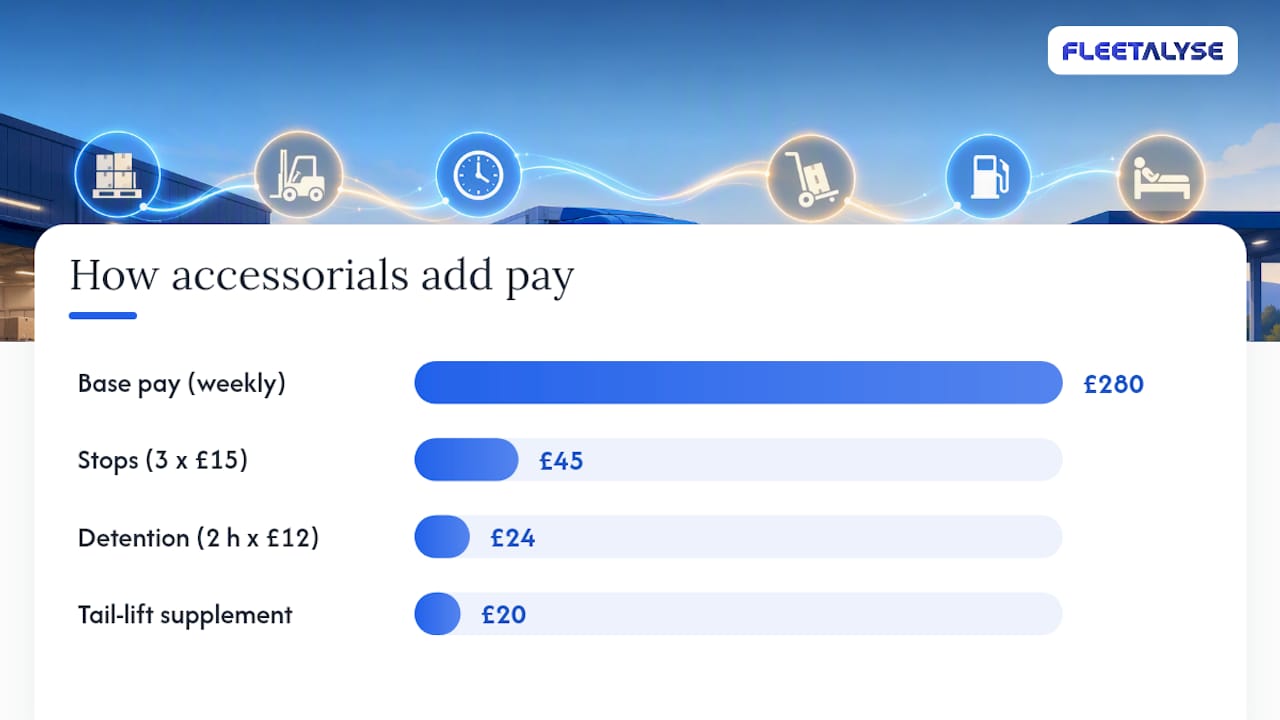
Example: A driver on a £280 PPM weekly base adds three stop payments at £15 each (£45), two hours of detention at £12 per hour (£24), and a tail-lift supplement of £20. That changes the effective hourly rate calculation substantially.
Pro Tip: Ask for the accessorial schedule in writing before accepting a role. Specifically ask how each item is triggered, how customers are billed for detention, and how that billing maps to what appears on your settlement. If the carrier bills the customer but does not pass detention pay to the driver, that is a material pay condition worth negotiating.
Employment status, tax, and legal points every UK driver should check
Employment status is the single most consequential variable in understanding driver pay. Whether you are an employee under PAYE or a self-employed contractor changes your tax obligations, National Insurance contributions, and statutory entitlements including holiday pay, statutory sick pay, and pension auto-enrolment. HMRC’s employment status guidance explains how status must be determined from the actual contract and working arrangements, not just the label an operator applies.
Key points to check:
- PAYE employee. Income tax and employee National Insurance are deducted at source. You are entitled to statutory holiday pay (5.6 weeks per year), statutory sick pay, and employer pension contributions. The employer also pays employer NICs on your earnings.
- Self-employed contractor. You are responsible for registering with HMRC, filing a Self Assessment return, and paying both Class 2 and Class 4 National Insurance. You are not entitled to statutory sick pay or holiday pay from the engaging operator. Expenses may be deductible, but the rules are specific.
- Worker status. A third category under UK employment law, sitting between employee and self-employed. Workers have some statutory rights (including National Minimum Wage and holiday pay) but not all employee rights. Agency drivers often fall here.
National Minimum Wage (NMW) compliance applies to all workers regardless of how pay is structured. If a PPM or salary arrangement results in an effective hourly rate below the NMW for your age band, the employer is in breach. HMRC enforces this, and drivers can report underpayment. The NMW applies to total hours on duty, not just driving hours, so dock time and loading time count.
Payslip basics to check:
- Gross pay should itemise base pay, accessorials, and any bonuses separately.
- Taxable allowances (such as a productivity bonus) must appear as gross income.
- Reimbursements (genuine expenses) should appear separately and not be included in gross taxable pay.
- Deductions for tax, employee NICs, pension, and any other items must be itemised.
- If you are on PAYE, your payslip must show your tax code. An incorrect code can mean you overpay or underpay tax.
For any unclear contract terms, ACAS provides free, impartial guidance on employment rights and pay disputes. Gov.uk’s employment status checker is a practical starting point for confirming your status. If a contract describes you as self-employed but the working arrangements look like employment (set hours, employer-provided vehicle, no ability to substitute another driver), HMRC may reclassify the relationship, with tax consequences for both parties.
How tachograph and telematics records help you verify your pay
Tachograph logs and telematics exports are the most objective evidence available when checking whether your pay settlement matches the hours and miles you actually worked. These records provide the evidence drivers need to contest unpaid paid-mile claims, detention disputes, or mileage calculation disagreements. Knowing how to use them is a practical skill, not just a compliance formality.
Useful data points for pay verification:
- Tachograph driving and on-duty records. Your digital tachograph card logs driving time, other work (loading, waiting), availability, and rest. A tachograph download gives you a timestamped record of every duty period, which you can compare against your settlement.
- Telematics mileage reports. GPS-based mileage figures show the actual distance driven on each trip. If your settlement uses hub miles or a different calculation basis, comparing GPS miles against paid miles reveals any systematic shortfall.
- Route traces and timestamps. GPS route data shows arrival and departure times at each customer site. This is direct evidence for detention claims: if you arrived at 09:00 and departed at 12:30, you have three and a half hours of site time on record.
- Stop and idle data. Telematics systems record engine-on/off events and stop durations, which corroborate stop pay claims and waiting time.
Short case use: A driver on PPM notices that weekly paid miles are consistently 30–40 miles below the GPS distance logged on the same routes. A telematics mileage report from Fleetalyse’s fleet GPS tracking shows actual route distances. Presented alongside the settlement, this gives a clear basis for querying the mileage methodology with payroll.
Keeping personal copies of your tachograph downloads and telematics summaries is straightforward and takes minutes. Drivers have a legal right to request a copy of their own tachograph data. Operators using automated telematics platforms can generate these summaries routinely, reducing the manual effort involved and the likelihood of disputes arising in the first place. Ensuring transportation compliance through consistent recordkeeping protects both the driver and the operator.

Pro Tip: Ask payroll or operations which telematics summary they use to calculate your mileage settlement. If the answer is unclear or access is refused, start keeping your own records: screenshot your tachograph card summary weekly and note GPS distances from your in-cab unit. A consistent log is far more persuasive in a dispute than a single disputed figure.
Questions to ask recruiters, negotiation tips, and red flags to avoid
Most pay disputes start with a conversation that never happened at recruitment. Asking the right questions upfront takes five minutes and can save weeks of frustration later.
Questions to ask before accepting a role:
- Which miles are paid: loaded miles only, or all miles including deadhead?
- Which mileage system does the carrier use: GPS/practical miles or hub miles?
- Is there a full written accessorial schedule, and can you see a sample settlement?
- How is detention calculated, and at what point does it trigger?
- Are stop payments included, and what is the rate per stop?
- What is the payslip cadence: weekly or monthly? Is it direct bank transfer?
- Are you engaged as an employee (PAYE) or a self-employed contractor?
- If per-diem is offered, how is it structured within payroll and what is the daily rate?
- Is there a weekly or daily minimum guarantee if miles fall short?
Negotiation tips:
- Use your effective hourly rate calculation as the anchor. If Offer A works out at £9.50 per hour and Offer B at £14.50, you have a concrete number to reference.
- Ask for a weekly minimum guarantee on PPM roles. This protects you in low-mileage weeks without capping your upside in strong weeks.
- Request transparency: ask to see a sample freight bill or settlement breakdown from a recent week. Operators confident in their pay model will not hesitate.
- On per-diem, ask whether it is an election or automatic, and confirm the daily rate and the tax treatment in writing.
Red flags to watch for:
- Verbal pay promises with no written schedule or contract.
- Refusal to provide a sample settlement or accessorial schedule.
- Vague answers about which miles are paid or how mileage is calculated.
- Claims of unusually high average weekly miles that cannot be verified against the route type.
- Missing or incomplete payslips that do not itemise deductions.
- A contract that labels you as self-employed but describes working arrangements that look like employment.
Negotiation checklist
- Calculate the effective hourly rate for each offer using conservative mileage assumptions.
- Request the written accessorial schedule and confirm detention and stop pay terms.
- Confirm employment status and ask for the contract in writing before your start date.
- Ask for a sample payslip or settlement from a recent week on the same route.
- If per-diem is offered, confirm the daily rate and its tax treatment with HMRC guidance.
- Agree a weekly minimum guarantee in writing if the role is PPM or percentage-based.
A fleet professional’s perspective on what actually matters
The drivers who feel most confident about their pay are rarely the ones on the highest headline rate. They are the ones who know exactly how their settlement is calculated, keep their own records, and ask the awkward questions before they sign.
Total compensation is what matters: base structure plus accessorials plus reimbursements, modelled across a realistic range of weeks. A 65p PPM rate with no detention pay and no stop pay on a route with heavy multi-drop dwell time will often pay less than a £13.50 hourly rate on a similar run. The maths is not complicated, but you have to do it.
Tachograph and telematics data are your most reliable allies here. Platforms like Fleetalyse give operators and drivers access to objective, timestamped records of hours, mileage, and stops. When those records are available and transparent, pay disputes become rare. When they are not, disputes become inevitable. Keeping your own copies of tachograph downloads and GPS summaries is a small habit with a disproportionate return.
Sources
- HMRC employment status manual
- Truck driver paychecks: CPM, accessorials, and questions to verify | TakeHome IQ
- Ways to pay truck drivers (Best pay structures for 2026) - STPS
- Truck driving jobs salary 2026: CDL pay guide & hiring
This article provides general information about driver pay structures and UK employment considerations. It is not legal, tax, or financial advice. For guidance specific to your situation, consult HMRC, ACAS, or a qualified employment adviser.
This article is general information, not a substitute for advice from a qualified financial advisor. Consult a qualified financial professional about your own circumstances before acting on anything here.