

Fleet accident management: a practical guide for UK fleets

An integrated telematics and incident-management platform is the fastest way for UK fleets to cut accident costs and downtime. If you operate under an Operator Licence or DVSA oversight, the right starting point is a pilot with a UK-focused vendor that offers plug-and-play hardware, automated tachograph downloads, and mobile-first First Notice of Loss (FNOL) capability.
Table of Contents
- What does fleet accident management actually cover?
- What does an effective incident management system need?
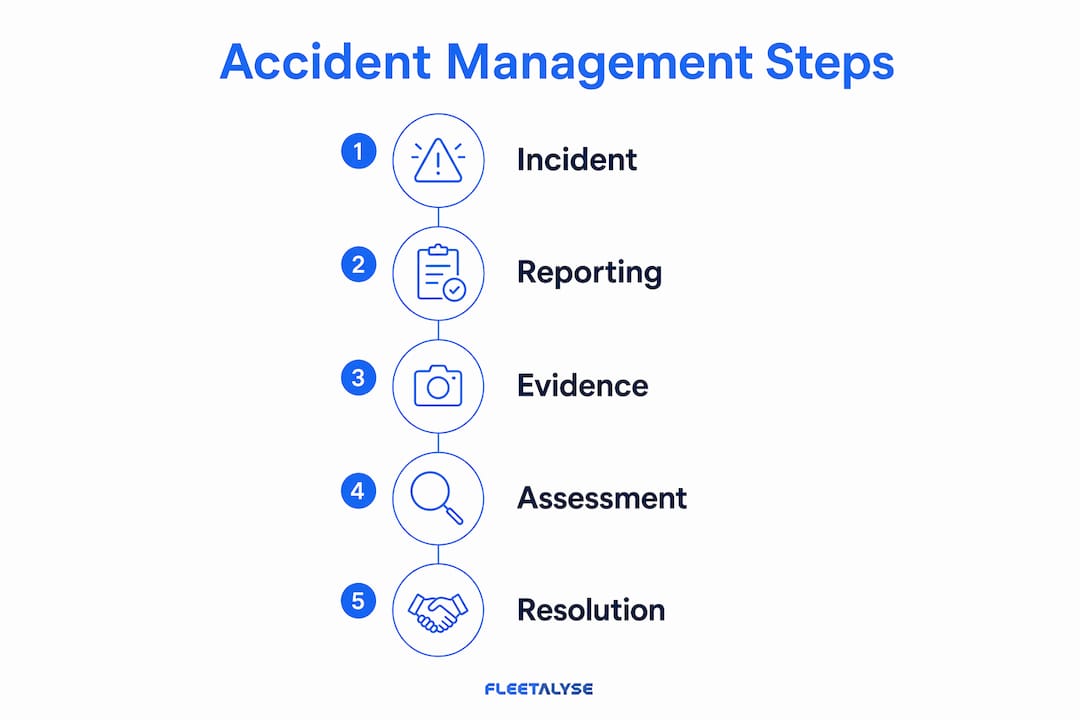
- How should your fleet handle an incident from scene to sign-off?
- How do you choose the right platform for a UK fleet?
- How does Fleetalyse address these requirements?
- What does implementation look like, and what should you measure?
- Key takeaways
- A practitioner’s view on where fleets go wrong
- Fleetalyse: built for UK fleet operators
- Useful sources and further reading
What does fleet accident management actually cover?
Fleet accident management is a proactive strategy that standardises the entire incident lifecycle: on-scene reporting, FNOL, claims, repairs, subrogation, and return to service. It is not simply a claims-handling arrangement bolted onto your insurance policy.

The operational case is straightforward. Faster evidence capture means shorter repair cycles, lower hire and storage charges, and cleaner audit trails for DVSA inspections and Operator Licence reviews. Tachograph records, GPS data, and timestamped photos together create the kind of contemporaneous evidence that holds up under scrutiny.
Financially, the gains compound. Claim leakage shrinks when you catch discrepancies early. Subrogation yields improve when you have a complete evidence trail. And diminished value, the reduction in a vehicle’s market price after repair, is a frequently overlooked recovery that a properly configured platform makes pursuable.
What does an effective incident management system need?
A capable system brings together several layers that work in concert rather than in isolation.
- Telematics and GPS telemetry: speed, location, and impact alerts feed incident reports the moment a collision occurs, giving managers real-time situational awareness.
- Mobile-first FNOL: drivers capture photos, GPS coordinates, and timestamps at the scene. Offline capture handles poor connectivity on rural routes.
- Connected dashcam integration: video evidence validates fault, protects against fraudulent claims, and accelerates insurer decisions.
- Claims and repair workflow: structured handoffs to vetted repairers, with status tracking and hire-vehicle coordination built in.
- Subrogation and legal support: tracking diminished value alongside repair and rental costs requires a complete, timestamped data trail from day one.
- Compliance features: automated tachograph downloads, audit logs, configurable data-retention periods, and GDPR-aware access controls.
- Service layer: 24/7 driver support, UK-based helpdesk, and certified repair oversight keep the process moving when incidents happen outside office hours.
Advanced platforms also use analytics and AI to surface risk patterns and recommend targeted coaching, shifting the programme from reactive claims handling to genuine accident prevention. That shift is where the long-term safety dividend lies.
How should your fleet handle an incident from scene to sign-off?
A time-bound workflow removes ambiguity and keeps costs under control at every stage.
Immediate actions (0–2 hours)
- Driver confirms safety, moves vehicle if safe to do so, and calls 24/7 support.
- Driver opens the mobile FNOL app and captures photos, GPS location, and timestamps.
- Telematics and dashcam data are pulled automatically by the platform.
- Fleet manager receives a real-time alert with initial incident details.
Short-term actions (2–24 hours)
- FNOL submitted to insurer with full evidence package attached.
- Tow and hire-vehicle coordination initiated.
- Initial repair estimate requested from vetted repairer.
- Reserve set and FNOL filing confirmed with insurer.
Follow-up (24–72 hours)
- Repair scheduled with approved bodyshop; damage verified against photos and video.
- Hidden damage assessment completed before authorisation.
- Vehicle availability update sent to operations.
Claim lifecycle (days to weeks)
- Subrogation discovery: review telematics, dashcam, and repair data for recovery potential.
- Pursue repair costs, hire charges, and diminished-value recovery where applicable.
- Final close and lessons-learned review fed back into driver coaching.
Pro Tip: Capture the vehicle’s VIN, odometer reading, and precise GPS coordinates in the first FNOL submission. Missing metadata is the most common reason subrogation claims are reduced or rejected by third-party insurers.
The speed of FNOL is the single most important cost lever in the entire process. Every hour between incident and FNOL adds hire and storage charges that are rarely recovered in full.
How do you choose the right platform for a UK fleet?
Selection criteria should map directly to your operational and compliance priorities.
Core capabilities to assess:
- Evidence capture quality: photo resolution, GPS accuracy, timestamp integrity.
- Telematics and dashcam integration: does data flow automatically into the incident record?
- Automated FNOL: can a driver complete a report in under five minutes, offline?
- Claims and repair workflow: is there a vetted UK repair network, or does the vendor rely on a single national provider?
- Subrogation support: does the platform track diminished value, or only direct repair costs?
- GDPR and data security: where is incident data stored, who can access it, and for how long?
- Tachograph automation: are remote downloads scheduled and logged without manual intervention?
- UK-based support: is there a helpdesk staffed by people who understand DVSA and Operator Licence obligations?
Questions to ask in a demo:
- What is the SLA for FNOL data transmission after an incident?
- Who owns the incident data, and can you export it in a standard format?
- How long does hardware installation take per vehicle?
- What is the repair network coverage in your operating region?
Red flags: opaque recovery-rate reporting, no automated tachograph downloads, unclear data-retention policies, and support teams with no knowledge of UK transport regulation. A vendor that cannot explain how their platform supports a DVSA roadside check is not ready for a UK commercial fleet.
A simple 0–5 scoring rubric, weighted by downtime impact, claims leakage risk, and regulatory exposure, gives procurement teams a defensible shortlist in a single afternoon.
How does Fleetalyse address these requirements?
Fleetalyse is built around the needs of UK commercial operators, and its feature set maps directly to the selection criteria above.
- Plug-and-play GPS trackers: hardware installs without professional setup, reducing deployment time across mixed fleets of HGVs, vans, and trailers.
- Driver behaviour monitoring: real-time scoring of harsh braking, speeding, and cornering feeds directly into driver coaching and incident reviews.
- Connected dashcams: video evidence is linked to the incident record automatically, supporting fault validation and insurer submissions.
- Automated remote tachograph downloads: scheduled downloads remove the manual collection burden and keep records audit-ready for DVSA inspections.
- Compliance support: the platform is designed around DVSA and Operator Licence requirements, with audit logs and configurable retention policies built in.
- UK-based support: the helpdesk understands the regulatory context, so queries about tachograph compliance or DVSA evidence are answered by people who know the framework.
Deployment follows a pilot-to-roll-out pattern. A small pilot tests hardware reliability, FNOL usability for drivers, and the platform’s ability to produce admissible evidence before you commit to a full fleet deployment. The 2026 UK fleet compliance checklist on the Fleetalyse blog is a useful reference for mapping platform capabilities to your current compliance gaps.
What does implementation look like, and what should you measure?
| Phase | Typical duration | Key activities |
|---|---|---|
| Pilot (5 vehicles) | 2–4 weeks | Hardware installation, FNOL walkthrough, tachograph automation test |
| Phased roll-out | 4 weeks | Fleet-wide hardware deployment, workflow configuration, driver briefing |
| Full fleet live | Week 8 | Back-office integration, KPI baseline set, coaching programme active |
Deployment checklist:
- Install plug-and-play telematics units (no specialist engineer required).
- Configure FNOL workflows and driver mobile app.
- Map incident policy to platform workflows and approval chains.
- Brief drivers on mobile reporting and evidence capture expectations.
- Integrate with existing back-office or transport management systems via API.
Metrics to track in the first 90 days: vehicle downtime per incident, FNOL-to-close time, subrogation recovery rate, claims leakage as a percentage of total claim value, and driver risk-score trend. These five figures give you a clear picture of where the programme is working and where coaching or process changes are needed.
Change management is often underestimated. Drivers who understand why they are capturing photos and GPS data at the scene are far more likely to do it correctly under stress. A short briefing session before go-live, reinforced by the platform’s guided FNOL forms, makes a material difference to data quality in the first weeks.
Key takeaways
An integrated telematics and incident-management platform, deployed with plug-and-play hardware and automated tachograph downloads, is the most effective approach to fleet accident management for UK commercial operators.
| Point | Details |
|---|---|
| FNOL speed is the primary cost lever | Every hour between incident and FNOL adds hire and storage charges that are rarely recovered in full. |
| Evidence quality determines recovery | Timestamped photos, GPS, and dashcam footage are required for subrogation and diminished-value claims. |
| Compliance and claims share the same data | The audit trail that satisfies DVSA is the same trail that supports insurer submissions and subrogation. |
| Pilot before full deployment | Test hardware reliability, FNOL usability, and evidence quality on 5 vehicles before fleet-wide roll-out. |
| Fleetalyse as a UK-first option | Fleetalyse combines plug-and-play GPS, automated tachograph downloads, driver behaviour monitoring, and UK-based support in one platform. |
A practitioner’s view on where fleets go wrong
The gap between a well-designed incident management programme and one that actually delivers is almost always behavioural, not technical. The platform can be configured perfectly, but if a driver waits four hours to report because they is not sure of the process, the FNOL window closes and the cost advantage evaporates.
Two things change that. First, make the mobile FNOL app the default first action after checking for injuries — not a secondary step after calling the transport office. Guided forms with mandatory photo fields remove the guesswork under stress. Second, use telematics data in driver coaching before incidents happen. Fleets that review harsh-braking and speeding alerts weekly, and act on them with targeted one-to-one conversations, see measurable reductions in incident frequency. The driver behaviour telematics data is already there; most fleets simply do not use it proactively enough.
The other common mistake is treating diminished value as an afterthought. By the time a fleet manager thinks to pursue it, the repair records are incomplete and the window for recovery has narrowed. Configure your platform to capture vehicle condition at the point of incident, not after the repair estimate arrives.
Fleetalyse: built for UK fleet operators
Fewer delays, cleaner evidence, and a compliance trail that holds up under DVSA scrutiny — that is what a properly deployed incident management platform delivers. Fleetalyse brings together plug-and-play GPS trackers, automated tachograph downloads, connected dashcams, and driver behaviour monitoring in a single UK-focused platform, without the complexity of stitching together separate systems.
A demo or pilot with Fleetalyse includes a hardware installation test, a live FNOL walkthrough, and a tachograph automation demonstration so you can verify the evidence quality before committing to a full roll-out. UK-based support is available throughout. Book your pilot at fleetalyse.co.uk and set your 90-day KPI baseline from day one.
Useful sources and further reading
- DVSA — Operator Licence guidance: the primary reference for UK transport operators on compliance obligations, record-keeping requirements, and roadside-check evidence standards. Available at gov.uk.
- HSE — Managing work-related road risk: the Health and Safety Executive’s framework for employers with drivers, covering risk assessment, incident reporting, and driver welfare obligations.
- SafetyCulture — Fleet accident management guide: a practical overview of incident lifecycle management, telematics integration, and proactive coaching approaches.
- Merchants Fleet — Fleet accident management programme: covers FNOL best practice, mobile reporting, and the cost impact of reporting delays.
- Wheels — Accident management services: details on 24/7 driver support, repair coordination, subrogation, and diminished-value recovery.
- CONFORMiT.ai — EHS incident management: enterprise-grade incident workflows, guided investigation forms, and CAPA assignment relevant to larger fleet operations.
- Cority — Incident management software: standardised workflows, severity scoring, and audit-trail features applicable to multi-site fleet compliance programmes.
- GDPR and incident data retention: the ICO (Information Commissioner’s Office) publishes guidance on lawful bases for retaining vehicle and driver data captured during incidents. Fleets should confirm retention periods with a qualified data-protection adviser for their specific operating context.