
Editorial correction: 30 September 2026. Removed unrelated third-party recommendations and an unsupported assurance about avoiding all manual errors. The original publication date is retained.
Your Operator Licence is the most valuable asset you own, yet it's often the one most at risk from simple administrative oversight. In 2026, the DVSA has no patience for manual data errors or missing records, especially with fixed penalties for overloading now reaching up to £300. You likely spend hours every week chasing drivers for tachograph cards or double-checking spreadsheets to avoid a catastrophic audit. Effective fleet compliance reporting shouldn't be a source of constant anxiety. It's time to move beyond the stress of manual tracking and adopt a more reliable, data-driven approach.
We understand that staying on top of the July 2026 Smart Tachograph 2 mandate for LCVs and new Event Data Recorder requirements feels like a full-time job. This guide will help you master these complexities and show you how to automate your reporting to stay 100% audit-ready. We'll explore the latest DVSA standards, the benefits of remote tachograph downloads, and how real-time visibility into driver hours can slash your administrative overhead. By the end, you'll have a clear roadmap to protect your licence and run a more efficient operation.
Key Takeaways
- Understand the systematic data collection required to meet 2026 DVSA standards and protect your Operator Licence from scrutiny.
- Learn how to automate your fleet compliance reporting to eliminate manual data entry errors and ensure you remain audit-ready at all times.
- Identify the essential components of a compliant report, including Working Time Directive analysis and Periodic Maintenance Inspection records.
- Discover how remote tachograph downloads remove the need to chase driver cards whilst significantly reducing administrative overhead.
- Gain real-time visibility into driver activity to organise better routes and prevent hours violations before they occur.
What is Fleet Compliance Reporting in the UK?
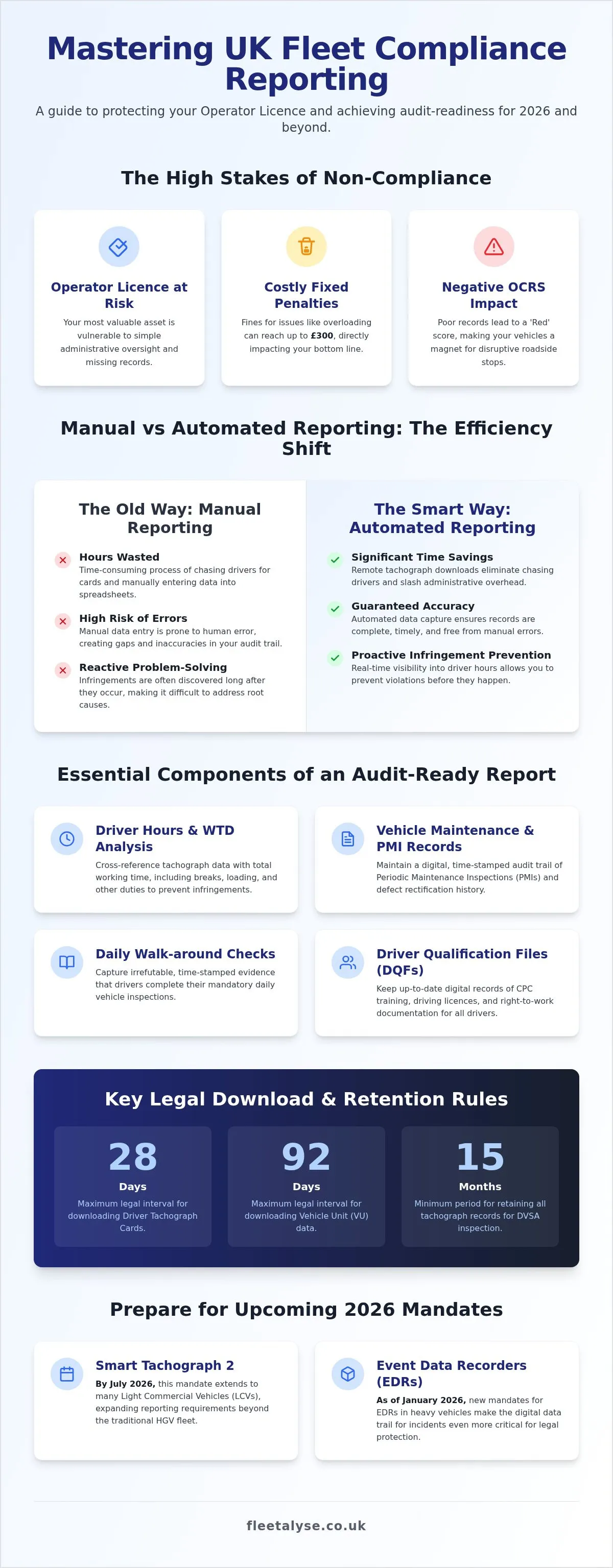
In the UK transport sector, fleet compliance reporting is the systematic process of gathering, analysing, and storing data to prove you are operating within the law. It isn't just about ticking boxes. It's the hard evidence you provide to the Driver and Vehicle Standards Agency (DVSA) to demonstrate your fitness to hold an Operator Licence (O-Licence). The DVSA sets strict reporting benchmarks that every haulier must meet to ensure road safety and fair competition. As of January 2026, new mandates for Event Data Recorders (EDRs) in heavy vehicles have made this data trail even more critical.
Your reporting framework acts as the backbone of your safety case. If a Traffic Commissioner ever reviews your operation, these reports are what protect your business. We've seen a massive shift away from unreliable paper logbooks toward digital telematics and remote data capture. Modern Fleet management now relies on automation to ensure that records are accurate, timely, and impossible to "lose" in the back of a cab. This transition's no longer optional for those aiming for Earned Recognition status.
The Legal Necessity of Accurate Records
The law is uncompromising regarding data retention. You must keep tachograph records for at least 15 months. Failure to produce these during an investigation often leads to "S-marked" prohibitions. These indicate a significant failure in your management systems. Such marks are public and highly damaging to your reputation. Your reporting quality directly impacts your Operator Compliance Risk Score (OCRS). A "Red" OCRS makes your vehicles a magnet for roadside stops; conversely, a "Green" score allows your fleet to keep moving without constant interference. Accurate fleet compliance reporting ensures your score remains in the clear.
Who is Responsible for Compliance Data?
The legal burden of maintaining these records falls heavily on the designated Transport Manager. They must ensure the systems are in place and functioning correctly. However, the data itself starts with the driver. Daily walk-around checks and proper tachograph use are non-negotiable duties. Even with a dedicated manager, business owners cannot delegate their ultimate legal responsibility. If the reporting fails, the owner faces the consequences at a Public Inquiry. Using automated tools helps bridge the gap between driver actions and management oversight. Assign responsibility for reviewing missing records and following up unresolved alerts.
A robust framework for fleet compliance reporting isn't a single document. It's a collection of living records that prove your operation is safe and legal. This commitment to rigorous oversight is common in all transport sectors; for example, SeaFleet Backbone provides independent inspections and safety audits for maritime operators. While generic software often focuses on US-centric DOT rules, UK operators must satisfy specific DVSA standards and EU-derived Working Time Directive (WTD) regulations. Every report you generate must serve as a transparent audit trail. If you can't produce the data instantly during a roadside check or a visit from the Traffic Commissioner, the law assumes the check never happened.
To maintain a "Green" OCRS, your reporting suite should include several critical pillars:
- Driver Hours and WTD Analysis: Reports that cross-reference tachograph data with total working time, including loading and cleaning.
- Vehicle Maintenance and PMI Records: Digital proof of Periodic Maintenance Inspections and long-term service history.
- Daily Walk-around Check Logs: Time-stamped evidence of driver inspections and a clear audit trail for defect rectification.
- Driver Qualification Files (DQFs): Up-to-date records of CPC training, licence mandates, and right-to-work documentation.
Tachograph Data: The Core of Compliance
Your analysis must go deeper than just checking for speeding. You need to report on missing mileage and unexplained vehicle movements. These gaps are often where the most serious infringements hide. Don't just look for isolated mistakes; identify "infringement patterns" that suggest systemic issues within your team. Adhering to the 28-day driver card and 92-day vehicle unit download cycles is the legal minimum. If you find your team is constantly chasing cards or missing these deadlines, it's time to automate your remote downloads to ensure you never miss a compliance window.
Vehicle Health and Maintenance Reporting
Maintenance reporting starts before the engine turns over. "First Use" inspections are vital for trailers and HGVs, especially if you're using hired assets or subcontractors. You should monitor brake test frequency and pass/fail trends over time. This data helps you spot failing components before they cause a breakdown or a MOT failure. Use VOR (Vehicle Off Road) logs to justify any gaps in your maintenance schedule. This level of transparency proves to the DVSA that you aren't skipping inspections due to operational pressure. It shows you value safety over short-term profit.
Manual vs. Remote Tachograph Reporting: Efficiency Analysis
Manual data collection is an invisible drain on your profit margins. For many regional operators, the traditional method involves vehicles returning to the depot just to plug in a download key. This process wastes fuel and incurs unnecessary driver downtime. It also creates a "chasing cards" culture. Transport Managers spend hours every week hunting down drivers to ensure 28-day deadlines aren't missed. This reactive approach is prone to error and leaves your business vulnerable to gaps in your fleet compliance reporting.
Remote tachograph downloads shift the burden from the person to the system. Data is captured whilst the vehicle is on the road, regardless of its location in the UK. This transition moves your operation from retrospective reporting to real-time oversight. Instead of discovering a rest-period violation three weeks after it happened, you can see the risk as it develops. Security is also tightened. Automated systems handle GDPR requirements and digital signatures with far greater consistency than a manual filing cabinet ever could.
The ROI of Automated Compliance Software
Automation delivers a clear return on investment by reclaiming lost time. If your admin team spends just 30 minutes per vehicle each month on manual downloads, a fleet of 20 vehicles loses 10 hours of productivity. Automated Remote Tachograph Download software eliminates this entirely. More importantly, it mitigates the financial risk of DVSA sanctions. As of May 2026, fixed penalties for drivers' hours offences reach up to £300. Avoiding just one or two of these fines pays for the software itself. Live driver hours tracking also improves dispatch behaviour. You'll stop asking drivers to take "one last job" when the data shows they are minutes away from an infringement.
Integrating Analysis with Telematics
Your GPS tracking and tachograph analysis shouldn't exist in silos. When these systems "talk" to each other, you gain a single, unified view of your entire operation. A combined dashboard allows you to see exactly where an HGV is located whilst simultaneously monitoring the driver's remaining legal hours. This transparency removes the guesswork from route planning. Tachograph analysis integration is a tool for proactive management that transforms raw data into a shield against regulatory scrutiny. It ensures your fleet compliance reporting is a live asset rather than a dusty archive.
How to Build an Audit-Ready Reporting Framework
Building a framework for fleet compliance reporting requires a shift from reactive fire-fighting to proactive management. You can't wait for a DVSA officer to point out your flaws. Instead, you must build a system that identifies risks before they become legal liabilities. A defensible safety case is built on the quality of your data and the consistency of your oversight. It's about proving that you're in control of your fleet every single day.
Preparing for DVSA Earned Recognition
The DVSA Earned Recognition scheme is the gold standard for UK hauliers. To achieve a "Green" rating, you must share your performance data periodically with the DVSA. They monitor specific KPIs, such as your MOT initial pass rate and tachograph infringement levels. Automated reporting makes this process seamless. It removes the need for manual submissions whilst proving your commitment to high standards. Being an Earned Recognition operator reduces the likelihood of your vehicles being stopped at the roadside, keeping your fleet moving.
Common Reporting Pitfalls to Avoid
One of the most frequent mistakes is ignoring "Unknown Driver" events. These vehicle movements without a card inserted suggest a lack of oversight. Another pitfall is failing to document the "Action Taken" after a violation is found. A report showing an infringement without a corresponding debrief note is a red flag to auditors. Finally, move away from paper checklists. These often lead to "tick-sheeting," where drivers complete them retrospectively at the end of a shift rather than during the actual inspection. If your current framework feels disjointed, it's time to implement an automated compliance system that does the heavy lifting for you.
Streamlining Your Fleet Compliance with Fleetalyse
Fleetalyse acts as your pragmatic partner in an increasingly complex regulatory environment. We don't just provide software; we offer a robust system built for the rigours of UK transport operations. Our platform automates the remote tachograph download process. This removes the administrative burden from your Transport Manager and ensures data is captured without the vehicle needing to return to base. By integrating tachograph analysis directly into our dashboard, we provide a transparent view of your compliance status. You'll see the facts as they are, without hidden complexities or theoretical data.
Utilising live driver hours allows you to organise better routes with confidence. You can see exactly how much driving time remains for every member of your team in real-time. This visibility prevents over-running and reduces the risk of costly infringements. UK hauliers trust Fleetalyse because we prioritise functional utility over flashy, unnecessary features. We understand that your priority is a safe, legal, and profitable fleet. Efficient fleet compliance reporting is the result of having the right tools in place to handle the heavy lifting for you.
Comprehensive Tracking for HGVs, Vans, and Trailers
Asset security and compliance monitoring shouldn't be separate tasks. Our platform combines GPS fleet tracking with trailer and van tracking to give you a unified view of your assets. This real-time visibility significantly reduces administrative overhead. You won't spend your day calling drivers to check their locations or status. Instead, customisable reporting alerts notify you well before a deadline is missed or a violation occurs. This proactive approach ensures your fleet compliance reporting remains flawless and your assets stay secure. It's about having total visibility without the manual effort.
Get Started with a Compliance Health Check
Transitioning from manual, paper-based systems to a digital solution is straightforward with our support. We specialise in helping regional operators across the UK modernise their approach to compliance. We focus on the practical challenges you face daily, from chasing tacho cards to preparing for audits. Our team ensures your data is accurate, accessible, and ready for inspection at a moment's notice. We value your time and resources, providing a steady stream of actionable information rather than just raw data. Stop worrying about the next DVSA check and start focusing on growing your business. Organise your fleet compliance reporting with Fleetalyse today.
Protect Your Operator Licence with Data-Driven Oversight
The landscape of UK transport regulation is shifting toward total transparency and automation. Staying ahead of DVSA standards in 2026 requires more than just keeping records; it demands real-time visibility and proactive intervention. Manual data entry and chasing tachograph cards are risks your business doesn't need to take. By adopting automated remote downloads and live driver hours monitoring, you transform fleet compliance reporting from a weekly chore into a strategic advantage. You save administrative hours whilst ensuring your safety case is always audit-ready.
Fleetalyse is a pragmatic partner for regional hauliers. We specialise in UK transport operator licence compliance, providing the tools you need to remove manual admin and focus on your core operations. Our platform integrates tachograph analysis to give you a clear, honest view of your fleet's performance. Don't wait for a roadside stop to discover a gap in your records. Take control of your data today and run a more efficient, compliant business.
Master your fleet compliance with Fleetalyse’s remote solutions and gain the peace of mind that comes with professional oversight. Your fleet is the lifeblood of your company. Secure it with the right technology.
Frequently Asked Questions
What is the most important report for fleet compliance?
The Driver Infringement Report is widely considered the most critical element of fleet compliance reporting. It provides a detailed breakdown of all Hours of Service (HOS) and Working Time Directive (WTD) violations. This report doesn't just list errors; it serves as a vital management tool to identify training needs. Without it, you cannot prove you're actively monitoring your drivers, which is a fundamental requirement of your Operator Licence.
How often do I need to download tachograph data in the UK?
In the UK, you must download driver card data at least every 28 days and vehicle unit data every 92 days. These are the legal maximum intervals. Most proactive operators choose to download data much more frequently, often daily or weekly, using remote systems. Frequent downloads ensure you spot infringements early and prevent data from being overwritten or lost, keeping your compliance records accurate and up to date.
Can I use GPS tracking data for compliance reporting?
GPS tracking data is an excellent tool for cross-referencing tachograph records and validating "Unknown Driver" events. Whilst it cannot replace the legal tachograph file for HGVs, it provides essential context for fleet compliance reporting in mixed fleets. It's a vital safety tool. For van drivers without tachographs, GPS data is the primary way to monitor working time and ensure they aren't exceeding safe driving limits or duty hours.
What happens if I miss a tachograph download deadline?
Missing a download deadline is a breach of your Operator Licence conditions and can lead to serious sanctions. The DVSA can issue fixed penalties of up to £300 for missing records or failing to produce them during an inspection. Repeated failures will negatively impact your Operator Compliance Risk Score (OCRS) and may result in a Public Inquiry. Consistent, automated downloads are the only way to ensure you never miss a legal deadline.
What are the benefits of remote tachograph downloads?
Remote tachograph downloads remove the need for vehicles to return to the depot just to plug in a download key. This automation eliminates the "chasing cards" culture and significantly reduces administrative overhead. You get real-time visibility of driver activity, which allows for better route planning and immediate intervention if an infringement occurs. It's a pragmatic solution that keeps your fleet on the road whilst maintaining 100% audit readiness at all times.
How does the DVSA use compliance reports during an audit?
During an audit, the DVSA uses your reports to check for systemic patterns of non-compliance rather than just isolated incidents. They look for evidence of "closing the loop," which means they want to see the report, the driver debrief, and the corrective action taken. They also scrutinise missing mileage and unexplained vehicle movements. If your reporting shows you've identified and dealt with issues, you're far more likely to maintain a "Green" rating.
Is digital compliance reporting mandatory for UK HGVs?
Digital tachographs have been mandatory for new HGVs since 2006, making digital records the standard for almost all modern fleets. From July 2026, Smart Tachograph 2 units will also be required for light commercial vehicles (LCVs) over 2.5 tonnes used for international transport. Whilst some older vehicles still use analogue charts, the DVSA's Earned Recognition scheme and most modern compliance frameworks are built entirely around digital data capture and analysis.
How do I manage driver hours reporting for a mixed fleet of vans and trucks?
Managing a mixed fleet requires a unified platform that can handle both tachograph data for HGVs and GPS tracking for vans. You must ensure that van drivers also adhere to UK domestic driving rules and the Working Time Directive. By using a single dashboard for live driver hours, you can monitor the entire fleet's activity in one place. This ensures consistency in your safety standards and simplifies the reporting process for your Transport Manager.
Frequently asked questions
Who is Responsible for Compliance Data?
The legal burden of maintaining these records falls heavily on the designated Transport Manager. They must ensure the systems are in place and functioning correctly. However, the data itself starts with the driver. Daily walk-around checks and proper tachograph use are non-negotiable duties. Even with a dedicated manager, business owners cannot delegate their ultimate legal responsibility. If the reporting fails, the owner faces the consequences at a Public Inquiry. Using automated tools helps bridge the gap between driver actions and management oversight. It ensures no one is left exposed by simple manual errors or forgotten downloads. A robust framework for fleet compliance reporting isn't a single document. It's a collection of living records that prove your operation is safe and legal. While generic software often focuses on US-centric DOT rules, UK operators must satisfy specific DVSA standards and EU-derived Working Time Directive (WTD) regulations. Every report you generate must serve as a transparent audit trail. If you can't produce the data instantly during a roadside check or a visit from the Traffic Commissioner, the law assumes the check never happened. To maintain a "Green" OCRS, your reporting suite should include several critical pillars:
What is the most important report for fleet compliance?
The Driver Infringement Report is widely considered the most critical element of fleet compliance reporting. It provides a detailed breakdown of all Hours of Service (HOS) and Working Time Directive (WTD) violations. This report doesn't just list errors; it serves as a vital management tool to identify training needs. Without it, you cannot prove you're actively monitoring your drivers, which is a fundamental requirement of your Operator Licence.
How often do I need to download tachograph data in the UK?
In the UK, you must download driver card data at least every 28 days and vehicle unit data every 92 days. These are the legal maximum intervals. Most proactive operators choose to download data much more frequently, often daily or weekly, using remote systems. Frequent downloads ensure you spot infringements early and prevent data from being overwritten or lost, keeping your compliance records accurate and up to date.
Can I use GPS tracking data for compliance reporting?
GPS tracking data is an excellent tool for cross-referencing tachograph records and validating "Unknown Driver" events. Whilst it cannot replace the legal tachograph file for HGVs, it provides essential context for fleet compliance reporting in mixed fleets. It's a vital safety tool. For van drivers without tachographs, GPS data is the primary way to monitor working time and ensure they aren't exceeding safe driving limits or duty hours.
What happens if I miss a tachograph download deadline?
Missing a download deadline is a breach of your Operator Licence conditions and can lead to serious sanctions. The DVSA can issue fixed penalties of up to £300 for missing records or failing to produce them during an inspection. Repeated failures will negatively impact your Operator Compliance Risk Score (OCRS) and may result in a Public Inquiry. Consistent, automated downloads are the only way to ensure you never miss a legal deadline.
What are the benefits of remote tachograph downloads?
Remote tachograph downloads remove the need for vehicles to return to the depot just to plug in a download key. This automation eliminates the "chasing cards" culture and significantly reduces administrative overhead. You get real-time visibility of driver activity, which allows for better route planning and immediate intervention if an infringement occurs. It's a pragmatic solution that keeps your fleet on the road whilst maintaining 100% audit readiness at all times.
How does the DVSA use compliance reports during an audit?
During an audit, the DVSA uses your reports to check for systemic patterns of non-compliance rather than just isolated incidents. They look for evidence of "closing the loop," which means they want to see the report, the driver debrief, and the corrective action taken. They also scrutinise missing mileage and unexplained vehicle movements. If your reporting shows you've identified and dealt with issues, you're far more likely to maintain a "Green" rating.
Is digital compliance reporting mandatory for UK HGVs?
Digital tachographs have been mandatory for new HGVs since 2006, making digital records the standard for almost all modern fleets. From July 2026, Smart Tachograph 2 units will also be required for light commercial vehicles (LCVs) over 2.5 tonnes used for international transport. Whilst some older vehicles still use analogue charts, the DVSA's Earned Recognition scheme and most modern compliance frameworks are built entirely around digital data capture and analysis.
How do I manage driver hours reporting for a mixed fleet of vans and trucks?
Managing a mixed fleet requires a unified platform that can handle both tachograph data for HGVs and GPS tracking for vans. You must ensure that van drivers also adhere to UK domestic driving rules and the Working Time Directive. By using a single dashboard for live driver hours, you can monitor the entire fleet's activity in one place. This ensures consistency in your safety standards and simplifies the reporting process for your Transport Manager.