
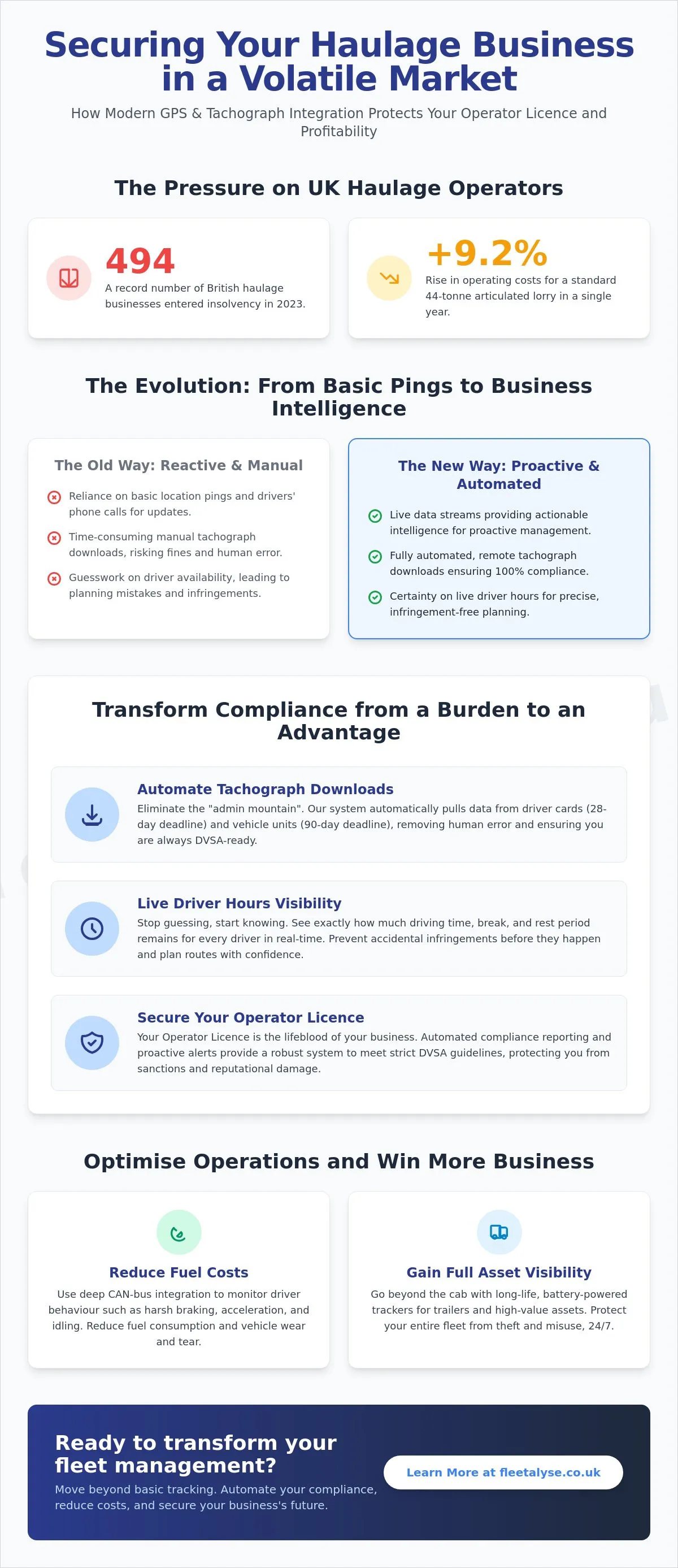
A record 494 British haulage businesses entered insolvency in 2023, while operating costs for a 44-tonne articulated lorry rose by 9.2 per cent. In such a volatile market, the margin for error has disappeared. Modern GPS tracking for haulage companies is no longer just about knowing where a vehicle is; it's about how your business stays compliant and profitable. You're likely tired of the manual tachograph download grind and the constant worry of a DVSA inspection revealing accidental driver hour infringements.
We know that your Operator Licence is the lifeblood of your business. This guide explains how integrating GPS fleet tracking with live tachograph data secures that licence while removing the administrative burden from your desk. You'll learn how to automate compliance reporting, protect your assets with trailer tracking, and use precise telematics to lower fuel costs. We'll show you how to transform a regulatory headache into a streamlined, efficient operation that protects your bottom line.
Key Takeaways
- Move beyond simple location data to adopt a proactive fleet management strategy that supports business growth.
- Eliminate manual administrative tasks by integrating remote tachograph downloads with live driver hours.
- Secure your Operator Licence by using automated compliance reporting to meet strict DVSA roadworthiness guidelines.
- Implement GPS tracking for haulage companies to gain full visibility over trailers and high-value assets.
- Reduce operating costs and improve fuel efficiency through transparent technical solutions designed specifically for UK hauliers.
Understanding GPS Tracking in the Modern UK Haulage Sector
GPS tracking for haulage companies has moved far beyond simple location pings. A modern vehicle tracking system acts as the central nervous system of a transport operation. It transforms raw data into actionable intelligence. This shift is essential in a market where the UK freight sector is projected to reach $207.2 billion by 2034. Whilst the market is growing, individual operators face intense pressure. Efficiency isn't just a goal. It's a requirement for staying in business. You can no longer afford to be reactive. Waiting for a driver to call with an update is a legacy habit that costs money.
Tier 1 logistics contracts now demand total transparency. Clients want to see real-time progress and precise ETAs. They don't want excuses; they want data. Proactive fleet management allows you to spot delays before they become disputes with your customers. By integrating live data into your workflow, you position your business as a reliable partner. This visibility is often the deciding factor when tendering for high-value work. If you can't prove your efficiency, you won't win the contract.
The Evolution of Haulage Telematics
Telematics has evolved from basic breadcrumb trails to deep CAN-bus integration. We now pull data directly from the engine and the digital tachograph head. This provides a complete picture of vehicle health and driver behaviour, allowing for the same level of technical oversight that specialists like Eurotech Automotive apply to high-performance European vehicles. 5G connectivity has largely eliminated traditional signal "black spots" across the UK road network. Data now flows faster and more reliably than ever before. Cloud-based platforms have decentralised fleet management, ensuring you have the right information at the right time, whether you're at the depot or off-site.
Key Components of a Haulage Tracking System
Hardware choice is the foundation of your system. For HGVs, hardwired trackers provide the most reliable data and security. For mixed fleets, OBD devices offer quick installation for vans or support vehicles. Trailer tracking requires long-life, battery-powered devices that can withstand harsh conditions. The software must be practical and stripped of unnecessary clutter. A dashboard should provide a clear overview of your assets and driver status at a glance. Fleetalyse focuses on this functional utility. We ensure the technology serves the operator, not the other way around. Connectivity must be robust. Your system should continue to record data even in remote areas, uploading it the moment a signal is restored.
Beyond Location: Integrating Remote Tachograph Data and Live Driver Hours
GPS tracking for haulage companies shouldn't exist in a vacuum. To be truly effective, it must communicate directly with the digital tachograph head. This synergy allows the transport office to see exactly how much driving time remains for every driver in the fleet. It's not just about the vehicle's physical location. It's about the driver's legal capacity to complete the next leg of a journey. By merging these data streams, you move from guessing availability to knowing it with absolute certainty.
The mechanics of remote tachograph download are straightforward and efficient. The system pulls data from the vehicle unit and the driver card via an internal cellular connection. There's no need for cables or manual card swiping at the depot. This automated approach aligns with HSE guidance on telematics, which encourages using technology to manage work-related road risks. Automated collection ensures you're always prepared for a DVSA audit without the last-minute panic of missing files.
The End of Manual Tacho Downloads
Manual downloading is a significant risk to your business continuity. It relies on drivers remembering to visit the office or using mobile tools that are prone to failure. Remote systems ensure you never miss the mandatory 28-day driver card or 90-day vehicle unit deadlines. Remote tachograph download is an automated compliance tool that removes human error from your record-keeping. It eliminates the "admin mountain" by feeding data directly into your analysis software. If you're ready to automate your compliance, you can view our integration options to get started.
Real-Time Visibility of Driver Availability
Planning the next day's routes is guesswork without live hours. You need to know which drivers have the spread to finish a late run without risking an infringement. Live tracking prevents accidental over-driving by flagging rest-period violations before they occur. It provides a unified view of your fleet's legal standing. You can see who is driving, who is on a break, and who is available for a new assignment at a glance. This precision reduces the pressure on your transport managers and keeps your drivers on the right side of the law. Integrating GPS tracking for haulage companies with tachograph analysis software creates a robust safety net for your entire operation.
Strengthening Compliance: How Tracking Protects Your Operator Licence
The Operator Licence is the foundation of your business. Without it, your fleet stops. The DVSA Guide to Maintaining Roadworthiness sets clear expectations for vehicle management and oversight. GPS tracking for haulage companies provides the digital proof that you're meeting these standards. It's no longer enough to claim you're compliant. You must prove it with granular, timestamped data. This evidence is your primary defence if your business is ever called before a Traffic Commissioner.
Geofencing is a practical tool for maintaining this level of control. You can set virtual boundaries around depots or specific delivery routes. If a vehicle leaves a designated zone or is used outside of authorised hours, you receive an immediate alert. This prevents unauthorised vehicle use and ensures your assets are only used for business purposes. It also helps identify route deviations that lead to missed delivery windows or unnecessary fuel spend. You're not just watching a map; you're enforcing your operational policies.
Addressing driver privacy is essential for fleet harmony. Some drivers view tracking as "big brother" surveillance. However, as an operator, you have a legal duty of care and a corporate responsibility to ensure road safety. Professional GPS tracking for haulage companies isn't about spying on individuals. It's about protecting the business and the driver from false accusations. Historical data serves as your strongest evidence during an Earned Recognition audit. It provides an objective record that can clear a driver's name after a disputed incident or a roadside check.
Audit Readiness and the DVSA
Tracking logs create a permanent, unalterable record for every vehicle movement. During a DVSA visit, you can produce automated reports that show exact routes, stop times, and speeds. This data is vital for proving compliance with speed limiters and rest requirements. Digital archives are far more reliable than manual logbooks. They allow you to pull up specific records from months ago in seconds. This level of organisation demonstrates to auditors that your operation is professional, transparent, and well-managed.
Managing Driver Behaviour and Safety
Monitoring driving style is a direct way to lower insurance premiums and reduce wear and tear. By tracking harsh braking, rapid acceleration, and excessive idling, you can identify high-risk behaviour before it leads to an accident. This data allows for constructive, evidence-based driver coaching. Instead of vague criticisms, you can show drivers exactly where they can improve. In the event of a collision, tracking data is invaluable for accident reconstruction. It provides an objective account of the vehicle's speed and position, which is crucial for insurance claim defence.
Evaluating GPS Tracking Solutions: Key Features for Haulage Operators
Selecting the right technology partner requires a focus on long-term reliability rather than the lowest upfront price. Cheap hardware alternatives often lead to higher costs through frequent failures, poor signal reception, and lack of technical support. When evaluating GPS tracking for haulage companies, you should prioritise a provider that offers total transparency regarding contract terms and data ownership. A pragmatic framework for your decision should balance hardware durability, software integration, and the specific security needs of your mixed fleet.
Your tracking system must talk to your existing tachograph analysis software. Siloed data is a major source of administrative overhead. If your GPS location data and driver hours don't sit on a unified platform, you're forced to cross-reference multiple screens to spot a single infringement. This integration is the difference between a basic "dots on a map" service and a professional compliance tool. Ensure any solution you consider can handle complex data streams from the vehicle's CAN-bus and the tachograph head simultaneously.
Total Cost of Ownership (TCO) is the most accurate metric for your budget. Look for providers that bundle hardware, connectivity, and support into a clear, predictable rate. Hidden fees for data overages or software updates can quickly erode the thin profit margins common in the UK haulage sector. If you want a solution built for the rigours of the road with no hidden complexities, you can get started with our transparent tracking plans today.
Trailer and Asset Tracking Specialisms
Trailers spend significant time away from a constant power source. They require specialised trailer tracking devices equipped with long-life internal batteries. These units should be rugged enough to withstand jet washing and extreme weather whilst providing independent location updates. Geofencing is vital for protecting "dropped" trailers in unsecure yards. You can set alerts to trigger the moment a trailer moves outside of a designated area. For temperature-controlled logistics, integrated telematics can also monitor reefer units, providing a digital record that the cold chain remained intact throughout the journey.
Software Usability and Reporting
A transport manager's desk is a high-pressure environment. The software interface must be intuitive and stripped of unnecessary "flashy" features that add no operational value. You need a dashboard that highlights exceptions, such as excessive idling or unauthorised route deviations, without requiring you to dig through menus. Automated alerts via email or SMS ensure you're notified of critical issues the moment they happen. Customisable reports for fuel usage and driver performance allow you to identify the 10 per cent of your fleet that might be responsible for 90 per cent of your wasted fuel.
Optimising Your Fleet with Fleetalyse: A Pragmatic Approach to Tracking
Fleetalyse is built for the specific demands of the UK haulage industry. We don't offer generic software designed for global markets. Instead, we provide a specialised platform that prioritises the regulatory adherence and operational clarity required by regional operators. GPS tracking for haulage companies must be more than a map; it must be a tool for survival. Our "Compliance-First" philosophy ensures that tachograph management becomes an effortless background process rather than a daily administrative burden.
Transparency is a core pillar of our service. Many providers hide costs behind complex contracts or add-on fees for basic functionality. We provide clear, upfront details regarding financial terms and rates. This openness allows you to calculate your exact return on investment without fear of hidden surprises. By focusing on functional utility over flashy, unnecessary features, we ensure your resources are spent on technology that actually improves your bottom line. It's about providing a reliable ally for your daily operational struggles.
Moving from manual systems to automated tracking is the most effective way to reduce administrative overhead. Manual data entry is prone to error and consumes valuable time that should be spent on fleet growth. Our system automates the collection of live driver hours and vehicle data, feeding it directly into your analysis tools. This transition removes the friction from your compliance workflow and allows your transport managers to focus on high-level efficiency.
A Localised Specialist for the UK Haulage Industry
A UK-based partner understands your specific challenges. We know the pressure of maintaining a "Green" OCRS score and the strict requirements of DVSA audits. Unlike global software providers, we offer direct access to expert support for your remote tachograph download setup. We've helped numerous operators move away from manual systems to protect their licences. This localised expertise ensures your tracking system is always aligned with the latest UK roadworthiness guidelines.
Getting Started with Fleetalyse
The transition to automated tracking is designed to be frictionless. Installation for HGVs, vans, and trailers is straightforward and handled with minimal downtime for your fleet. Once the hardware is active, we help you train your team to use live driver hours for precise route planning. You'll move from reactive troubleshooting to proactive management in days. If you're ready to secure your operation, enquire about our GPS tracking and remote tacho solutions to see how we can streamline your business.
Secure Your Fleet's Future with Automated Compliance
Effective fleet management is no longer just about tracking vehicle movements. It's about protecting your Operator Licence through automated data collection and precise driver hour monitoring. By integrating GPS tracking for haulage companies with remote tachograph downloads, you eliminate the manual errors that lead to DVSA infringements. You gain a transparent view of your entire operation, from live vehicle locations to remaining driver availability.
As specialists in Remote Tachograph Download with seamless Tachograph Analysis Integration, we provide the tools you need to stay compliant whilst reducing administrative overhead. Our UK-based support team understands the specific pressures of the local industry and is ready to help you transition to a more efficient, digital workflow. Don't leave your compliance to chance in an increasingly regulated market.
See our published pricing for your fleet tracking and tacho needs to start optimising your performance today. We look forward to becoming your pragmatic partner in transport excellence.
Frequently Asked Questions
Is GPS tracking mandatory for haulage companies in the UK?
GPS tracking is not a legal requirement for UK hauliers. However, it's a vital tool for meeting the DVSA Guide to Maintaining Roadworthiness. Without it, proving your oversight of driver behaviour and vehicle location during an audit is significantly harder. Most Tier 1 logistics contracts now require this level of transparency as a standard condition for winning and maintaining work.
Can I integrate GPS tracking with my existing tachograph analysis software?
Yes, seamless integration is a core feature of professional GPS tracking for haulage companies. The system should feed location data and live driver hours directly into your analysis platform. This removes the need for manual data entry and ensures your records are always up to date. It creates a single source of truth for your transport office and simplifies compliance management.
How much does a GPS tracking system for a haulage fleet typically cost?
Costs vary based on your fleet's specific needs and the number of assets. Typical components include an initial hardware fee and a monthly subscription per vehicle. We prioritise transparent pricing with no hidden charges or unexpected data fees. It's best to request a tailored quote to understand the total cost of ownership for your specific operation and asset types.
What is the difference between HGV tracking and trailer tracking?
HGV tracking systems are hardwired into the vehicle's power and CAN-bus system to monitor engine data and tachograph status. Trailer tracking units are often independent, battery-powered devices. They're designed to provide location updates even when the trailer is uncoupled and has no external power source. Both are essential for full fleet visibility and protecting high-value assets in unsecure yards.
How does remote tachograph download improve DVSA compliance?
Remote tachograph download automates the mandatory collection of driver card and vehicle unit data. This ensures you never miss the 28-day or 90-day deadlines set by the DVSA. By removing the human element, you eliminate the risk of missing files and accidental infringements. It keeps your records audit-ready at all times and protects your Operator Licence from avoidable regulatory scrutiny.
What happens if a vehicle enters an area with poor GPS signal?
Modern trackers store data on internal memory when a cellular signal is lost. Once the vehicle enters an area with 4G or 5G coverage, the device automatically uploads the recorded information. You won't lose any historical data points, although the live map may show the last known position until the connection is restored. This ensures your compliance records remain complete and accurate.
How do drivers usually react to the installation of tracking devices?
Drivers often have concerns about privacy initially. Clear communication is the best approach to gain their support. Explain that GPS tracking for haulage companies is a safety tool that protects them from false insurance claims and proves their compliance. When drivers see how it simplifies their admin and ensures they get their legal rest periods, initial resistance usually fades quickly.
Can GPS tracking help reduce my fleet’s fuel consumption?
Yes, tracking identifies the specific behaviours that drive up fuel costs across your fleet. You can monitor excessive idling, harsh acceleration, and inefficient routing. Addressing these issues with evidence-based coaching often leads to measurable savings. Even a small reduction in idling time can have a significant impact on your annual fuel bill and your overall business profitability.
Frequently asked questions
The Evolution of Haulage Telematics
Telematics has evolved from basic breadcrumb trails to deep CAN-bus integration. We now pull data directly from the engine and the digital tachograph head. This provides a complete picture of vehicle health and driver behaviour. 5G connectivity has largely eliminated traditional signal "black spots" across the UK road network. Data now flows faster and more reliably than ever before. Cloud-based platforms have decentralised fleet management. You can now oversee your entire operation from a tablet or smartphone, whether you're at the depot or off-site. It's about having the right information at the right time.
Key Components of a Haulage Tracking System
Hardware choice is the foundation of your system. For HGVs, hardwired trackers provide the most reliable data and security. For mixed fleets, OBD devices offer quick installation for vans or support vehicles. Trailer tracking requires long-life, battery-powered devices that can withstand harsh conditions. The software must be practical and stripped of unnecessary clutter. A dashboard should provide a clear overview of your assets and driver status at a glance. Fleetalyse focuses on this functional utility. We ensure the technology serves the operator, not the other way around. Connectivity must be robust. Your system should continue to record data even in remote areas, uploading it the moment a signal is restored. GPS tracking for haulage companies shouldn't exist in a vacuum. To be truly effective, it must communicate directly with the digital tachograph head. This synergy allows the transport office to see exactly how much driving time remains for every driver in the fleet. It's not just about the vehicle's physical location. It's about the driver's legal capacity to complete the next leg of a journey. By merging these data streams, you move from guessing availability to knowing it with absolute certainty. The mechanics of remote tachograph download are straightforward and efficient. The system pulls data from the vehicle unit and the driver card via an internal cellular connection. There's no need for cables or manual card swiping at the depot. This automated approach aligns with HSE guidance on telematics, which encourages using technology to manage work-related road risks. Automated collection ensures you're always prepared for a DVSA audit without the last-minute panic of missing files.
The End of Manual Tacho Downloads
Manual downloading is a significant risk to your business continuity. It relies on drivers remembering to visit the office or using mobile tools that are prone to failure. Remote systems ensure you never miss the mandatory 28-day driver card or 90-day vehicle unit deadlines. Remote tachograph download is an automated compliance tool that removes human error from your record-keeping. It eliminates the "admin mountain" by feeding data directly into your analysis software. If you're ready to automate your compliance, you can view our integration options to get started.
Real-Time Visibility of Driver Availability
Planning the next day's routes is guesswork without live hours. You need to know which drivers have the spread to finish a late run without risking an infringement. Live tracking prevents accidental over-driving by flagging rest-period violations before they occur. It provides a unified view of your fleet's legal standing. You can see who is driving, who is on a break, and who is available for a new assignment at a glance. This precision reduces the pressure on your transport managers and keeps your drivers on the right side of the law. Integrating GPS tracking for haulage companies with tachograph analysis software creates a robust safety net for your entire operation. The Operator Licence is the foundation of your business. Without it, your fleet stops. The DVSA Guide to Maintaining Roadworthiness sets clear expectations for vehicle management and oversight. GPS tracking for haulage companies provides the digital proof that you're meeting these standards. It's no longer enough to claim you're compliant. You must prove it with granular, timestamped data. This evidence is your primary defence if your business is ever called before a Traffic Commissioner. Geofencing is a practical tool for maintaining this level of control. You can set virtual boundaries around depots or specific delivery routes. If a vehicle leaves a designated zone or is used outside of authorised hours, you receive an immediate alert. This prevents unauthorised vehicle use and ensures your assets are only used for business purposes. It also helps identify route deviations that lead to missed delivery windows or unnecessary fuel spend. You're not just watching a map; you're enforcing your operational policies. Addressing driver privacy is essential for fleet harmony. Some drivers view tracking as "big brother" surveillance. However, as an operator, you have a legal duty of care and a corporate responsibility to ensure road safety. Professional GPS tracking for haulage companies isn't about spying on individuals. It's about protecting the business and the driver from false accusations. Historical data serves as your strongest evidence during an Earned Recognition audit. It provides an objective record that can clear a driver's name after a disputed incident or a roadside check.
Audit Readiness and the DVSA
Tracking logs create a permanent, unalterable record for every vehicle movement. During a DVSA visit, you can produce automated reports that show exact routes, stop times, and speeds. This data is vital for proving compliance with speed limiters and rest requirements. Digital archives are far more reliable than manual logbooks. They allow you to pull up specific records from months ago in seconds. This level of organisation demonstrates to auditors that your operation is professional, transparent, and well-managed.
Managing Driver Behaviour and Safety
Monitoring driving style is a direct way to lower insurance premiums and reduce wear and tear. By tracking harsh braking, rapid acceleration, and excessive idling, you can identify high-risk behaviour before it leads to an accident. This data allows for constructive, evidence-based driver coaching. Instead of vague criticisms, you can show drivers exactly where they can improve. In the event of a collision, tracking data is invaluable for accident reconstruction. It provides an objective account of the vehicle's speed and position, which is crucial for insurance claim defence. Selecting the right technology partner requires a focus on long-term reliability rather than the lowest upfront price. Cheap hardware alternatives often lead to higher costs through frequent failures, poor signal reception, and lack of technical support. When evaluating GPS tracking for haulage companies, you should prioritise a provider that offers total transparency regarding contract terms and data ownership. A pragmatic framework for your decision should balance hardware durability, software integration, and the specific security needs of your mixed fleet. Your tracking system must talk to your existing tachograph analysis software. Siloed data is a major source of administrative overhead. If your GPS location data and driver hours don't sit on a unified platform, you're forced to cross-reference multiple screens to spot a single infringement. This integration is the difference between a basic "dots on a map" service and a professional compliance tool. Ensure any solution you consider can handle complex data streams from the vehicle's CAN-bus and the tachograph head simultaneously. Total Cost of Ownership (TCO) is the most accurate metric for your budget. Look for providers that bundle hardware, connectivity, and support into a clear, predictable rate. Hidden fees for data overages or software updates can quickly erode the thin profit margins common in the UK haulage sector. If you want a solution built for the rigours of the road with no hidden complexities, you can get started with our transparent tracking plans today.
Trailer and Asset Tracking Specialisms
Trailers spend significant time away from a constant power source. They require specialised trailer tracking devices equipped with long-life internal batteries. These units should be rugged enough to withstand jet washing and extreme weather whilst providing independent location updates. Geofencing is vital for protecting "dropped" trailers in unsecure yards. You can set alerts to trigger the moment a trailer moves outside of a designated area. For temperature-controlled logistics, integrated telematics can also monitor reefer units, providing a digital record that the cold chain remained intact throughout the journey.
Software Usability and Reporting
A transport manager's desk is a high-pressure environment. The software interface must be intuitive and stripped of unnecessary "flashy" features that add no operational value. You need a dashboard that highlights exceptions, such as excessive idling or unauthorised route deviations, without requiring you to dig through menus. Automated alerts via email or SMS ensure you're notified of critical issues the moment they happen. Customisable reports for fuel usage and driver performance allow you to identify the 10 per cent of your fleet that might be responsible for 90 per cent of your wasted fuel. Fleetalyse is built for the specific demands of the UK haulage industry. We don't offer generic software designed for global markets. Instead, we provide a specialised platform that prioritises the regulatory adherence and operational clarity required by regional operators. GPS tracking for haulage companies must be more than a map; it must be a tool for survival. Our "Compliance-First" philosophy ensures that tachograph management becomes an effortless background process rather than a daily administrative burden. Transparency is a core pillar of our service. Many providers hide costs behind complex contracts or add-on fees for basic functionality. We provide clear, upfront details regarding financial terms and rates. This openness allows you to calculate your exact return on investment without fear of hidden surprises. By focusing on functional utility over flashy, unnecessary features, we ensure your resources are spent on technology that actually improves your bottom line. It's about providing a reliable ally for your daily operational struggles. Moving from manual systems to automated tracking is the most effective way to reduce administrative overhead. Manual data entry is prone to error and consumes valuable time that should be spent on fleet growth. Our system automates the collection of live driver hours and vehicle data, feeding it directly into your analysis tools. This transition removes the friction from your compliance workflow and allows your transport managers to focus on high-level efficiency.
A Localised Specialist for the UK Haulage Industry
A UK-based partner understands your specific challenges. We know the pressure of maintaining a "Green" OCRS score and the strict requirements of DVSA audits. Unlike global software providers, we offer direct access to expert support for your remote tachograph download setup. We've helped numerous operators move away from manual systems to protect their licences. This localised expertise ensures your tracking system is always aligned with the latest UK roadworthiness guidelines.
Getting Started with Fleetalyse
The transition to automated tracking is designed to be frictionless. Installation for HGVs, vans, and trailers is straightforward and handled with minimal downtime for your fleet. Once the hardware is active, we help you train your team to use live driver hours for precise route planning. You'll move from reactive troubleshooting to proactive management in days. If you're ready to secure your operation, enquire about our GPS tracking and remote tacho solutions to see how we can streamline your business. Effective fleet management is no longer just about tracking vehicle movements. It's about protecting your Operator Licence through automated data collection and precise driver hour monitoring. By integrating GPS tracking for haulage companies with remote tachograph downloads, you eliminate the manual errors that lead to DVSA infringements. You gain a transparent view of your entire operation, from live vehicle locations to remaining driver availability. As specialists in Remote Tachograph Download with seamless Tachograph Analysis Integration, we provide the tools you need to stay compliant whilst reducing administrative overhead. Our UK-based support team understands the specific pressures of the local industry and is ready to help you transition to a more efficient, digital workflow. Don't leave your compliance to chance in an increasingly regulated market. See our published pricing for your fleet tracking and tacho needs to start optimising your performance today. We look forward to becoming your pragmatic partner in transport excellence.
Is GPS tracking mandatory for haulage companies in the UK?
GPS tracking is not a legal requirement for UK hauliers. However, it's a vital tool for meeting the DVSA Guide to Maintaining Roadworthiness. Without it, proving your oversight of driver behaviour and vehicle location during an audit is significantly harder. Most Tier 1 logistics contracts now require this level of transparency as a standard condition for winning and maintaining work.
Can I integrate GPS tracking with my existing tachograph analysis software?
Yes, seamless integration is a core feature of professional GPS tracking for haulage companies. The system should feed location data and live driver hours directly into your analysis platform. This removes the need for manual data entry and ensures your records are always up to date. It creates a single source of truth for your transport office and simplifies compliance management.
How much does a GPS tracking system for a haulage fleet typically cost?
Costs vary based on your fleet's specific needs and the number of assets. Typical components include an initial hardware fee and a monthly subscription per vehicle. We prioritise transparent pricing with no hidden charges or unexpected data fees. It's best to request a tailored quote to understand the total cost of ownership for your specific operation and asset types.
What is the difference between HGV tracking and trailer tracking?
HGV tracking systems are hardwired into the vehicle's power and CAN-bus system to monitor engine data and tachograph status. Trailer tracking units are often independent, battery-powered devices. They're designed to provide location updates even when the trailer is uncoupled and has no external power source. Both are essential for full fleet visibility and protecting high-value assets in unsecure yards.
How does remote tachograph download improve DVSA compliance?
Remote tachograph download automates the mandatory collection of driver card and vehicle unit data. This ensures you never miss the 28-day or 90-day deadlines set by the DVSA. By removing the human element, you eliminate the risk of missing files and accidental infringements. It keeps your records audit-ready at all times and protects your Operator Licence from avoidable regulatory scrutiny.
What happens if a vehicle enters an area with poor GPS signal?
Modern trackers store data on internal memory when a cellular signal is lost. Once the vehicle enters an area with 4G or 5G coverage, the device automatically uploads the recorded information. You won't lose any historical data points, although the live map may show the last known position until the connection is restored. This ensures your compliance records remain complete and accurate.
How do drivers usually react to the installation of tracking devices?
Drivers often have concerns about privacy initially. Clear communication is the best approach to gain their support. Explain that GPS tracking for haulage companies is a safety tool that protects them from false insurance claims and proves their compliance. When drivers see how it simplifies their admin and ensures they get their legal rest periods, initial resistance usually fades quickly.
Can GPS tracking help reduce my fleet’s fuel consumption?
Yes, tracking identifies the specific behaviours that drive up fuel costs across your fleet. You can monitor excessive idling, harsh acceleration, and inefficient routing. Addressing these issues with evidence-based coaching often leads to measurable savings. Even a small reduction in idling time can have a significant impact on your annual fuel bill and your overall business profitability.