
A single missing tachograph download can trigger a £300 fine, but the true damage to your business is the hidden administrative drain that costs thousands more every year. If you're still manually collecting data, you're paying for vehicle downtime and high office overheads whilst risking non-compliance. Understanding the automated tachograph download system cost is now essential for protecting your margins and your operator licence. You likely feel that manual compliance is a growing burden that pulls your team away from more productive tasks. It's a frustration shared by many UK operators who need to maintain a healthy OCRS without overspending on complex telematics contracts.
This 2026 guide provides a transparent breakdown of the total cost of ownership, cutting through the marketing noise to reveal the true price of automation. We'll show you how to calculate a clear ROI against manual methods to help you build a business case for your directors. You will discover the differences between CAPEX and OPEX models, the reality of installation fees, and how to find a system that integrates with your existing analysis software. We'll move from high-level operational gains to the granular financial details you need to make an informed, frictionless decision for your fleet.
Key Takeaways
- Quantify the hidden administrative drain of manual collection, including the fuel costs and downtime required to bring vehicles back to the depot.
- Break down every component of an automated tachograph download system cost to understand the difference between upfront hardware investment and ongoing service fees.
- Protect your Operator Compliance Risk Score (OCRS) by automating 28-day and 90-day downloads to eliminate the risk of DVSA fines.
- Compare CAPEX and OPEX models to determine whether purchasing hardware or choosing a subscription better suits your fleet's cash flow.
- Prepare a robust ROI case for your transport board by identifying the soft savings found in reduced office stress and improved driver retention.
The True Cost of Manual Tachograph Management
Many UK operators view compliance as a fixed administrative burden. They focus on the price of the hardware but ignore the "Total Cost of Compliance." To understand what a tachograph is in a modern context, you must see it as a data management challenge. Manual collection isn't just slow; it's a drain on your most expensive resources. It requires physical access to every vehicle and driver card, often forcing vehicles to deviate from profitable routes just to reach a download point.
Returning a vehicle to the depot specifically for data retrieval carries a heavy price tag. You're paying for the driver's time, the fuel consumed, and the additional wear and tear on the tyres and engine. If a heavy goods vehicle (HGV) travels 30 miles out of its way for a download, that single event could cost more than a month of remote monitoring. These "hidden" costs quickly erode the perceived savings of staying with a manual system.
Labour Hours vs. Automated Efficiency
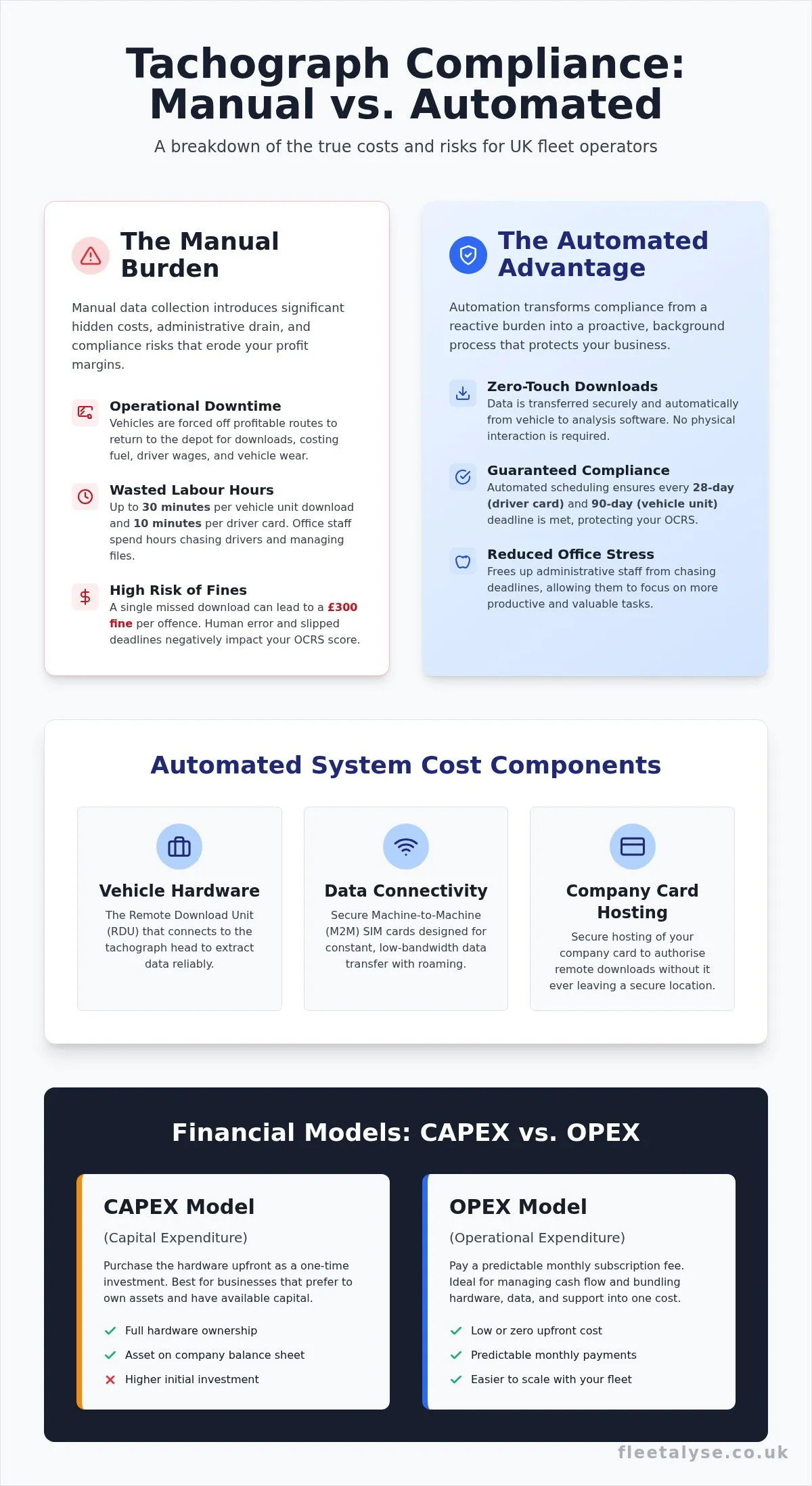
Manual downloads are a massive time-sink. A typical driver card download takes roughly 10 minutes, whilst a full vehicle unit (VU) download can take up to 30 minutes of stationary time. For a fleet of 10 vehicles, you're looking at several hours of lost productivity every month. This doesn't include the time spent by office staff tracking 28-day and 90-day deadlines on spreadsheets. They have to chase drivers, organise files, and manually upload data to analysis software.
When you evaluate the automated tachograph download system cost, you're really comparing a small monthly fee against these mounting labour hours. Most operators find that once their fleet grows beyond five vehicles, the cost of manual labour exceeds the price of an automated subscription. Automation provides a zero-touch solution. The data moves from the vehicle to your analysis platform without anyone lifting a finger. It's about moving from reactive chasing to proactive management.
The Risk of Non-Compliance Fines
Human error is the biggest threat to your Operator Licence. In a manual setup, it's easy for a deadline to slip through the cracks. A single missing download can result in a £300 fine per offence during a DVSA check. If multiple drivers are out of scope, these fines escalate rapidly. However, the financial penalty is only the start of the trouble. Missing data directly impacts your Operator Compliance Risk Score (OCRS).
A poor OCRS status makes your vehicles a magnet for roadside inspections. Frequent stops lead to late deliveries and unhappy customers. In extreme cases, consistent failures lead to a public inquiry and the potential loss of your licence. Using a system from a specialist like Fleetalyse acts as an insurance policy. It ensures every file is captured on time, every time, protecting your reputation and your right to operate. It turns compliance from a constant worry into a background process that just works.
Breaking Down Automated Tachograph Download System Costs
Calculating the total automated tachograph download system cost requires looking beyond the initial hardware purchase. A complete solution consists of the vehicle hardware, a secure data connection, and the cloud-based infrastructure that manages the file transfer. Most UK operators find that a transparent, all-in-one model is more cost-effective than piecing together separate components. It eliminates the risk of technical conflicts between different vendors.
Hardware Components and Connectivity
The Remote Download Unit (RDU) is the heart of the system. It connects directly to the tachograph head to extract data. Quality matters here. Cheap, generic units often fail under high heat or vibration, leading to data gaps that can trigger DVSA audits. You also need a secure data connection that works wherever the vehicle travels. Unlike standard mobile SIMs, machine-to-machine (M2M) SIMs are designed for constant, low-bandwidth data transfers. They should include roaming capabilities as standard to ensure data is retrieved even when vehicles are in remote areas or crossing borders. According to Logistics UK compliance guidance, maintaining a consistent data flow is vital for meeting strict legal deadlines.
A common complexity is the Company Card. To authorise a remote download, the system must 'see' your Company Card to unlock the data. Most providers offer a card hosting service. Your card stays in a secure reader at a data centre or your office, and the system accesses it digitally. This removes the need for local servers and ensures 24/7 availability for downloads without manual intervention.
Ongoing Service and Support Fees
Subscription fees typically cover data hosting and technical support. A reliable provider ensures the hardware remains compatible with evolving regulations, such as the Smart Tachograph G2V2 requirements. You should also look for seamless integration with your existing analysis software. If the data doesn't flow directly into your reporting tools, you're simply trading one administrative task for another. The goal is a "fit and forget" solution that delivers data in the correct format for your specific analysis platform.
Transparency is key. Many telematics contracts hide overage charges or roaming fees. You want a fixed monthly rate that includes all data transfers. This allows for accurate budgeting and prevents unexpected spikes in your operational expenditure. It's often better to pay a slightly higher fixed fee than to risk variable costs that fluctuate with vehicle usage. If you're ready to simplify your fleet management, you can view our compliance packages to find a model that fits your fleet size.
CAPEX vs. OPEX: Purchase and Rental Models Compared
Choosing the right financial model for your automated tachograph download system cost is as much a tax decision as an operational one. UK operators generally choose between Capital Expenditure (CAPEX) and Operational Expenditure (OPEX). Each approach offers distinct advantages for cash flow management and long-term profitability. Your choice should reflect your fleet's growth plans and how you prefer to manage business assets on your balance sheet.
For some, the priority is minimising monthly outgoings through an upfront investment. Others prefer the flexibility of a service-based agreement that scales as their fleet grows. Understanding the nuances of these models ensures you don't overpay for compliance over the lifetime of your vehicles. It's about finding the balance between immediate affordability and the total cost of ownership over a three to five-year period.
The Benefits of Outright Purchase
Buying your hardware upfront is often the most cost-effective route for established hauliers with stable cash reserves. This CAPEX model means you own the Remote Download Units (RDUs) from day one. Whilst the initial investment is higher, your ongoing monthly outgoings are significantly lower. You only pay for the data connection, hosting, and analysis integration. This provides a clear end date for your hardware payments, which improves your margins in the long run.
Owning the equipment turns compliance hardware into a tangible business asset. This can be beneficial for your balance sheet and overall company valuation. In the UK, capital allowances may also allow you to deduct the cost of the equipment from your profits before tax. After the first 24 to 36 months, an outright purchase typically results in a lower total cost of ownership compared to a continuous rental agreement. It's a pragmatic choice for those looking to lock in compliance costs and minimise long-term overheads.
Why Fleet Rental Models are Trending
Many smaller fleets or rapidly expanding businesses prefer the OPEX model. This subscription-based approach removes the high upfront barrier to entry. Instead of a large capital outlay, you pay a single, predictable monthly fee that covers both the hardware and the service. This makes budgeting straightforward. It's an efficient way to modernise your fleet without straining your credit lines or depleting your working capital. You get the latest technology immediately without the heavy initial price tag.
Rental models often include "always-on" support and hardware replacement guarantees. If a unit fails due to a technical fault, the provider typically replaces it as part of the service agreement. This reduces the risk of vehicle downtime and unexpected repair bills. It also protects you against technology obsolescence. As regulations change, service-based contracts often provide a smoother path to hardware upgrades. You aren't stuck with old equipment that no longer meets the latest DVSA standards. This flexibility is a key reason why many operators now view compliance as a service rather than a one-off purchase.
Leasing provides a middle ground for full fleet rollouts. It allows you to spread the cost of a large-scale installation over several years whilst still moving toward ownership. This can be particularly useful for fleets of 50 or more vehicles where the total automated tachograph download system cost would otherwise be a significant hit to quarterly cash flow. Regardless of the model, the goal remains the same: seamless, automated data retrieval that keeps your fleet moving and your licence safe.
Calculating ROI: When Does the System Pay for Itself?
Presenting a business case to the transport board requires hard data. You aren't just buying a gadget; you're investing in a hedge against operational friction. To justify the automated tachograph download system cost, you must look at the total bottom line. It's about more than just avoiding fines. It's about reclaiming lost productivity and reducing the administrative stress that often leads to high staff turnover. Most UK fleets find that the transition from a manual burden to a profit-generating asset happens faster than expected.
Recovering Administrative Time
Transport managers often lose several days a month to the "paperwork chase." If a manager spends just 10 hours a month on manual downloads and data entry, that's time stolen from route optimisation or business development. By automating this process, you gain back that time for revenue-generating tasks. The weekly "infringement debrief" also becomes a five-minute conversation rather than a two-hour investigation. You simply print the report and speak with the driver. It turns a confrontational process into a constructive one.
ROI in fleet compliance is the net financial gain achieved by replacing manual labour and operational risk with automated data accuracy.
Fuel and Operational Savings
Fuel is your biggest variable cost. Eliminating "compliance runs" where vehicles return to the depot solely for data retrieval provides an immediate saving. A single 20-mile round trip in an HGV can cost over £15 in fuel and driver wages. If this happens twice a month per vehicle, the manual method is already more expensive than most remote subscriptions. Real-time visibility of driver hours also allows for tighter vehicle utilisation. You can assign the next load with confidence, knowing exactly who has the legal hours to complete the job. This reduces idle time and ensures you maximise every shift.
The financial value of having "audit-ready" data cannot be overstated. When the DVSA requests records, a manual system often leads to a frantic search for missing files. An automated system ensures every byte of data is archived and accessible in seconds. This prevents the costly disruption of a full-scale office audit and the potential grounding of your fleet. Improved driver morale also plays a role in ROI. Drivers prefer staying on the road rather than being recalled to the depot for paperwork. Most operators see a full return on their investment in under 12 months. To start your transition and protect your margins, you can select your automated download package today.
Choosing Fleetalyse for Transparent Compliance Costs
Fleetalyse understands the unique pressures on UK regional operators. We don't hide behind complex contracts or tiered data fees. Our model is built on operational clarity. When assessing the automated tachograph download system cost, you need a partner that provides everything in one place. We focus on national UK compliance, ensuring your HGV, van, and trailer data is always secure and ready for inspection. Our transparent pricing structure is a direct response to the "hidden fee" models often found amongst global telematics providers.
Beyond Basic Downloads: Live Driver Hours
Standard remote downloads ensure you meet the legal requirement to archive data every 28 or 90 days. But waiting for a download to discover an infringement is a reactive, risky strategy. Live Driver Hours monitoring adds a layer of proactive protection. It allows you to see exactly how much driving time a driver has left right now. This visibility prevents infringements before they happen, saving you from the cumulative fines and legal fees that follow DVSA roadside checks.
Integrating live data with your automated tachograph download system cost considerations provides a superior level of asset management. You aren't just downloading files; you're gaining a real-time tool for route planning and driver safety. Managing GPS tracking, tacho data, and trailer assets from one dashboard eliminates the need for multiple subscriptions. It streamlines your workflow and ensures your transport office operates at peak efficiency.
Getting Started with Fleetalyse
The process for upgrading your fleet is designed to be frictionless. We assist with the hardware setup and ensure seamless integration with your current analysis software. You don't need to change your existing reporting habits; we simply automate the data feed that powers them. This allows your team to focus on moving goods rather than managing spreadsheets.
Our UK-based support team acts as a pragmatic expert partner for regional hauliers. We understand the specific challenges of UK infrastructure and the rigours of local regulations. We value your time and resources, which is why we prioritise functional utility over flashy, unnecessary features. If you're ready to remove the administrative burden of manual compliance, you can Secure your automated tachograph system today. It's time to move toward a more reliable, transparent way of managing your fleet's future.
Secure Your Fleet's Compliance and Future-Proof Your Margins
Transitioning to automation is a strategic shift from reactive chasing to proactive management. You've seen how the hidden drain of manual labour and fuel for compliance runs often outweighs the automated tachograph download system cost. By choosing between CAPEX and OPEX models, you can tailor your investment to match your fleet's cash flow and tax requirements. It's about moving toward a "fit and forget" solution that protects your OCRS without constant office intervention.
Fleetalyse provides specialised UK transport compliance expertise that removes the guesswork from data retrieval. Our systems offer real-time driver hours visibility to prevent infringements before they occur. We prioritise transparency; there are no hidden data fees or roaming surprises in our contracts. It's about giving you a reliable ally that values your time and resources. View our automated tachograph download packages and pricing to streamline your operations today. Protecting your operator licence and your bottom line has never been more straightforward.
Frequently Asked Questions
How much does a remote tachograph download device typically cost?
Industry hardware prices typically range from £250 to £500 per unit for those choosing an outright purchase. This initial automated tachograph download system cost covers the physical device required to extract data from the vehicle unit. Some providers also offer rental models that eliminate this upfront expense in exchange for a slightly higher monthly subscription fee.
Are there monthly fees for automated tachograph download systems?
Most providers charge a monthly service fee to cover secure data transfer and cloud storage. These subscriptions ensure your records are archived for the legally required 12 months without any manual effort from your office team. Fees generally include technical support and software updates to keep your fleet compliant with evolving DVSA regulations.
Does the system require a separate SIM card and data plan?
You don't need to manage separate mobile contracts or data plans. The units use specialised M2M SIM cards that are usually integrated into the hardware and included in your service package. This ensures a dedicated, secure connection for data transmission across the UK and Europe without the hassle of sourcing external plans.
Can I install the remote download unit myself to save on costs?
Many units allow for straightforward self-installation via the front port of the tachograph head. However, professional installation is often recommended for a more permanent, secure fitment behind the dashboard. This prevents accidental disconnection by the driver and ensures a consistent, uninterrupted data flow for your analysis software.
Is automated downloading compatible with my existing tacho analysis software?
Yes, the data is delivered in the industry-standard .ddd format. This ensures seamless compatibility with almost all existing UK analysis platforms. You can automate the data collection process without needing to change your current reporting habits or infringement debriefing workflows, making the transition frictionless for your transport office.
What is the average ROI period for a remote tachograph system?
UK operators generally experience a full return on investment in under 12 months. By eliminating the fuel and labour costs associated with manual downloads, the system pays for itself through improved vehicle utilisation. You also avoid the significant financial risk of DVSA fines for missing download deadlines.
Are there hidden costs like roaming charges for vehicles travelling to Europe?
Transparent providers include European data roaming within their fixed monthly rate as standard. It's vital to check your service agreement for potential "overage" or "roaming" fees to ensure your automated tachograph download system cost remains predictable. A fixed-cost model prevents unexpected spikes in your operational expenditure when vehicles cross borders.
How much can I save on administrative labour by switching to automated downloads?
Savings vary by fleet size, but transport managers often reclaim several hours each week. For a fleet of 20 vehicles, automation can save roughly 10 hours of manual labour per week. This allows your team to focus on profitable tasks like route optimisation rather than chasing drivers for their cards.
Frequently asked questions
How much does a remote tachograph download device typically cost?
Industry hardware prices typically range from £250 to £500 per unit for those choosing an outright purchase. This initial automated tachograph download system cost covers the physical device required to extract data from the vehicle unit. Some providers also offer rental models that eliminate this upfront expense in exchange for a slightly higher monthly subscription fee.
Are there monthly fees for automated tachograph download systems?
Most providers charge a monthly service fee to cover secure data transfer and cloud storage. These subscriptions ensure your records are archived for the legally required 12 months without any manual effort from your office team. Fees generally include technical support and software updates to keep your fleet compliant with evolving DVSA regulations.
Does the system require a separate SIM card and data plan?
You don't need to manage separate mobile contracts or data plans. The units use specialised M2M SIM cards that are usually integrated into the hardware and included in your service package. This ensures a dedicated, secure connection for data transmission across the UK and Europe without the hassle of sourcing external plans.
Can I install the remote download unit myself to save on costs?
Many units allow for straightforward self-installation via the front port of the tachograph head. However, professional installation is often recommended for a more permanent, secure fitment behind the dashboard. This prevents accidental disconnection by the driver and ensures a consistent, uninterrupted data flow for your analysis software.
Is automated downloading compatible with my existing tacho analysis software?
Yes, the data is delivered in the industry-standard .ddd format. This ensures seamless compatibility with almost all existing UK analysis platforms. You can automate the data collection process without needing to change your current reporting habits or infringement debriefing workflows, making the transition frictionless for your transport office.
What is the average ROI period for a remote tachograph system?
UK operators generally experience a full return on investment in under 12 months. By eliminating the fuel and labour costs associated with manual downloads, the system pays for itself through improved vehicle utilisation. You also avoid the significant financial risk of DVSA fines for missing download deadlines.
Are there hidden costs like roaming charges for vehicles travelling to Europe?
Transparent providers include European data roaming within their fixed monthly rate as standard. It's vital to check your service agreement for potential "overage" or "roaming" fees to ensure your automated tachograph download system cost remains predictable. A fixed-cost model prevents unexpected spikes in your operational expenditure when vehicles cross borders.
How much can I save on administrative labour by switching to automated downloads?
Savings vary by fleet size, but transport managers often reclaim several hours each week. For a fleet of 20 vehicles, automation can save roughly 10 hours of manual labour per week. This allows your team to focus on profitable tasks like route optimisation rather than chasing drivers for their cards.