
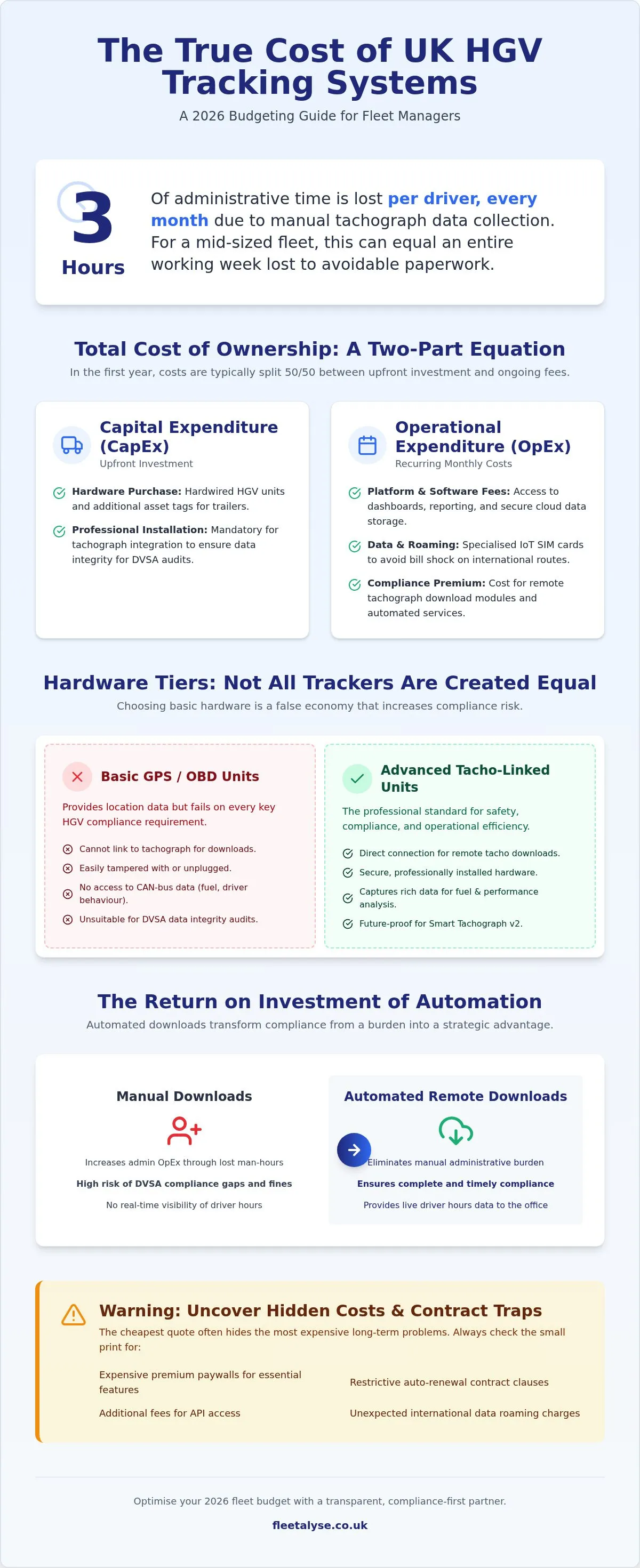
Did you know that manual data collection still strips away up to three hours of administrative time per driver every month? For a mid-sized fleet, that represents an entire working week lost to avoidable paperwork. You likely already know that calculating hgv tracking system costs uk involves much more than just comparing basic monthly fees. It is frustrating to sign a contract only to find that essential features like remote tachograph downloads or live driver hours are hidden behind expensive premium paywalls.
We believe transparency is the only way to plan a reliable 2026 budget. This guide provides a clear breakdown of the total cost of ownership, from initial hardware investment to the long-term value of automated compliance. You will discover how the Smart Tachograph Version 2 mandate affects your operational costs and why the cheapest hardware often leads to the highest risk of DVSA fines. We'll examine subscription tiers, the impact of new regulations, and the specific tools that actually reduce your administrative burden whilst keeping your fleet compliant.
Key Takeaways
- Understand the split between initial capital expenditure and ongoing operational costs, including the impact of international data roaming on your monthly budget.
- Compare hardware tiers to determine how tachograph-connected units provide superior value over basic GPS trackers when evaluating hgv tracking system costs uk.
- Calculate the financial gain from automating remote tachograph downloads to eliminate manual administrative burdens and avoid costly DVSA compliance gaps.
- Recognise hidden contractual pitfalls such as API access fees and restrictive auto-renewal clauses that often lead to unexpected price hikes.
- Learn how a localised, compliance-first partner helps you optimise your 2026 fleet budget without sacrificing data accuracy or driver hours visibility.
Understanding the Components of HGV Tracking System Costs
Calculating hgv tracking system costs uk requires a clear distinction between Capital Expenditure (CapEx) and Operational Expenditure (OpEx). CapEx covers your upfront investment in physical hardware and installation. OpEx represents the recurring monthly fees for data transmission and software access. HGV tracking is more complex than standard van tracking because the hardware must withstand heavy-duty vibrations and interface directly with the vehicle's engine and tachograph. This technical depth ensures you aren't just seeing a dot on a map, but a complete picture of vehicle health and driver legality.
Data roaming is another critical factor. If your fleet crosses into Europe, you need specialised IoT SIM cards to avoid unpredictable roaming charges. These Vehicle Tracking System Components are designed to transmit small packets of data constantly without the "bill shock" associated with standard consumer SIMs. For UK operators, this reliability is non-negotiable for maintaining real-time visibility over international routes.
The "Compliance Premium" often accounts for the largest difference in price between entry-level and professional systems. Remote tachograph modules require specific hardware that connects to the rear of the tachograph head. This is a separate cost factor because it enables the automated download of driver and vehicle files. Without this, you're stuck with manual downloads, which increase your administrative OpEx through lost man-hours.
Hardware vs Software Subscriptions
You'll face one-off costs for the hardwired HGV units and any additional asset tags for trailers. Monthly platform fees follow, providing access to real-time dashboards, automated reporting, and secure cloud storage for your data. In the first year of operation, the initial hardware and installation costs typically represent roughly 50% of the total per-vehicle expenditure. Choosing high-quality hardware at the start reduces the likelihood of expensive unit failures and replacements later in the contract term.
Installation and Professional Fitting Fees
Don't confuse professional HGV systems with plug-and-play OBD units. OBD trackers are unsuitable for HGVs because they are easily tampered with and cannot securely facilitate remote tachograph downloads. Professional installation is mandatory for systems that integrate with the vehicle's tachograph to ensure data integrity for DVSA audits. To minimise vehicle downtime, Fleetalyse focuses on efficient deployment, often organising engineers to fit units at your depot during scheduled vehicle rest periods. This approach ensures your fleet stays on the road whilst your compliance infrastructure is modernised.
Hardware Tiers: From Basic GPS to Advanced HGV Compliance
HGV hardware is not a "one size fits all" purchase. Whilst a standard van tracker might suffice for a local courier, heavy goods vehicles require deeper integration with the vehicle's internal computer (CAN-bus) and the tachograph head. When assessing hgv tracking system costs uk, operators must choose between basic tracking and full-compliance hardware. Basic units provide location data but fail to capture the critical telemetry needed for fuel management or driver behaviour analysis. High-end units bridge this gap by pulling data directly from the vehicle's brain, providing a level of detail that simpler devices cannot match.
Security standards also dictate your hardware choice. S7 trackers provide basic stolen vehicle recovery features. In contrast, S5 systems are the advanced standard, featuring driver identification tags and enhanced signal protection. Many insurers now mandate S5 hardware for HGVs over 7.5 tonnes, especially those carrying high-value cargo. Investing in the higher tier often results in lower insurance premiums, which helps offset the initial purchase price over the life of the vehicle.
Durability is equally vital for long-term reliability. Hardware mounted on trailers or external chassis must be IP-rated, typically IP67 or higher, to survive pressure washing, road salt, and extreme weather. Cheap, non-rated hardware will inevitably fail when exposed to the British climate. This leads to frustrating data gaps and the additional cost of replacement units and engineer call-outs.
Tachograph-Linked Hardware
Advanced HGV units connect directly to the digital tachograph head. This connection is essential for the remote download of driver cards and vehicle units. By 2026, most fleets will have transitioned to Smart Tachograph Version 2, which requires compatible hardware to handle increased data loads and new GPS-based positioning features. Without this physical link, your tracking system is merely a map tool rather than a robust compliance engine. You can configure a compliance-ready system to ensure your hardware matches these specific regulatory demands.
Trailer and Asset Tracking Hardware
Trailers present a unique challenge because they often lack a constant power source when uncoupled. Specialist trailer tracking units use long-life internal batteries, sometimes lasting several years on a single charge. These units offer geofencing and motion alerts, notifying you instantly if a trailer leaves a designated zone or moves unexpectedly. Integrating this trailer data into your primary GPS Fleet Tracking dashboard allows you to manage your entire operation from a single screen, reducing the risk of lost assets and improving trailer utilisation across your fleet.
The ROI of Integrated Remote Tachograph Downloads
Investing in compliance automation shifts the focus of hgv tracking system costs uk from a monthly expense to a measurable saving. Research indicates that remote tachograph downloads save an estimated 2 to 3 hours of administrative time per driver, per month. For a fleet of twenty vehicles, that's up to 60 hours of high-level administrative labour reclaimed every single month. Beyond labour, the financial impact of DVSA fines for missing or late data is a constant threat. These penalties often exceed the annual cost of a premium tracking subscription after just a single serious infraction.
Real-time visibility of driver hours also prevents expensive accidental infringements. When dispatchers know exactly how much driving time remains, they can assign loads with precision. This eliminates the risk of a driver unknowingly exceeding their hours, which protects both the driver's professional competence and the company's legal standing. Knowing the exact status of every driver whilst they are on the road allows for a level of operational agility that manual systems simply cannot match. It turns compliance from a reactive burden into a proactive dispatch tool.
Eliminating Manual Data Collection
Manual data retrieval is a significant hidden labour cost that many operators fail to quantify. It requires a driver or manager to physically connect a download tool to the vehicle unit and insert the driver card. This process often dictates vehicle routing, forcing trucks to return to a specific depot solely for data retrieval. Remote Tachograph Download technology removes this geographical constraint. Data is pulled automatically via the cellular network, ensuring 100% coverage regardless of where the vehicle is located in the UK or Europe. This guarantees you're always audit-ready without ever disrupting your delivery schedules.
Protecting Your Operator Licence
Your Operator Compliance Risk Score (OCRS) is the lifeblood of your transport business. A "Green" score reduces the likelihood of roadside stops and targeted DVSA inspections, which directly impacts your fleet's uptime. Automated tracking provides the digital evidence needed to demonstrate a proactive approach to road safety and regulatory adherence. By using Tachograph Analysis Integration, you can identify patterns of infringements early and implement corrective training. Remote tachograph downloads effectively act as a digital insurance policy, shielding your transport business from the catastrophic operational impact of a suspended operator licence.

Hidden Costs and Contractual Pitfalls to Avoid
A low headline rate for hgv tracking system costs uk often serves as a distraction from expensive contractual "gotchas." Many providers offer an attractive entry price but recoup their margins through secondary service fees. API access is a common example; you might find that connecting your tracking data to your existing transport management system requires an additional monthly surcharge. Other providers limit the number of staff who can access the dashboard, charging extra for every additional user login or custom report generated.
Contractual lock-ins represent a significant risk for regional operators. Standard 36-month minimum terms are common, but the real danger lies in auto-renewal clauses. These often require a specific 90-day notice period before the contract ends; otherwise, you're automatically committed to another full term. You should also scrutinise data limits for international work. If your HGVs cross into the EU, standard data packages may incur heavy overage charges if the provider doesn't use specialised IoT SIMs with flat-rate European coverage.
Fleet turnover also introduces hidden expenses. When you upgrade a vehicle, you'll likely face de-installation and re-installation fees to move the hardware. These labour costs can be substantial if they aren't negotiated upfront. Always ask for a transparent breakdown of these engineer call-out rates before signing any long-term agreement.
Spotting the "Cheap" Subscription Trap
A £9.99 monthly fee is rarely the bargain it seems. These "budget" plans often mask high upfront hardware costs or mandatory professional installation fees that push the total cost of ownership (TCO) much higher over a three-year period. You must also consider the quality of technical support. Offshore call centres may offer lower costs, but they lack the localised industry insight required to solve complex tachograph integration issues quickly. A UK-based partner understands domestic regulations and can provide more efficient, pragmatic assistance when your fleet is grounded by a technical fault.
Scalability and Flexibility
Your tracking system must grow with your business. Some providers make it difficult to add or remove vehicles, imposing administrative fees for every change to your plan. True value comes from a system that integrates seamlessly with your existing tachograph analysis software without requiring expensive custom development. For transport managers who value operational clarity, Fleetalyse offers transparent, UK-focused pricing that eliminates these common contractual pitfalls. You can view our straightforward pricing options to ensure your 2026 budget remains predictable and protected from hidden inflation.
Optimising Your Fleet Budget with Fleetalyse
Fleetalyse simplifies hgv tracking system costs uk by consolidating essential services into a single, predictable fee. Instead of managing multiple vendors for location data and compliance files, you receive a unified solution that combines GPS Fleet Tracking with remote tachograph downloads. This approach eliminates the "module creep" often seen with global providers who charge extra for every additional feature. By bundling these services, you reduce your total administrative spend whilst ensuring every vehicle in your fleet remains visible and compliant.
Working with a UK-based partner provides a distinct advantage when managing domestic transport regulations. We understand the specific pressures of the UK infrastructure and the rigorous standards set by the DVSA. Whether you require basic Van Tracking for a support fleet or full-compliance Asset Tracking for trailers, our solutions are tailored to your specific operational needs. The transition from manual data retrieval to automated telematics is designed to be frictionless, allowing you to move away from memory sticks and manual downloads without disrupting your daily delivery schedules.
Transparent Pricing for UK Hauliers
Our approach to pricing is built on straightforward hardware costs and clear subscription rates. We believe that what you see on the initial quote should be exactly what you pay. There are no hidden extras for API access or additional user logins. We focus on high-priority services that provide immediate value, such as Live Driver Hours monitoring. This ensures your budget is spent on features that actively improve your bottom line rather than unnecessary software bloat. You won't find any unexpected price hikes mid-contract, giving you the financial certainty needed for long-term planning.
A Partner in Compliance
We act as more than just a software provider; we are your partner in maintaining a healthy Operator Licence. Our system offers seamless Tachograph Analysis Integration, allowing your data to flow automatically into your preferred analysis tools. This joined-up approach ensures that you have the digital evidence required for any audit at your fingertips. By automating the most time-consuming parts of compliance, we free your transport managers to focus on fleet efficiency and driver safety. See our published Fleetalyse pricing — from £5.99 per device per month inc VAT to see how we can streamline your 2026 fleet budget and protect your operation from the risks of non-compliance.
Securing Your Fleet's Compliance for 2026
Managing a transport operation in 2026 requires a shift from reactive spending to strategic investment. The true hgv tracking system costs uk are defined by the efficiency of your compliance automation rather than just the initial hardware price. By prioritising remote tachograph downloads and live driver hours monitoring, you reclaim valuable administrative time. It's the most effective way to protect your Operator Licence from avoidable risks. Transparent contracts and localised support ensure your budget remains predictable whilst your fleet stays mobile.
We are specialists in UK transport compliance. We offer remote tachograph downloads as standard to eliminate manual data burdens. Our approach is built on practical utility rather than marketing hyperbole. Don't settle for generic software when you need a localised specialist that understands the rigours of domestic regulations. Take the first step toward a more efficient, audit-ready operation. Get a Transparent HGV Tracking Quote from Fleetalyse and secure your fleet's future today.
Frequently Asked Questions
How much does a basic HGV tracking system cost per month in the UK?
Basic tracking subscriptions typically start around £9.99 per vehicle, per month for entry-level GPS services. These plans focus on location data and driver behaviour rather than complex HGV compliance features. When calculating hgv tracking system costs uk, you should consider that these basic rates often exclude essential tools like tachograph integration. Mid-range systems with compliance features generally range from £10 to £35 monthly, depending on the data depth required.
Are there extra costs for remote tachograph downloading?
Remote tachograph downloading is often positioned as a premium feature or a separate add-on module. Whilst some providers bundle it into their higher-tier subscriptions, others charge a specific monthly fee per vehicle to enable automated file retrieval. It's important to check if the subscription includes both the driver card and vehicle unit downloads. Missing either could leave significant gaps in your compliance records and lead to avoidable DVSA fines.
What is the difference between S7 and S5 HGV trackers?
S5 trackers offer a higher level of security than S7 units, primarily through the inclusion of driver identification tags. S7 systems are standard stolen vehicle recovery units, whilst S5 systems feature enhanced signal protection and unauthorised movement alerts. Many insurers now mandate S5 hardware for heavy goods vehicles over 7.5 tonnes to mitigate the risk of sophisticated theft. Investing in the higher standard often helps reduce your annual insurance premiums.
Do I have to pay for installation on top of the hardware price?
Professional installation is typically a separate one-off charge on top of the hardware purchase price. Because HGV systems require hardwiring into the vehicle electrical system and tachograph head, you cannot use simple plug-and-play units. Budgeting for an expert engineer ensures the installation is secure and doesn't interfere with the vehicle warranty. Some providers offer mobile fitting at your depot to minimise vehicle downtime and keep your fleet moving.
Can I track trailers and HGVs on the same system?
You can track trailers and HGVs within a single unified dashboard. This integrated approach allows transport managers to see the location of both the tractor unit and the trailer, even when they are uncoupled. Trailer tracking units usually rely on long-life internal batteries, whilst HGV units are powered by the vehicle engine. Combining these data streams simplifies asset management and improves overall fleet utilisation across your entire operation without switching between platforms.
How does HGV tracking help with DVSA compliance?
HGV tracking supports DVSA compliance by automating the collection of driver hours and tachograph data. It provides real-time visibility into driving, break, and rest periods, allowing managers to prevent infringements before they occur. Automated remote downloads ensure that vehicle and driver files are retrieved within legal timeframes. This creates a digital audit trail that is essential for maintaining a "Green" Operator Compliance Risk Score and protecting your operator licence.
Are there hidden fees for data roaming when driving in Europe?
Data roaming fees can be a significant hidden cost if your provider doesn't use specialised IoT SIM cards. Standard consumer-grade SIMs often incur high charges when vehicles cross into Europe. Professional tracking systems use multi-network roaming SIMs that transmit data at a flat rate across the UK and the EU. Always confirm that your subscription includes European data to avoid unexpected bill shock if your fleet operates internationally or near borders.
What is the typical contract length for fleet tracking in the UK?
Contract lengths for fleet tracking in the UK generally range from 12 to 36 months. Shorter contracts offer more flexibility but often come with higher upfront hardware costs. Longer 36-month terms are common with providers that subsidise the initial equipment price to lower the entry cost. You should pay close attention to auto-renewal clauses, which can commit you to a new term if you don't provide notice before the expiry date.
Frequently asked questions
How much does a basic HGV tracking system cost per month in the UK?
Basic tracking subscriptions typically start around £9.99 per vehicle, per month for entry-level GPS services. These plans focus on location data and driver behaviour rather than complex HGV compliance features. When calculating hgv tracking system costs uk, you should consider that these basic rates often exclude essential tools like tachograph integration. Mid-range systems with compliance features generally range from £10 to £35 monthly, depending on the data depth required.
Are there extra costs for remote tachograph downloading?
Remote tachograph downloading is often positioned as a premium feature or a separate add-on module. Whilst some providers bundle it into their higher-tier subscriptions, others charge a specific monthly fee per vehicle to enable automated file retrieval. It's important to check if the subscription includes both the driver card and vehicle unit downloads. Missing either could leave significant gaps in your compliance records and lead to avoidable DVSA fines.
What is the difference between S7 and S5 HGV trackers?
S5 trackers offer a higher level of security than S7 units, primarily through the inclusion of driver identification tags. S7 systems are standard stolen vehicle recovery units, whilst S5 systems feature enhanced signal protection and unauthorised movement alerts. Many insurers now mandate S5 hardware for heavy goods vehicles over 7.5 tonnes to mitigate the risk of sophisticated theft. Investing in the higher standard often helps reduce your annual insurance premiums.
Do I have to pay for installation on top of the hardware price?
Professional installation is typically a separate one-off charge on top of the hardware purchase price. Because HGV systems require hardwiring into the vehicle electrical system and tachograph head, you cannot use simple plug-and-play units. Budgeting for an expert engineer ensures the installation is secure and doesn't interfere with the vehicle warranty. Some providers offer mobile fitting at your depot to minimise vehicle downtime and keep your fleet moving.
Can I track trailers and HGVs on the same system?
You can track trailers and HGVs within a single unified dashboard. This integrated approach allows transport managers to see the location of both the tractor unit and the trailer, even when they are uncoupled. Trailer tracking units usually rely on long-life internal batteries, whilst HGV units are powered by the vehicle engine. Combining these data streams simplifies asset management and improves overall fleet utilisation across your entire operation without switching between platforms.
How does HGV tracking help with DVSA compliance?
HGV tracking supports DVSA compliance by automating the collection of driver hours and tachograph data. It provides real-time visibility into driving, break, and rest periods, allowing managers to prevent infringements before they occur. Automated remote downloads ensure that vehicle and driver files are retrieved within legal timeframes. This creates a digital audit trail that is essential for maintaining a "Green" Operator Compliance Risk Score and protecting your operator licence.
Are there hidden fees for data roaming when driving in Europe?
Data roaming fees can be a significant hidden cost if your provider doesn't use specialised IoT SIM cards. Standard consumer-grade SIMs often incur high charges when vehicles cross into Europe. Professional tracking systems use multi-network roaming SIMs that transmit data at a flat rate across the UK and the EU. Always confirm that your subscription includes European data to avoid unexpected bill shock if your fleet operates internationally or near borders.
What is the typical contract length for fleet tracking in the UK?
Contract lengths for fleet tracking in the UK generally range from 12 to 36 months. Shorter contracts offer more flexibility but often come with higher upfront hardware costs. Longer 36-month terms are common with providers that subsidise the initial equipment price to lower the entry cost. You should pay close attention to auto-renewal clauses, which can commit you to a new term if you don't provide notice before the expiry date.