
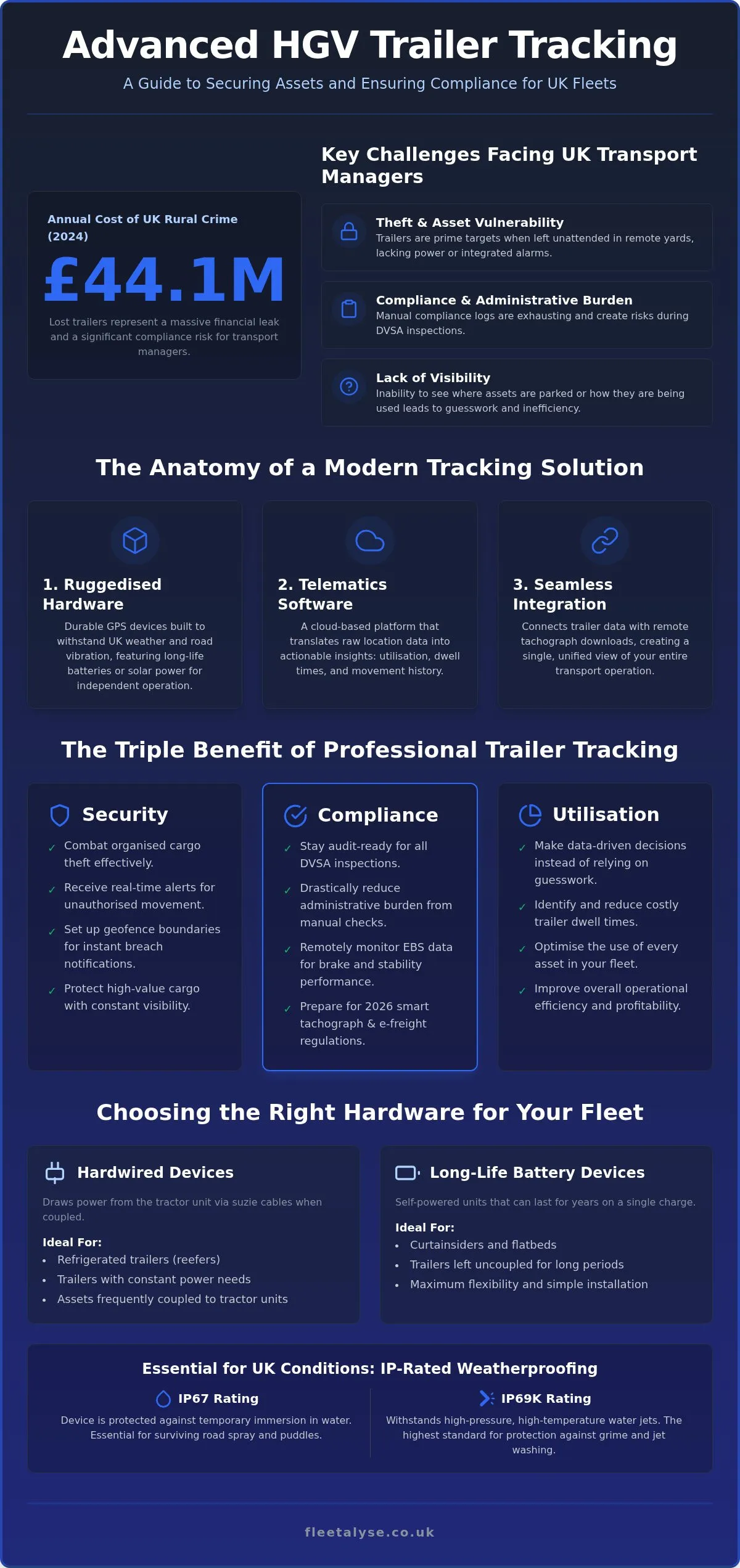
Rural crime cost the UK £44.1 million in 2024. For a transport manager, a "lost" trailer isn't just a missing asset; it's a massive financial leak and a compliance risk. Finding the right hgv trailer tracking solutions is no longer a luxury for large-scale operations. It's a fundamental requirement for any fleet prioritising security and operational efficiency.
You likely recognise the frustration of manual compliance logs and the administrative burden they create. It's exhausting to manage assets when you can't see where they're parked or how they're being used. This guide will show you how professional trailer tracking secures your assets, ensures DVSA compliance, and transforms fleet utilisation across the UK. We'll explore the transition from simple GPS pings to integrated telematics that keep you audit-ready. We'll examine theft prevention, insurance requirements, and the latest 2026 regulations for smart tachographs and electronic freight information. It's time to move beyond guesswork and start making data-driven decisions that protect your bottom line.
Key Takeaways
- Understand the critical distinction between basic GPS hardware and advanced telematics software designed specifically for non-powered assets.
- Learn how high-sensitivity GPS receivers provide essential visibility in both urban and rural environments to combat the rise in UK trailer theft.
- Discover how to stay audit-ready for DVSA inspections whilst significantly reducing the administrative burden of manual compliance checks.
- Identify the most effective hgv trailer tracking solutions for your fleet by auditing specific trailer types and defining your primary operational goals.
- See how integrating asset tracking with remote tachograph downloads creates a single, reliable point of truth for your entire transport operation.
What are HGV Trailer Tracking Solutions?
Professional hgv trailer tracking solutions represent a sophisticated synergy between ruggedised GPS hardware and cloud-based telematics software. Unlike standard vehicle tracking, these systems are specifically engineered for non-powered assets like curtainsiders, reefers, and flatbeds. They don't just tell you where a trailer is; they provide a comprehensive overview of its status, movement, and history. In essence, trailer tracking is a compliance-first asset management tool designed to bridge the gap between physical location and regulatory adherence.
Trailers are often the most vulnerable link in a logistics chain. They're frequently left unattended in remote yards, industrial estates, or roadside laybys for extended periods. Without a tractor unit attached, they lack an active power source or an integrated alarm system. This makes them prime targets for organised cargo theft. Basic GPS trackers often fail here because they lack the intelligence to alert you to unauthorised movement or geofence breaches in real-time. The UK transport sector requires advanced telematics that offer deep operational insight rather than just simple location pings.
The Core Components of a Trailer Tracking System
A reliable system consists of three primary elements. First, the hardware must be durable enough to withstand British weather and constant road vibration. These devices usually feature long-life internal batteries or solar panels to function independently of a tractor unit. Second, the telematics platform serves as your operational hub. It translates raw data into actionable insights regarding utilisation and dwell times. Finally, integration is key. Modern systems allow you to connect this data with remote tachograph download services. This creates a unified view of both the driver's hours and the trailer's location, simplifying your administrative workflow.
GPS vs. GSM: How Data is Transmitted in the UK
Understanding the technical side helps when selecting a provider. GPS (Global Positioning System) uses a network of satellites to determine the exact coordinates of your asset. However, knowing the location is useless if the device can't report back to base. This is where GSM (Global System for Mobile Communications) comes in. It transmits the location data via cellular networks to your software dashboard. Learning how vehicle tracking systems work reveals that the reliability of your tracking depends on the quality of these dual components. In the UK, high-sensitivity receivers are essential. They maintain connectivity in rural "dead zones" and amongst the high-rise infrastructure of urban centres, ensuring you never lose sight of your assets.
How Modern Trailer Tracking Works for UK Fleets
Modern hgv trailer tracking solutions rely on high-sensitivity GPS receivers to provide precise location data across the UK's varied terrain. In remote rural areas or deep within industrial zones, signal strength can be erratic. High-sensitivity hardware ensures a lock on satellite signals even in "urban canyons" or under heavy foliage. This data is then transmitted via GSM networks to a cloud-based platform where it's organised into actionable reports. You don't just see a dot on a map. You see dwell times, movement history, and asset health.
Data frequency is a critical choice for any operator. Real-time reporting provides updates every few seconds, which is essential for high-value cargo security. Interval-based reporting, however, might only ping every few hours when the trailer is stationary. This preserves battery life and reduces data costs for fleets focused on general haulage and utilisation. Advanced systems also integrate with the trailer's Electronic Braking System (EBS). This allows you to monitor brake performance, mileage, and roll-stability events remotely, ensuring you remain audit-ready for DVSA inspections.
Power Options: Hardwired vs. Long-Life Battery Devices
Choosing the right power source depends on your trailer type. Hardwired devices are ideal for reefers or trailers with constant power needs, drawing energy from the suzie cables when coupled. For curtainsiders or flatbeds that may sit uncoupled for weeks, long-life battery devices are superior. These units can last for years on a single charge, providing consistent visibility without requiring a tractor unit connection. If you're unsure which hardware fits your fleet, you can enquire about our specific hardware options to find a tailored match.
The Importance of IP67 and IP69K Weatherproofing
British weather is notoriously harsh on external electronics. Hardware must be durable enough to survive constant road spray, salt, and grime. An IP67 rating means the device is protected against temporary immersion in water. However, IP69K is the gold standard for UK fleets. This rating ensures the tracker can withstand high-pressure, high-temperature steam cleaning during routine maintenance. Choosing lower-grade housing often leads to premature failure and "lost" assets.
Geofencing: Creating Virtual Boundaries for UK Depots
Geofencing allows you to draw virtual perimeters around your depots, customer sites, or specific laybys. When a trailer enters or exits these zones, the system triggers an immediate alert. This is a vital component of the Road Transport Security Standards, as it provides an early warning of unauthorised movement. It's a proactive security measure that stops theft in its tracks whilst automating arrival and departure logs for your administrative team.
Compliance, Security, and Utilisation: The Triple Benefit
Implementing hgv trailer tracking solutions provides a multi-layered defence for your business. It isn't just about security; it's about building a resilient, data-driven operation. By centralising your asset data, you ensure your fleet stays audit-ready whilst protecting your profit margins from avoidable losses. This approach directly supports your UK Operator Licence compliance, proving to regulators that you maintain full oversight and control over your equipment at all times.
Meeting DVSA Standards and EBPMS Guidelines
The DVSA increasingly looks for evidence of robust, proactive maintenance systems. Electronic Braking Performance Monitoring Systems (EBPMS) are a vital part of this framework. By integrating tracking hardware with the trailer's EBS, you can monitor braking performance during every journey. This reduces the frequency of mandatory roller brake tests, which saves significant time and money. It ensures you have the digital documentation required to prove your fleet's safety during roadside stops or comprehensive office audits. You're no longer reacting to faults; you're managing them before they become compliance failures.
Theft Recovery: Stolen Vehicle Tracking (SVT) Protocols
Rural crime cost the UK £44.1 million in 2024 according to ABAX research. For fleet operators, the loss of a trailer often includes high-value cargo and the administrative nightmare of missed contracts. Professional hgv trailer tracking solutions use Stolen Vehicle Tracking (SVT) protocols to facilitate rapid recovery. Many insurers now mandate Thatcham-approved S5 or S7 devices for high-value assets to validate policies. If a trailer moves without authorisation, the system triggers an immediate alert. This allows you to provide police with precise, real-time coordinates, which significantly increases the chances of recovering the asset before it's stripped or moved across borders.
Utilisation Analytics: Identifying Underused Assets
Lost or forgotten trailers are a common drain on UK logistics. Often, assets sit idle in a customer's yard or a remote depot because there's no central visibility. Utilisation analytics solve this by identifying trailers with high dwell times. You can see exactly which units are underused and redirect them to high-demand routes. This helps reduce dead mileage and empty runs, ensuring every asset in your fleet is earning its keep. It's a practical way to scale your operations and improve efficiency without the capital expense of buying additional equipment you don't actually need.
Choosing the Right HGV Trailer Tracking Solution
Selecting the right hgv trailer tracking solutions isn't a one-size-fits-all process. It requires a pragmatic evaluation of your current fleet and long-term operational goals. Follow this five-step framework to ensure your investment delivers tangible returns and helps you maintain an audit-ready operation.
- Step 1: Audit your fleet. Different trailer types have different tracking needs. A flatbed might only need basic location pings, whilst a temperature-controlled reefer requires integrated sensor data.
- Step 2: Define your priority. Are you solving a theft problem, or are you looking to automate DVSA compliance? Your primary goal dictates whether you need high-frequency reporting or simple interval updates.
- Step 3: Check integration. Your tracking data shouldn't exist in a silo. Ensure the software integrates with your existing tachograph analysis tools to provide a single view of drivers and assets.
- Step 4: Calculate TCO. Don't just look at the hardware price. Factor in subscription fees, installation costs, and potential downtime for maintenance.
- Step 5: Verify support. Ensure your provider offers a UK-based installation network and technical support that understands regional regulations.
Standard vs. Specialised Trailers: Matching Tech to Asset
Standard curtainsiders often sit uncoupled in yards. For these assets, battery life is your priority. Specialised trailers, such as reefers, are usually powered by the tractor unit, allowing for more data-heavy features like temperature monitoring or EBS health checks. Matching the device's power profile to the trailer's typical usage prevents unnecessary battery failures. It ensures consistent visibility without requiring constant manual intervention from your maintenance team.
Key Features to Look for in Telematics Software
The best software translates raw data into simple, actionable reports. Look for customisable geofencing alerts, automated utilisation logs, and historical route playbacks. A clean interface is essential for busy transport managers. The system should highlight at-risk assets automatically, such as those with low battery levels or excessive dwell times. This allows you to manage by exception rather than sifting through endless spreadsheets.
Evaluating Reliability: Battery Life and Signal Strength
Reliability is non-negotiable for fleet security. Look for devices with internal batteries capable of lasting months or years uncoupled. Signal strength is equally vital. In the UK, high-sensitivity receivers are necessary to maintain connectivity in rural areas or dense industrial estates. If the tracker can't report back, it's a liability, not an asset. To begin your fleet audit and find a system built for UK operations, you can start your trailer tracking setup here.
Streamlining Operations with Fleetalyse Solutions
Fleetalyse operates as a specialised UK technology partner. We understand that regional operators don't need flashy, unnecessary features. You need tools that work in the real world. Our hgv trailer tracking solutions are built to bridge the gap between physical asset security and regulatory compliance. By choosing a localised specialist, you gain a partner that understands DVSA requirements and the specific challenges of UK infrastructure. We don't present ourselves as a distant, global software provider, but as a local expert that understands your daily struggles. We focus on providing a steady stream of information that allows you to make frictionless decisions.
Seamless Tachograph Analysis Integration
Managing a fleet is often a balancing act between monitoring assets and tracking driver hours. Fleetalyse simplifies this by combining trailer tracking with remote tachograph download. This integration means you no longer have to chase vehicles to retrieve data manually. The system automates the entire collection process, ensuring you're always audit-ready for DVSA inspections. It removes hours of manual administrative burden every week. This allows transport managers to focus on moving freight rather than sifting through digital files or spreadsheets.
Live Visibility: Managing Your Entire Fleet in One View
Having a single point of truth for both drivers and assets is a significant operational advantage. Our platform provides live visibility across your entire operation. You can see which driver is coupled to which trailer in real-time. This level of clarity prevents "lost" assets and reduces the risk of compliance errors. It's an efficient way to manage utilisation and ensure every part of your fleet is working at maximum capacity. You can identify underused trailers instantly and redirect them to where they're needed most, reducing dead mileage across the UK.
Getting Started: A Frictionless Transition to Smart Tracking
We prioritise functional utility and transparency. Transitioning to smart tracking shouldn't be a complex or overwhelming process. Fleetalyse provides a structured approach to implementation, from the initial fleet audit to final installation via our UK-wide network. We offer clear contractual terms and upfront pricing, avoiding the hidden complexities common in the telematics sector. Our goal is to be a reliable ally that values your resources. It's a pragmatic solution designed for operators who want results, not just theoretical data collection.
Secure Your Fleet and Simplify Compliance
Modern haulage requires more than just knowing where your assets are parked. It's about maintaining a robust, audit-ready operation that stands up to DVSA scrutiny. You've seen how the right hardware prevents theft and how integrated data reduces the administrative burden of manual checks. Investing in professional hgv trailer tracking solutions is a strategic move for any UK operator looking to eliminate dead mileage and protect high-value cargo. It turns a vulnerable asset into a source of actionable intelligence.
Fleetalyse provides a pragmatic partnership built on UK-based expert support and a deep specialisation in transport compliance. We offer transparent pricing with no hidden complexities, ensuring you know exactly what you're paying for from day one. It's time to move away from fragmented systems and adopt a single point of truth for your drivers and trailers. Optimise your fleet with Fleetalyse trailer tracking solutions. Take control of your assets today and build a more resilient, efficient transport business.
Frequently Asked Questions
Do HGV trailer trackers require a constant power source?
No. While some units are hardwired to the suzie cables, many professional hgv trailer tracking solutions use long-life internal batteries or solar panels. These allow the device to operate independently when the trailer is uncoupled. Hardwired units typically charge while the trailer is connected to the tractor unit, ensuring they remain active during long periods of stationary storage in yards or laybys. This provides consistent visibility regardless of the trailer's power status.
How does trailer tracking help with DVSA compliance?
It automates the collection of operational data required for an audit-ready fleet. By integrating with Electronic Braking Performance Monitoring Systems (EBPMS), trackers provide digital evidence of braking efficiency during every journey. This reduces the need for frequent roller brake tests. It also supports your Operator Licence requirements by proving you maintain full oversight of asset movements and maintenance schedules across your entire UK operation, significantly reducing the administrative burden on your team.
Can I track trailers when they are uncoupled from the tractor unit?
Yes, provided you use hardware designed for non-powered assets. Standalone trackers feature high-capacity batteries that allow for continued location reporting even without a tractor unit attached. This is essential for identifying "lost" assets in remote depots or customer sites. You can configure the reporting frequency to preserve battery life whilst ensuring you still receive regular pings during extended uncoupled periods. It's a pragmatic way to manage assets that spend time sitting idle.
What is the average battery life of a standalone trailer tracker?
Battery life varies significantly based on reporting frequency and hardware type. Some long-life battery devices can last between three to five years on a single charge if they only ping once or twice a day. However, if the device is set to real-time reporting for high-value cargo security, the battery will deplete much faster. Solar-powered options offer a pragmatic middle ground, providing virtually indefinite power in typical UK daylight conditions without manual charging.
Is geofencing effective for preventing trailer theft in the UK?
Geofencing is a highly effective proactive security measure. By creating virtual perimeters around your depots or regular delivery sites, the system triggers an immediate alert if a trailer leaves the zone without authorisation. This early warning is crucial for rapid theft recovery. It allows you to notify the police immediately with precise GPS coordinates, which is far more effective than discovering a theft hours or even days after the event has occurred.
How much does HGV trailer tracking typically cost per month?
Monthly costs depend on the level of service and the size of your fleet. Basic asset tracking is generally more affordable, whilst premium hgv trailer tracking solutions that include EBS integration and remote tachograph downloads sit at the higher end of the market. You should consider the total cost of ownership, including hardware and installation, rather than just the monthly subscription fee. We provide transparent pricing to ensure operational clarity for all regional operators.
Can trailer tracking devices monitor temperature for refrigerated goods?
Yes, specialised telematics hardware can integrate with temperature sensors inside reefers. This allows you to monitor the internal environment in real-time and receive alerts if the temperature deviates from a set range. This feature is vital for cold chain compliance and protecting perishable cargo. It provides a digital audit trail that proves you maintained the required temperature throughout the entire journey, which is essential for insurance purposes and maintaining high levels of customer satisfaction.
Will trailer tracking integrate with my existing fleet management software?
Most modern systems are designed with integration in mind. Fleetalyse solutions focus on creating a single point of truth by integrating asset data with tachograph analysis tools. This ensures you can manage drivers and trailers from a unified dashboard rather than sifting through fragmented data. Before choosing a provider, you should verify their software capabilities and ensure the system can export data in formats compatible with your current administrative and compliance monitoring systems.
Frequently asked questions
Do HGV trailer trackers require a constant power source?
No. While some units are hardwired to the suzie cables, many professional hgv trailer tracking solutions use long-life internal batteries or solar panels. These allow the device to operate independently when the trailer is uncoupled. Hardwired units typically charge while the trailer is connected to the tractor unit, ensuring they remain active during long periods of stationary storage in yards or laybys. This provides consistent visibility regardless of the trailer's power status.
How does trailer tracking help with DVSA compliance?
It automates the collection of operational data required for an audit-ready fleet. By integrating with Electronic Braking Performance Monitoring Systems (EBPMS), trackers provide digital evidence of braking efficiency during every journey. This reduces the need for frequent roller brake tests. It also supports your Operator Licence requirements by proving you maintain full oversight of asset movements and maintenance schedules across your entire UK operation, significantly reducing the administrative burden on your team.
Can I track trailers when they are uncoupled from the tractor unit?
Yes, provided you use hardware designed for non-powered assets. Standalone trackers feature high-capacity batteries that allow for continued location reporting even without a tractor unit attached. This is essential for identifying "lost" assets in remote depots or customer sites. You can configure the reporting frequency to preserve battery life whilst ensuring you still receive regular pings during extended uncoupled periods. It's a pragmatic way to manage assets that spend time sitting idle.
What is the average battery life of a standalone trailer tracker?
Battery life varies significantly based on reporting frequency and hardware type. Some long-life battery devices can last between three to five years on a single charge if they only ping once or twice a day. However, if the device is set to real-time reporting for high-value cargo security, the battery will deplete much faster. Solar-powered options offer a pragmatic middle ground, providing virtually indefinite power in typical UK daylight conditions without manual charging.
Is geofencing effective for preventing trailer theft in the UK?
Geofencing is a highly effective proactive security measure. By creating virtual perimeters around your depots or regular delivery sites, the system triggers an immediate alert if a trailer leaves the zone without authorisation. This early warning is crucial for rapid theft recovery. It allows you to notify the police immediately with precise GPS coordinates, which is far more effective than discovering a theft hours or even days after the event has occurred.
How much does HGV trailer tracking typically cost per month?
Monthly costs depend on the level of service and the size of your fleet. Basic asset tracking is generally more affordable, whilst premium hgv trailer tracking solutions that include EBS integration and remote tachograph downloads sit at the higher end of the market. You should consider the total cost of ownership, including hardware and installation, rather than just the monthly subscription fee. We provide transparent pricing to ensure operational clarity for all regional operators.
Can trailer tracking devices monitor temperature for refrigerated goods?
Yes, specialised telematics hardware can integrate with temperature sensors inside reefers. This allows you to monitor the internal environment in real-time and receive alerts if the temperature deviates from a set range. This feature is vital for cold chain compliance and protecting perishable cargo. It provides a digital audit trail that proves you maintained the required temperature throughout the entire journey, which is essential for insurance purposes and maintaining high levels of customer satisfaction.
Will trailer tracking integrate with my existing fleet management software?
Most modern systems are designed with integration in mind. Fleetalyse solutions focus on creating a single point of truth by integrating asset data with tachograph analysis tools. This ensures you can manage drivers and trailers from a unified dashboard rather than sifting through fragmented data. Before choosing a provider, you should verify their software capabilities and ensure the system can export data in formats compatible with your current administrative and compliance monitoring systems.