
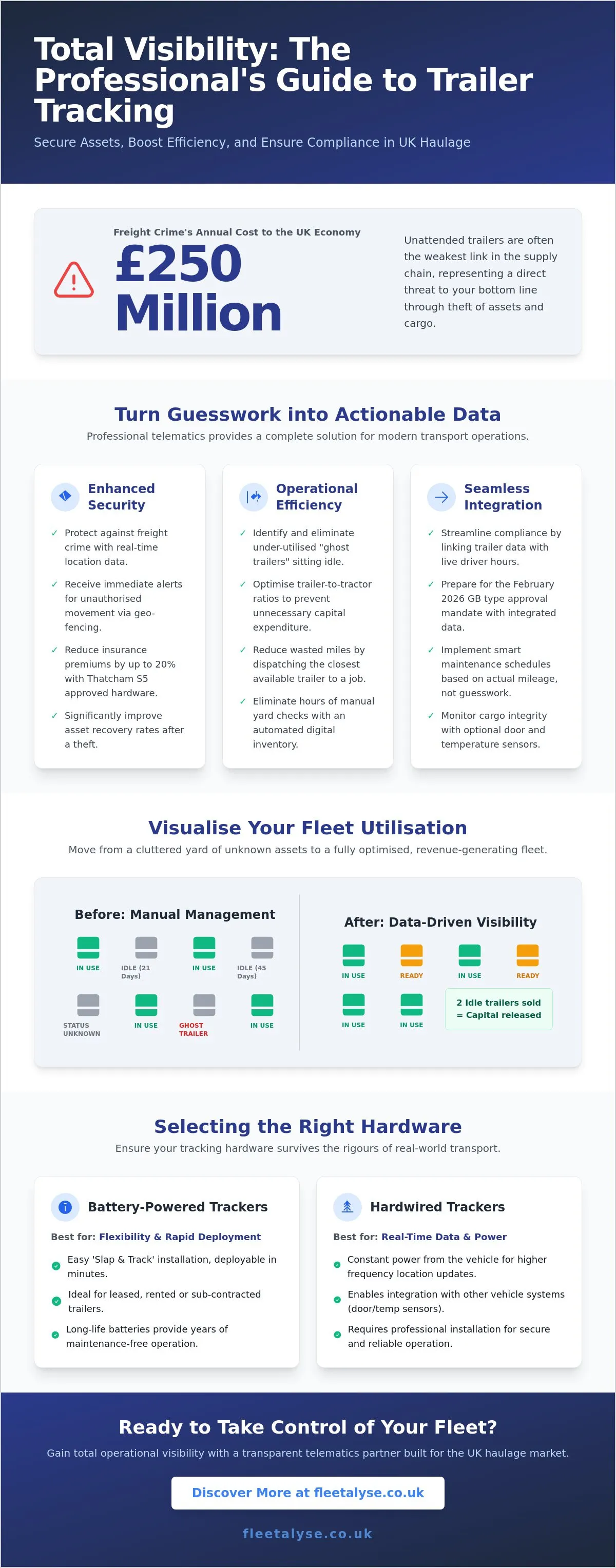
Freight crime cost the UK economy £250 million in 2023, yet many operators still lose hours every week searching for "lost" assets in large yards or managing trailers that have sat idle for months. Leaving a trailer unattended is no longer just a logistical risk. It's a direct threat to your bottom line. Implementing robust trailer tracking is the only way to gain total visibility over your fleet. It turns guesswork into actionable data for real transport operations.
You likely agree that managing multiple, disconnected platforms is an unnecessary headache for busy transport managers. You need a system that works as hard as your drivers do. This guide explains how professional trailer tracking secures your assets and integrates with compliance data to streamline your haulage. We will preview the impact of the February 2026 GB type approval mandate, the insurance benefits of Thatcham Category S5 security, and how to improve your trailer-to-tractor ratios using real-time visibility.
Key Takeaways
- Protect your fleet against rising freight crime by implementing insurance-approved security standards for unattended assets.
- Identify under-utilised equipment and optimise trailer-to-tractor ratios to prevent unnecessary capital expenditure on new kit.
- Streamline your compliance by integrating professional trailer tracking with live driver hours and tachograph analysis.
- Evaluate the performance of battery-powered versus hardwired trackers to ensure your hardware survives the rigours of real-world transport.
- Gain total operational visibility through transparent, industry-specific telematics built specifically for the UK haulage market.
What is Trailer Tracking and Why is it Essential for UK Hauliers?
Trailer tracking is no longer a luxury for large fleets. It is a fundamental requirement for any professional haulage business. To understand What is Trailer Tracking, you have to look beyond simple GPS coordinates. It is a specialised system designed to monitor the location, movement, and status of non-powered assets. In 2026, the industry has moved past basic "pings" that only update once a day. Modern transport operations require real-time visibility to stay competitive and compliant.
The threat to UK hauliers is significant. Freight crime cost the UK economy £250 million in 2023. Trailers are often the weakest link in the supply chain because they are frequently left unattended. If an asset is stolen, the loss includes the physical trailer, the cargo, and the potential for massive insurance hikes. Professional trailer tracking acts as a digital sentry. It ensures that even when a trailer is unhooked, it is never truly alone.
Security is only one side of the coin. Simple tracking tells you where a trailer is; real telematics tells you what it is doing. There is a massive difference between a basic GPS device and a system built for real transport operations. High-quality systems integrate with your wider fleet data. This allows you to see which trailers are working and which are sitting idle. With new GB type approval standards becoming mandatory in February 2026, having integrated data is essential for maintaining vehicle standards across your fleet.
Securing Unattended Assets Across the UK
Trailers often spend days parked at customer sites or remote distribution centres. These are prime locations for unauthorised movement. Geo-fencing allows you to draw virtual boundaries around these depots. If a trailer leaves a designated zone outside of scheduled hours, the system triggers an immediate alert. This technology is vital for rapid response. Trailer tracking significantly reduces the recovery window after a theft occurs by providing live, accurate location data to recovery teams and the police.
The Financial Case for Professional Tracking
The "ghost trailer" problem is a silent profit killer. These are assets that sit forgotten in the corner of a yard or a third-party site. They don't earn money, but they still require maintenance and insurance. Visibility eliminates this waste. You can stop the administrative burden of manual yard checks, which often take hours of staff time. Furthermore, using Thatcham-accredited hardware can lead to insurance premium reductions of up to 20%. By proving your assets are secured with gold-standard technology, you turn a security cost into an operational saving. For more information on how to integrate these tools, visit Fleetalyse to see our transparent approach to fleet data.
Improving Fleet Utilisation and Operational Efficiency
Every trailer sitting idle in a yard is a drain on your capital. In a sector where margins are notoriously thin, you can't afford to have assets that aren't earning their keep. The latest RHA Cost Movement Survey highlights the relentless pressure of rising operating costs on UK hauliers. Professional trailer tracking addresses this by providing a clear view of your entire inventory. It allows you to spot under-utilised units that have been stationary for days or even weeks. This data is the foundation for right-sizing your fleet.
Optimising your trailer-to-tractor ratio is a quick way to reduce capital expenditure. Many operators keep "just in case" kit that rarely moves. By analysing usage patterns, you can identify exactly how many trailers you need to support your current workload. Real-time visibility also transforms your daily dispatching. Instead of guessing, transport managers can see exactly which trailer is closest to a new job or which specific unit is ready for collection at a customer site. This level of precision reduces wasted miles and keeps your drivers moving.
Data-Driven Asset Management
Smart maintenance relies on actual usage, not just the calendar. Telematics allows you to organise servicing based on the real mileage a trailer has covered. This prevents over-servicing low-use units while ensuring high-mileage assets remain safe and compliant. For specialised haulage, integrating door sensors and temperature monitoring ensures cargo integrity throughout the journey. Total transparency in asset location also improves the relationship between transport offices and drivers. No more radio silence or confusion about where a specific trailer was dropped; the data provides a single version of the truth.
Reducing 'Empty Running' with Better Visibility
Hauling empty trailers is an environmental and financial disaster. Visibility is the key to coordinating backloads and improving fleet profitability. When you know exactly where your trailers are finishing their runs, you can proactively find return loads that fill that empty space. This is where integrating your assets with GPS fleet tracking for HGV fleets becomes a competitive advantage. You gain a holistic view of the entire operation, from the tractor unit to the rear doors of the trailer. This strategic approach ensures every mile driven contributes to your bottom line. If you're ready to turn your fleet data into decisions, you can start your journey with Fleetalyse today.
Compliance Integration: Linking Trailer Data with Driver Hours
Most tracking providers treat security as a standalone feature. This approach is a mistake for professional hauliers. In real transport operations, your data shouldn't exist in a silo. Your trailer tracking system must work in tandem with your driver data to provide a complete operational picture. For UK operators, the focus on operational efficiency and technology is now a matter of survival. Linking asset location with live driver hours ensures you aren't just moving trailers, but doing so legally and efficiently.
Maintaining a UK Operator Licence requires strict adherence to record-keeping standards. The DVSA expects you to demonstrate "effective control" over your entire fleet. Integrated data provides a digital audit trail that proves where every asset was at any given time. It removes the guesswork from compliance. When your office can see exactly which driver hooked which trailer, you eliminate the manual errors that lead to costly fines. Clear records. Total control.
Tachograph Analysis and Asset Tracking
The synergy between remote tachograph downloads and trailer location data is where the Fleetalyse advantage becomes clear. By overlaying GPS coordinates with tachograph activity, you can verify that drivers are sticking to their routes and rest periods whilst in charge of specific assets. Matching the right driver to the right trailer automatically ensures your records are accurate, significantly reducing the risk of DVSA infringements during roadside checks. This integration is particularly vital as the July 2026 deadline for G2V2 smart tachographs in international van operations approaches, bringing more of your fleet under strict regulatory scrutiny.
Streamlining Regulatory Reporting
Consolidated reporting is the end of the administrative headache. Instead of chasing paper trails or checking multiple screens, you have a single source of truth. You can generate reports that combine vehicle health, trailer location, and driver hours in seconds. This "Total Transparency" allows for faster, more confident management decisions. If a customer questions a delivery time or a regulator requests an audit, you have the data ready. Reducing administrative overhead means your transport managers can focus on moving freight, not filing paperwork. It's a pragmatic solution for the rigours of the British haulage industry.
Selecting the Right Hardware for Real-World Transport Operations
The biggest hurdle for trailer tracking is the "unattended asset" problem. Unlike a tractor unit, a trailer spends a significant portion of its life disconnected from a power source. You need hardware that can survive without a constant feed from the cab. Battery-powered trackers with a lifespan of 3 to 7 years are the standard for this reason. They provide peace of mind for assets left at customer sites or remote depots where they might sit for weeks at a time.
Choosing between hardwired and battery-powered units depends on your specific trailer type. Hardwired units are ideal for refrigerated trailers or units that are almost always coupled. These devices support power-hungry features like temperature sensors and door alerts. For flatbeds or older curtain-siders, a self-powered unit is often more practical. Regardless of the power source, durability is non-negotiable. British roads are harsh. Between heavy rain and winter road salt, your hardware must have a high IP rating, such as IP67 or IP69K, to prevent moisture ingress and corrosion.
Installation strategy also matters for your bottom line. Plug and Play connections allow for rapid deployment across a large fleet, which is essential when you need to get kit on the road quickly. However, high-value assets often require covert installation to hide the device from thieves. This is especially important for meeting Thatcham Category S5 standards. Many UK insurers now mandate these standards for high-risk cargo or high-value trailers to ensure a better chance of recovery after a theft.
Battery Life and Reporting Frequency
There is always a trade-off between how often a device "pings" and how long the battery lasts. Reporting every 30 seconds will drain a battery in weeks, whereas reporting once a day provides little security. Smart power management solves this. Modern trackers use accelerometers to stay in a low-power "sleep" mode until movement is detected. Solar-assisted units are another excellent option for flatbeds and curtain-siders. These use a small solar strip on the roof to trickle-charge the internal battery, extending the service life significantly without manual intervention.
Installation and Maintenance
Professional installation is critical. It ensures the device is positioned for the best GPS signal whilst remaining hidden from tampering. It also maintains your asset warranties and keeps your insurance valid. At Fleetalyse, we focus on total transparency. We offer a fee-free lease model for hardware to keep your initial costs manageable. This approach ensures you get the best technology without the heavy upfront burden of purchasing expert-level systems outright, which can cost over £300 per unit. You can view our hardware and pricing options for UK fleets to see what fits your operation.
Ready to Take Control? Implementing Trailer Tracking with Fleetalyse
Moving from manual yard checks to automated trailer tracking is a fundamental shift in how you manage your business. Many UK operators still rely on spreadsheets or whiteboards to track assets. In 2026, this is a significant risk. With the GB Type Approval Scheme now mandatory for all new trailers sold in Great Britain as of February 1, 2026, the need for precise asset data has never been higher. Fleetalyse provides a transition path that removes the administrative burden. We help you move from "where is my trailer?" to "how is my trailer performing?".
We don't do marketing hyperbole. Fleetalyse is built for real transport operations, not just simple tracking. This means our system is designed to handle the rigours of British haulage. It is about more than just a dot on a map; it is about integrating location with driver hours and compliance data. We provide total transparency in our contracts. You won't find hidden fees or complex jargon here. Just clear pricing and a reliable partner. Transitioning to our system allows you to automate your audit trails and prove exactly where an asset was at any given time.
Why UK Operators Trust Fleetalyse
UK operators face unique challenges, from unpredictable traffic delays to strict DVSA regulations. Our team understands HGV compliance inside out. We know that a trailer isn't just a box; it's a critical part of your earning potential. Our "No-Nonsense" approach means we focus on what works. We offer a fee-free lease model for hardware, ensuring you aren't hit with massive upfront costs. This transparency is why hauliers across the country trust us to secure their unattended assets. We speak the language of logistics, not just software.
Get Started Today
Ready to take control? The first step is a simple assessment of your fleet size and required integration level. Whether you need basic security or full compliance integration, we have a solution. In the first 30 days of implementation, you'll see a reduction in idle time and an immediate improvement in asset visibility. You can book a consultation or order your hardware directly through our portal to begin the process. Don't let your assets sit idle or unprotected. Secure your assets and streamline your fleet at Fleetalyse.
Secure Your Fleet and Maximise Every Mile
Professional trailer tracking is no longer just a theft recovery tool. It is an operational necessity for any haulier serious about efficiency in 2026. By integrating asset location with live compliance data, you protect your UK Operator Licence whilst cutting unnecessary capital expenditure on idle kit. You now have the roadmap to reduce empty running, optimise your trailer-to-tractor ratios, and ensure your hardware survives the rigours of British roads.
At Fleetalyse, we build our systems for Real Transport Operations, not just simple data collection. We provide the visibility you need to run a profitable business with total transparency and clear pricing. You get expert UK-based support and a platform that speaks the language of haulage. Don't let your assets sit idle or unprotected in a yard. It's time to turn your fleet data into decisive action and take full control of your unattended assets.
Start your trailer tracking journey with Fleetalyse and see the difference that expert-led telematics makes to your bottom line. We're ready to help you streamline your operations today.
Frequently Asked Questions
How long does the battery last on a trailer tracker when it is not connected to a tractor unit?
Battery life typically spans between 3 and 7 years for high-quality self-powered units. This longevity depends on how often the device is programmed to wake up and report its location. For assets that remain stationary for long periods, smart power management ensures the battery isn't wasted on unnecessary pings. It's a pragmatic solution for trailers that spend weeks at customer sites without a power connection.
Can trailer tracking help me reduce my insurance premiums for HGVs?
Yes, installing Thatcham-approved hardware often leads to insurance premium reductions of up to 20%. Insurers recognise that professional trailer tracking significantly increases the chances of asset recovery after a theft. By meeting the S5 security standards, you demonstrate a commitment to risk management that justifies lower rates. It turns a security requirement into a measurable financial saving for your haulage operation.
Is it possible to track trailers that are being moved by third-party hauliers?
You can track your assets regardless of which tractor unit is pulling them. Because the hardware is mounted directly to the trailer, it provides independent visibility across the entire UK road network. This is essential for managing sub-contracted work where you need to verify that third-party hauliers are meeting their delivery windows and following agreed routes. You maintain control of your equipment at all times.
Do I need different tracking hardware for a refrigerated trailer compared to a flatbed?
Refrigerated trailers usually require hardwired trackers to support temperature probes and door sensors. These devices draw power from the reefer's battery to provide constant data on cargo integrity. Conversely, flatbeds and curtain-siders are better suited to self-powered or solar-assisted units. These don't rely on an external power source to function, making them ideal for trailers that are frequently unhooked and left in remote locations.
How does trailer tracking integrate with my existing tachograph analysis software?
Integrated systems sync location data with your tachograph analysis software to create a single source of truth. This allows you to automatically match driver activity with specific trailer tracking events. It simplifies your audit trail and ensures that your records for the DVSA are accurate and complete. You won't have to waste time with manual data entry from the transport office or chasing paper trails.
Can I set up alerts to be notified if a trailer leaves a specific yard or depot?
Geo-fencing allows you to set up immediate alerts if an asset leaves a designated zone. You can draw virtual boundaries around your depots, customer sites, or maintenance centres. If a trailer moves outside these areas during unauthorised hours, the system sends a notification to your mobile or desktop. This allows for a rapid response to potential theft or unauthorised use of your equipment.
What happens if a trailer tracker is tampered with or removed by thieves?
High-security trackers trigger an immediate alert if they detect tampering or unauthorised removal. Most expert-level systems are covertly mounted to make them difficult for thieves to find. Even if the main power is cut, the internal backup battery ensures the device continues to broadcast its location during a theft event. This technology is vital for protecting high-value cargo and ensuring a high recovery rate.
Is there a mobile app for transport managers to check trailer locations on the go?
Transport managers can access real-time location data through a dedicated mobile app. This provides full visibility of the fleet whilst you are away from the desk. You can check dwell times, verify deliveries, and respond to alerts directly from your smartphone. It ensures that the operation continues to run smoothly regardless of your location, providing the flexibility required in the fast-paced logistics industry.
Frequently asked questions
Securing Unattended Assets Across the UK
Trailers often spend days parked at customer sites or remote distribution centres. These are prime locations for unauthorised movement. Geo-fencing allows you to draw virtual boundaries around these depots. If a trailer leaves a designated zone outside of scheduled hours, the system triggers an immediate alert. This technology is vital for rapid response. Trailer tracking significantly reduces the recovery window after a theft occurs by providing live, accurate location data to recovery teams and the police.
The Financial Case for Professional Tracking
The "ghost trailer" problem is a silent profit killer. These are assets that sit forgotten in the corner of a yard or a third-party site. They don't earn money, but they still require maintenance and insurance. Visibility eliminates this waste. You can stop the administrative burden of manual yard checks, which often take hours of staff time. Furthermore, using Thatcham-accredited hardware can lead to insurance premium reductions of up to 20%. By proving your assets are secured with gold-standard technology, you turn a security cost into an operational saving. For more information on how to integrate these tools, visit Fleetalyse to see our transparent approach to fleet data. Every trailer sitting idle in a yard is a drain on your capital. In a sector where margins are notoriously thin, you can't afford to have assets that aren't earning their keep. The latest RHA Cost Movement Survey highlights the relentless pressure of rising operating costs on UK hauliers. Professional trailer tracking addresses this by providing a clear view of your entire inventory. It allows you to spot under-utilised units that have been stationary for days or even weeks. This data is the foundation for right-sizing your fleet. Optimising your trailer-to-tractor ratio is a quick way to reduce capital expenditure. Many operators keep "just in case" kit that rarely moves. By analysing usage patterns, you can identify exactly how many trailers you need to support your current workload. Real-time visibility also transforms your daily dispatching. Instead of guessing, transport managers can see exactly which trailer is closest to a new job or which specific unit is ready for collection at a customer site. This level of precision reduces wasted miles and keeps your drivers moving.
Data-Driven Asset Management
Smart maintenance relies on actual usage, not just the calendar. Telematics allows you to organise servicing based on the real mileage a trailer has covered. This prevents over-servicing low-use units while ensuring high-mileage assets remain safe and compliant. For specialised haulage, integrating door sensors and temperature monitoring ensures cargo integrity throughout the journey. Total transparency in asset location also improves the relationship between transport offices and drivers. No more radio silence or confusion about where a specific trailer was dropped; the data provides a single version of the truth.
Reducing 'Empty Running' with Better Visibility
Hauling empty trailers is an environmental and financial disaster. Visibility is the key to coordinating backloads and improving fleet profitability. When you know exactly where your trailers are finishing their runs, you can proactively find return loads that fill that empty space. This is where integrating your assets with GPS fleet tracking for HGV fleets becomes a competitive advantage. You gain a holistic view of the entire operation, from the tractor unit to the rear doors of the trailer. This strategic approach ensures every mile driven contributes to your bottom line. If you're ready to turn your fleet data into decisions, you can start your journey with Fleetalyse today. Most tracking providers treat security as a standalone feature. This approach is a mistake for professional hauliers. In real transport operations, your data shouldn't exist in a silo. Your trailer tracking system must work in tandem with your driver data to provide a complete operational picture. For UK operators, the focus on operational efficiency and technology is now a matter of survival. Linking asset location with live driver hours ensures you aren't just moving trailers, but doing so legally and efficiently. Maintaining a UK Operator Licence requires strict adherence to record-keeping standards. The DVSA expects you to demonstrate "effective control" over your entire fleet. Integrated data provides a digital audit trail that proves where every asset was at any given time. It removes the guesswork from compliance. When your office can see exactly which driver hooked which trailer, you eliminate the manual errors that lead to costly fines. Clear records. Total control.
Tachograph Analysis and Asset Tracking
The synergy between remote tachograph downloads and trailer location data is where the Fleetalyse advantage becomes clear. By overlaying GPS coordinates with tachograph activity, you can verify that drivers are sticking to their routes and rest periods whilst in charge of specific assets. Matching the right driver to the right trailer automatically ensures your records are accurate, significantly reducing the risk of DVSA infringements during roadside checks. This integration is particularly vital as the July 2026 deadline for G2V2 smart tachographs in international van operations approaches, bringing more of your fleet under strict regulatory scrutiny.
Streamlining Regulatory Reporting
Consolidated reporting is the end of the administrative headache. Instead of chasing paper trails or checking multiple screens, you have a single source of truth. You can generate reports that combine vehicle health, trailer location, and driver hours in seconds. This "Total Transparency" allows for faster, more confident management decisions. If a customer questions a delivery time or a regulator requests an audit, you have the data ready. Reducing administrative overhead means your transport managers can focus on moving freight, not filing paperwork. It's a pragmatic solution for the rigours of the British haulage industry. The biggest hurdle for trailer tracking is the "unattended asset" problem. Unlike a tractor unit, a trailer spends a significant portion of its life disconnected from a power source. You need hardware that can survive without a constant feed from the cab. Battery-powered trackers with a lifespan of 3 to 7 years are the standard for this reason. They provide peace of mind for assets left at customer sites or remote depots where they might sit for weeks at a time. Choosing between hardwired and battery-powered units depends on your specific trailer type. Hardwired units are ideal for refrigerated trailers or units that are almost always coupled. These devices support power-hungry features like temperature sensors and door alerts. For flatbeds or older curtain-siders, a self-powered unit is often more practical. Regardless of the power source, durability is non-negotiable. British roads are harsh. Between heavy rain and winter road salt, your hardware must have a high IP rating, such as IP67 or IP69K, to prevent moisture ingress and corrosion. Installation strategy also matters for your bottom line. Plug and Play connections allow for rapid deployment across a large fleet, which is essential when you need to get kit on the road quickly. However, high-value assets often require covert installation to hide the device from thieves. This is especially important for meeting Thatcham Category S5 standards. Many UK insurers now mandate these standards for high-risk cargo or high-value trailers to ensure a better chance of recovery after a theft.
Battery Life and Reporting Frequency
There is always a trade-off between how often a device "pings" and how long the battery lasts. Reporting every 30 seconds will drain a battery in weeks, whereas reporting once a day provides little security. Smart power management solves this. Modern trackers use accelerometers to stay in a low-power "sleep" mode until movement is detected. Solar-assisted units are another excellent option for flatbeds and curtain-siders. These use a small solar strip on the roof to trickle-charge the internal battery, extending the service life significantly without manual intervention.
Installation and Maintenance
Professional installation is critical. It ensures the device is positioned for the best GPS signal whilst remaining hidden from tampering. It also maintains your asset warranties and keeps your insurance valid. At Fleetalyse, we focus on total transparency. We offer a fee-free lease model for hardware to keep your initial costs manageable. This approach ensures you get the best technology without the heavy upfront burden of purchasing expert-level systems outright, which can cost over £300 per unit. You can view our hardware and pricing options for UK fleets to see what fits your operation. Moving from manual yard checks to automated trailer tracking is a fundamental shift in how you manage your business. Many UK operators still rely on spreadsheets or whiteboards to track assets. In 2026, this is a significant risk. With the GB Type Approval Scheme now mandatory for all new trailers sold in Great Britain as of February 1, 2026, the need for precise asset data has never been higher. Fleetalyse provides a transition path that removes the administrative burden. We help you move from "where is my trailer?" to "how is my trailer performing?". We don't do marketing hyperbole. Fleetalyse is built for real transport operations, not just simple tracking. This means our system is designed to handle the rigours of British haulage. It is about more than just a dot on a map; it is about integrating location with driver hours and compliance data. We provide total transparency in our contracts. You won't find hidden fees or complex jargon here. Just clear pricing and a reliable partner. Transitioning to our system allows you to automate your audit trails and prove exactly where an asset was at any given time.
Why UK Operators Trust Fleetalyse
UK operators face unique challenges, from M25 congestion to strict DVSA regulations. Our team understands HGV compliance inside out. We know that a trailer isn't just a box; it's a critical part of your earning potential. Our "No-Nonsense" approach means we focus on what works. We offer a fee-free lease model for hardware, ensuring you aren't hit with massive upfront costs. This transparency is why hauliers across the country trust us to secure their unattended assets. We speak the language of logistics, not just software.
Get Started Today
Ready to take control? The first step is a simple assessment of your fleet size and required integration level. Whether you need basic security or full compliance integration, we have a solution. In the first 30 days of implementation, you'll see a reduction in idle time and an immediate improvement in asset visibility. You can book a consultation or order your hardware directly through our portal to begin the process. Don't let your assets sit idle or unprotected. Secure your assets and streamline your fleet at Fleetalyse. Professional trailer tracking is no longer just a theft recovery tool. It is an operational necessity for any haulier serious about efficiency in 2026. By integrating asset location with live compliance data, you protect your UK Operator Licence whilst cutting unnecessary capital expenditure on idle kit. You now have the roadmap to reduce empty running, optimise your trailer-to-tractor ratios, and ensure your hardware survives the rigours of British roads. At Fleetalyse, we build our systems for Real Transport Operations, not just simple data collection. We provide the visibility you need to run a profitable business with total transparency and clear pricing. You get expert UK-based support and a platform that speaks the language of haulage. Don't let your assets sit idle or unprotected in a yard. It's time to turn your fleet data into decisive action and take full control of your unattended assets. Start your trailer tracking journey with Fleetalyse and see the difference that expert-led telematics makes to your bottom line. We're ready to help you streamline your operations today.
How long does the battery last on a trailer tracker when it is not connected to a tractor unit?
Battery life typically spans between 3 and 7 years for high-quality self-powered units. This longevity depends on how often the device is programmed to wake up and report its location. For assets that remain stationary for long periods, smart power management ensures the battery isn't wasted on unnecessary pings. It's a pragmatic solution for trailers that spend weeks at customer sites without a power connection.
Can trailer tracking help me reduce my insurance premiums for HGVs?
Yes, installing Thatcham-approved hardware often leads to insurance premium reductions of up to 20%. Insurers recognise that professional trailer tracking significantly increases the chances of asset recovery after a theft. By meeting the S5 security standards, you demonstrate a commitment to risk management that justifies lower rates. It turns a security requirement into a measurable financial saving for your haulage operation.
Is it possible to track trailers that are being moved by third-party hauliers?
You can track your assets regardless of which tractor unit is pulling them. Because the hardware is mounted directly to the trailer, it provides independent visibility across the entire UK road network. This is essential for managing sub-contracted work where you need to verify that third-party hauliers are meeting their delivery windows and following agreed routes. You maintain control of your equipment at all times.
Do I need different tracking hardware for a refrigerated trailer compared to a flatbed?
Refrigerated trailers usually require hardwired trackers to support temperature probes and door sensors. These devices draw power from the reefer's battery to provide constant data on cargo integrity. Conversely, flatbeds and curtain-siders are better suited to self-powered or solar-assisted units. These don't rely on an external power source to function, making them ideal for trailers that are frequently unhooked and left in remote locations.
How does trailer tracking integrate with my existing tachograph analysis software?
Integrated systems sync location data with your tachograph analysis software to create a single source of truth. This allows you to automatically match driver activity with specific trailer tracking events. It simplifies your audit trail and ensures that your records for the DVSA are accurate and complete. You won't have to waste time with manual data entry from the transport office or chasing paper trails.
Can I set up alerts to be notified if a trailer leaves a specific yard or depot?
Geo-fencing allows you to set up immediate alerts if an asset leaves a designated zone. You can draw virtual boundaries around your depots, customer sites, or maintenance centres. If a trailer moves outside these areas during unauthorised hours, the system sends a notification to your mobile or desktop. This allows for a rapid response to potential theft or unauthorised use of your equipment.
What happens if a trailer tracker is tampered with or removed by thieves?
High-security trackers trigger an immediate alert if they detect tampering or unauthorised removal. Most expert-level systems are covertly mounted to make them difficult for thieves to find. Even if the main power is cut, the internal backup battery ensures the device continues to broadcast its location during a theft event. This technology is vital for protecting high-value cargo and ensuring a high recovery rate.
Is there a mobile app for transport managers to check trailer locations on the go?
Transport managers can access real-time location data through a dedicated mobile app. This provides full visibility of the fleet whilst you are away from the desk. You can check dwell times, verify deliveries, and respond to alerts directly from your smartphone. It ensures that the operation continues to run smoothly regardless of your location, providing the flexibility required in the fast-paced logistics industry.