
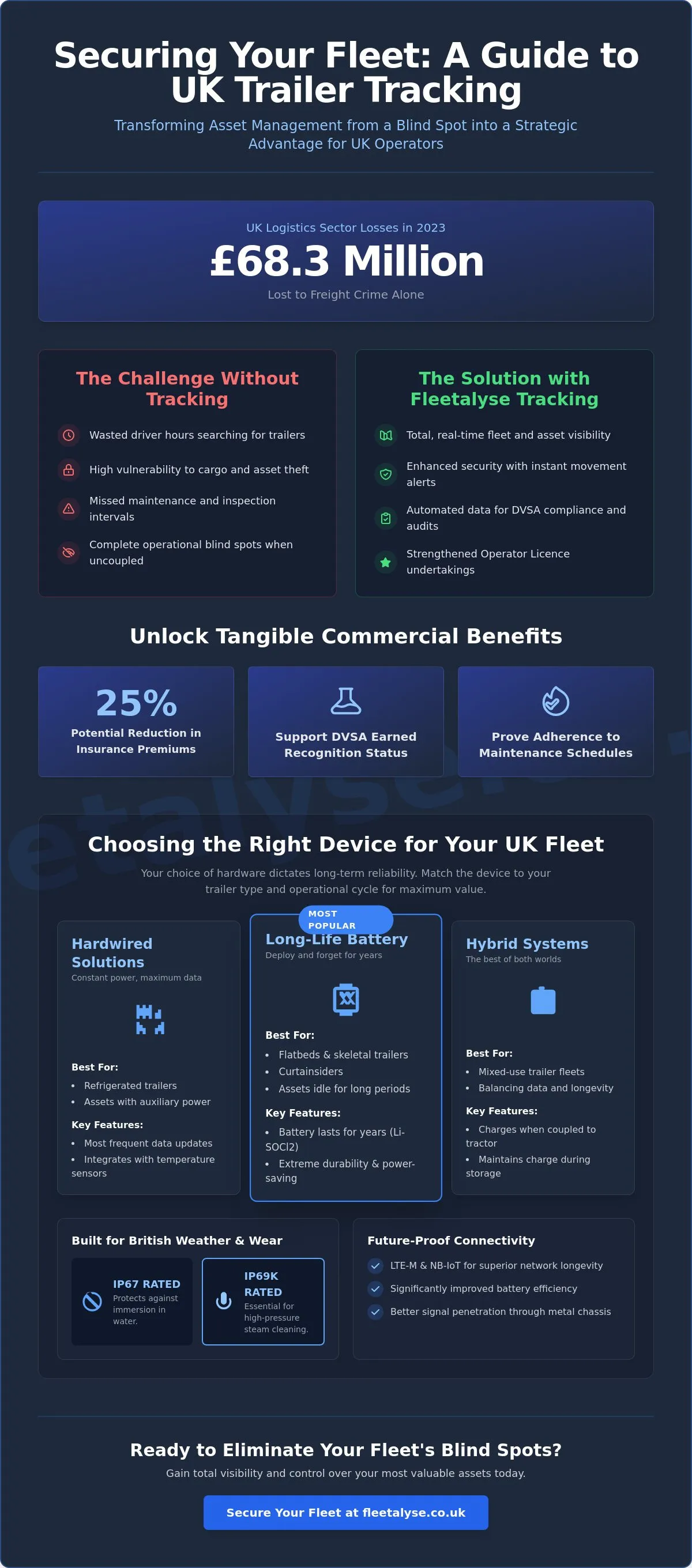
The UK logistics sector suffered a staggering £68.3 million in freight crime losses in 2023 alone. For regional operators, the risk of losing high-value cargo is a constant pressure that demands more than just a padlock. Implementing trailer tracking devices uk fleets can trust is now a fundamental requirement for any business serious about asset protection and operational clarity.
You've likely felt the frustration of drivers wasting hours searching for specific trailers in a busy yard or struggling to keep non-motorised assets on a strict maintenance schedule. It's a common drain on resources that directly impacts your bottom line. We'll show you how to secure your assets and streamline HGV operations using the latest tracking technology.
This guide covers everything from achieving total fleet visibility to reducing insurance premiums by up to 25%. You'll learn how integrated data supports your DVSA Earned Recognition status and ensures your trailers remain roadworthy without the guesswork.
Key Takeaways
- Understand the technical requirements for UK weather by selecting hardware with appropriate IP67 or IP69K ratings to ensure long-term durability.
- Discover how trailer tracking devices uk operators utilise provide the location history needed to prove strict adherence to maintenance and inspection intervals.
- Learn to use asset data to support your Operator Licence undertakings and strengthen your "Statement of Intent" for the DVSA.
- Move beyond basic GPS pings by integrating trailer data with remote tachograph downloads for a unified view of fleet compliance.
- Evaluate your investment using a framework that balances initial hardware costs against the long-term operational value of total fleet visibility.
What are Trailer Tracking Devices and Why are They Essential for UK Fleets?
Trailer tracking is no longer a luxury for high-value logistics; it's a telematics-based asset management solution. Historically, unpowered trailers were the blind spot of the transport industry. Whilst tractor units were fitted with sophisticated telematics, the assets they pulled often vanished from the digital map the moment they were uncoupled. This lack of visibility led to wasted driver hours, missed maintenance windows, and increased vulnerability to theft.
Modern trailer tracking devices uk operators utilise have closed this gap. There's a vital distinction between a simple GPS "ping" and comprehensive fleet data. A basic tracker might tell you where a trailer was six hours ago. A professional-grade vehicle tracking system provides real-time movement alerts, hitching status, and geofencing capabilities. This transition toward "smart trailers" allows managers to treat every asset as an active participant in the supply chain rather than a passive piece of equipment.
The Core Technology: How UK Trailer Trackers Work
Reliability starts with pinpoint accuracy. Professional devices use both GPS and GLONASS satellite constellations to ensure a signal is maintained even in remote areas or amongst tall warehouse structures. These units transmit data across the UK via 4G and GSM connectivity, providing a constant stream of location and status updates. High-sensitivity accelerometers play a crucial role by detecting unauthorised movement or the vibration of a trailer being hitched. This immediate alert system allows you to respond to potential theft before the asset leaves the yard.
The Critical Difference Between Powered and Unpowered Tracking
Choosing the right hardware depends entirely on your trailer type and operational cycle. Don't settle for a one-size-fits-all approach. Consider these three primary configurations:
- Hardwired Solutions: Best for refrigerated trailers or those with constant auxiliary power. These units provide the most frequent data updates and can often integrate with additional sensors for temperature monitoring.
- Long-Life Battery Units: Essential for flatbeds, skeletal trailers, and curtainsiders that may stand idle for weeks. These devices are designed for extreme durability and use power-saving modes to ensure the battery lasts for years without intervention.
- Hybrid Systems: These clever units operate on internal batteries but charge automatically whilst the trailer is coupled to the tractor. This ensures the device remains active during long transit routes and maintains a high state of charge for periods of storage.
By selecting the correct trailer tracking devices uk businesses can eliminate operational blind spots. You gain the ability to prove exactly when a trailer arrived at a site and how long it remained there. This data is the foundation of a transparent, efficient, and secure fleet operation.
Choosing the Right Hardware: Battery Life, Durability, and Connectivity
Hardware selection dictates the long-term success of your tracking strategy. It isn't just about finding the cheapest unit. You must match the device to the specific environment of a UK trailer yard. For instance, an IP67 rating protects against immersion in water, but an IP69K rating is necessary if your fleet undergoes regular high-pressure steam cleaning. This level of ingress protection ensures that sensitive electronics remain dry during both the British winter and rigorous maintenance cycles.
Connectivity is another shifting variable. With the phased sunset of 2G and 3G networks, future-proofing is essential. Modern trailer tracking devices uk operators choose should support LTE-M or NB-IoT. These low-power, wide-area networks offer better signal penetration through metal chassis and significantly improved battery efficiency. For covert installations, internal antennas are preferred to prevent tampering. However, if the device is buried deep within a steel frame, an external antenna might be required to maintain a stable link.
Battery chemistry is the silent engine of asset tracking. Lithium-thionyl chloride (Li-SOCl2) is the industry standard for unpowered assets. It offers exceptional energy density and can operate in temperatures as low as -60°C. This ensures reliability during the coldest months when standard lithium-ion cells often fail. When you're ready to secure your fleet with professional hardware, ensure you've audited your trailer types to match the power source to the asset's duty cycle.
Battery-Powered Asset Trackers for Long-Term Deployment
Unpowered assets require a strategic approach to power management. By setting "heartbeat" intervals to once or twice a day, you can extend battery life up to 10 years. This is ideal for trailers that spend long periods in storage or at customer sites. If a theft occurs, these trailer tracking devices uk can be switched remotely into "recovery mode." This increases the ping frequency to provide real-time location updates for recovery teams. Using these location logs also helps you comply with the UK Guide to Maintaining Roadworthiness by providing a digital audit trail of where each asset has been and for how long.
Hardwired and Solar-Powered Alternatives
For trailers with a constant power source, such as those with EBS/ABS systems, hardwiring is often the most efficient route. These units draw power directly from the tractor unit whilst coupled, allowing for high-frequency tracking without draining an internal battery. Solar-assisted units are another robust alternative, particularly for curtainsiders with exposed roof space. These devices use integrated solar panels to trickle-charge the internal battery, providing an almost indefinite service life. Most professional units also feature tamper alerts. If a thief attempts to cut the power supply, the device immediately switches to its backup battery and sends an emergency notification to your fleet manager.
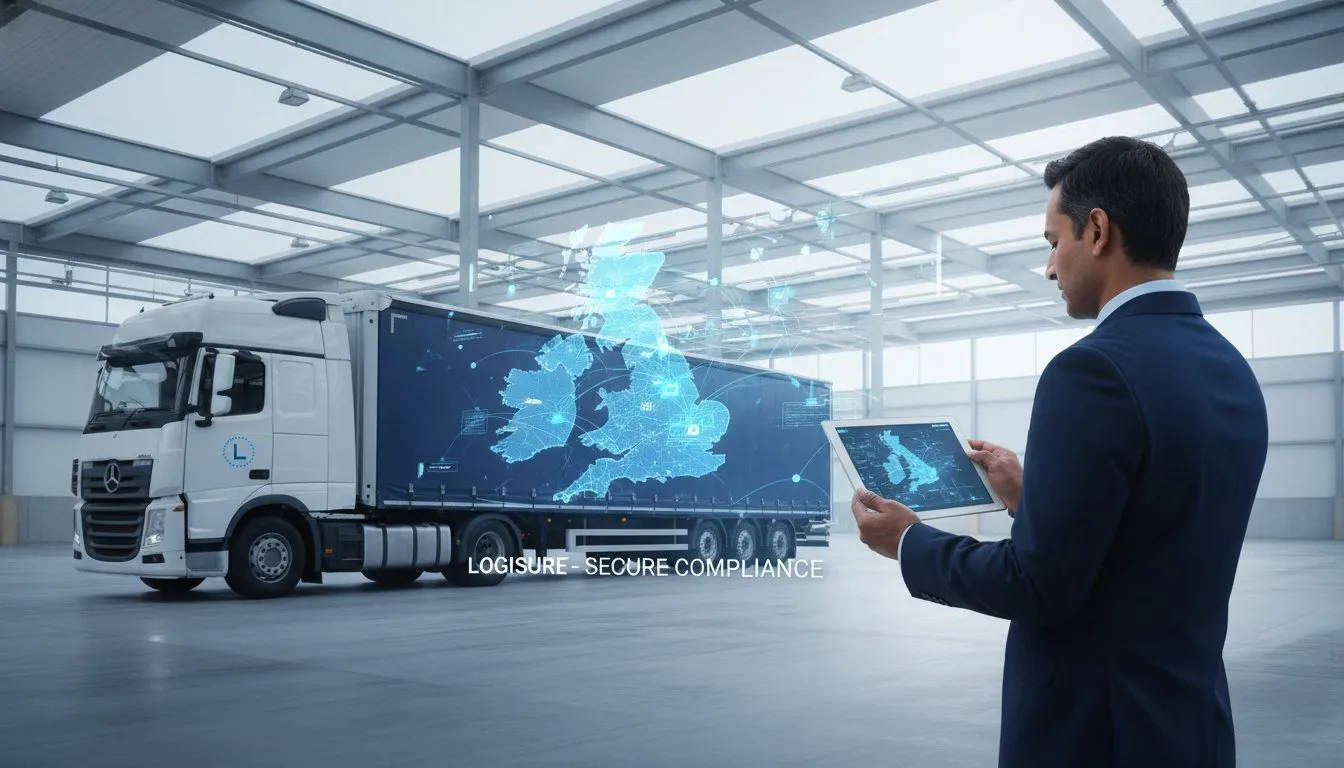
Trailer Data and UK Operator Licence Compliance
Compliance is the backbone of any successful haulage business. Whilst many competitors focus solely on theft recovery, the real value of trailer tracking devices uk operators use lies in regulatory adherence. When you apply for an Operator Licence, you commit to a "Statement of Intent." You promise the Traffic Commissioner that your vehicles and trailers will be kept in a fit and serviceable condition. Digital data provides the objective proof you need to back up those promises during a desk-based assessment or a site visit.
The DVSA is moving rapidly toward a data-led enforcement model. Schemes like Earned Recognition reward operators who share their compliance data by subjecting them to fewer roadside stops. By integrating your asset data with remote tachograph download systems, you create a unified record of both driver activity and vehicle health. An industry telematics report highlights that fleets using integrated systems see a marked improvement in audit scores and operational transparency.
Improving Safety and Maintenance Schedules
Manual spreadsheets are prone to error. You can't afford to let a trailer miss its mandatory Safety Inspection (PMI) or annual MOT because it was parked in a remote corner of a customer's yard. Automated trailer tracking devices uk fleets rely on can trigger alerts based on actual mileage or time intervals. This ensures tyres and brakes are serviced before they become a safety risk. Geofencing your maintenance depots also allows you to track exactly how long repairs take, helping you manage workshop throughput more effectively.
Audit Readiness: Documenting Asset Movement
Roadside enquiries can be stressful without the right documentation. Tracking data provides a digital breadcrumb trail that proves where a trailer has been, which tractor unit was pulling it, and for how long. This is particularly vital for organisations using rented or sub-contracted trailers where maintenance records might be complex to track. Accurate record-keeping is a non-negotiable requirement of your O-Licence undertakings.
- Provide time-stamped evidence to defend against fraudulent insurance claims or "crash-for-cash" scams.
- Ensure every asset in your fleet, regardless of ownership, adheres to your internal safety standards.
- Maintain a complete history of asset usage to justify maintenance expenditure and plan for future fleet renewals.
This level of detail doesn't just keep you on the right side of the law; it builds a culture of accountability. You're no longer guessing about the status of your assets. You're managing them with precision.
Comparing UK Trailer Tracking Solutions: A Decision Framework
Choosing between different trailer tracking devices uk providers requires a clear framework. Don't just look at the upfront hardware price. You must consider the total cost of ownership over the asset's lifecycle. A cheap device with a poor service level agreement (SLA) often becomes a liability when you need technical support or data accuracy during a DVSA audit. Transparency regarding monthly costs and data reliability is the mark of a professional partner.
Software usability is another critical factor. If your transport office can't navigate the platform quickly, the data stays trapped. Look for an interface that allows managers to see the entire fleet status at a glance. Installation also demands a choice: do you have the workshop capacity for in-house fitting, or do you require mobile engineers? Professional installation ensures the device is positioned for optimal signal strength and remains covert to prevent tampering by thieves.
Subscription models should be straightforward. Avoid complex contracts with hidden fees for data overages or software updates. A reliable SLA should guarantee high uptime and provide clear protocols for hardware replacements. When you're ready to invest, view our trailer tracking solutions to see how a transparent pricing model supports your long-term operational goals.
The Operational ROI of Trailer Visibility
"Trailer hunting" is a hidden cost that drains productivity every day. In large distribution centres, drivers can spend 20 to 30 minutes searching for a specific asset amongst hundreds of others. This wasted time adds up across a fleet. By providing pinpoint locations, tracking technology eliminates this search time entirely. Visibility also allows you to identify "static" trailers. These are assets that haven't moved in weeks but still incur insurance and maintenance costs. Improving asset utilisation often allows operators to reduce their total fleet size whilst maintaining the same level of service.
Security Features That Actually Stop Theft
Security is most effective when it's proactive. Geofencing is your primary tool for yard security. You can set a digital boundary around your depot and receive instant alerts if an asset leaves that area. This is particularly useful for identifying unauthorised weekend use or potential theft in real time. Out-of-hours movement alerts ensure you're notified the moment a trailer is hitched and moved when it should be stationary. Whilst some systems rely on 24/7 monitoring centres for recovery, the ability for your own team to receive direct, immediate alerts is often the fastest way to prevent a theft from progressing.
Fleetalyse: Integrating Trailer Tracking into Your Compliance Strategy
Fleet management is more than just watching dots move across a screen. It's about operational clarity. Many trailer tracking devices uk providers offer basic location data but fail to connect that information to the rest of your business. Fleetalyse takes a different approach. We provide a holistic platform that bridges the gap between your motorised vehicles and your static assets. This unified perspective is essential for regional operators who need to manage resources with precision.
Centralising your data is the only way to eliminate the friction in a busy transport office. By using a single interface for your HGVs, vans, and trailers, you remove the need for multiple logins and fragmented reporting. This unified view gives you the confidence to make quick, data-backed decisions. Our UK-based team understands the specific pressures of regional infrastructure and regulations. We don't offer generic, global software; we provide a practical tool built for the rigours of the British transport sector.
Operational efficiency improves significantly when you combine remote tachograph download with real-time asset tracking. You no longer have to cross-reference different systems to see which driver is closest to a specific trailer or how many hours they have left on their shift. Everything is in one place. This integration ensures that your compliance records are always up to date and easily accessible for any internal or external audit.
Seamless Tachograph and Asset Integration
Dispatching becomes faster when you can view live driver hours alongside trailer locations. You can identify the best-positioned asset for a job and ensure the driver has the legal capacity to complete the route. This automation reduces the administrative burden on your compliance team. Instead of chasing paper trails, they can focus on high-level fleet strategy. Customised reporting allows you to pull the exact data you need for business reviews without wading through irrelevant metrics. It makes your transport office more agile and responsive to customer demands.
Getting Started with a Professional UK Solution
Switching to a professional tracking system shouldn't be a headache. We prioritise transparency in everything we do. You'll find no hidden fees or complex contractual traps here. Our rollout process is designed to be efficient and straightforward. We work with you to organise a fleet-wide implementation that minimises vehicle downtime. The goal is to get your system live and delivering value as quickly as possible. Book a consultation today to see the platform in action and discover how these trailer tracking devices uk fleets depend on can secure your future operations.
Future-Proof Your Fleet with Integrated Tracking
Managing a modern haulage operation requires more than just gut instinct; it demands precise, actionable data. You've seen how the right hardware choices, from IP69K-rated durability to future-proofed LTE-M connectivity, protect your assets against the harshest conditions. Efficiency follows visibility. By moving beyond basic security and embracing the data-led compliance standards set by the DVSA, you position your business as a leader in safety and operational standards.
The most successful regional operators don't treat tracking as a standalone tool. They integrate it. Using trailer tracking devices uk specialists recommend allows you to bridge the gap between live driver hours and asset location. This level of transparency reduces wasted yard hours and ensures you never miss a mandatory maintenance window. As specialists in HGV and trailer compliance, we provide the UK-based expert support and seamless tachograph analysis integration required to keep your fleet moving safely.
Secure your fleet and simplify compliance with Fleetalyse. Take full control of your assets today and build a more resilient, transparent operation for the years ahead.
Frequently Asked Questions
Do I need a different tracker for an unpowered trailer?
Unpowered trailers require specific battery-powered or solar units because they lack a constant power source. Unlike motorised vehicles, these assets rely on high-capacity internal batteries or hybrid systems that charge via the EBS/ABS line whilst coupled to a tractor. This ensures the asset remains visible on your map even when it is uncoupled and parked in a remote yard for several weeks.
How long does the battery last on a trailer tracking device?
Battery life depends entirely on your reporting frequency, but many professional units last up to 10 years. If you set the device to a "heartbeat" mode where it only reports its location once or twice a day, power consumption is minimal. Most units use lithium-thionyl chloride batteries. These are chosen for their longevity and their ability to operate reliably during cold UK winters.
Will trailer tracking reduce my UK insurance premiums?
Installing Thatcham-approved trailer tracking devices uk insurers recognise can lead to premium discounts of 15% to 25%. Insurance providers view these systems as essential risk management tools. Since the recovery rate for certain stolen trailers is as low as 23%, having a reliable tracking system in place makes your fleet a much lower risk for the underwriter.
Can I track my trailers whilst they are on a ferry or abroad?
You can track assets internationally if your device is fitted with a roaming multi-network SIM. These SIMs automatically connect to the strongest available signal across Europe and beyond. Whilst a GPS signal might be temporarily lost if a trailer is parked on a lower ferry deck, the device will store its data and update the portal immediately upon disembarking.
Is it difficult to install a trailer tracker on a curtainsider?
Installation on curtainsiders is a routine task that typically involves mounting the device to the front bulkhead or within the roof frame. Covert fitting is the standard approach to ensure the device remains hidden from thieves. Solar-powered units are particularly effective for this trailer type. They can be mounted on the roof to provide a constant trickle charge to the internal battery.
How does trailer tracking help with DVSA compliance?
Tracking data provides a digital audit trail that proves you are meeting your Operator Licence undertakings. It allows you to automate maintenance alerts based on actual mileage or time intervals rather than relying on manual logs. This objective data is a key component of the Earned Recognition scheme, showing the DVSA that your fleet maintenance is proactive and well-documented.
Can the tracking data be integrated with my tachograph analysis software?
Integration is a primary benefit of modern telematics platforms. You can view your trailer locations alongside data from your remote tachograph download system to get a unified view of your fleet. This allows transport managers to see exactly which driver is pulling which trailer and how many hours they have remaining on their shift. It simplifies dispatch and improves overall accountability.
What happens if a trailer tracker is tampered with or removed?
Professional trailer tracking devices uk fleets use are equipped with immediate tamper alerts. If the device is disconnected from a power source or removed from the chassis, it triggers an emergency notification to the fleet manager. Most units also feature an internal backup battery and a ruggedised housing. This ensures they continue to transmit location data even if a thief attempts to disable the system.
Frequently asked questions
The Core Technology: How UK Trailer Trackers Work
Reliability starts with pinpoint accuracy. Professional devices use both GPS and GLONASS satellite constellations to ensure a signal is maintained even in remote areas or amongst tall warehouse structures. These units transmit data across the UK via 4G and GSM connectivity, providing a constant stream of location and status updates. High-sensitivity accelerometers play a crucial role by detecting unauthorised movement or the vibration of a trailer being hitched. This immediate alert system allows you to respond to potential theft before the asset leaves the yard.
The Critical Difference Between Powered and Unpowered Tracking
Choosing the right hardware depends entirely on your trailer type and operational cycle. Don't settle for a one-size-fits-all approach. Consider these three primary configurations: By selecting the correct trailer tracking devices uk businesses can eliminate operational blind spots. You gain the ability to prove exactly when a trailer arrived at a site and how long it remained there. This data is the foundation of a transparent, efficient, and secure fleet operation. Hardware selection dictates the long-term success of your tracking strategy. It isn't just about finding the cheapest unit. You must match the device to the specific environment of a UK trailer yard. For instance, an IP67 rating protects against immersion in water, but an IP69K rating is necessary if your fleet undergoes regular high-pressure steam cleaning. This level of ingress protection ensures that sensitive electronics remain dry during both the British winter and rigorous maintenance cycles. Connectivity is another shifting variable. With the phased sunset of 2G and 3G networks, future-proofing is essential. Modern trailer tracking devices uk operators choose should support LTE-M or NB-IoT. These low-power, wide-area networks offer better signal penetration through metal chassis and significantly improved battery efficiency. For covert installations, internal antennas are preferred to prevent tampering. However, if the device is buried deep within a steel frame, an external antenna might be required to maintain a stable link. Battery chemistry is the silent engine of asset tracking. Lithium-thionyl chloride (Li-SOCl2) is the industry standard for unpowered assets. It offers exceptional energy density and can operate in temperatures as low as -60°C. This ensures reliability during the coldest months when standard lithium-ion cells often fail. When you're ready to secure your fleet with professional hardware, ensure you've audited your trailer types to match the power source to the asset's duty cycle.
Battery-Powered Asset Trackers for Long-Term Deployment
Unpowered assets require a strategic approach to power management. By setting "heartbeat" intervals to once or twice a day, you can extend battery life up to 10 years. This is ideal for trailers that spend long periods in storage or at customer sites. If a theft occurs, these trailer tracking devices uk can be switched remotely into "recovery mode." This increases the ping frequency to provide real-time location updates for recovery teams. Using these location logs also helps you comply with the UK Guide to Maintaining Roadworthiness by providing a digital audit trail of where each asset has been and for how long.
Hardwired and Solar-Powered Alternatives
For trailers with a constant power source, such as those with EBS/ABS systems, hardwiring is often the most efficient route. These units draw power directly from the tractor unit whilst coupled, allowing for high-frequency tracking without draining an internal battery. Solar-assisted units are another robust alternative, particularly for curtainsiders with exposed roof space. These devices use integrated solar panels to trickle-charge the internal battery, providing an almost indefinite service life. Most professional units also feature tamper alerts. If a thief attempts to cut the power supply, the device immediately switches to its backup battery and sends an emergency notification to your fleet manager. Compliance is the backbone of any successful haulage business. Whilst many competitors focus solely on theft recovery, the real value of trailer tracking devices uk operators use lies in regulatory adherence. When you apply for an Operator Licence, you commit to a "Statement of Intent." You promise the Traffic Commissioner that your vehicles and trailers will be kept in a fit and serviceable condition. Digital data provides the objective proof you need to back up those promises during a desk-based assessment or a site visit. The DVSA is moving rapidly toward a data-led enforcement model. Schemes like Earned Recognition reward operators who share their compliance data by subjecting them to fewer roadside stops. By integrating your asset data with remote tachograph download systems, you create a unified record of both driver activity and vehicle health. An industry telematics report highlights that fleets using integrated systems see a marked improvement in audit scores and operational transparency.
Improving Safety and Maintenance Schedules
Manual spreadsheets are prone to error. You can't afford to let a trailer miss its mandatory Safety Inspection (PMI) or annual MOT because it was parked in a remote corner of a customer's yard. Automated trailer tracking devices uk fleets rely on can trigger alerts based on actual mileage or time intervals. This ensures tyres and brakes are serviced before they become a safety risk. Geofencing your maintenance depots also allows you to track exactly how long repairs take, helping you manage workshop throughput more effectively.
Audit Readiness: Documenting Asset Movement
Roadside enquiries can be stressful without the right documentation. Tracking data provides a digital breadcrumb trail that proves where a trailer has been, which tractor unit was pulling it, and for how long. This is particularly vital for organisations using rented or sub-contracted trailers where maintenance records might be complex to track. Accurate record-keeping is a non-negotiable requirement of your O-Licence undertakings. This level of detail doesn't just keep you on the right side of the law; it builds a culture of accountability. You're no longer guessing about the status of your assets. You're managing them with precision. Choosing between different trailer tracking devices uk providers requires a clear framework. Don't just look at the upfront hardware price. You must consider the total cost of ownership over the asset's lifecycle. A cheap device with a poor service level agreement (SLA) often becomes a liability when you need technical support or data accuracy during a DVSA audit. Transparency regarding monthly costs and data reliability is the mark of a professional partner. Software usability is another critical factor. If your transport office can't navigate the platform quickly, the data stays trapped. Look for an interface that allows managers to see the entire fleet status at a glance. Installation also demands a choice: do you have the workshop capacity for in-house fitting, or do you require mobile engineers? Professional installation ensures the device is positioned for optimal signal strength and remains covert to prevent tampering by thieves. Subscription models should be straightforward. Avoid complex contracts with hidden fees for data overages or software updates. A reliable SLA should guarantee high uptime and provide clear protocols for hardware replacements. When you're ready to invest, view our trailer tracking solutions to see how a transparent pricing model supports your long-term operational goals.
The Operational ROI of Trailer Visibility
"Trailer hunting" is a hidden cost that drains productivity every day. In large distribution centres, drivers can spend 20 to 30 minutes searching for a specific asset amongst hundreds of others. This wasted time adds up across a fleet. By providing pinpoint locations, tracking technology eliminates this search time entirely. Visibility also allows you to identify "static" trailers. These are assets that haven't moved in weeks but still incur insurance and maintenance costs. Improving asset utilisation often allows operators to reduce their total fleet size whilst maintaining the same level of service.
Security Features That Actually Stop Theft
Security is most effective when it's proactive. Geofencing is your primary tool for yard security. You can set a digital boundary around your depot and receive instant alerts if an asset leaves that area. This is particularly useful for identifying unauthorised weekend use or potential theft in real time. Out-of-hours movement alerts ensure you're notified the moment a trailer is hitched and moved when it should be stationary. Whilst some systems rely on 24/7 monitoring centres for recovery, the ability for your own team to receive direct, immediate alerts is often the fastest way to prevent a theft from progressing. Fleet management is more than just watching dots move across a screen. It's about operational clarity. Many trailer tracking devices uk providers offer basic location data but fail to connect that information to the rest of your business. Fleetalyse takes a different approach. We provide a holistic platform that bridges the gap between your motorised vehicles and your static assets. This unified perspective is essential for regional operators who need to manage resources with precision. Centralising your data is the only way to eliminate the friction in a busy transport office. By using a single interface for your HGVs, vans, and trailers, you remove the need for multiple logins and fragmented reporting. This unified view gives you the confidence to make quick, data-backed decisions. Our UK-based team understands the specific pressures of regional infrastructure and regulations. We don't offer generic, global software; we provide a practical tool built for the rigours of the British transport sector. Operational efficiency improves significantly when you combine remote tachograph download with real-time asset tracking. You no longer have to cross-reference different systems to see which driver is closest to a specific trailer or how many hours they have left on their shift. Everything is in one place. This integration ensures that your compliance records are always up to date and easily accessible for any internal or external audit.
Seamless Tachograph and Asset Integration
Dispatching becomes faster when you can view live driver hours alongside trailer locations. You can identify the best-positioned asset for a job and ensure the driver has the legal capacity to complete the route. This automation reduces the administrative burden on your compliance team. Instead of chasing paper trails, they can focus on high-level fleet strategy. Customised reporting allows you to pull the exact data you need for business reviews without wading through irrelevant metrics. It makes your transport office more agile and responsive to customer demands.
Getting Started with a Professional UK Solution
Switching to a professional tracking system shouldn't be a headache. We prioritise transparency in everything we do. You'll find no hidden fees or complex contractual traps here. Our rollout process is designed to be efficient and straightforward. We work with you to organise a fleet-wide implementation that minimises vehicle downtime. The goal is to get your system live and delivering value as quickly as possible. Book a consultation today to see the platform in action and discover how these trailer tracking devices uk fleets depend on can secure your future operations. Managing a modern haulage operation requires more than just gut instinct; it demands precise, actionable data. You've seen how the right hardware choices, from IP69K-rated durability to future-proofed LTE-M connectivity, protect your assets against the harshest conditions. Efficiency follows visibility. By moving beyond basic security and embracing the data-led compliance standards set by the DVSA, you position your business as a leader in safety and operational standards. The most successful regional operators don't treat tracking as a standalone tool. They integrate it. Using trailer tracking devices uk specialists recommend allows you to bridge the gap between live driver hours and asset location. This level of transparency reduces wasted yard hours and ensures you never miss a mandatory maintenance window. As specialists in HGV and trailer compliance, we provide the UK-based expert support and seamless tachograph analysis integration required to keep your fleet moving safely. Secure your fleet and simplify compliance with Fleetalyse. Take full control of your assets today and build a more resilient, transparent operation for the years ahead.
Do I need a different tracker for an unpowered trailer?
Unpowered trailers require specific battery-powered or solar units because they lack a constant power source. Unlike motorised vehicles, these assets rely on high-capacity internal batteries or hybrid systems that charge via the EBS/ABS line whilst coupled to a tractor. This ensures the asset remains visible on your map even when it is uncoupled and parked in a remote yard for several weeks.
How long does the battery last on a trailer tracking device?
Battery life depends entirely on your reporting frequency, but many professional units last up to 10 years. If you set the device to a "heartbeat" mode where it only reports its location once or twice a day, power consumption is minimal. Most units use lithium-thionyl chloride batteries. These are chosen for their longevity and their ability to operate reliably during cold UK winters.
Will trailer tracking reduce my UK insurance premiums?
Installing Thatcham-approved trailer tracking devices uk insurers recognise can lead to premium discounts of 15% to 25%. Insurance providers view these systems as essential risk management tools. Since the recovery rate for certain stolen trailers is as low as 23%, having a reliable tracking system in place makes your fleet a much lower risk for the underwriter.
Can I track my trailers whilst they are on a ferry or abroad?
You can track assets internationally if your device is fitted with a roaming multi-network SIM. These SIMs automatically connect to the strongest available signal across Europe and beyond. Whilst a GPS signal might be temporarily lost if a trailer is parked on a lower ferry deck, the device will store its data and update the portal immediately upon disembarking.
Is it difficult to install a trailer tracker on a curtainsider?
Installation on curtainsiders is a routine task that typically involves mounting the device to the front bulkhead or within the roof frame. Covert fitting is the standard approach to ensure the device remains hidden from thieves. Solar-powered units are particularly effective for this trailer type. They can be mounted on the roof to provide a constant trickle charge to the internal battery.
How does trailer tracking help with DVSA compliance?
Tracking data provides a digital audit trail that proves you are meeting your Operator Licence undertakings. It allows you to automate maintenance alerts based on actual mileage or time intervals rather than relying on manual logs. This objective data is a key component of the Earned Recognition scheme, showing the DVSA that your fleet maintenance is proactive and well-documented.
Can the tracking data be integrated with my tachograph analysis software?
Integration is a primary benefit of modern telematics platforms. You can view your trailer locations alongside data from your remote tachograph download system to get a unified view of your fleet. This allows transport managers to see exactly which driver is pulling which trailer and how many hours they have remaining on their shift. It simplifies dispatch and improves overall accountability.
What happens if a trailer tracker is tampered with or removed?
Professional trailer tracking devices uk fleets use are equipped with immediate tamper alerts. If the device is disconnected from a power source or removed from the chassis, it triggers an emergency notification to the fleet manager. Most units also feature an internal backup battery and a ruggedised housing. This ensures they continue to transmit location data even if a thief attempts to disable the system.