
Editorial correction: 30 September 2026. Removed an unrelated horse-monitoring recommendation and unsupported absolute claims about trailer recovery. The original publication date is retained.
How much time did your yard staff spend this morning physically checking trailer IDs against a clipboard? For many UK hauliers, the reality of managing uncoupled assets involves manual guesswork and the constant risk of theft. When a trailer sits idle in a remote depot or disappears from a site overnight, the impact on your bottom line is immediate. You already know that visibility is the only way to protect your margins, but keeping eyes on every asset at once often feels like an impossible task.
This guide explains how modern hgv trailer tracking solutions bridge the gap between your office and the road. We'll show you how to secure your assets with automated alerts, maintain compliance without the paperwork, and optimise fleet utilisation using live data. You'll learn how real-time location tracking and seamless integration with your existing fleet management tools can turn underutilised trailers into high-performing assets. We'll move from the basics of GPS hardware to the practical gains of having all your compliance and location data in one place.
Key Takeaways
- Identify and recover assets quickly using automated alerts and geofencing to combat the rising costs of rural crime and trailer theft across the UK.
- Eliminate manual yard checks and reduce idle time by gaining real-time visibility over every trailer in your fleet, regardless of which depot they are sitting in.
- Evaluate hgv trailer tracking solutions based on your specific power requirements, choosing between long-life battery units and hardwired hardware for uncoupled assets.
- Strengthen your Operator Licence compliance by using precise location data to support your maintenance pillar and provide clear audit trails.
- Streamline your back-office operations by integrating trailer tracking with remote tachograph downloads to manage all fleet and compliance data through a single, transparent platform.
The Operational Challenges of Managing HGV Trailer Assets
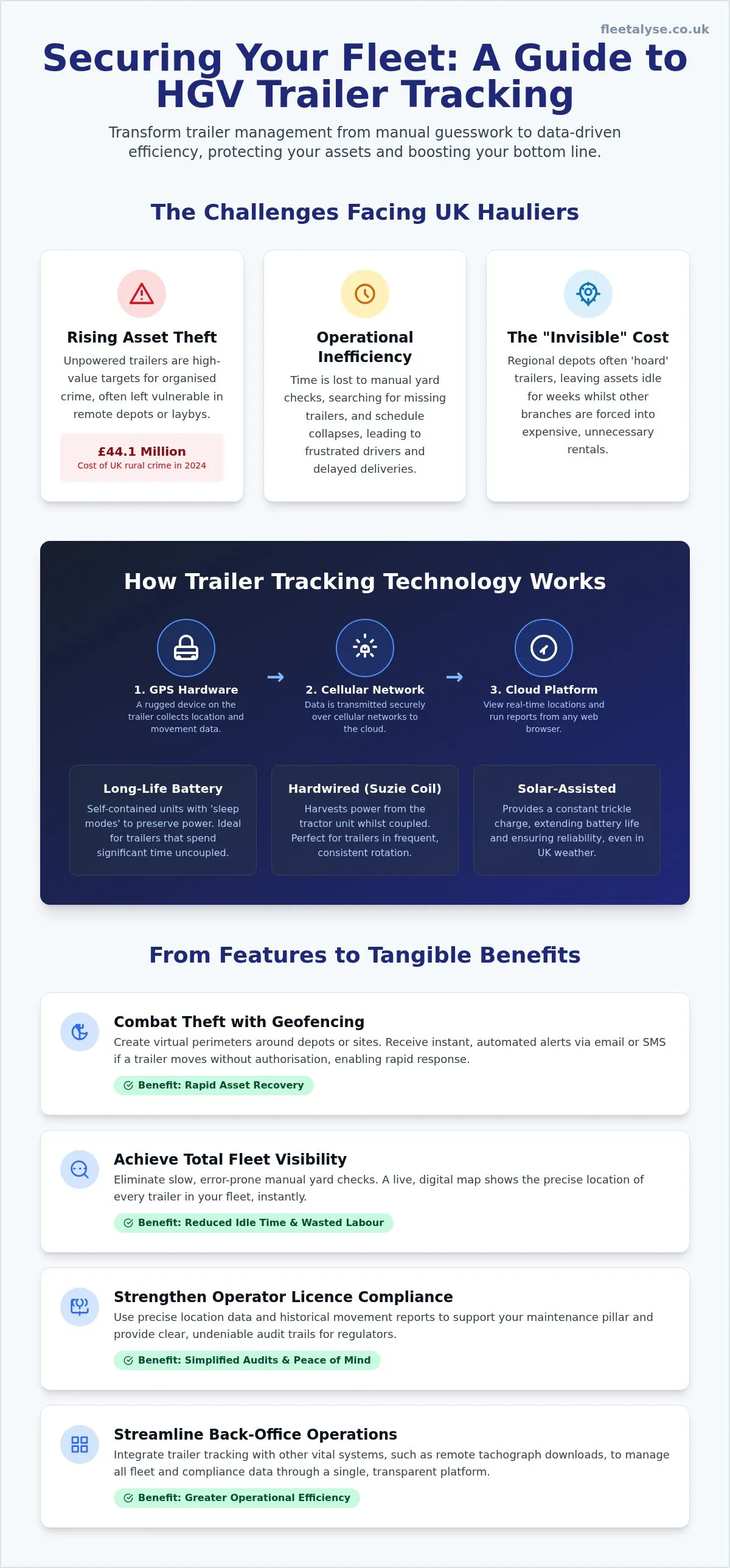
Managing a fleet of trailers involves more than just keeping wheels turning. For many UK logistics firms, the financial burden of missing or underutilised assets is a constant drain on resources. Rural crime cost the UK £44.1 million in 2024. Whilst this is a decrease from the previous year, it highlights a persistent threat to hauliers operating in remote or unsecured locations. Theft isn't just about the loss of the physical asset. It's about the lost revenue, insurance hikes, and the disruption to your operational flow.
The Impact of Rural Crime on UK Haulage
When assessing a vehicle tracking system for a trailer, ask how it reports movement while the trailer is uncoupled and who will respond to an alert. Test the proposed process, including how the dashboard distinguishes a recent position from an older report. Do not treat a tracker as a guarantee that a stolen trailer will be recovered.
Operational Inefficiency and Idle Assets
The "invisible" costs of idle assets often hurt a business more than a one-off theft. It's common for regional depots to "hoard" trailers to ensure they aren't caught short during peak periods. This behaviour leaves assets sitting idle for weeks whilst other branches are forced into expensive, unnecessary rentals. Manual yard checks add to this burden. Staff spend hours physically walking through depots with clipboards to verify IDs. It's a slow, error-prone process that wastes valuable time. Professional hgv trailer tracking solutions eliminate this guesswork by providing a digital map of every asset instantly.
Visibility is also critical for meeting strict delivery windows. If a driver arrives at a depot but can't find the assigned trailer, or if that trailer has been moved to a different site without record, your schedule collapses. These delays lead to frustrated drivers and disappointed customers. By using technology to monitor your fleet, you ensure that every trailer is accounted for and positioned exactly where it needs to be. This level of clarity allows Fleetalyse partners to maximise their existing resources rather than over-investing in surplus hardware.
Technical Breakdown: How HGV Trailer Tracking Solutions Work
Modern hgv trailer tracking solutions rely on a synergy between GPS hardware and cloud-based telematics. The hardware collects location and movement data, which is then transmitted via secure cellular networks to a central dashboard. This allows fleet managers to view their entire operation in real time. It's an efficient way to manage assets without needing constant manual updates. By using Fleetalyse technology, you gain a transparent view of your fleet that generic systems often fail to provide.
Power Management for Unpowered Assets
Choosing the right power source is a pragmatic decision based on how your trailers are used. Long-life internal batteries are standard for trailers that spend significant time uncoupled. These units often feature "sleep modes" that preserve power by only transmitting data when motion is detected. Alternatively, hardwired units harvest power from the Suzie coil whilst the trailer is coupled to a tractor unit. Solar-assisted tracking units are also a reliable choice for UK hauliers, providing a constant trickle charge that extends the life of the internal battery during summer months.
Durability and Environmental Standards
An IP67 rating ensures the device is dust-tight and protected against immersion, whilst IP69K indicates it can withstand high-pressure, high-temperature washdowns. The British climate and road conditions demand this level of ruggedised hardware. Vibration resistance is equally critical. HGV trailers endure constant mechanical stress from uneven road surfaces, so internal components must be built for the rigours of real-world application. You don't want a system that fails the moment the weather turns or the terrain gets rough.
Secure, discreet mounting is a non-negotiable feature for asset protection. Devices should be hidden from plain sight to prevent tampering by unauthorised parties. This physical security complements the technical data, ensuring your tracking remains active when you need it most. Beyond theft, tracking data helps you monitor how trailers are handled, which aligns with official government guidance on load security and general vehicle safety. It's about maintaining a standard of excellence across every mile.
Effective tracking isn't just about the hardware; it's about how that data integrates into your daily workflow. By centralising your asset information, you reduce the friction of fleet management. If you're ready to improve your operational clarity, you can explore our tracking packages to find a fit for your fleet. Professional-grade technology ensures you stay in control of your assets, regardless of where they are in the country.
Essential Features for Protecting and Organising Your Trailers
Professional hgv trailer tracking solutions provide more than just a dot on a map. They serve as a strategic management layer that bridges the gap between physical assets and digital oversight. Whilst basic GPS tools focus on location, a specialised system integrates with your operational workflow to improve security and compliance. You need functional utility that supports your daily dispatch decisions. Choosing a system with the right feature set ensures your trailers remain productive and protected; furthermore, to see how professional safety and coordination are applied in other areas of the transport sector, you can learn more about Acquired Awareness Traffic Management.
Geofencing allows you to organise virtual "safe zones" around your depots, customer sites, and regular rest stops. It's a simple, effective way to maintain control over uncoupled assets. If a trailer crosses these digital boundaries during "out-of-hours" periods, the system triggers an instant notification to your transport team. This immediate visibility is vital for preventing unauthorised use or identifying a theft in progress. Beyond security, arrival and departure timestamps provide objective data for customer billing. You no longer have to rely on manual logs to prove when a trailer reached a site or how long it stayed there. This level of transparency reduces invoice disputes and improves cash flow; for specialised haulage providers such as Bewlake Lift & Haul Ltd, this level of precise asset tracking is essential for coordinating their nationwide crane hire services.
Asset Utilisation and Reporting
Idle trailers represent wasted capital. A professional tracking dashboard helps you identify "dormant" assets that haven't moved in 48 hours or more. This data allows you to redistribute trailers to higher-demand regions, reducing the need for costly external rentals. Utilisation reports also play a critical role in your maintenance programme. By using precise mileage data rather than estimated calendar dates, you can schedule MOTs and servicing more accurately. This proactive approach ensures your fleet stays roadworthy and compliant with your Operator Licence requirements. Historical route replay adds another layer of protection. If a customer reports a delivery delay or an incident occurs on the road, you can replay the exact path taken by the trailer to investigate the facts.
Effective fleet management requires a partner that understands the specific pressures of the UK transport industry. At Fleetalyse, we prioritise data clarity and ease of use. Our platform ensures that your trailer information is accessible and actionable, helping you turn raw GPS coordinates into meaningful business insights. By focusing on these essential features, you move from reactive problem-solving to a proactive, data-driven strategy that protects your margins and your reputation.
Assessing ROI: Why Visibility is More Than Just a Map Location
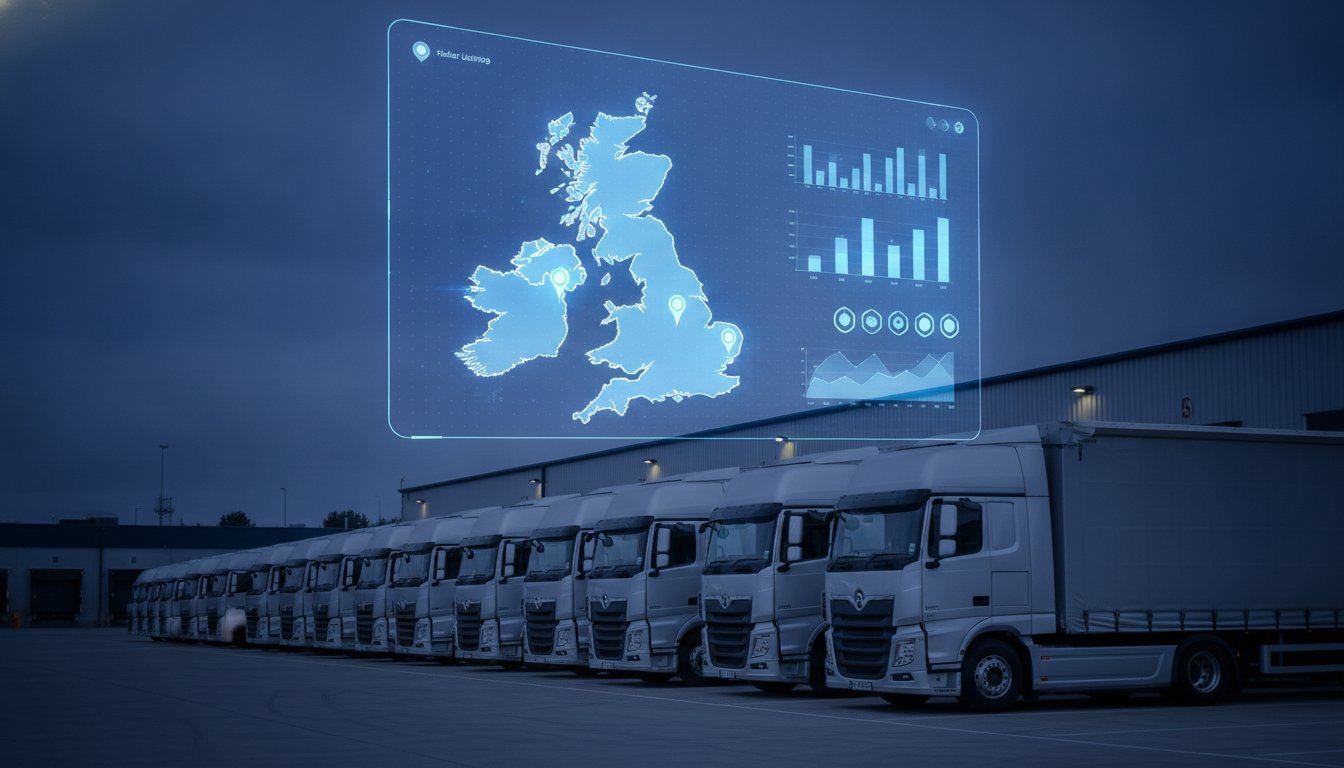
ROI in haulage is often viewed through the narrow lens of theft recovery. However, the true value of hgv trailer tracking solutions lies in the day-to-day operational gains that generic systems overlook. You aren't just buying a security tool. You're investing in a system that clarifies your overheads and identifies waste. Better asset planning reduces the fuel wasted by tractor units hunting for uncoupled trailers or making unnecessary trips to remote depots. By improving asset turnover, the hardware pays for itself through recovered time and resources.
Compliance and the Operator Licence
The DVSA expects you to be in professional control of your fleet at all times. Accurate trailer records are a non-negotiable part of audit readiness. Tracking data provides a digital audit trail that links trailer mileage directly to your preventative maintenance inspections (PMIs). Instead of guessing when a trailer is due for service based on the calendar, you use real-world usage data. This ensures you never miss a safety check whilst avoiding the cost of over-servicing idle assets. It's a pragmatic way to prove you're in control of your fleet, which is exactly what the traffic commissioner looks for during an inspection.
Reducing Administrative and Insurance Costs
Think about the hours lost to manual yard checks. Staff walking through depots to find a specific trailer is an expensive use of labour. Automating this process saves significant administrative time every week. Insurance is another area for direct savings. Many UK insurers mandate Thatcham-approved tracking for high-value assets to combat the threat of organised crime. Installing these devices can lead to lower premiums and significantly reduces insurance claim complexity. When you can provide live location data to the police, the likelihood of a rapid recovery increases, preventing a total loss on your books.
Better management also extends the life of your trailers. By monitoring usage patterns, you prevent the premature wear and tear associated with over-utilised units across your network. This holistic approach to visibility turns a simple GPS coordinate into a powerful financial lever for your business. If you want to start seeing these returns in your own fleet, you can view our trailer tracking solutions here. Professional-grade data ensures your investment translates into measurable operational improvement.
Implementing Fleetalyse Trailer Tracking for UK Transport
Choosing a technology partner requires more than just looking at a feature list. You need a specialist that understands the specific pressures of the UK logistics sector. Fleetalyse operates as a pragmatic ally for regional hauliers, providing hgv trailer tracking solutions that are built for real-world application. Founded in 2020 as a specialised UK technology partner, we have built our reputation on providing national coverage and deep industry insight. We don't offer generic, global software. Instead, we focus on the granular needs of British operators who value transparency and reliability. By consolidating your tools, you reduce administrative noise and gain a clearer view of your margins.
The primary benefit of our approach is the seamless integration of asset data and compliance records. Most providers treat these as separate issues. We believe they are two sides of the same coin. When you link your trailer tracking with remote tachograph download services, you remove the need for manual data entry and fragmented reporting. This unified strategy ensures that your office staff spend less time chasing paperwork and more time managing active movements.
The Power of Integrated Fleet Data
Efficiency in the transport office depends on having the right information at the right time. Seeing live driver hours alongside real-time trailer locations allows you to make dispatch decisions with total confidence. You can immediately identify which driver has the remaining hours to complete a job and where the closest available trailer is located. This prevents illegal over-driving and reduces empty running. You manage your entire fleet, including HGVs, vans, and trailers, through a single dashboard. This simplicity is backed by specialised UK-based support. We speak your language and understand the local infrastructure, ensuring you get technical help that is actually useful.
Getting Started with Fleetalyse
We prioritise honesty in our business relationships. This starts with our financial terms. You won't find hidden fees, complex tiers, or restrictive long-term contracts that don't serve your interests. Our commitment to transparency means you know exactly what you are paying for from day one. We focus on providing functional utility that improves your operational clarity without unnecessary, flashy features that add cost but no value. Our goal is to be a reliable ally that values your time and resources.
Taking control of your assets is a straightforward process. We begin with a bespoke fleet assessment to understand your current pain points and operational goals. Whether you are struggling with underutilised trailers in remote depots or need to tighten your compliance audit trail, we provide a tailored plan. Contact us today to request your assessment. It's time to stop guessing and start managing your fleet with the precision that modern UK haulage demands.
Secure Your Fleet with Data-Driven Oversight
Effective fleet management is no longer a matter of manual checks and guesswork. By implementing professional hgv trailer tracking solutions, you transform unpowered assets into visible, data-rich components of your logistics chain. This technology does more than just deter theft; it provides the operational clarity needed to eliminate idle time and ensure every trailer contributes to your bottom line. You gain the ability to manage maintenance schedules with precision, supporting your Operator Licence requirements through accurate mileage data and digital audit trails.
Fleetalyse stands as a pragmatic partner for UK operators. We offer seamless tachograph analysis integration and UK-based expert support to ensure your transition is frictionless. Our commitment to transparent pricing with no hidden complexities means you can plan your overheads with total confidence. It's time to move away from fragmented systems and consolidate your compliance tools into one reliable platform. Optimise your fleet with Fleetalyse HGV trailer tracking solutions today. Taking control of your assets is the first step toward a more resilient and profitable transport operation.
Frequently Asked Questions
How long does the battery last on an unpowered HGV trailer tracker?
Battery longevity depends on the reporting frequency and the specific hardware chosen for your fleet. Typically, professional-grade internal batteries last between three and seven years when configured to report location several times a day. Most units use intelligent sleep modes to conserve energy when the trailer is stationary. If the device is solar-assisted or harvests power from the Suzie coil, the internal battery life can be extended significantly beyond these standard estimates.
Will trailer tracking help me pass a DVSA compliance audit?
Yes, it provides the digital audit trail required to prove professional control of your assets. During a DVSA audit, you must demonstrate that your maintenance schedules are robust. Using hgv trailer tracking solutions allows you to record precise mileage for every asset. This data ensures that Preventative Maintenance Inspections (PMIs) are scheduled based on actual wear and tear rather than guesswork, which is a key requirement for maintaining a healthy Operator Licence.
Can I track trailers that are being moved by third-party sub-contractors?
You maintain full visibility of your trailers regardless of which tractor unit is pulling them. Because the tracking hardware is mounted directly to the trailer chassis and operates on its own power source, it functions independently of the driver or the vehicle. This is particularly useful for hauliers who rely on sub-contractors, as it ensures your high-value assets are always accounted for, even when they are outside your immediate fleet's tractor units.
What is the difference between a standard GPS tracker and a trailer-specific solution?
Standard GPS trackers usually require a constant power feed from a vehicle's ignition and aren't built for external exposure. In contrast, hgv trailer tracking solutions are ruggedised to withstand the mechanical vibrations of a trailer and the British weather. They feature high-capacity batteries and IP69K-rated housings for pressure washing. These units are specifically designed to operate for years in unpowered environments, providing reliability that consumer-grade trackers simply cannot match.
Is it difficult to install tracking hardware on an existing fleet of trailers?
Installation is a straightforward process that minimises fleet downtime. Most units are discreetly mounted to the bulkhead or chassis using high-strength fixings or magnets. Hardwired versions require a simple connection to the trailer's existing electrical loom, whilst battery-powered versions are entirely self-contained. A professional rollout can be organised to coincide with your existing maintenance windows, ensuring your trailers are equipped and back on the road without disrupting your delivery schedules.
How does geofencing work for large distribution centres and depots?
Geofencing allows you to draw a custom digital boundary, known as a polygon, around the exact perimeter of a site on your map. When a trailer crosses this virtual line, the system records the precise time and sends an automated notification. This is highly effective for large depots where you need to monitor gate exit times or identify if a trailer has been moved to an unauthorised holding area during the night.
Can I integrate trailer tracking with my existing tachograph analysis software?
Integration is a core feature of the Fleetalyse platform. By linking your trailer data with remote tachograph downloads and live driver hours, you consolidate all your compliance information into one dashboard. This allows transport managers to see which driver is coupled to which trailer in real time. It removes the need for fragmented spreadsheets and ensures that your asset management and driver compliance data work together to improve overall operational efficiency.
What happens if a trailer is stolen and taken to an area with poor signal?
Professional tracking units use "store and forward" technology to handle signal interruptions. If a trailer enters a dead zone, the device continues to log GPS coordinates to its internal memory. Once the unit regains a cellular connection, it uploads the entire journey history to your dashboard. Many units also feature high-sensitivity antennas that can maintain a connection in remote rural areas where standard mobile phones often struggle to find a signal.
Frequently asked questions
How long does the battery last on an unpowered HGV trailer tracker?
Battery longevity depends on the reporting frequency and the specific hardware chosen for your fleet. Typically, professional-grade internal batteries last between three and seven years when configured to report location several times a day. Most units use intelligent sleep modes to conserve energy when the trailer is stationary. If the device is solar-assisted or harvests power from the Suzie coil, the internal battery life can be extended significantly beyond these standard estimates.
Will trailer tracking help me pass a DVSA compliance audit?
Yes, it provides the digital audit trail required to prove professional control of your assets. During a DVSA audit, you must demonstrate that your maintenance schedules are robust. Using hgv trailer tracking solutions allows you to record precise mileage for every asset. This data ensures that Preventative Maintenance Inspections (PMIs) are scheduled based on actual wear and tear rather than guesswork, which is a key requirement for maintaining a healthy Operator Licence.
Can I track trailers that are being moved by third-party sub-contractors?
You maintain full visibility of your trailers regardless of which tractor unit is pulling them. Because the tracking hardware is mounted directly to the trailer chassis and operates on its own power source, it functions independently of the driver or the vehicle. This is particularly useful for hauliers who rely on sub-contractors, as it ensures your high-value assets are always accounted for, even when they are outside your immediate fleet's tractor units.
What is the difference between a standard GPS tracker and a trailer-specific solution?
Standard GPS trackers usually require a constant power feed from a vehicle's ignition and aren't built for external exposure. In contrast, hgv trailer tracking solutions are ruggedised to withstand the mechanical vibrations of a trailer and the British weather. They feature high-capacity batteries and IP69K-rated housings for pressure washing. These units are specifically designed to operate for years in unpowered environments, providing reliability that consumer-grade trackers simply cannot match.
Is it difficult to install tracking hardware on an existing fleet of trailers?
Installation is a straightforward process that minimises fleet downtime. Most units are discreetly mounted to the bulkhead or chassis using high-strength fixings or magnets. Hardwired versions require a simple connection to the trailer's existing electrical loom, whilst battery-powered versions are entirely self-contained. A professional rollout can be organised to coincide with your existing maintenance windows, ensuring your trailers are equipped and back on the road without disrupting your delivery schedules.
How does geofencing work for large distribution centres and depots?
Geofencing allows you to draw a custom digital boundary, known as a polygon, around the exact perimeter of a site on your map. When a trailer crosses this virtual line, the system records the precise time and sends an automated notification. This is highly effective for large depots where you need to monitor gate exit times or identify if a trailer has been moved to an unauthorised holding area during the night.
Can I integrate trailer tracking with my existing tachograph analysis software?
Integration is a core feature of the Fleetalyse platform. By linking your trailer data with remote tachograph downloads and live driver hours, you consolidate all your compliance information into one dashboard. This allows transport managers to see which driver is coupled to which trailer in real time. It removes the need for fragmented spreadsheets and ensures that your asset management and driver compliance data work together to improve overall operational efficiency.
What happens if a trailer is stolen and taken to an area with poor signal?
Professional tracking units use "store and forward" technology to handle signal interruptions. If a trailer enters a dead zone, the device continues to log GPS coordinates to its internal memory. Once the unit regains a cellular connection, it uploads the entire journey history to your dashboard. Many units also feature high-sensitivity antennas that can maintain a connection in remote rural areas where standard mobile phones often struggle to find a signal.