
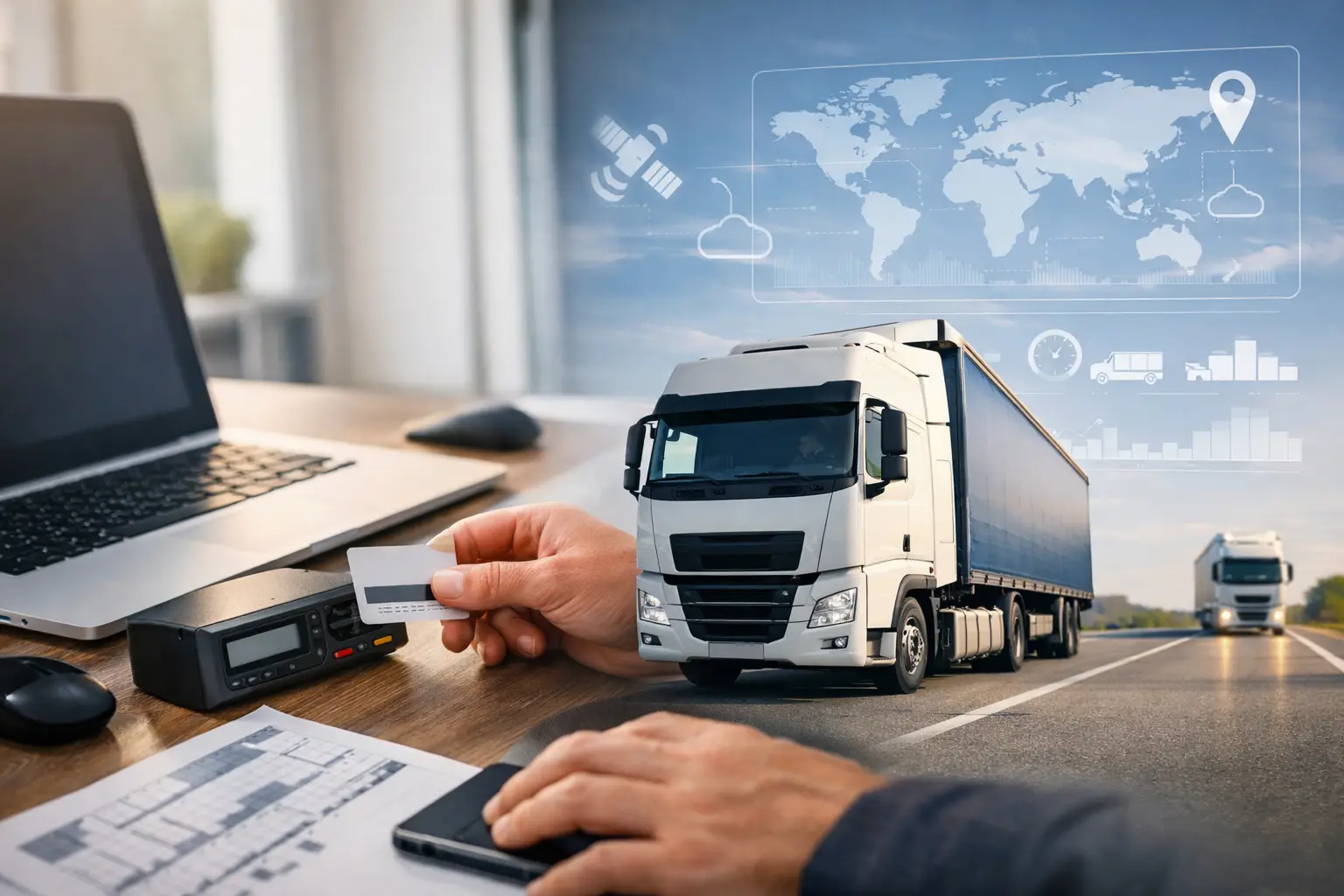
Monday morning is where weak compliance processes show themselves. Driver cards still need downloading, vehicles are out on the road, and someone in the office is trying to work out who is close to a driving hours issue before the next job goes on the board. Remote tachograph compliance changes that picture. It gives transport teams timely access to driver and vehicle unit data without building the week around manual downloads, missing files and spreadsheet chasing.
For UK operators, that matters for more than convenience. Tachograph management sits close to operator licence risk, OCRS pressure, driver welfare and day-to-day planning. If data arrives late, or if infringements are only spotted after the fact, the problem is rarely confined to compliance. It spills into dispatch, payroll checks, working time oversight and management time that should be spent running the fleet.
What remote tachograph compliance actually means
At a practical level, remote tachograph compliance is the ability to collect tachograph data from vehicles and driver cards without bringing the vehicle back to depot purely for a download. Instead of relying on physical contact with each unit, data is captured remotely and made available in a platform where the transport team can review activity, identify issues and maintain proper records.
That distinction is important. Remote downloads on their own solve one part of the problem, but not the whole one. A business can still be drowning in admin if downloaded files sit in one system, vehicle tracking in another, and driver hours checks in a separate report that only one person knows how to run. The real value comes when compliance data is visible alongside the operational picture - where the vehicle is, who is driving it, how many hours remain, and what needs attention before it becomes an infringement.
Why manual processes create avoidable risk
Manual download routines often survive because they are familiar, not because they are efficient. A depot team may have a process that technically works, but it usually depends on vehicles returning on time, drivers remembering cards, and somebody in the office keeping a careful diary of deadlines. That is manageable with a small, static fleet. It becomes fragile once vehicles move between sites, nights out increase, subcontracted patterns change, or planners are making live adjustments during the day.
The risk is not just a missed download. It is the delay between activity happening and management seeing it. If an infringement trend only appears in a weekly check, you have already lost the chance to intervene early. If driver hours are reviewed after jobs are assigned, planners are making decisions with incomplete information. If records are stored across email chains and folders, audit preparation becomes harder than it should be.
Remote tachograph compliance reduces that lag. It gives transport managers a clearer line of sight before the compliance issue turns into an operational problem.
Where the biggest gains show up first
Most operators see the first benefit in admin time. Staff no longer need to coordinate as many vehicle returns around download schedules, chase missing card data, or spend hours moving files between disconnected systems. That matters, but it is only the start.
The bigger gain is control. When driver hours and tachograph records are available remotely, dispatch decisions become easier to make with confidence. A planner can see whether a driver is in a safe position to take an extra run. A compliance manager can focus on exceptions rather than checking every record manually. A business owner gets a clearer sense of whether the fleet is being run within the rules without waiting for a monthly review.
There is also a quality benefit. Manual handling increases the chance of missed records, duplicated effort and inconsistent follow-up. Remote processes create a more regular, dependable flow of data. That helps with audit readiness and strengthens the evidence trail if questions arise from enforcement activity.
Remote tachograph compliance in daily operations
The operational value becomes clearer when you look at how a transport office actually works. Drivers set off at different times, trailers move between units, jobs change during the day, and vehicles do not always return to the same depot. In that environment, compliance cannot be treated as a separate back-office task.
A useful system supports the people making live decisions. It should show driver hours in a way that dispatch can understand quickly. It should flag approaching issues early enough for the office to act. It should keep vehicle and driver records accessible without forcing teams to switch between multiple platforms. When compliance data is tied to live fleet visibility, the office can plan more accurately and with fewer assumptions.
That is especially relevant for mixed fleets. Operators running HGVs alongside vans, trailers or specialist assets often struggle when each part of the fleet is managed differently. The more disconnected the systems, the more likely it is that the transport team spends time reconciling information rather than using it.
What to look for in a remote tachograph compliance setup
Not every system described as remote tachograph compliance delivers the same outcome. Some focus narrowly on collecting files. Others offer broader visibility but make installation, pricing or daily use more complicated than they need to be.
For most UK operators, a strong setup should do three things well. First, it should automate remote downloads reliably, so compliance deadlines are not resting on memory or vehicle availability. Second, it should surface driver hours and infringement risks in a format that is useful to transport managers, not just compliance specialists. Third, it should sit alongside tracking and fleet visibility so that compliance decisions are informed by what is happening on the road.
Ease of rollout matters too. A platform that takes months to install or needs specialist hardware work across the fleet can delay the benefit and add cost before any value is seen. Straightforward implementation, clear monthly pricing and one interface for core fleet tasks are often worth more than an extensive feature list that nobody uses properly.
The trade-offs operators should think about
There is no single answer that suits every fleet. A smaller operator with a stable route pattern may feel less urgency than a national fleet with rotating vehicles and multiple depots. But even smaller fleets can be exposed if compliance knowledge sits with one person or manual routines break down during holidays, sickness or periods of growth.
There is also a balance between data and action. More information is only useful if the office can respond to it. Alerts need to be meaningful, reports need to be readable, and the platform needs to fit how planners, transport managers and depot staff actually work. Otherwise, remote data simply creates another screen to monitor.
Cost should be assessed in the same practical way. The right question is not whether remote tachograph compliance costs more than doing it manually on paper. It is whether the business is currently paying in hidden admin time, vehicle disruption, missed planning opportunities and avoidable compliance exposure. For many fleets, that hidden cost is higher than expected.
Why one platform makes a difference
The strongest operational gains usually come when tachograph compliance is not isolated from the rest of fleet management. When remote downloads, live driver hours, vehicle tracking, trailer visibility and reporting sit together, the office works from one version of events. That cuts down the back-and-forth between systems and reduces the risk of decisions being made on incomplete data.
This is where a purpose-built platform stands apart from generic tracking software. Transport teams do not need more dots on a map if they still have to export files, update spreadsheets and manually check hours before assigning work. They need compliance and visibility in the same place, presented in a way that supports operator licence responsibilities and daily transport planning. Fleetalyse is built around that reality.
A better standard for compliance control
Remote tachograph compliance is not just a technical upgrade. It is a shift from reactive management to earlier, clearer control. The office spends less time collecting information and more time using it. Drivers are less likely to be put in difficult positions because hours risks are visible sooner. Management has a stronger grip on the records and processes that protect the licence.
For UK fleet operators, that is the real standard to aim for - not simply downloading files from a distance, but running compliance in a way that is faster, calmer and far more workable when the day does not go to plan. If a system helps the transport office stay ahead of the next issue rather than chasing the last one, it is doing the job properly.