
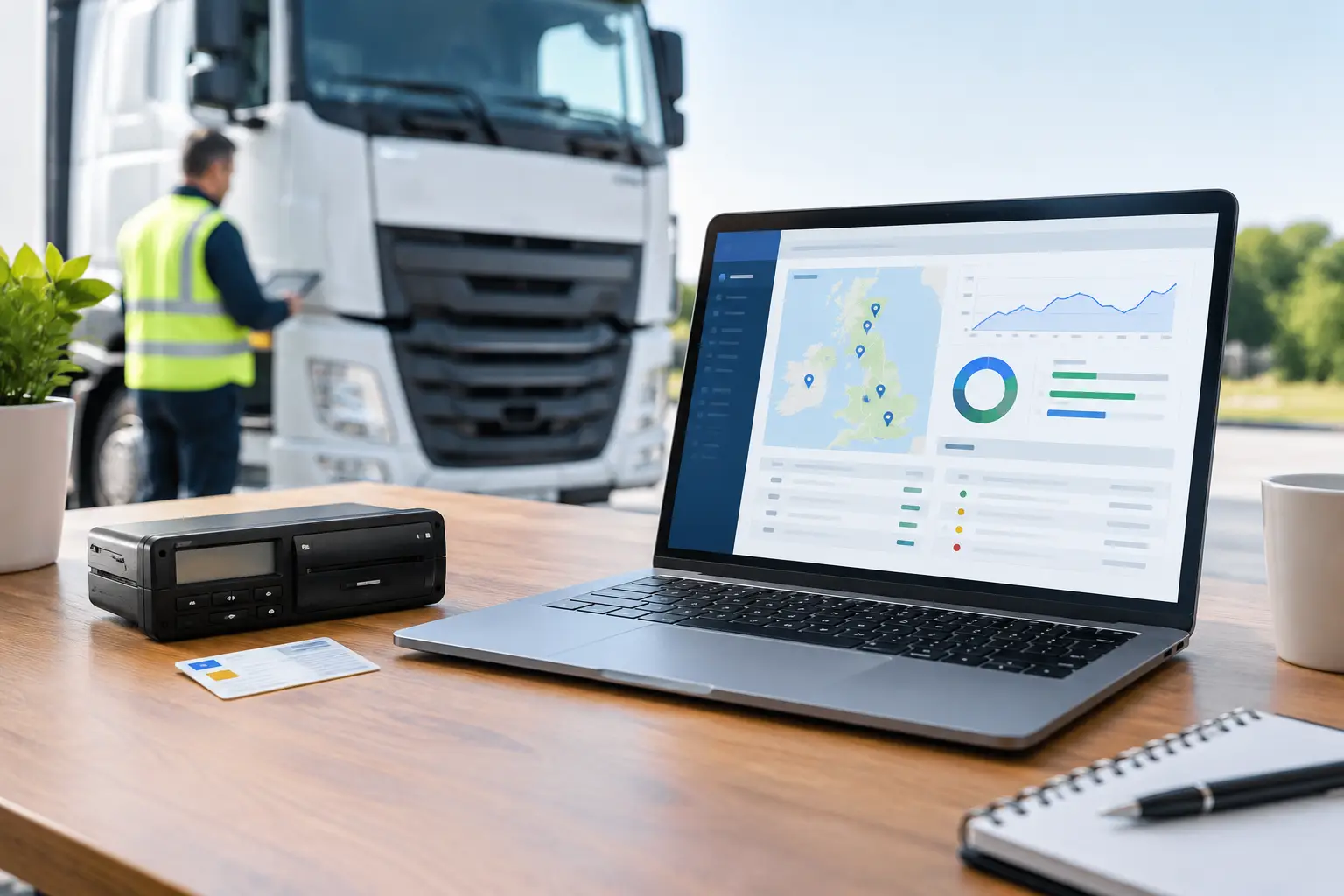
A missed driver card download rarely starts as a compliance failure. It starts as an ordinary busy week: a vehicle changes depot, a driver is on holiday, the transport office is chasing delivery paperwork, and a download deadline disappears into a spreadsheet. A proper UK tachograph software review should therefore look beyond whether a system can store files. The real question is whether it gives your team enough control to spot risks before they become infringements, investigations or pressure on your operator licence.
For UK haulage and mixed-fleet operators, tachograph software is not a standalone back-office tool. It should support the daily work of planning, dispatch, driver management and vehicle control. The strongest systems turn legally required data into practical actions, without creating another portal for the team to maintain.
What a UK tachograph software review should test
The right platform depends on fleet size, operating model and the systems already in place. A small operator with ten vehicles may prioritise remote downloads and clear infringement reporting. A multi-depot fleet may need live driver hours, vehicle location, trailer visibility and role-based access across several transport offices.
Whatever the scale, assess software against the work it must remove from your team. A demonstration should show a genuine operational workflow, not only a dashboard full of charts.
Remote downloads and data completeness
Remote tachograph download capability should be the starting point. The system needs to collect driver card and vehicle unit data reliably, according to the schedule you set, and flag exceptions clearly when a download cannot happen.
In practice, that means checking what happens when a vehicle is out of coverage, a driver changes vehicle, a card is not present, or hardware loses power. A system that simply reports a failed download still leaves somebody to investigate it. Better software makes the reason visible and puts the affected driver, vehicle and missing period in front of the person who can act.
Your process should support the statutory download intervals, including driver card data at least every 28 days and vehicle unit data at least every 90 days. However, treating those dates as the whole compliance plan is risky. More frequent collection gives the office a clearer picture of current activity and reduces the chance of a last-minute data gap.
Ask whether raw files are retained securely, whether download history is auditable, and how easily records can be retrieved when requested. Software should make it easier to demonstrate control, not leave data buried in an archive nobody can navigate.
Live driver hours rather than retrospective surprises
Historical infringement reports remain necessary, but they are not enough for a planner making decisions at 3pm. Live driver hours monitoring gives dispatch teams a clearer view of available driving time, working time, breaks and rest before allocating the next job.
This is where tachograph software earns its place in operations. If a planner can see that a driver is approaching a limit, they can adjust the run, arrange a changeover or manage customer expectations. If they find out after the shift, the only available action is usually an explanation.
Check how the platform presents this information. Good driver hours screens are clear enough for non-specialists to use, while still allowing a compliance manager to review the underlying detail. They should distinguish warnings from confirmed issues and account for the reality that data can be incomplete when cards have not been read or vehicles are offline.
No system can make an unlawful schedule compliant by colouring it green. Driver availability must still be checked against the actual work planned, applicable rules and any relevant records. Software is decision support, not a substitute for competent transport management.
Infringement reporting that leads to action
A report listing hundreds of events has limited value if nobody knows where to start. Look for software that groups infringements by severity, driver, vehicle, depot and time period, allowing the team to identify repeat patterns rather than chase every minor exception in isolation.
The review process matters as much as detection. Can a manager add comments, record an investigation, attach supporting information and document corrective action? Can the business show that issues were considered, discussed with the driver where appropriate and monitored over time?
Context is essential. A missed manual entry, an apparent overspeed or a break-related event may need further review before it is treated as a confirmed breach. The software should help managers investigate consistently, rather than encouraging a tick-box approach that produces noise but no improvement.
One operational view across compliance and telematics
Many fleets still operate with one supplier for tracking, another for tachograph data and separate spreadsheets for maintenance or trailers. That creates duplicate admin and conflicting information. It also makes planning harder than it needs to be.
A combined platform can show where a lorry is, whether the driver has usable hours, which trailer is attached, and whether a maintenance task is approaching. For a transport manager, these are connected questions. Sending a vehicle to a late collection is not just a location decision if it affects driving time, return-to-base planning or a scheduled inspection.
This does not mean every business needs every module immediately. If your immediate issue is manual downloading, begin there. But choose a platform that can support the next operational requirement without forcing a full replacement six months later. Fleetalyse, for example, brings remote tachograph downloads, live driver hours, GPS tracking, trailer visibility and maintenance reminders into one UK-focused platform.
The practical checks before you sign
A sales demonstration should be followed by a disciplined evaluation. Ask suppliers to show your real-world scenarios: a missing driver card download, an agency driver, a vehicle swapped mid-shift, a planner checking remaining hours, and a compliance manager reviewing a recurring issue.
Four checks are particularly useful:
- Hardware and installation: Confirm what is fitted, who fits it, whether self-install is suitable for your fleet and how the solution works across different vehicle makes and tachograph generations.
- Data coverage: Establish which drivers, vehicles and cards are included, how agency or occasional drivers are handled, and what happens when assets leave the fleet.
- Reporting and access: Review scheduled reports, downloadable records, user permissions and whether depot managers can see only the fleet they manage.
- Support and pricing: Clarify monthly charges, hardware lease arrangements, contract length, setup fees, data limits and the cost of adding vehicles or modules later.
Transparent pricing matters because a low headline subscription can become expensive once remote download hardware, compliance reporting, tracking and support are added separately. Equally, the cheapest option may be a false economy if the office still spends hours reconciling exports and chasing missed downloads.
Implementation is part of the software decision
The value of a tachograph platform depends on whether people use it consistently. A rushed rollout often recreates the same spreadsheet habits inside a new system. Start by agreeing ownership: who checks download exceptions, who reviews infringements, who follows up with drivers, and who monitors the actions taken.
Set sensible alert rules. Too many notifications lead to alert fatigue; too few leave risk unnoticed. Most operators benefit from prioritising missed-download exceptions, serious or repeat infringements, approaching driver-hours constraints and data gaps that need prompt investigation.
Training should include planners and depot teams, not only the compliance manager. A planner who understands remaining driving time can prevent problems before they enter the infringement report. A depot administrator who can resolve a failed download quickly prevents a small gap becoming an audit issue.
It is also worth agreeing a short review cycle after launch. In the first month, examine where exceptions are coming from. They may reveal a hardware issue, a process gap, poor driver understanding or a scheduling pattern that needs changing. The aim is not to create more reporting. It is to make fewer avoidable decisions under pressure.
Choosing software for the fleet you run now
The best tachograph software is not necessarily the system with the longest feature list. It is the one that makes compliance evidence accessible, gives planners usable driver-hours information and connects to the wider visibility your fleet needs.
Before making a decision, put one current pain point at the centre of the assessment. It may be late downloads, recurring infringements, poor depot visibility or planners relying on phone calls to locate vehicles. Then ask each supplier to show exactly how its platform changes that task on an ordinary working day. That is usually where the difference between software that stores data and software that gives you control becomes clear.