
What if your fleet vehicles could coach their own drivers and dismiss false insurance claims before the paperwork even hits your desk? You're likely facing the relentless pressure of rising insurance premiums and the constant threat of "crash for cash" scams. It's a heavy burden, especially when the anxiety of a DVSA audit looms over your daily operations. Managing driver behaviour across a national fleet often feels like a losing battle against hidden risks and rising costs.
Deploying 4G AI dashcams for transport companies changes the equation from reactive damage control to proactive fleet management. This guide shows you how to protect your UK operator’s licence and lower insurance costs by up to 15% using real-time technology. You'll learn how these systems provide automated driver coaching and the transparent evidence needed to resolve incidents instantly. We will explore the specific features that turn standard vehicles into intelligent, compliant assets that safeguard your business's reputation.
Key Takeaways
- Understand how edge-computing technology shifts fleet management from reactive SD card retrieval to proactive, real-time cloud protection.
- Discover why 4G AI dashcams for transport companies are essential for providing the "continuous and effective" management evidence required for UK operator's licence compliance.
- Learn the technical distinction between ADAS and DSM sensors to effectively monitor both external road hazards and internal driver fatigue.
- Identify the non-negotiable hardware requirements, including 1080p resolution and multi-network roaming connectivity, to ensure reliable footage across the national network.
- Transform your compliance strategy by moving from punitive monitoring to constructive driver coaching that integrates with your live driver hours data.
What are 4G AI Dashcams and why do transport companies need them?
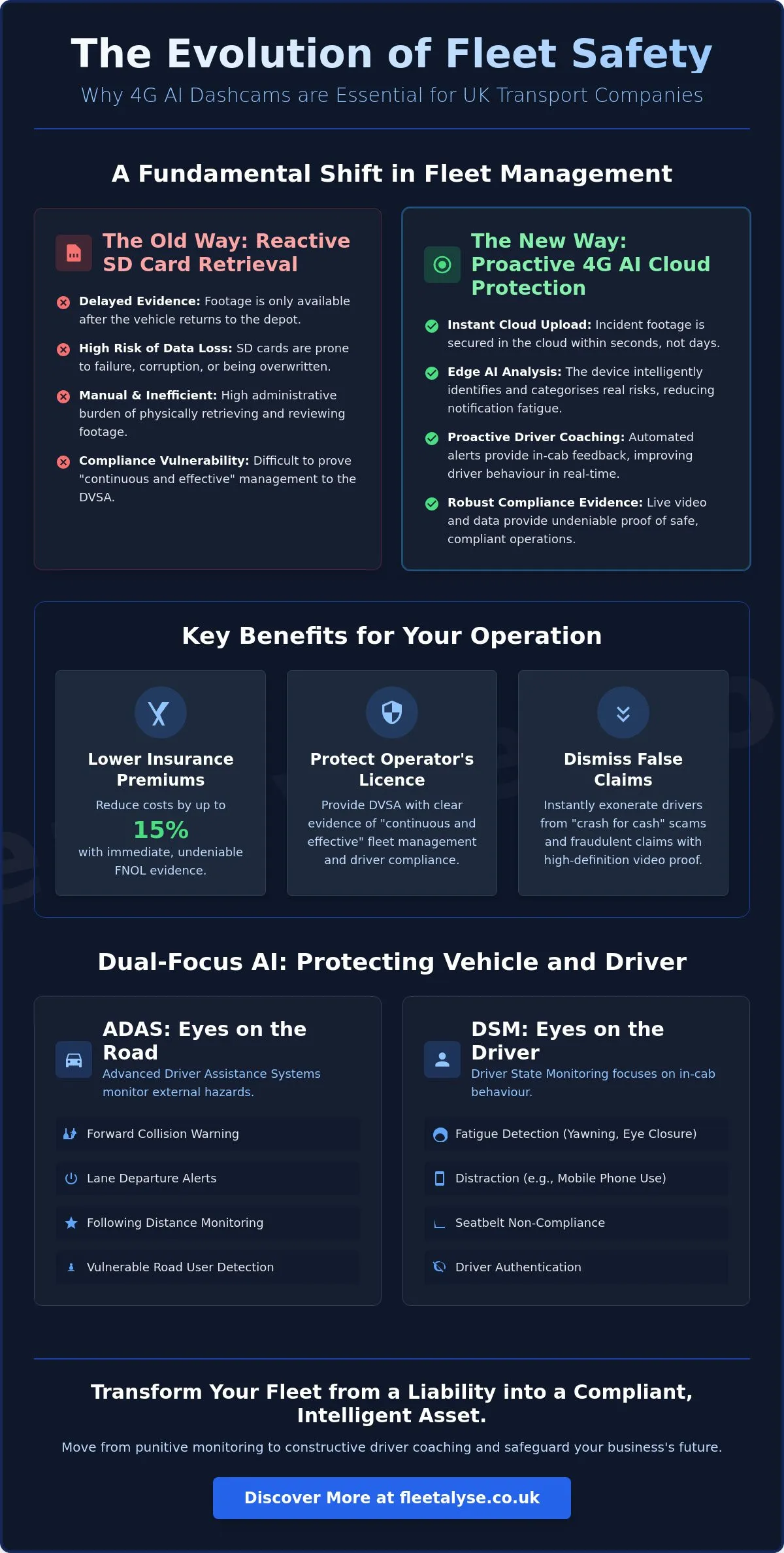
Modern 4G AI dashcams for transport companies are far more than simple recording devices. They function as high-performance, connected telematics nodes that use edge-computing to analyse video data locally on the hardware. This means the device itself identifies risky events, such as tailgating or lane drifting, rather than just capturing raw footage. This shift represents the evolution of fleet video telematics from a passive archive to a proactive management tool that understands the context of the road.
The industry is moving away from reactive SD card retrieval. In the past, transport managers had to wait for a vehicle to return to the depot to check footage. By then, data might be overwritten or the card itself corrupted. High-speed 4G connectivity ensures that incident footage is uploaded to the cloud in real time. By 2026, industry standards for First Notification of Loss (FNOL) will require this level of immediacy. Having clear evidence within seconds of a collision allows for faster insurance resolutions and immediate driver support. This speed is vital for national transport operations where vehicles stay away from their home base for days at a time.
The transition from traditional dashcams to 4G AI systems
Manual SD card retrieval is a significant compliance risk. Physical cards are prone to failure and can be easily tampered with. 4G systems remove this vulnerability entirely. They allow for live streaming and remote configuration of camera settings without taking the vehicle off the road. The cost-benefit is clear. You trade the high administrative burden of chasing physical evidence for the efficiency of automated, digital record-keeping. It ensures that your data is always accessible when a DVSA officer or insurance provider requests it.
Core benefits for UK transport and logistics firms
British motorways are frequent sites for "crash for cash" scams. These staged accidents target commercial fleets specifically. 4G AI dashcams for transport companies provide immediate, undeniable proof to exonerate your drivers on the spot. This rapid resolution is a primary factor in reducing fleet insurance premiums. Beyond incident management, these devices enhance asset security for HGVs, vans, and trailers across the UK. They act as a connected eye on your equipment, ensuring that whether a vehicle is parked in a remote layby or moving through a busy city centre, your assets remain protected and monitored.
The mechanics of Artificial Intelligence in fleet video telematics
The intelligence behind 4G AI dashcams for transport companies sits within the hardware itself. This is known as "Edge AI". Instead of streaming every second of video to a central server, which would be prohibitively expensive and slow, the camera processes the visual data in real-time on the device. It only uploads footage when it identifies a specific risk or violation. This method is similar to how government bodies use AI for street data collection to map infrastructure without overwhelming their networks. For a transport manager, this means you only see what matters.
Smart event detection is the filter that protects managers from notification fatigue. If you manage a fleet of 50 vehicles, you don't want an alert every time a driver hits a minor pothole or a kerb during a tight turn. AI algorithms distinguish between a genuine near-miss and a routine operational vibration. It categorises events automatically by severity. This allows you to focus on high-risk incidents first, such as harsh swerving or sudden impacts, whilst ignoring the background noise of daily haulage.
Advanced Driver Assistance Systems (ADAS)
ADAS focuses on the environment outside the cab. On narrow British A-roads, lane departure alerts are critical for HGV drivers. The system monitors the road ahead to provide forward collision warnings if the gap between vehicles closes too quickly. It also detects vulnerable road users, such as cyclists and pedestrians. This is particularly useful in busy urban delivery centres where blind spots are a constant risk. Monitoring following distance isn't just about safety; it's a key metric for reducing heavy braking and improving fuel efficiency across your fleet.
Driver State Monitoring (DSM) and in-cab safety
DSM looks inward at the driver. It uses infrared sensors to identify signs of fatigue, such as frequent yawning or prolonged eye closure. The AI also detects distraction, specifically mobile phone usage or seatbelt non-compliance. These systems operate in real-time, providing an audible alert to the driver to correct their behaviour before an accident occurs. Balancing this with privacy is essential. Most systems are configured to only record and upload when a violation is detected. This ensures drivers don't feel constantly watched during safe operation. If you're looking to upgrade your safety standards, you can view our available hardware options to see which configuration fits your specific fleet requirements.
Protecting your Operator’s Licence with live video evidence
The Traffic Commissioner requires every operator to demonstrate "continuous and effective" management of their transport activities. Compliance is not a one-time event; it is an ongoing obligation. 4G AI dashcams for transport companies serve as a digital witness that substantiates your compliance efforts. They provide the objective data needed to prove you are actively monitoring your fleet, rather than simply hoping for the best. This technology turns raw road data into a verifiable record of professional competence.
AI-verified footage carries significant legal weight in defending against traffic prosecutions. Unlike traditional cameras that might miss the seconds leading up to an event, AI systems provide the full context. They identify if a driver was distracted or if an external factor, such as a third party's erratic manoeuvre, caused the incident. This level of detail is essential for protecting your reputation. Demonstrating a "Culture of Safety" to the Traffic Commissioner becomes far easier when you can show a clear history of proactive risk management and incident resolution.
Mitigating risk in the event of a DVSA investigation
If the DVSA initiates an investigation, you must show you've taken "all reasonable steps" to ensure compliance. Dashcams provide objective evidence of driver training and any corrective actions taken after a near-miss. This data supplements your records, filling the gaps that tachographs alone cannot cover. Linking your video telematics to remote tachograph download systems creates a holistic compliance view. It allows you to cross-reference driving behaviour with official hours of service, proving that your management is both thorough and transparent.
Insurance and legal advantages for national fleets
UK insurers favour AI-monitored fleets because they present a lower risk profile. Some operators have achieved up to a 15% reduction in insurance premiums by implementing these systems. The speed of data retrieval is a critical factor here. 4G connectivity drastically shortens the First Notification of Loss (FNOL) timeline. By providing footage to your insurer within minutes of an incident, you prevent the inflation of third-party costs. In a high-risk transport environment, this immediate evidence is your best defence against litigious claims and "crash for cash" scams that target commercial HGVs.
Key criteria for selecting a 4G AI dashcam system
Selecting 4G AI dashcams for transport companies requires looking beyond the initial price tag. You need hardware that withstands the constant vibration and temperature shifts of a commercial cab. Image quality is the first hurdle. 1080p resolution is non-negotiable for identifying number plates or facial features in a legal dispute. Because many UK transport operations run through the night, high-performance night vision is equally critical. Low-quality sensors produce grainy footage that won't stand up in court or during a DVSA review.
Connectivity must be resilient. A standard 4G SIM isn't enough for a national fleet. You need multi-network roaming capabilities to ensure the camera stays connected in rural areas where single-provider coverage often drops. Storage capacity acts as your fail-safe. Look for devices with dual-storage mechanisms, such as an internal memory chip paired with an SD card. If one fails, the other preserves the evidence. Speed of access is the ultimate test for any system. Your transport manager should be able to locate and download specific footage in under 60 seconds. If the platform is clunky, it's a liability, not an asset.
Hardware vs. Software: Finding the right balance
Ruggedised hardware is essential for HGVs. Consumer-grade electronics simply don't last in a professional environment. However, the software is where the real management value lies. Look for platforms that offer automated reporting and driver league tables. These tools turn raw data into actionable insights without requiring hours of manual review. Be wary of "Plug and Play" claims. Complex transport fleets usually require professional installation to ensure the camera integrates correctly with vehicle power and ignition systems. If you are ready to upgrade your fleet's technology, you can order your 4G AI dashcam system here to begin the implementation process.
Data management and privacy considerations
Operating dashcams in the UK brings strict GDPR responsibilities. You must have clear data retention policies and manage driver consent effectively. Secure cloud storage with high-level encryption is a must for protecting sensitive business data. To keep operational costs low, choose a system that allows you to preview low-resolution thumbnails before committing to a high-definition download. This approach maintains visibility whilst minimising data usage across the fleet. Integration with your existing tracking and tachograph software ensures that you aren't managing multiple disconnected systems, which is vital for maintaining a clean audit trail.
Integrating AI dashcams into your fleet compliance strategy
Successful integration of 4G AI dashcams for transport companies depends on a cultural shift within the business. You must move away from "gotcha" management where cameras are only used for punishment. Instead, use video as a tool for constructive coaching. This creates a clear feedback loop: the AI identifies an event, the manager reviews the footage, and the driver receives a debrief based on objective facts. This method fosters a culture of transparency and continuous compliance improvement across the entire organisation.
Don't treat video as an isolated data stream. Use it to inform your live driver hours monitoring. For instance, if a driver is repeatedly flagged for fatigue-related behaviours, cross-reference this with their recent tacho records. It allows you to identify if scheduling pressures or insufficient rest periods are contributing to safety risks. The future of fleet management lies in this intersection of video, GPS, and tachograph data. Combining these insights provides a 360-degree view of your operations that raw numbers alone cannot match.
Effective driver coaching and engagement
Transparency is the best way to overcome driver resistance. Use "positive" footage to reward drivers who handle difficult road situations professionally. This builds trust and proves the system isn't just there to find faults. Develop training programmes that address specific risks identified by the AI, such as tailgating in heavy traffic or lane drifting. When drivers see that the system protects them from false claims and "crash for cash" scams, they are more likely to engage with the coaching process as a professional development tool.
The Fleetalyse approach to total fleet visibility
Managing multiple disconnected systems creates a heavy administrative burden. A single platform that integrates GPS fleet tracking with AI video telematics streamlines your entire operation. It provides a unified view of asset security and driver compliance, reducing the time spent jumping between different software windows. As you prepare for the 2026 regulatory landscape, use this final checklist to ensure your fleet is ready:
- Automated cloud uploading: Ensure all high-severity incidents are stored off-device immediately.
- System integration: Connect your video data with tacho analysis for a complete compliance audit trail.
- Documented coaching: Maintain digital records of driver debriefs to show the DVSA you are taking "all reasonable steps."
- Connectivity resilience: Verify that your hardware uses multi-network SIMs to prevent data gaps in rural areas.
Future-Proof Your Fleet Compliance
Implementing 4G AI dashcams for transport companies isn't just about recording the road. It's a fundamental shift towards proactive risk management. By replacing unreliable SD cards with real-time cloud uploading, you ensure that critical evidence is always available when you need it most. These systems provide the transparent data required to satisfy DVSA audits and protect your UK operator’s licence. You gain the ability to exonerate drivers instantly and address risky behaviour through evidence-based coaching.
Fleetalyse provides pragmatic solutions built for the rigours of real-world fleet challenges. We are specialists in remote tachograph and compliance monitoring, offering expert UK-based support to help you manage the data deluge effectively. Don't leave your business vulnerable to litigious claims or regulatory scrutiny. Protect your fleet and simplify compliance with Fleetalyse today. It's time to transform your safety culture and secure your professional reputation for the years ahead.
Frequently Asked Questions
Do 4G AI dashcams record 24/7 or only during incidents?
Most professional systems record continuously to local storage whilst the vehicle's ignition is on. However, the 4G connection is only used to upload specific "events" or incidents to the cloud for immediate review. This approach ensures you have a full record of every journey on the device's internal memory whilst keeping data costs low by only transmitting footage that requires management attention.
How much data does a 4G dashcam use per month?
Monthly data usage typically ranges between 500MB and 2GB per vehicle, depending on the frequency of triggered alerts and how often you use live streaming. To manage costs effectively, many operators use low-resolution thumbnails for initial incident reviews. You only commit to a full high-definition download when the footage is required for an insurance claim or a driver coaching session.
Can drivers turn off the AI monitoring features?
No, drivers cannot disable these features as the hardware is hardwired into the vehicle and settings are password-protected. Management software allows you to configure which alerts are active, but the driver has no physical way to switch off the AI sensors. This prevents gaps in your compliance data and ensures that your safety records remain complete and untampered with for DVSA purposes.
Is AI dashcam footage admissible in a UK court of law?
Yes, high-quality video evidence from 4G AI dashcams for transport companies is fully admissible in UK courts and is highly valued by insurers. It provides an objective account of events that can exonerate drivers and resolve "crash for cash" disputes instantly. To ensure your footage is legally sound, your company must be registered with the ICO and follow strict data protection policies.
Will AI dashcams drain my vehicle battery when parked?
Professional dashcams are equipped with intelligent voltage protection and automatic cut-off features. These systems monitor the vehicle's battery level and will shut down the camera if the voltage drops below a safe threshold. This prevents battery drain whilst still allowing for "wake-on-impact" features that record and upload footage if the vehicle is struck whilst parked in a depot or layby.
How do AI dashcams help with my Operator’s Licence compliance?
The Traffic Commissioner requires proof of "continuous and effective" management of your transport activities. AI dashcams provide a documented audit trail of how you identify and rectify risky driving behaviour. By using video evidence to inform driver debriefs and training programmes, you demonstrate a proactive safety culture that is essential for maintaining a clean record during DVSA investigations.
What is the difference between ADAS and DSM in dashcams?
ADAS (Advanced Driver Assistance Systems) uses the road-facing camera to identify external risks such as tailgating, lane departures, and potential forward collisions. DSM (Driver State Monitoring) uses an internal, infrared sensor to monitor the driver for signs of fatigue, distraction, or mobile phone usage. Using both systems together allows you to manage both environmental hazards and internal driver behaviour simultaneously.
Can I integrate dashcams with my existing tachograph analysis software?
Many 4G AI dashcams for transport companies offer API integration or sit within a unified telematics platform. This allows you to cross-reference video-proven incidents with live driver hours and tachograph data. Consolidating these data streams into one dashboard reduces administrative overhead and gives you a holistic view of fleet compliance without the need to manage multiple, disconnected software systems.
Frequently asked questions
The transition from traditional dashcams to 4G AI systems
Manual SD card retrieval is a significant compliance risk. Physical cards are prone to failure and can be easily tampered with. 4G systems remove this vulnerability entirely. They allow for live streaming and remote configuration of camera settings without taking the vehicle off the road. The cost-benefit is clear. You trade the high administrative burden of chasing physical evidence for the efficiency of automated, digital record-keeping. It ensures that your data is always accessible when a DVSA officer or insurance provider requests it.
Core benefits for UK transport and logistics firms
British motorways are frequent sites for "crash for cash" scams. These staged accidents target commercial fleets specifically. 4G AI dashcams for transport companies provide immediate, undeniable proof to exonerate your drivers on the spot. This rapid resolution is a primary factor in reducing fleet insurance premiums. Beyond incident management, these devices enhance asset security for HGVs, vans, and trailers across the UK. They act as a connected eye on your equipment, ensuring that whether a vehicle is parked in a remote layby or moving through a busy city centre, your assets remain protected and monitored. The intelligence behind 4G AI dashcams for transport companies sits within the hardware itself. This is known as "Edge AI". Instead of streaming every second of video to a central server, which would be prohibitively expensive and slow, the camera processes the visual data in real-time on the device. It only uploads footage when it identifies a specific risk or violation. This method is similar to how government bodies use AI for street data collection to map infrastructure without overwhelming their networks. For a transport manager, this means you only see what matters. Smart event detection is the filter that protects managers from notification fatigue. If you manage a fleet of 50 vehicles, you don't want an alert every time a driver hits a minor pothole or a kerb during a tight turn. AI algorithms distinguish between a genuine near-miss and a routine operational vibration. It categorises events automatically by severity. This allows you to focus on high-risk incidents first, such as harsh swerving or sudden impacts, whilst ignoring the background noise of daily haulage.
Advanced Driver Assistance Systems (ADAS)
ADAS focuses on the environment outside the cab. On narrow British A-roads, lane departure alerts are critical for HGV drivers. The system monitors the road ahead to provide forward collision warnings if the gap between vehicles closes too quickly. It also detects vulnerable road users, such as cyclists and pedestrians. This is particularly useful in busy urban delivery centres where blind spots are a constant risk. Monitoring following distance isn't just about safety; it's a key metric for reducing heavy braking and improving fuel efficiency across your fleet.
Driver State Monitoring (DSM) and in-cab safety
DSM looks inward at the driver. It uses infrared sensors to identify signs of fatigue, such as frequent yawning or prolonged eye closure. The AI also detects distraction, specifically mobile phone usage or seatbelt non-compliance. These systems operate in real-time, providing an audible alert to the driver to correct their behaviour before an accident occurs. Balancing this with privacy is essential. Most systems are configured to only record and upload when a violation is detected. This ensures drivers don't feel constantly watched during safe operation. If you're looking to upgrade your safety standards, you can view our available hardware options to see which configuration fits your specific fleet requirements. The Traffic Commissioner requires every operator to demonstrate "continuous and effective" management of their transport activities. Compliance is not a one-time event; it is an ongoing obligation. 4G AI dashcams for transport companies serve as a digital witness that substantiates your compliance efforts. They provide the objective data needed to prove you are actively monitoring your fleet, rather than simply hoping for the best. This technology turns raw road data into a verifiable record of professional competence. AI-verified footage carries significant legal weight in defending against traffic prosecutions. Unlike traditional cameras that might miss the seconds leading up to an event, AI systems provide the full context. They identify if a driver was distracted or if an external factor, such as a third party's erratic manoeuvre, caused the incident. This level of detail is essential for protecting your reputation. Demonstrating a "Culture of Safety" to the Traffic Commissioner becomes far easier when you can show a clear history of proactive risk management and incident resolution.
Mitigating risk in the event of a DVSA investigation
If the DVSA initiates an investigation, you must show you've taken "all reasonable steps" to ensure compliance. Dashcams provide objective evidence of driver training and any corrective actions taken after a near-miss. This data supplements your records, filling the gaps that tachographs alone cannot cover. Linking your video telematics to remote tachograph download systems creates a holistic compliance view. It allows you to cross-reference driving behaviour with official hours of service, proving that your management is both thorough and transparent.
Insurance and legal advantages for national fleets
UK insurers favour AI-monitored fleets because they present a lower risk profile. Some operators have achieved up to a 15% reduction in insurance premiums by implementing these systems. The speed of data retrieval is a critical factor here. 4G connectivity drastically shortens the First Notification of Loss (FNOL) timeline. By providing footage to your insurer within minutes of an incident, you prevent the inflation of third-party costs. In a high-risk transport environment, this immediate evidence is your best defence against litigious claims and "crash for cash" scams that target commercial HGVs. Selecting 4G AI dashcams for transport companies requires looking beyond the initial price tag. You need hardware that withstands the constant vibration and temperature shifts of a commercial cab. Image quality is the first hurdle. 1080p resolution is non-negotiable for identifying number plates or facial features in a legal dispute. Because many UK transport operations run through the night, high-performance night vision is equally critical. Low-quality sensors produce grainy footage that won't stand up in court or during a DVSA review. Connectivity must be resilient. A standard 4G SIM isn't enough for a national fleet. You need multi-network roaming capabilities to ensure the camera stays connected in rural areas where single-provider coverage often drops. Storage capacity acts as your fail-safe. Look for devices with dual-storage mechanisms, such as an internal memory chip paired with an SD card. If one fails, the other preserves the evidence. Speed of access is the ultimate test for any system. Your transport manager should be able to locate and download specific footage in under 60 seconds. If the platform is clunky, it's a liability, not an asset.
Hardware vs. Software: Finding the right balance
Ruggedised hardware is essential for HGVs. Consumer-grade electronics simply don't last in a professional environment. However, the software is where the real management value lies. Look for platforms that offer automated reporting and driver league tables. These tools turn raw data into actionable insights without requiring hours of manual review. Be wary of "Plug and Play" claims. Complex transport fleets usually require professional installation to ensure the camera integrates correctly with vehicle power and ignition systems. If you are ready to upgrade your fleet's technology, you can order your 4G AI dashcam system here to begin the implementation process.
Data management and privacy considerations
Operating dashcams in the UK brings strict GDPR responsibilities. You must have clear data retention policies and manage driver consent effectively. Secure cloud storage with high-level encryption is a must for protecting sensitive business data. To keep operational costs low, choose a system that allows you to preview low-resolution thumbnails before committing to a high-definition download. This approach maintains visibility whilst minimising data usage across the fleet. Integration with your existing tracking and tachograph software ensures that you aren't managing multiple disconnected systems, which is vital for maintaining a clean audit trail. Successful integration of 4G AI dashcams for transport companies depends on a cultural shift within the business. You must move away from "gotcha" management where cameras are only used for punishment. Instead, use video as a tool for constructive coaching. This creates a clear feedback loop: the AI identifies an event, the manager reviews the footage, and the driver receives a debrief based on objective facts. This method fosters a culture of transparency and continuous compliance improvement across the entire organisation. Don't treat video as an isolated data stream. Use it to inform your live driver hours monitoring. For instance, if a driver is repeatedly flagged for fatigue-related behaviours, cross-reference this with their recent tacho records. It allows you to identify if scheduling pressures or insufficient rest periods are contributing to safety risks. The future of fleet management lies in this intersection of video, GPS, and tachograph data. Combining these insights provides a 360-degree view of your operations that raw numbers alone cannot match.
Effective driver coaching and engagement
Transparency is the best way to overcome driver resistance. Use "positive" footage to reward drivers who handle difficult road situations professionally. This builds trust and proves the system isn't just there to find faults. Develop training programmes that address specific risks identified by the AI, such as tailgating in heavy traffic or lane drifting. When drivers see that the system protects them from false claims and "crash for cash" scams, they are more likely to engage with the coaching process as a professional development tool.
The Fleetalyse approach to total fleet visibility
Managing multiple disconnected systems creates a heavy administrative burden. A single platform that integrates GPS fleet tracking with AI video telematics streamlines your entire operation. It provides a unified view of asset security and driver compliance, reducing the time spent jumping between different software windows. As you prepare for the 2026 regulatory landscape, use this final checklist to ensure your fleet is ready: Implementing 4G AI dashcams for transport companies isn't just about recording the road. It's a fundamental shift towards proactive risk management. By replacing unreliable SD cards with real-time cloud uploading, you ensure that critical evidence is always available when you need it most. These systems provide the transparent data required to satisfy DVSA audits and protect your UK operator’s licence. You gain the ability to exonerate drivers instantly and address risky behaviour through evidence-based coaching. Fleetalyse provides pragmatic solutions built for the rigours of real-world fleet challenges. We are specialists in remote tachograph and compliance monitoring, offering expert UK-based support to help you manage the data deluge effectively. Don't leave your business vulnerable to litigious claims or regulatory scrutiny. Protect your fleet and simplify compliance with Fleetalyse today. It's time to transform your safety culture and secure your professional reputation for the years ahead.
Do 4G AI dashcams record 24/7 or only during incidents?
Most professional systems record continuously to local storage whilst the vehicle's ignition is on. However, the 4G connection is only used to upload specific "events" or incidents to the cloud for immediate review. This approach ensures you have a full record of every journey on the device's internal memory whilst keeping data costs low by only transmitting footage that requires management attention.
How much data does a 4G dashcam use per month?
Monthly data usage typically ranges between 500MB and 2GB per vehicle, depending on the frequency of triggered alerts and how often you use live streaming. To manage costs effectively, many operators use low-resolution thumbnails for initial incident reviews. You only commit to a full high-definition download when the footage is required for an insurance claim or a driver coaching session.
Can drivers turn off the AI monitoring features?
No, drivers cannot disable these features as the hardware is hardwired into the vehicle and settings are password-protected. Management software allows you to configure which alerts are active, but the driver has no physical way to switch off the AI sensors. This prevents gaps in your compliance data and ensures that your safety records remain complete and untampered with for DVSA purposes.
Is AI dashcam footage admissible in a UK court of law?
Yes, high-quality video evidence from 4G AI dashcams for transport companies is fully admissible in UK courts and is highly valued by insurers. It provides an objective account of events that can exonerate drivers and resolve "crash for cash" disputes instantly. To ensure your footage is legally sound, your company must be registered with the ICO and follow strict data protection policies.
Will AI dashcams drain my vehicle battery when parked?
Professional dashcams are equipped with intelligent voltage protection and automatic cut-off features. These systems monitor the vehicle's battery level and will shut down the camera if the voltage drops below a safe threshold. This prevents battery drain whilst still allowing for "wake-on-impact" features that record and upload footage if the vehicle is struck whilst parked in a depot or layby.
How do AI dashcams help with my Operator’s Licence compliance?
The Traffic Commissioner requires proof of "continuous and effective" management of your transport activities. AI dashcams provide a documented audit trail of how you identify and rectify risky driving behaviour. By using video evidence to inform driver debriefs and training programmes, you demonstrate a proactive safety culture that is essential for maintaining a clean record during DVSA investigations.
What is the difference between ADAS and DSM in dashcams?
ADAS (Advanced Driver Assistance Systems) uses the road-facing camera to identify external risks such as tailgating, lane departures, and potential forward collisions. DSM (Driver State Monitoring) uses an internal, infrared sensor to monitor the driver for signs of fatigue, distraction, or mobile phone usage. Using both systems together allows you to manage both environmental hazards and internal driver behaviour simultaneously.
Can I integrate dashcams with my existing tachograph analysis software?
Many 4G AI dashcams for transport companies offer API integration or sit within a unified telematics platform. This allows you to cross-reference video-proven incidents with live driver hours and tachograph data. Consolidating these data streams into one dashboard reduces administrative overhead and gives you a holistic view of fleet compliance without the need to manage multiple, disconnected software systems.