
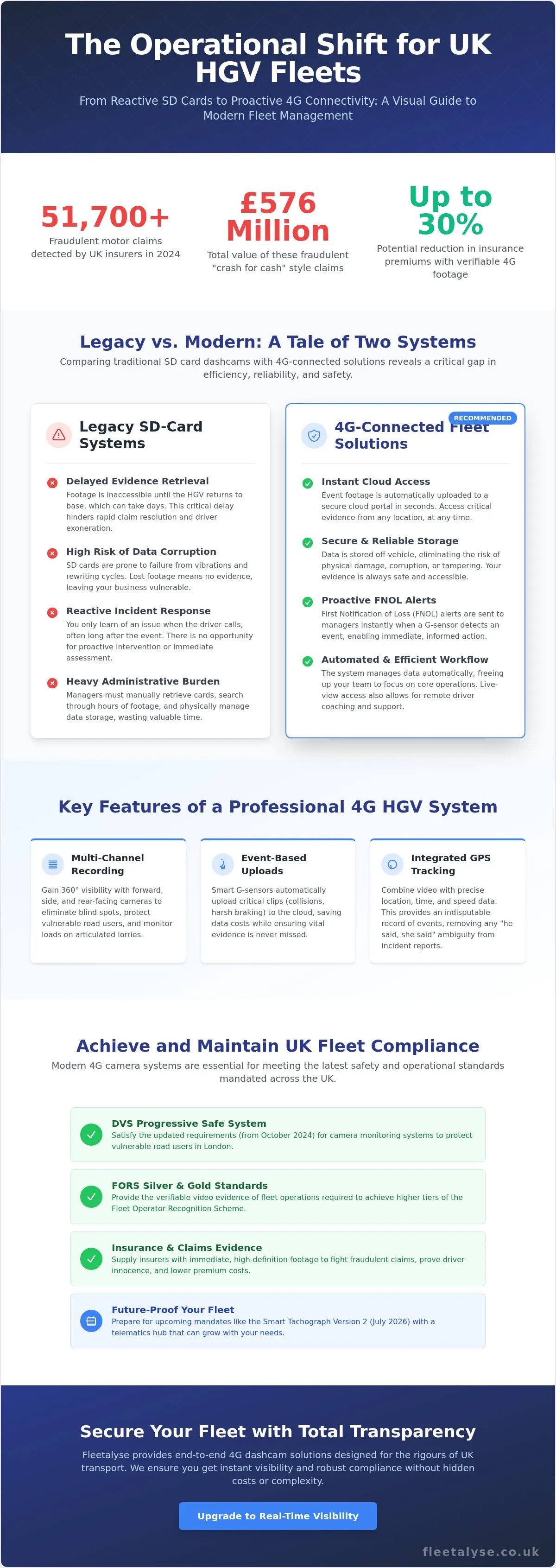
In 2024, UK insurers detected over 51,700 fraudulent motor claims valued at £576 million. You know the pressure of rising premiums and the headache of defending a driver against a "crash for cash" scam when the evidence is locked on an SD card 200 miles away. Waiting days for a vehicle to return to base is no longer a viable way to manage a professional fleet. It leaves your business vulnerable and your safety scores at risk.
Choosing the right 4G dashcam for HGV operations transforms your fleet from a series of isolated assets into a connected, transparent network. This guide shows you how to secure instant access to incident footage, reduce insurance costs by up to 30%, and maintain total compliance with the latest DVSA and DVS standards. We will break down the October 2024 Progressive Safe System requirements, the July 2026 Smart Tachograph Version 2 mandate, and the hardware that delivers real results for UK transport operations.
Key Takeaways
- Learn how a 4G dashcam for HGV operations replaces slow SD card retrieval with instant cloud access to protect your fleet from false claims.
- Identify the exact camera configurations required to meet the latest DVS Progressive Safe System and FORS Silver standards.
- Discover how multi-channel systems provide 360-degree visibility for articulated lorries, protecting both your drivers and vulnerable road users.
- Understand the operational benefits of shifting from reactive tracking to proactive, real-time fleet visibility and driver coaching.
- Explore the Fleetalyse approach to total transparency, ensuring you avoid hidden costs whilst maximising your return on investment.
Beyond Video: Why 4G Connectivity is Essential for Modern HGV Fleets
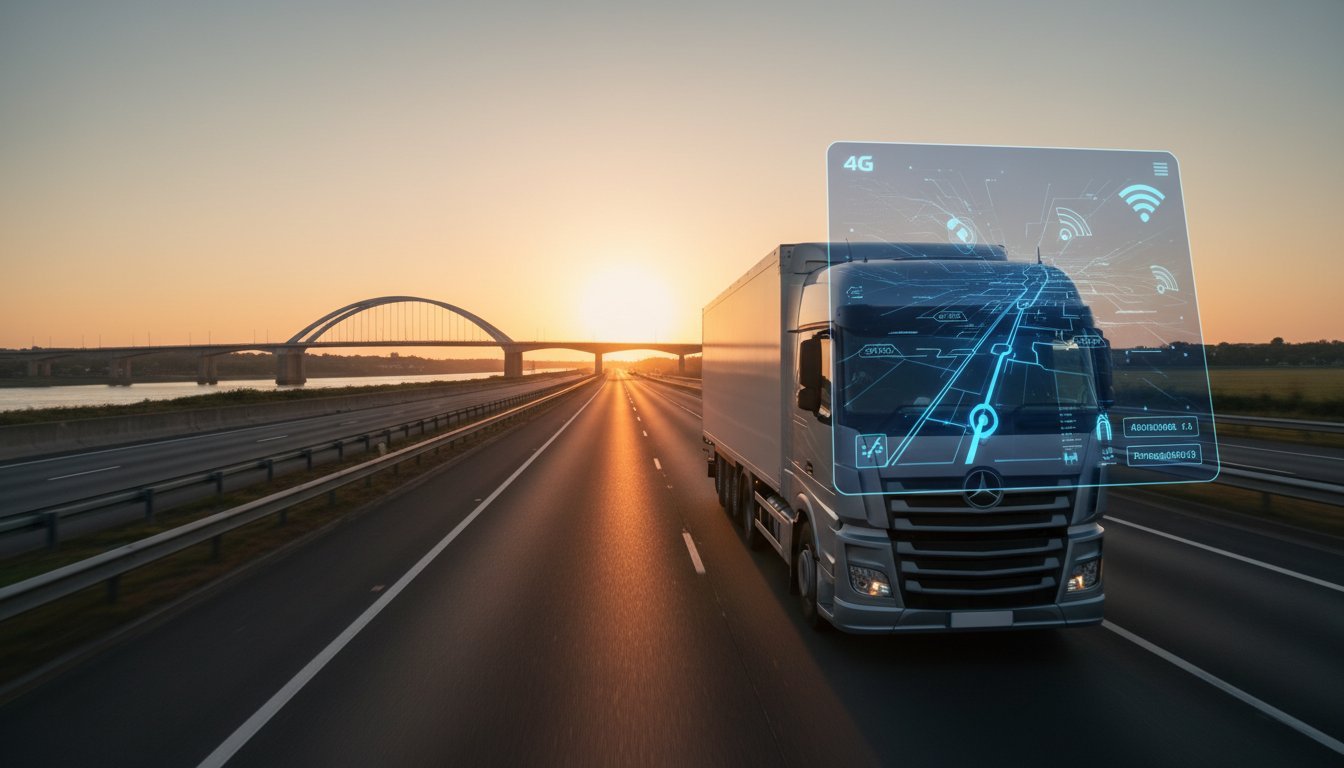
A 4G dashcam for HGV is no longer a peripheral accessory; it's a critical telematics hub. For years, haulage operators relied on standard cameras that simply recorded footage to a local storage card. If an incident occurred, you had to wait for the vehicle to return to the depot. You then hoped the SD card hadn't corrupted. By 2026, this reactive approach is obsolete. Real transport operations require instant visibility and data that flows as fast as your fleet moves.
Modern 4G connectivity turns a standard camera into a live portal. It provides three essential pillars: instant evidence, live tracking, and remote diagnostics. When you integrate these systems through Fleetalyse, you gain a tool built for the rigours of the UK road network, not just a generic tracking device. This connectivity ensures that your fleet data is turned into actionable decisions the moment an event occurs.
The Limitations of Traditional SD-Card Dashcams
HGVs are high-vibration environments. Constant road feedback and engine resonance often lead to SD card corruption. In a standard setup, you might only discover a card has failed when you go to retrieve critical footage after an accident. This data loss is catastrophic for insurance claims and compliance audits. Distance also creates a massive delay. When a driver is on a multi-day route across the UK, physical access to the footage is impossible until they return. A foundational step in understanding dashcam technology is recognising that local storage is the weakest link in a professional commercial chain. Manual data collection is an administrative burden your team doesn't need.
How 4G LTE Transforms Incident Management
4G LTE connectivity introduces the concept of First Notification of Loss (FNOL). The moment a G-sensor detects an impact, the system sends a live alert and a video clip to the transport office. You don't have to wait for a phone call from a distressed driver. You see what happened as it happens. This remote access allows managers to exonerate drivers within minutes. If a third party makes a false claim on-site, you can view the live playback and settle the dispute before the vehicle even leaves the scene. 4G HGV dashcams are the cornerstone of 2026 fleet insurance requirements, providing the total transparency needed to drive down premiums and protect your operator licence.
Real-Time Visibility vs SD Card Retrieval: The Operational Shift
Manual SD card retrieval is a drain on resources. It requires physical access to the vehicle, which is often impossible when HGVs are away for days on multi-drop routes. If a manager needs footage to settle a dispute or verify a delivery, they're stuck in a queue. This delay impacts fleet uptime and manager productivity. By contrast, a 4G dashcam for HGV operations automates this entire workflow. It moves video from the vehicle to the cloud in seconds. This shift allows transport offices to function with a higher level of efficiency. It's a system built for real transport operations, where every minute of downtime costs money.
One of the core modern fleet management benefits is the ability to use real-time data to make instant decisions. When video is paired with GPS integration, you don't just see what happened; you know exactly where, when, and at what speed. This combined data set provides a level of verification that a standalone camera cannot match. It removes the "he said, she said" element from road incident reports. You gain a clear, objective record of every mile travelled.
Automated Event Uploading: Saving Time and Data
Managing data consumption is vital for cost control. Constant streaming is rarely necessary and can be expensive. Instead, professional 4G systems use "event-based" recording. Internal G-sensors trigger an automatic upload only when they detect harsh braking, rapid acceleration, or a collision. This ensures the most important clips are safe on the cloud without you having to "hunt" through hours of irrelevant road footage. If you need a specific non-event clip, you can request time-stamped footage remotely from your desk. It's a precise, surgical approach to video management. Using a 4G dashcam for HGV fleets means you only pay for the data that actually matters to your business.
Live Streaming: When and Why to Use It
Live-view functionality is a powerful tool for driver coaching and navigating high-risk manoeuvres. If a driver is struggling with a difficult delivery site or an unfamiliar urban centre, a manager can provide real-time guidance via a 1080p high-definition stream. This clarity is essential for identifying hazards that a lower-resolution camera might miss. Of course, this must be balanced with driver privacy and GDPR. Professional systems ensure live-view is used as a safety tool rather than a constant surveillance method. If you're ready to upgrade your fleet's visibility, you can view our transparent pricing and hardware options today.
Compliance and Safety Standards: FORS, DVS, and Insurance Requirements
Compliance in the UK haulage sector is a rigorous, ongoing commitment. Since 28 October 2024, any HGV over 12 tonnes operating in Greater London must meet the Progressive Safe System (PSS) requirements to secure a DVS safety permit. A 4G dashcam for HGV operations is a central component of this system. It isn't just about a single forward-facing lens anymore. To remain compliant and competitive, operators need a multi-channel setup that integrates side-view cameras and sensors to eliminate blind spots. This technology provides the "Total Transparency" that modern regulators demand.
Insurers are also driving this shift toward connected video. Specialist UK insurers now offer premium discounts typically ranging from 10% to 15%, with some specialist providers reaching up to 30% for fleets using integrated video telematics. They know that a 4G dashcam for HGV fleets reduces the risk of fraudulent "crash for cash" claims and significantly speeds up the settlement process. By 1 July 2026, the Smart Tachograph Version 2 mandate will further increase the data requirements for international transport. Having a unified platform that handles video and compliance data isn't just a convenience; it's a strategic necessity.
Meeting DVS and FORS Silver/Gold Requirements
Achieving FORS Silver or Gold accreditation is a mark of quality that opens doors to major infrastructure contracts. These standards demand more than basic recording. You need a system that includes audible alerts for turning and a Blind Spot Information System (BSIS) to protect vulnerable road users. Integrated 4G systems allow you to prove these safety features are active and functional in real time. This evidence-based approach builds a safety culture that goes beyond ticking boxes for a permit. It's about protecting lives and your business reputation simultaneously.
Protecting Your Operator Licence
Your operator licence is the lifeblood of your business. The DVSA uses the Operator Compliance Risk Score (OCRS) to target inspections. High safety scores are hard to maintain without total visibility. Video evidence provides the context that raw telematics data alone cannot offer. Supporting your remote tachograph download data with incident footage is vital during accident investigations. If a driver is accused of a violation, you can cross-reference their hours with the actual road conditions they faced. This transparency is exactly what the DVSA looks for in a well-managed operation. Dashcams provide the missing link in driver behaviour monitoring, ensuring you have a complete picture of every journey.
Key Features to Prioritise When Selecting a 4G Dashcam System
Selecting a 4G dashcam for HGV fleets requires looking beyond basic video quality. You need a system that integrates with your existing telematics and provides a 360-degree view. For articulated lorries, a single camera isn't enough. Multi-channel support is essential. This allows you to connect side and rear cameras into one hub. It ensures you have eyes on every corner of the vehicle. This is particularly useful during complex urban deliveries or motorway lane changes where blind spots are most dangerous.
Dual-vision models feature both forward-facing and driver-facing lenses. This setup is vital for identifying distracted driving behaviours whilst protecting the driver from false accusations. Since haulage is a 24/7 industry, low-light performance is a non-negotiable feature. Look for sensors that maintain 1080p clarity at night. This prevents grainy footage that insurers might reject during a claim investigation. Data integrity is equally paramount. Professional units come with tamper-proof designs, including locking covers for SIM and SD cards. This prevents unauthorised removal of footage or data cards by anyone other than authorised management.
Integration capabilities are the final piece of the puzzle. Your camera shouldn't exist in a vacuum. It must talk to your existing fleet management software. This allows you to view video alongside tachograph data and fuel reports in a single dashboard. This unified view saves you from logging into multiple portals just to find one piece of evidence. It's a system built for real transport operations where efficiency is everything.
Hardware Durability for the Logistics Industry
HGV cabs are harsh environments. Standard consumer cameras fail under the constant vibration of a 44-tonne tractor unit. Ruggedised casings and supercapacitors are superior to lithium-ion batteries. Supercapacitors handle extreme temperature shifts better. They ensure the camera finishes writing the last file even if power is cut during a collision. A wide-angle lens of at least 140 degrees provides full road coverage without the "fish-eye" distortion that can obscure number plates. These technical details ensure your hardware survives the rigours of the road for years, not just months.
Software and Connectivity: The 4G Factor
A 4G dashcam for HGV is only as good as its connection. UK-wide roaming SIMs are essential to avoid data dead zones in remote areas like the Scottish Highlands or the Pennines. The software must be intuitive. A user-friendly web portal allows you to manage the entire fleet from your desk. Whilst "Plug & Play" connections speed up installation, hardwired options are often preferred for permanent fleet fit-outs to ensure the system is always on. If you want to eliminate blind spots and secure your data, you can secure your hardware and transparent data plan here.
Implementing a 4G Dashcam Solution: Fleetalyse’s Transparent Approach
Implementing new technology shouldn't be a gamble. In an industry where hidden costs and complex contracts are common, Fleetalyse stands apart. Our philosophy is simple: we provide tools Built for Real Transport Operations. We understand that UK fleet managers don't need marketing hyperbole; they need reliable hardware and clear pricing. Choosing a 4G dashcam for HGV fleets is a long-term investment in your business's safety and compliance. We ensure that investment is protected through our "Total Transparency" promise, covering every aspect of hardware and data costs from day one.
One of the biggest hurdles for haulage operators is the initial capital expenditure. To solve this, we offer a fee-free lease model for hardware. This approach reduces your upfront CAPEX, allowing you to equip your entire fleet without a massive drain on cash flow. Whilst some competitors might hide their true costs behind a "request a quote" button, we provide the granular details you need to calculate your total cost of ownership. This financial clarity is essential for managing a modern transport business, especially as we approach the 1 July 2026 Smart Tachograph Version 2 mandate.
Working with a single partner for tracking, tachograph management, and video telematics creates a more efficient operation. You no longer have to juggle multiple subscriptions or contact different support desks when a problem arises. By unifying these services, you gain a streamlined workflow that saves time and reduces administrative errors. It's a pragmatic, efficient way to manage the rigours of the UK road network.
Seamless Integration with Fleetalyse Tracking
Video footage is most powerful when it's contextualised. Our 4G dashcam for HGV systems fits perfectly into the wider GPS fleet tracking ecosystem. Instead of logging into separate portals, you see driver behaviour, vehicle location, and live video in one interface. This integration allows you to cross-reference tachograph data with road incidents instantly. If a driver is flagged for a potential infringement, you can pull the video to see exactly what was happening at that moment. This simplifies the life of a transport manager, turning hours of investigation into minutes of review.
Ready to Take Control of Your Fleet Safety?
We don't believe in high-pressure sales. We are a no-nonsense expert partner focused on providing practical solutions for UK commercial fleets. If you're struggling with rising insurance premiums or the complexity of DVS compliance, we can help. We offer a straightforward consultation to assess your fleet's specific needs and show you how connected video can protect your operator licence. Take the first step toward total transparency. Contact Fleetalyse for a transparent 4G dashcam quote today and see how we support real transport operations.
Secure Your Fleet with Total Transparency
Managing a commercial fleet in 2026 requires more than just basic tracking; it requires absolute certainty on the road. By integrating a 4G dashcam for HGV operations, you move from reactive manual retrieval to proactive, real-time management. This transition protects your business against fraudulent claims whilst ensuring you meet the October 2024 DVS requirements and the July 2026 Smart Tachograph Version 2 mandate. You gain instant visibility that protects your safety scores and your bottom line.
Fleetalyse is here to simplify this shift. Our solutions are Built for Real UK Transport Operations. We provide Total Transparency Pricing and Fee-Free Hardware Lease Options to keep your capital where it belongs: in your business. We don't believe in hidden costs or complex contracts; we believe in providing the strategic insights you need to stay compliant and competitive.
Don't leave your operator licence or your insurance premiums to chance. Ready to Take Control? Request a Transparent 4G Dashcam Proposal today. We look forward to helping you build a safer, more efficient transport operation.
Frequently Asked Questions
Are 4G dashcams legal for HGVs in the UK?
Dashcams are entirely legal in the UK provided they don't obstruct the driver's vision. Specifically, the device must not protrude more than 40mm into the swept area of the windscreen. You must also comply with GDPR by having clear data policies and informing employees they are being recorded. Registering with the Information Commissioner's Office (ICO) is a standard requirement for commercial operators.
How much data does a 4G HGV dashcam use per month?
Monthly data usage varies based on your recording settings. Most professional operators use event-based uploading, which typically consumes between 1GB and 2GB per month. If you frequently use live-view or 1080p high-definition streaming, this figure will increase significantly. Using a 4G dashcam for HGV fleets with a roaming SIM ensures you only upload the critical clips needed for evidence or coaching.
Can a 4G dashcam help reduce my HGV insurance premiums?
Yes, insurers often reward fleets that provide integrated video evidence. Typical premium discounts range from 10% to 15%, though some specialist UK insurers offer up to 30% for comprehensive telematics. By providing First Notification of Loss (FNOL), you reduce the time a claim stays open, which directly lowers the total cost of the incident for the insurer.
Do 4G dashcams record when the engine is turned off?
Most professional systems feature a "parking mode" that continues to monitor the vehicle after the ignition is off. These units use low-power settings or internal supercapacitors to record events like impacts or motion around the HGV. This is vital for protecting unattended assets and identifying "hit and run" incidents in depots or motorway service areas.
What is the difference between a 4G dashcam and a standard vehicle tracker?
A standard vehicle tracker only provides GPS coordinates and basic speed data. A 4G dashcam for HGV operations adds the "why" to the "where" by providing visual telematics. Whilst a tracker shows a harsh braking event, the dashcam shows if the driver was reacting to a hazard or was simply distracted, providing the context needed for fair driver coaching.
Is driver consent required to install in-cab facing cameras?
You don't strictly need individual driver consent, but you must satisfy GDPR requirements. This means you need a "lawful basis" for processing the data, such as legitimate business interests in safety or security. You must inform drivers they are being recorded, usually through a company policy and cab stickers, and ensure you have a clear data retention schedule.
How difficult is it to install a 4G dashcam system across a large fleet?
Large-scale installation is straightforward when managed by professional engineers. A hardwired multi-channel system typically takes between 60 and 90 minutes per vehicle to install correctly. Professional fitting ensures the wires are hidden and the unit is connected to a permanent power source, preventing the tamper risks associated with simple plug-and-play devices.
Can I integrate my dashcam with my tachograph analysis software?
Integration is possible and highly recommended for modern fleets. Platforms like Fleetalyse allow you to view video clips alongside tachograph data in a single interface. This means when you see a driving infringement in your analysis software, you can immediately view the corresponding 4G footage. It creates a unified compliance record that simplifies your daily transport office tasks.
Frequently asked questions
The Limitations of Traditional SD-Card Dashcams
HGVs are high-vibration environments. Constant road feedback and engine resonance often lead to SD card corruption. In a standard setup, you might only discover a card has failed when you go to retrieve critical footage after an accident. This data loss is catastrophic for insurance claims and compliance audits. Distance also creates a massive delay. When a driver is on a multi-day route across the UK, physical access to the footage is impossible until they return. A foundational step in understanding dashcam technology is recognising that local storage is the weakest link in a professional commercial chain. Manual data collection is an administrative burden your team doesn't need.
How 4G LTE Transforms Incident Management
4G LTE connectivity introduces the concept of First Notification of Loss (FNOL). The moment a G-sensor detects an impact, the system sends a live alert and a video clip to the transport office. You don't have to wait for a phone call from a distressed driver. You see what happened as it happens. This remote access allows managers to exonerate drivers within minutes. If a third party makes a false claim on-site, you can view the live playback and settle the dispute before the vehicle even leaves the scene. 4G HGV dashcams are the cornerstone of 2026 fleet insurance requirements, providing the total transparency needed to drive down premiums and protect your operator licence. Manual SD card retrieval is a drain on resources. It requires physical access to the vehicle, which is often impossible when HGVs are away for days on multi-drop routes. If a manager needs footage to settle a dispute or verify a delivery, they're stuck in a queue. This delay impacts fleet uptime and manager productivity. By contrast, a 4G dashcam for HGV operations automates this entire workflow. It moves video from the vehicle to the cloud in seconds. This shift allows transport offices to function with a higher level of efficiency. It's a system built for real transport operations, where every minute of downtime costs money. One of the core modern fleet management benefits is the ability to use real-time data to make instant decisions. When video is paired with GPS integration, you don't just see what happened; you know exactly where, when, and at what speed. This combined data set provides a level of verification that a standalone camera cannot match. It removes the "he said, she said" element from road incident reports. You gain a clear, objective record of every mile travelled.
Automated Event Uploading: Saving Time and Data
Managing data consumption is vital for cost control. Constant streaming is rarely necessary and can be expensive. Instead, professional 4G systems use "event-based" recording. Internal G-sensors trigger an automatic upload only when they detect harsh braking, rapid acceleration, or a collision. This ensures the most important clips are safe on the cloud without you having to "hunt" through hours of irrelevant road footage. If you need a specific non-event clip, you can request time-stamped footage remotely from your desk. It's a precise, surgical approach to video management. Using a 4G dashcam for HGV fleets means you only pay for the data that actually matters to your business.
Live Streaming: When and Why to Use It
Live-view functionality is a powerful tool for driver coaching and navigating high-risk manoeuvres. If a driver is struggling with a difficult delivery site or an unfamiliar urban centre, a manager can provide real-time guidance via a 1080p high-definition stream. This clarity is essential for identifying hazards that a lower-resolution camera might miss. Of course, this must be balanced with driver privacy and GDPR. Professional systems ensure live-view is used as a safety tool rather than a constant surveillance method. If you're ready to upgrade your fleet's visibility, you can view our transparent pricing and hardware options today. Compliance in the UK haulage sector is a rigorous, ongoing commitment. Since 28 October 2024, any HGV over 12 tonnes operating in Greater London must meet the Progressive Safe System (PSS) requirements to secure a DVS safety permit. A 4G dashcam for HGV operations is a central component of this system. It isn't just about a single forward-facing lens anymore. To remain compliant and competitive, operators need a multi-channel setup that integrates side-view cameras and sensors to eliminate blind spots. This technology provides the "Total Transparency" that modern regulators demand. Insurers are also driving this shift toward connected video. Specialist UK insurers now offer premium discounts typically ranging from 10% to 15%, with some specialist providers reaching up to 30% for fleets using integrated video telematics. They know that a 4G dashcam for HGV fleets reduces the risk of fraudulent "crash for cash" claims and significantly speeds up the settlement process. By 1 July 2026, the Smart Tachograph Version 2 mandate will further increase the data requirements for international transport. Having a unified platform that handles video and compliance data isn't just a convenience; it's a strategic necessity.
Meeting DVS and FORS Silver/Gold Requirements
Achieving FORS Silver or Gold accreditation is a mark of quality that opens doors to major infrastructure contracts. These standards demand more than basic recording. You need a system that includes audible alerts for turning and a Blind Spot Information System (BSIS) to protect vulnerable road users. Integrated 4G systems allow you to prove these safety features are active and functional in real time. This evidence-based approach builds a safety culture that goes beyond ticking boxes for a permit. It's about protecting lives and your business reputation simultaneously.
Protecting Your Operator Licence
Your operator licence is the lifeblood of your business. The DVSA uses the Operator Compliance Risk Score (OCRS) to target inspections. High safety scores are hard to maintain without total visibility. Video evidence provides the context that raw telematics data alone cannot offer. Supporting your remote tachograph download data with incident footage is vital during accident investigations. If a driver is accused of a violation, you can cross-reference their hours with the actual road conditions they faced. This transparency is exactly what the DVSA looks for in a well-managed operation. Dashcams provide the missing link in driver behaviour monitoring, ensuring you have a complete picture of every journey. Selecting a 4G dashcam for HGV fleets requires looking beyond basic video quality. You need a system that integrates with your existing telematics and provides a 360-degree view. For articulated lorries, a single camera isn't enough. Multi-channel support is essential. This allows you to connect side and rear cameras into one hub. It ensures you have eyes on every corner of the vehicle. This is particularly useful during complex urban deliveries or motorway lane changes where blind spots are most dangerous. Dual-vision models feature both forward-facing and driver-facing lenses. This setup is vital for identifying distracted driving behaviours whilst protecting the driver from false accusations. Since haulage is a 24/7 industry, low-light performance is a non-negotiable feature. Look for sensors that maintain 1080p clarity at night. This prevents grainy footage that insurers might reject during a claim investigation. Data integrity is equally paramount. Professional units come with tamper-proof designs, including locking covers for SIM and SD cards. This prevents unauthorised removal of footage or data cards by anyone other than authorised management. Integration capabilities are the final piece of the puzzle. Your camera shouldn't exist in a vacuum. It must talk to your existing fleet management software. This allows you to view video alongside tachograph data and fuel reports in a single dashboard. This unified view saves you from logging into multiple portals just to find one piece of evidence. It's a system built for real transport operations where efficiency is everything.
Hardware Durability for the Logistics Industry
HGV cabs are harsh environments. Standard consumer cameras fail under the constant vibration of a 44-tonne tractor unit. Ruggedised casings and supercapacitors are superior to lithium-ion batteries. Supercapacitors handle extreme temperature shifts better. They ensure the camera finishes writing the last file even if power is cut during a collision. A wide-angle lens of at least 140 degrees provides full road coverage without the "fish-eye" distortion that can obscure number plates. These technical details ensure your hardware survives the rigours of the road for years, not just months.
Software and Connectivity: The 4G Factor
A 4G dashcam for HGV is only as good as its connection. UK-wide roaming SIMs are essential to avoid data dead zones in remote areas like the Scottish Highlands or the Pennines. The software must be intuitive. A user-friendly web portal allows you to manage the entire fleet from your desk. Whilst "Plug & Play" connections speed up installation, hardwired options are often preferred for permanent fleet fit-outs to ensure the system is always on. If you want to eliminate blind spots and secure your data, you can secure your hardware and transparent data plan here. Implementing new technology shouldn't be a gamble. In an industry where hidden costs and complex contracts are common, Fleetalyse stands apart. Our philosophy is simple: we provide tools Built for Real Transport Operations. We understand that UK fleet managers don't need marketing hyperbole; they need reliable hardware and clear pricing. Choosing a 4G dashcam for HGV fleets is a long-term investment in your business's safety and compliance. We ensure that investment is protected through our "Total Transparency" promise, covering every aspect of hardware and data costs from day one. One of the biggest hurdles for haulage operators is the initial capital expenditure. To solve this, we offer a fee-free lease model for hardware. This approach reduces your upfront CAPEX, allowing you to equip your entire fleet without a massive drain on cash flow. Whilst some competitors might hide their true costs behind a "request a quote" button, we provide the granular details you need to calculate your total cost of ownership. This financial clarity is essential for managing a modern transport business, especially as we approach the 1 July 2026 Smart Tachograph Version 2 mandate. Working with a single partner for tracking, tachograph management, and video telematics creates a more efficient operation. You no longer have to juggle multiple subscriptions or contact different support desks when a problem arises. By unifying these services, you gain a streamlined workflow that saves time and reduces administrative errors. It's a pragmatic, efficient way to manage the rigours of the UK road network.
Seamless Integration with Fleetalyse Tracking
Video footage is most powerful when it's contextualised. Our 4G dashcam for HGV systems fits perfectly into the wider GPS fleet tracking ecosystem. Instead of logging into separate portals, you see driver behaviour, vehicle location, and live video in one interface. This integration allows you to cross-reference tachograph data with road incidents instantly. If a driver is flagged for a potential infringement, you can pull the video to see exactly what was happening at that moment. This simplifies the life of a transport manager, turning hours of investigation into minutes of review.
Ready to Take Control of Your Fleet Safety?
We don't believe in high-pressure sales. We are a no-nonsense expert partner focused on providing practical solutions for UK commercial fleets. If you're struggling with rising insurance premiums or the complexity of DVS compliance, we can help. We offer a straightforward consultation to assess your fleet's specific needs and show you how connected video can protect your operator licence. Take the first step toward total transparency. Contact Fleetalyse for a transparent 4G dashcam quote today and see how we support real transport operations. Managing a commercial fleet in 2026 requires more than just basic tracking; it requires absolute certainty on the road. By integrating a 4G dashcam for HGV operations, you move from reactive manual retrieval to proactive, real-time management. This transition protects your business against fraudulent claims whilst ensuring you meet the October 2024 DVS requirements and the July 2026 Smart Tachograph Version 2 mandate. You gain instant visibility that protects your safety scores and your bottom line. Fleetalyse is here to simplify this shift. Our solutions are Built for Real UK Transport Operations. We provide Total Transparency Pricing and Fee-Free Hardware Lease Options to keep your capital where it belongs: in your business. We don't believe in hidden costs or complex contracts; we believe in providing the strategic insights you need to stay compliant and competitive. Don't leave your operator licence or your insurance premiums to chance. Ready to Take Control? Request a Transparent 4G Dashcam Proposal today. We look forward to helping you build a safer, more efficient transport operation.
Are 4G dashcams legal for HGVs in the UK?
Dashcams are entirely legal in the UK provided they don't obstruct the driver's vision. Specifically, the device must not protrude more than 40mm into the swept area of the windscreen. You must also comply with GDPR by having clear data policies and informing employees they are being recorded. Registering with the Information Commissioner's Office (ICO) is a standard requirement for commercial operators.
How much data does a 4G HGV dashcam use per month?
Monthly data usage varies based on your recording settings. Most professional operators use event-based uploading, which typically consumes between 1GB and 2GB per month. If you frequently use live-view or 1080p high-definition streaming, this figure will increase significantly. Using a 4G dashcam for HGV fleets with a roaming SIM ensures you only upload the critical clips needed for evidence or coaching.
Can a 4G dashcam help reduce my HGV insurance premiums?
Yes, insurers often reward fleets that provide integrated video evidence. Typical premium discounts range from 10% to 15%, though some specialist UK insurers offer up to 30% for comprehensive telematics. By providing First Notification of Loss (FNOL), you reduce the time a claim stays open, which directly lowers the total cost of the incident for the insurer.
Do 4G dashcams record when the engine is turned off?
Most professional systems feature a "parking mode" that continues to monitor the vehicle after the ignition is off. These units use low-power settings or internal supercapacitors to record events like impacts or motion around the HGV. This is vital for protecting unattended assets and identifying "hit and run" incidents in depots or motorway service areas.
What is the difference between a 4G dashcam and a standard vehicle tracker?
A standard vehicle tracker only provides GPS coordinates and basic speed data. A 4G dashcam for HGV operations adds the "why" to the "where" by providing visual telematics. Whilst a tracker shows a harsh braking event, the dashcam shows if the driver was reacting to a hazard or was simply distracted, providing the context needed for fair driver coaching.
Is driver consent required to install in-cab facing cameras?
You don't strictly need individual driver consent, but you must satisfy GDPR requirements. This means you need a "lawful basis" for processing the data, such as legitimate business interests in safety or security. You must inform drivers they are being recorded, usually through a company policy and cab stickers, and ensure you have a clear data retention schedule.
How difficult is it to install a 4G dashcam system across a large fleet?
Large-scale installation is straightforward when managed by professional engineers. A hardwired multi-channel system typically takes between 60 and 90 minutes per vehicle to install correctly. Professional fitting ensures the wires are hidden and the unit is connected to a permanent power source, preventing the tamper risks associated with simple plug-and-play devices.
Can I integrate my dashcam with my tachograph analysis software?
Integration is possible and highly recommended for modern fleets. Platforms like Fleetalyse allow you to view video clips alongside tachograph data in a single interface. This means when you see a driving infringement in your analysis software, you can immediately view the corresponding 4G footage. It creates a unified compliance record that simplifies your daily transport office tasks.