
A single roadside prohibition costs more than just a fine; it triggers a downward spiral for your OCRS score that can take months to rectify. You already know that maintaining a "Green" status is essential for operational freedom. Yet, the pressure of manual data collection and complex tachograph rules makes every stop feel like a gamble. It's a frustration shared by many UK hauliers who value transparency but struggle with the administrative weight of compliance. According to the DVSA, mechanical defects and driver hours violations remain the primary reasons for vehicle stops across the UK road network.
This guide changes that. We'll help you master every element of an inspection by providing a definitive DVSA roadside check checklist for HGVs for 2026. You'll learn how to protect your Operator Licence by ensuring both physical roadworthiness and digital tachograph data are beyond reproach. We're moving past the guesswork to give you a clear, streamlined process for total roadside confidence. This article breaks down the essential mechanical inspections, driver documentation requirements, and the latest digital compliance standards you need to follow.
Key Takeaways
- Identify the critical differences between random stops and targeted inspections to better prepare your drivers for 2026 DVSA encounters.
- Utilise our comprehensive DVSA roadside check checklist for HGVs to ensure daily walkaround checks catch defects before they lead to roadside prohibitions.
- Secure your digital compliance by mastering tachograph data management, driver card protocols, and calibration requirements before an officer requests them.
- Understand how the Operator Compliance Risk Score (OCRS) functions as your fleet’s "secret" reputation and learn practical ways to improve your rating.
- Build a proactive culture of roadside readiness that protects your Operator Licence and keeps your HGVs moving with minimal operational friction.
Understanding the DVSA Roadside Inspection Process
The Driver and Vehicle Standards Agency (DVSA) serves as the frontline regulator for UK road safety. In 2026, their enforcement strategy relies heavily on data and real-time intelligence. They don't just guess who to stop. They use the Operator Compliance Risk Score (OCRS) to target vehicles from fleets with a poor history. If your OCRS is in the red, you're a priority for an inspection. Understanding the DVSA roadside check checklist for HGVs is the first step in protecting your operator's licence.
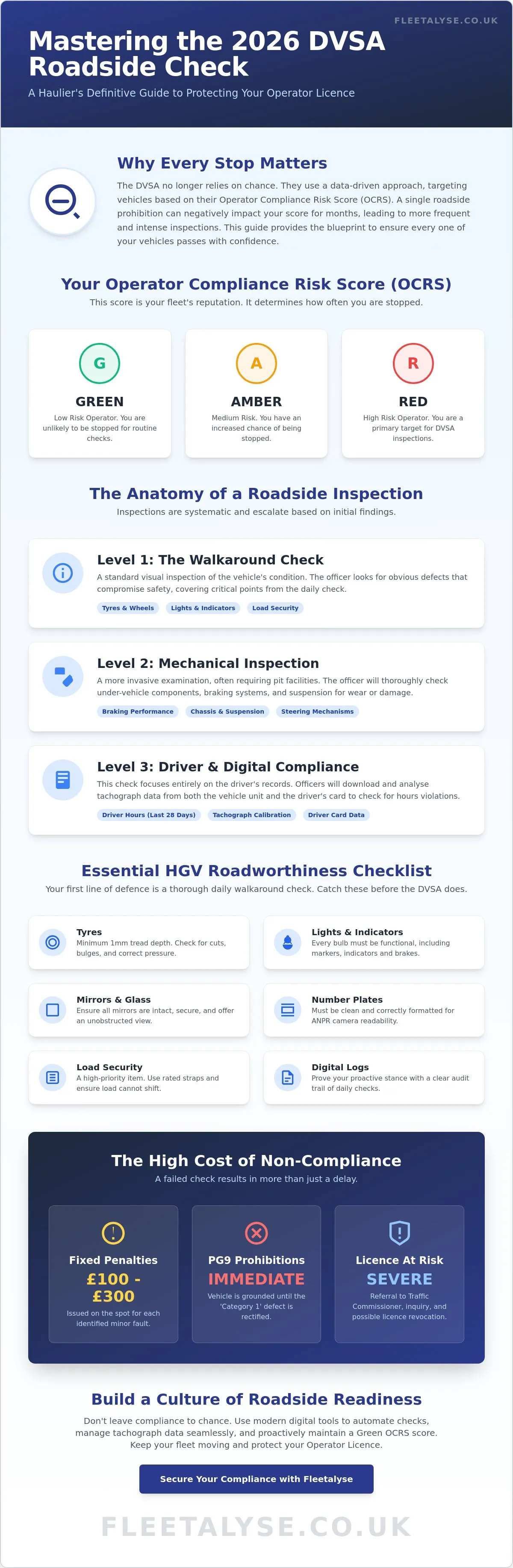
Officers have broad legal powers under the Road Traffic Act 1988. They can stop any commercial vehicle for a spot check. Failing to comply isn't an option; it leads to immediate prosecution. The consequences of a failed inspection are severe. You might face fixed penalties between £100 and £300 for minor faults. A PG9 prohibition notice will ground your vehicle on the spot. For serious or repeat offenders, the DVSA refers cases to the Traffic Commissioner. This can lead to a Public Inquiry and the total revocation of your licence.
Who Can Stop You and Where?
Both DVSA officers and the Police can stop HGVs. DVSA officers usually operate in liveried vehicles and wear high-visibility uniforms. They use "Follow Me" signs to lead drivers to safe inspection areas. These sites include dedicated weighbridges, motorway lay-bys, and specialized check centres. You must follow their instructions immediately. Ignoring a signal to stop is a serious offence that almost guarantees a full audit of your entire fleet operation.
The Different Levels of Inspection
Inspections vary in intensity based on what the officer finds. A Level 1 check is a standard walkaround. They'll check your DVSA roadside check checklist for HGVs items like tyres, lights, and load security. Level 2 is more invasive. It involves a mechanical inspection, often using pit facilities to check the under-vehicle components and braking performance. Level 3 focuses on the driver. Officers will download tachograph data to verify compliance with driver hours regulations for the previous 28 days. Any gaps in your records will lead to immediate fines.
For operators looking to stay ahead of these checks, using tools from Fleetalyse provides the visibility needed to catch issues before the DVSA does. Real transport operations require real-time data to maintain a green OCRS rating and ensure total compliance.
The Essential HGV Roadworthiness Checklist
A DVSA roadside inspection isn't a random event. It's a systematic review of your vehicle's safety. Your first line of defence is the daily walkaround check. If your driver misses a frayed strap or a bald tyre, the DVSA won't. They look for immediate safety risks that put other road users in danger. This DVSA roadside check checklist for HGVs serves as your operational blueprint to avoid costly delays.
According to official government guidance, examiners focus on items that impact road safety and environmental standards. If they find a "Category 1" defect, you'll face an immediate prohibition. This means the vehicle stays exactly where it is until the fault is fixed. Don't let a 10-minute oversight lead to a £300 fixed penalty and a tarnished O-licence. Record every defect in writing immediately. Digital logs are better. They provide a clear audit trail that proves you take compliance seriously. It's about being proactive, not reactive.
External Vehicle Condition
Maintain a professional exterior to avoid unnecessary scrutiny. Examiners use visual cues to decide which vehicles to pull over for a closer look.
- Tyres: Check for a minimum tread depth of 1mm across the central three-quarters. Look for deep cuts or bulges in the sidewall.
- Lights: Every bulb must work. This includes marker lamps, indicators, and brake lights. A single blown bulb is an easy reason for a stop.
- Mirrors: Ensure glass is intact and brackets are secure. Cracked mirrors or obscured views are instant fail items.
- Number Plates: They must be clean and correctly positioned. If an ANPR camera cannot read the plate, you become a high-priority target for a stop.
Load Security and Weight
Load security is a high-priority area for enforcement in 2026. A shifting load is a killer. It's one of the most common reasons for immediate roadside prohibitions.
- Security: Use rated straps and chains. Curtains are not load-bearing unless they meet the EN 12642 XL standard.
- Bulging: If the side curtains are bulging, the load has moved. This is a red flag for any examiner.
- Weight: Overloading a single axle is just as serious as exceeding the Gross Vehicle Weight (GVW). Check your weight distribution before leaving the depot to avoid fines.
Braking and Mechanical Systems
Mechanical failures lead to the most severe prohibitions. These systems require constant monitoring beyond the daily walkaround.
- Air Systems: Listen for audible leaks. Check that the pressure builds quickly and stays stable during operation.
- Steering and Suspension: Look for excessive play or snapped leaf springs. These are "quick-fail" items that lead to the vehicle being towed.
- Fluid Leaks: Any significant leak of oil, fuel, or coolant will end the journey. Fuel security is vital; check the filler cap seal for signs of perish.
Real-world compliance requires more than just a paper checklist. It requires visibility across your entire fleet. Upgrade your fleet management tools to track maintenance schedules and defect reports in real time, ensuring your DVSA roadside check checklist for HGVs is always up to date.

Digital Compliance: Tachographs and Driver Hours
Digital data is almost always the first thing a DVSA officer requests during a stop. It provides an objective, unalterable timeline of a driver's activity and vehicle movement. Officers use this information to calculate your Operator Compliance Risk Score (OCRS), which directly influences how often your fleet is targeted for inspections. If your digital records show frequent "minor" infringements, your score will drop, and your vehicles will be pulled over more regularly.
A robust DVSA roadside check checklist for HGVs must prioritise tachograph integrity. Officers don't just look for hours violations; they check the hardware itself. You must ensure the tachograph unit is calibrated every two years and that the calibration plaque is visible and intact. Missing a calibration date is a "Critical" defect that can lead to immediate prosecution or a grounded vehicle. Keep these items ready for every inspection:
- Valid driver digital smart card with no physical damage.
- Tachograph calibration certificate and visible vehicle plaque.
- Sufficient spare rolls for the digital printer.
- Records of any manual entries made during the shift.
Driver Records and Tachograph Analysis
Drivers are legally required to produce records for the current day and the previous 28 calendar days. This includes digital data on their card and any analogue charts used if they've driven older vehicles. A common error that triggers fines is the failure to record "other work" or rest periods correctly. Officers look for "mode switch" mistakes where a driver remains on "work" whilst taking a break. These errors are easily spotted during a roadside download and suggest a lack of proper training or oversight.
Managing Driver Hours in Real-Time
Waiting for a driver to return to the depot to analyse data is a reactive strategy that leads to fines. Live visibility allows transport managers to intervene before an infringement occurs. You can see exactly how much driving time remains before a break is mandatory, ensuring the 4.5-hour limit isn't breached by a few minutes. This proactive approach is a core part of the DVSA roadside check checklist for HGVs in 2026.
Inspectors also look for "missing mileage," which is any vehicle movement recorded without a driver card inserted. This is a major red flag that suggests a deliberate attempt to hide hours. Using remote tachograph download technology eliminates this risk by capturing VU and driver card data wirelessly. It ensures your records are always complete and available for inspection, even if the vehicle hasn't been back to base for weeks. This level of transparency proves your operation is built for real-world compliance.
The Operator Compliance Risk Score (OCRS) Explained
The Operator Compliance Risk Score (OCRS) is the DVSA's internal grading system. It's the primary mechanism that decides whether your driver is waved through or pulled into a check site. Think of it as a rolling three-year report card. The DVSA uses a data-driven algorithm to crunch information from every MOT, roadside inspection, and historical prosecution. This data determines your likelihood of non-compliance. If your vehicles are frequently found with defects, your score drops. It's that simple.
The system operates on a three-tier traffic light scale:
- Green (Low Risk): Operators with a clean history. You're rarely targeted.
- Amber (Medium Risk): You've had some issues. Expect more frequent stops.
- Red (High Risk): You're a priority for enforcement. Every DVSA officer will be looking for your livery.
A single roadside prohibition can "stain" your score for up to 36 months. This long-term impact makes using a robust DVSA roadside check checklist for HGVs essential for every pre-use inspection. One loose wheel nut or a cracked mirror isn't just a fine; it's a three-year penalty on your operational efficiency. The DVSA prioritises vehicles from operators with Red scores, meaning your fleet will face much higher scrutiny than others on the road.
How to Improve Your OCRS Status
Improving your score requires a commitment to data. You can't fix what you don't measure. Clean roadside inspections are the only way to move from Red to Green. By incorporating the DVSA roadside check checklist for HGVs into your daily driver walk-around routine, you catch issues before they become prohibitions. Forward-thinking UK operators use telematics and integrated compliance software to spot mechanical trends before the DVSA finds them. Monitoring defect reports daily ensures your fleet stays compliant. The ultimate goal is achieving "Earned Recognition," which proves your systems are so reliable that the DVSA stops targeting your vehicles entirely.
The Consequences of a Red OCRS Score
A Red OCRS score is a massive burden on any transport business. You'll face significantly higher stop frequencies. Some operators report being pulled over five times more often than their Green-rated competitors. These delays cost money and damage your reputation with customers. Worse still, a Red score often acts as a trigger for a full DVSA office audit. If they find systemic failures in your record-keeping, you'll be summoned to a Public Inquiry. Here, a Traffic Commissioner has the power to suspend or revoke your Operator Licence entirely. It's a risk no professional haulage business should take.
Building a Culture of Roadside Readiness
Compliance isn't a part-time job or a reaction to a flashing blue light. It's a daily operational standard. Most UK hauliers operate in a state of "firefighting," only addressing maintenance or tacho issues when an inspection is imminent. To maintain a high OCRS score in 2026, you must shift to proactive management. This means your DVSA roadside check checklist for HGVs should be a living document, not a piece of paper sitting in a glovebox.
Total transparency is the goal. You need to know the status of every vehicle and driver before they leave the yard. Fleetalyse helps operators achieve this by integrating GPS fleet tracking with live compliance data. This connection ensures you aren't just tracking locations; you're monitoring the health of your entire operation in real time.
Follow these five steps to ensure every vehicle is ready for a stop at any time:
- Digital Daily Checks: Eliminate paper pads. Use digital apps that timestamp walkarounds.
- Live Tacho Monitoring: Spot infringements as they happen, not 28 days later.
- Predictive Maintenance: Use telematics data to schedule repairs before components fail.
- Remote Downloads: Automate data collection to ensure 100% data coverage.
- Continuous Feedback: Use inspection data to coach drivers immediately.
Driver Training and Accountability
Your drivers are your first line of defence. Conducting regular "mock" roadside checks is an effective way to keep them sharp. Recent industry data suggests that drivers who undergo monthly mock inspections are 40% less likely to receive a PG9 prohibition. Don't just punish errors; reward excellence. Implementation of a "Clean Sheet" bonus for drivers who pass genuine DVSA stops without advisory notes encourages a culture of pride. Use driver behaviour data to identify those who frequently trigger harsh braking or speeding alerts, as these drivers are statistically more likely to overlook the DVSA roadside check checklist for HGVs during their morning walkaround.
Leveraging Technology for Compliance
Paper systems are slow and prone to loss. In 2023, an estimated 15% of paper defect reports were either lost or illegible by the time they reached the workshop. Moving to a digital environment removes these gaps. Automated remote tachograph downloads ensure you never miss a deadline, whilst digital defect reporting apps provide an instant audit trail for the DVSA. This level of digitisation turns fleet data into actionable decisions. It's about having the evidence ready the moment an examiner asks for it. Built for real transport operations, Fleetalyse provides the tools to make this transition seamless.
Contact Fleetalyse to automate your compliance today and ensure your fleet stays on the road and out of the DVSA's red zone.
Future-Proof Your Fleet Against Roadside Prohibitions
Roadside inspections are becoming increasingly data-driven. DVSA figures indicate that mechanical defects and driver hours infringements are the leading causes for prohibitions during the thousands of checks conducted on UK roads every year. Maintaining a Green OCRS score requires more than just basic record-keeping. It demands total visibility into vehicle health and driver behaviour. Utilising a digital DVSA roadside check checklist for HGVs ensures your team stays ahead of regulatory changes whilst minimising the risk of unplanned downtime.
Fleetalyse delivers the precision required for modern haulage. We provide UK-based expert support and remote tachograph downloads to ensure total transparency across your entire operation. With real-time driver hours tracking, you'll always know exactly where your compliance stands. It's about moving beyond simple tracking to embrace a system built for the realities of British transport logistics.
Master your fleet compliance with Fleetalyse — Built for Real Transport Operations
Protect your operator licence and keep your business moving forward with confidence.
Frequently Asked Questions
How long does a typical DVSA roadside check take?
A standard DVSA roadside check usually takes between 45 and 60 minutes to complete. This timeframe covers a full mechanical inspection, tachograph data analysis, and weight verification. If an officer identifies specific defects or hours-of-service violations, the process can extend beyond 90 minutes. Efficiency during these stops depends on having your DVSA roadside check checklist for HGVs organised and ready for presentation.
Can a DVSA officer issue a fixed penalty on the spot?
Yes, DVSA officers have the legal authority to issue Graduated Fixed Penalties at the roadside. These fines typically range from £50 to £300 depending on the severity of the offence. If a driver lacks a UK address, they must pay a "financial penalty deposit" immediately. Failure to pay on the spot usually results in the vehicle being prohibited from moving until the fine is settled.
What is the most common reason for an HGV to fail a roadside check?
Faulty lighting and signalling remain the most frequent reasons for failure, accounting for 17% of all roadside prohibitions according to recent DVSA enforcement data. Braking system defects and tyre condition follow closely. Most of these issues are easily avoidable through a disciplined daily walk-around check. Maintaining a rigorous DVSA roadside check checklist for HGVs ensures these common mechanical failures don't disrupt your delivery schedule.
Do I need to carry my CPC card during a DVSA stop?
You must carry your Driver Qualification Card (DQC) at all times while driving professionally. DVSA officers will ask to see this card to verify your Driver CPC status during any roadside inspection. If you've applied for a replacement but haven't received it yet, you can continue driving, but the officer will check the database to confirm your compliance. Driving without a valid DQC can result in a £50 fixed penalty.
What happens if my vehicle is issued with a "Delayed Prohibition"?
A "Delayed Prohibition" (PG9) means your vehicle has a defect that must be repaired within a set period, typically up to 10 days. Unlike an immediate prohibition, you can drive the vehicle away from the check point. However, you must clear the prohibition before the deadline. If the repairs aren't completed and verified by the specified date, the vehicle cannot be used on public roads.
How can I check my company’s OCRS score?
You can check your Operator Compliance Risk Score (OCRS) through the DVSA’s online "Manage your vehicle operator licence" service. This portal provides a clear breakdown of your roadworthiness and traffic compliance scores. Scores are updated weekly and use a red, amber, and green system. Monitoring this regularly is vital, as a high-risk red score significantly increases the likelihood of your fleet being targeted for roadside inspections.
Is a roadside check the same as an MOT?
No, a roadside check is a spot inspection rather than a scheduled annual test. While an MOT confirms a vehicle met minimum safety standards on a specific date, a DVSA check ensures continuous compliance. Roadside inspections focus on immediate safety, weight limits, and driver hours. An HGV with a valid annual test certificate can still be prohibited if defects have developed since the last inspection.
Can a driver refuse to be weighed at a roadside check?
Drivers cannot legally refuse a request to have their vehicle weighed. Refusing to comply with a DVSA officer’s direction to a weighbridge is a criminal offence that often leads to prosecution and heavy fines. Officers can direct a vehicle up to five miles from its current route to reach a weighing station. Compliance is mandatory, and any attempt to bypass this process will result in an immediate prohibition and a report to the Traffic Commissioner.
Frequently asked questions
Who Can Stop You and Where?
Both DVSA officers and the Police can stop HGVs. DVSA officers usually operate in liveried vehicles and wear high-visibility uniforms. They use "Follow Me" signs to lead drivers to safe inspection areas. These sites include dedicated weighbridges, motorway lay-bys, and specialized check centres. You must follow their instructions immediately. Ignoring a signal to stop is a serious offence that almost guarantees a full audit of your entire fleet operation.
The Different Levels of Inspection
Inspections vary in intensity based on what the officer finds. A Level 1 check is a standard walkaround. They'll check your DVSA roadside check checklist for HGVs items like tyres, lights, and load security. Level 2 is more invasive. It involves a mechanical inspection, often using pit facilities to check the under-vehicle components and braking performance. Level 3 focuses on the driver. Officers will download tachograph data to verify compliance with driver hours regulations for the previous 28 days. Any gaps in your records will lead to immediate fines. For operators looking to stay ahead of these checks, using tools from Fleetalyse provides the visibility needed to catch issues before the DVSA does. Real transport operations require real-time data to maintain a green OCRS rating and ensure total compliance. A DVSA roadside inspection isn't a random event. It's a systematic review of your vehicle's safety. Your first line of defence is the daily walkaround check. If your driver misses a frayed strap or a bald tyre, the DVSA won't. They look for immediate safety risks that put other road users in danger. This DVSA roadside check checklist for HGVs serves as your operational blueprint to avoid costly delays. According to official government guidance, examiners focus on items that impact road safety and environmental standards. If they find a "Category 1" defect, you'll face an immediate prohibition. This means the vehicle stays exactly where it is until the fault is fixed. Don't let a 10-minute oversight lead to a £300 fixed penalty and a tarnished O-licence. Record every defect in writing immediately. Digital logs are better. They provide a clear audit trail that proves you take compliance seriously. It's about being proactive, not reactive.
External Vehicle Condition
Maintain a professional exterior to avoid unnecessary scrutiny. Examiners use visual cues to decide which vehicles to pull over for a closer look.
Load Security and Weight
Load security is a high-priority area for enforcement in 2026. A shifting load is a killer. It's one of the most common reasons for immediate roadside prohibitions.
Braking and Mechanical Systems
Mechanical failures lead to the most severe prohibitions. These systems require constant monitoring beyond the daily walkaround. Real-world compliance requires more than just a paper checklist. It requires visibility across your entire fleet. Upgrade your fleet management tools to track maintenance schedules and defect reports in real time, ensuring your DVSA roadside check checklist for HGVs is always up to date. Digital data is almost always the first thing a DVSA officer requests during a stop. It provides an objective, unalterable timeline of a driver's activity and vehicle movement. Officers use this information to calculate your Operator Compliance Risk Score (OCRS), which directly influences how often your fleet is targeted for inspections. If your digital records show frequent "minor" infringements, your score will drop, and your vehicles will be pulled over more regularly. A robust DVSA roadside check checklist for HGVs must prioritise tachograph integrity. Officers don't just look for hours violations; they check the hardware itself. You must ensure the tachograph unit is calibrated every two years and that the calibration plaque is visible and intact. Missing a calibration date is a "Critical" defect that can lead to immediate prosecution or a grounded vehicle. Keep these items ready for every inspection:
Driver Records and Tachograph Analysis
Drivers are legally required to produce records for the current day and the previous 28 calendar days. This includes digital data on their card and any analogue charts used if they've driven older vehicles. A common error that triggers fines is the failure to record "other work" or rest periods correctly. Officers look for "mode switch" mistakes where a driver remains on "work" whilst taking a break. These errors are easily spotted during a roadside download and suggest a lack of proper training or oversight.
Managing Driver Hours in Real-Time
Waiting for a driver to return to the depot to analyse data is a reactive strategy that leads to fines. Live visibility allows transport managers to intervene before an infringement occurs. You can see exactly how much driving time remains before a break is mandatory, ensuring the 4.5-hour limit isn't breached by a few minutes. This proactive approach is a core part of the DVSA roadside check checklist for HGVs in 2026. Inspectors also look for "missing mileage," which is any vehicle movement recorded without a driver card inserted. This is a major red flag that suggests a deliberate attempt to hide hours. Using remote tachograph download technology eliminates this risk by capturing VU and driver card data wirelessly. It ensures your records are always complete and available for inspection, even if the vehicle hasn't been back to base for weeks. This level of transparency proves your operation is built for real-world compliance. The Operator Compliance Risk Score (OCRS) is the DVSA's internal grading system. It's the primary mechanism that decides whether your driver is waved through or pulled into a check site. Think of it as a rolling three-year report card. The DVSA uses a data-driven algorithm to crunch information from every MOT, roadside inspection, and historical prosecution. This data determines your likelihood of non-compliance. If your vehicles are frequently found with defects, your score drops. It's that simple. The system operates on a three-tier traffic light scale: A single roadside prohibition can "stain" your score for up to 36 months. This long-term impact makes using a robust DVSA roadside check checklist for HGVs essential for every pre-use inspection. One loose wheel nut or a cracked mirror isn't just a fine; it's a three-year penalty on your operational efficiency. The DVSA prioritises vehicles from operators with Red scores, meaning your fleet will face much higher scrutiny than others on the road.
How to Improve Your OCRS Status
Improving your score requires a commitment to data. You can't fix what you don't measure. Clean roadside inspections are the only way to move from Red to Green. By incorporating the DVSA roadside check checklist for HGVs into your daily driver walk-around routine, you catch issues before they become prohibitions. Forward-thinking UK operators use telematics and integrated compliance software to spot mechanical trends before the DVSA finds them. Monitoring defect reports daily ensures your fleet stays compliant. The ultimate goal is achieving "Earned Recognition," which proves your systems are so reliable that the DVSA stops targeting your vehicles entirely.
The Consequences of a Red OCRS Score
A Red OCRS score is a massive burden on any transport business. You'll face significantly higher stop frequencies. Some operators report being pulled over five times more often than their Green-rated competitors. These delays cost money and damage your reputation with customers. Worse still, a Red score often acts as a trigger for a full DVSA office audit. If they find systemic failures in your record-keeping, you'll be summoned to a Public Inquiry. Here, a Traffic Commissioner has the power to suspend or revoke your Operator Licence entirely. It's a risk no professional haulage business should take. Compliance isn't a part-time job or a reaction to a flashing blue light. It's a daily operational standard. Most UK hauliers operate in a state of "firefighting," only addressing maintenance or tacho issues when an inspection is imminent. To maintain a high OCRS score in 2026, you must shift to proactive management. This means your DVSA roadside check checklist for HGVs should be a living document, not a piece of paper sitting in a glovebox. Total transparency is the goal. You need to know the status of every vehicle and driver before they leave the yard. Fleetalyse helps operators achieve this by integrating GPS fleet tracking with live compliance data. This connection ensures you aren't just tracking locations; you're monitoring the health of your entire operation in real time. Follow these five steps to ensure every vehicle is ready for a stop at any time:
Driver Training and Accountability
Your drivers are your first line of defence. Conducting regular "mock" roadside checks is an effective way to keep them sharp. Recent industry data suggests that drivers who undergo monthly mock inspections are 40% less likely to receive a PG9 prohibition. Don't just punish errors; reward excellence. Implementation of a "Clean Sheet" bonus for drivers who pass genuine DVSA stops without advisory notes encourages a culture of pride. Use driver behaviour data to identify those who frequently trigger harsh braking or speeding alerts, as these drivers are statistically more likely to overlook the DVSA roadside check checklist for HGVs during their morning walkaround.
Leveraging Technology for Compliance
Paper systems are slow and prone to loss. In 2023, an estimated 15% of paper defect reports were either lost or illegible by the time they reached the workshop. Moving to a digital environment removes these gaps. Automated remote tachograph downloads ensure you never miss a deadline, whilst digital defect reporting apps provide an instant audit trail for the DVSA. This level of digitisation turns fleet data into actionable decisions. It's about having the evidence ready the moment an examiner asks for it. Built for real transport operations, Fleetalyse provides the tools to make this transition seamless. Contact Fleetalyse to automate your compliance today and ensure your fleet stays on the road and out of the DVSA's red zone. Roadside inspections are becoming increasingly data-driven. DVSA figures indicate that mechanical defects and driver hours infringements are the leading causes for prohibitions during the thousands of checks conducted on UK roads every year. Maintaining a Green OCRS score requires more than just basic record-keeping. It demands total visibility into vehicle health and driver behaviour. Utilising a digital DVSA roadside check checklist for HGVs ensures your team stays ahead of regulatory changes whilst minimising the risk of unplanned downtime. Fleetalyse delivers the precision required for modern haulage. We provide UK-based expert support and remote tachograph downloads to ensure total transparency across your entire operation. With real-time driver hours tracking, you'll always know exactly where your compliance stands. It's about moving beyond simple tracking to embrace a system built for the realities of British transport logistics. Master your fleet compliance with Fleetalyse — Built for Real Transport Operations Protect your operator licence and keep your business moving forward with confidence.
How long does a typical DVSA roadside check take?
A standard DVSA roadside check usually takes between 45 and 60 minutes to complete. This timeframe covers a full mechanical inspection, tachograph data analysis, and weight verification. If an officer identifies specific defects or hours-of-service violations, the process can extend beyond 90 minutes. Efficiency during these stops depends on having your DVSA roadside check checklist for HGVs organised and ready for presentation.
Can a DVSA officer issue a fixed penalty on the spot?
Yes, DVSA officers have the legal authority to issue Graduated Fixed Penalties at the roadside. These fines typically range from £50 to £300 depending on the severity of the offence. If a driver lacks a UK address, they must pay a "financial penalty deposit" immediately. Failure to pay on the spot usually results in the vehicle being prohibited from moving until the fine is settled.
What is the most common reason for an HGV to fail a roadside check?
Faulty lighting and signalling remain the most frequent reasons for failure, accounting for 17% of all roadside prohibitions according to recent DVSA enforcement data. Braking system defects and tyre condition follow closely. Most of these issues are easily avoidable through a disciplined daily walk-around check. Maintaining a rigorous DVSA roadside check checklist for HGVs ensures these common mechanical failures don't disrupt your delivery schedule.
Do I need to carry my CPC card during a DVSA stop?
You must carry your Driver Qualification Card (DQC) at all times while driving professionally. DVSA officers will ask to see this card to verify your Driver CPC status during any roadside inspection. If you've applied for a replacement but haven't received it yet, you can continue driving, but the officer will check the database to confirm your compliance. Driving without a valid DQC can result in a £50 fixed penalty.
What happens if my vehicle is issued with a "Delayed Prohibition"?
A "Delayed Prohibition" (PG9) means your vehicle has a defect that must be repaired within a set period, typically up to 10 days. Unlike an immediate prohibition, you can drive the vehicle away from the check point. However, you must clear the prohibition before the deadline. If the repairs aren't completed and verified by the specified date, the vehicle cannot be used on public roads.
How can I check my company’s OCRS score?
You can check your Operator Compliance Risk Score (OCRS) through the DVSA’s online "Manage your vehicle operator licence" service. This portal provides a clear breakdown of your roadworthiness and traffic compliance scores. Scores are updated weekly and use a red, amber, and green system. Monitoring this regularly is vital, as a high-risk red score significantly increases the likelihood of your fleet being targeted for roadside inspections.
Is a roadside check the same as an MOT?
No, a roadside check is a spot inspection rather than a scheduled annual test. While an MOT confirms a vehicle met minimum safety standards on a specific date, a DVSA check ensures continuous compliance. Roadside inspections focus on immediate safety, weight limits, and driver hours. An HGV with a valid annual test certificate can still be prohibited if defects have developed since the last inspection.
Can a driver refuse to be weighed at a roadside check?
Drivers cannot legally refuse a request to have their vehicle weighed. Refusing to comply with a DVSA officer’s direction to a weighbridge is a criminal offence that often leads to prosecution and heavy fines. Officers can direct a vehicle up to five miles from its current route to reach a weighing station. Compliance is mandatory, and any attempt to bypass this process will result in an immediate prohibition and a report to the Traffic Commissioner.