
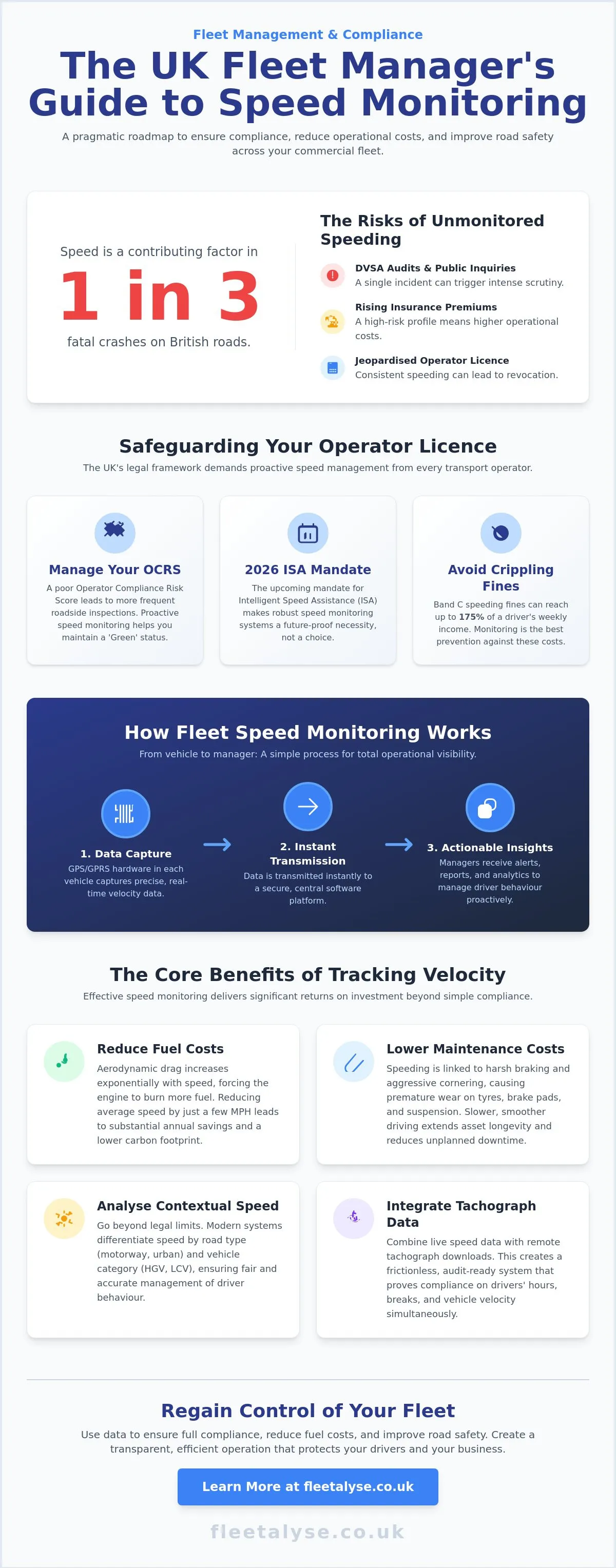
Speed is a contributing factor in 1 in 3 fatal crashes on British roads. For any transport manager, this isn't just a statistic; it's a direct threat to your business's survival. Implementing effective fleet speed monitoring uk is now a necessity to protect both your drivers and your assets. With the 2026 mandate for Intelligent Speed Assistance (ISA) and Band C fines reaching up to 175% of a driver's weekly income, the margin for error has disappeared.
We understand the pressure you're under. You're likely facing rising insurance premiums and the constant worry that a single speeding incident could trigger a DVSA audit. It's tough to manage driver pushback whilst trying to secure your Operator Licence. This article provides a pragmatic roadmap to help you regain control. You'll learn how to use speed data to ensure full compliance, reduce fuel costs, and improve road safety. We will examine how integrating GPS tracking with your existing tachograph data creates a transparent, efficient operation that benefits both the business and the driver.
Key Takeaways
- Understand how GPS and GPRS technology capture precise velocity data to provide total visibility over your mobile assets.
- Discover the direct link between speed management and operational savings through reduced fuel consumption and lower maintenance costs.
- Learn why fleet speed monitoring uk is essential for maintaining tachograph compliance and safeguarding your UK Operator Licence.
- Establish a robust Speed and Safety Policy whilst selecting tracking hardware tailored to your specific vehicle types.
- Integrate remote tachograph downloads with live tracking data to create a frictionless, audit-ready compliance system.
What is Fleet Speed Monitoring in the UK?
Fleet speed monitoring in the UK is the systematic tracking and analysis of vehicle velocity across a commercial fleet. It isn't just about catching drivers breaking the law. It's a core component of a modern Fleet telematics system. By using GPS and GPRS technology, hardware installed in the vehicle captures real-time velocity data. This information is transmitted instantly to a central platform, giving transport managers total visibility over their mobile assets.
For UK operators, this data serves as the foundation of their Duty of Care. You have a legal and moral obligation to ensure your drivers operate safely on public roads. If an incident occurs, claiming ignorance of a driver's habits isn't a valid defence. Implementing robust fleet speed monitoring uk provides the oversight needed to intervene before an accident happens. It allows you to identify high-risk behaviour and implement corrective training based on facts rather than assumptions.
The Legal Framework for UK Transport Operators
The DVSA expects every operator to have systems that monitor and manage driver behaviour. Your UK Operator Licence depends on your ability to prove you are in control of your fleet. If your drivers are consistently caught speeding, your Operator Compliance Risk Score (OCRS) will suffer. A poor score leads to more frequent, time-consuming roadside inspections and potential public inquiries. High-quality speed monitoring helps you maintain a "Green" status. It proves to the authorities that you're a proactive, compliant operator. You can find more details on managing these standards at fleetalyse.co.uk.
Legal Speed Limits vs. Contextual Speed
Understanding vehicle-specific speed limits is critical. An HGV over 7.5 tonnes has different legal limits on a dual carriageway compared to a standard car or a small van. However, a legal limit isn't always a safe speed. Driving at 30mph through a congested residential zone during school hours might be legal, but it's often inappropriate for a heavy asset. Effective fleet speed monitoring uk goes beyond simple threshold alerts. Modern software identifies speeding based on:
- Specific Road Types: Differentiating between motorways, dual carriageways, and urban streets.
- Vehicle Categories: Applying the correct legal limit for HGVs, LCVs, or trailers.
- Contextual Risks: Identifying high-speed events in sensitive areas like depots or customer sites.
This nuance is essential for fair management. It ensures you aren't penalising a van driver for doing 60mph on a road where a car can do 70mph, but an HGV cannot. It provides the clarity required to protect your drivers and your business reputation simultaneously.
The Core Benefits of Tracking Fleet Velocity
Speeding is an expensive habit. It drains your fuel budget and accelerates vehicle depreciation. By implementing fleet speed monitoring uk, you gain the data needed to stop these losses. It's about operational efficiency as much as it's about safety. Every mile per hour over the limit adds unnecessary pressure to your profit margins. You can't manage what you don't measure. Tracking velocity provides the transparency required to transform driver behaviour and protect your bottom line.
Fuel Efficiency and Environmental Impact
Aerodynamic drag increases exponentially with speed. For heavy vehicles, the engine must work significantly harder to overcome air resistance at higher velocities. This directly translates to higher fuel burn. Aerodynamic drag increases significantly at higher speeds; an HGV's fuel consumption typically rises for every mile per hour maintained above its most efficient cruising speed. Reducing your average fleet speed by just a few miles per hour can lead to substantial annual savings.
Beyond the immediate cost, reducing speed is a practical way to lower your fleet's carbon footprint. This is vital for ESG (Environmental, Social, and Governance) reporting. Accurate speed data allows you to quantify these emissions savings for clients and stakeholders. It turns compliance into a competitive advantage during tender processes. Many modern contracts now require proof of environmental responsibility. Speed monitoring provides the evidence you need to secure those deals.
Asset Longevity and Maintenance Costs
Speeding rarely happens in isolation. It's usually accompanied by harsh braking and aggressive cornering. These behaviours cause premature wear on tyres, brake pads, and suspension systems. By monitoring speed, you reduce the mechanical stress on your trailers and vans. It's a simple equation: less speed equals less damage. This proactive approach prevents the aggressive driving styles that lead to costly, unplanned maintenance.
Reducing speed-related wear means fewer unplanned repairs. It keeps your assets on the road for longer. This extension of the vehicle lifecycle improves your return on investment and lowers the total cost of ownership. You aren't just saving on parts; you're preventing the downtime that disrupts your delivery schedules. A reliable fleet is a profitable fleet.
A consistent safety record is your best leverage during annual insurance renewals. Underwriters look for evidence of risk management. By providing detailed reports from your fleet speed monitoring uk system, you demonstrate a proactive approach to safety. This transparency often results in more competitive premiums compared to operators who lack such oversight. Your vehicles are mobile billboards. A speeding van with your logo on it damages your brand in the eyes of the public and potential clients. Adhering to Health and Safety Executive (HSE) guidance regarding road safety protects your professional standing. It ensures your business remains a reliable partner for your customers who value safety and compliance.
To see how tracking can protect your bottom line, explore our GPS tracking solutions.
Speed Data and Tachograph Compliance: The Vital Link
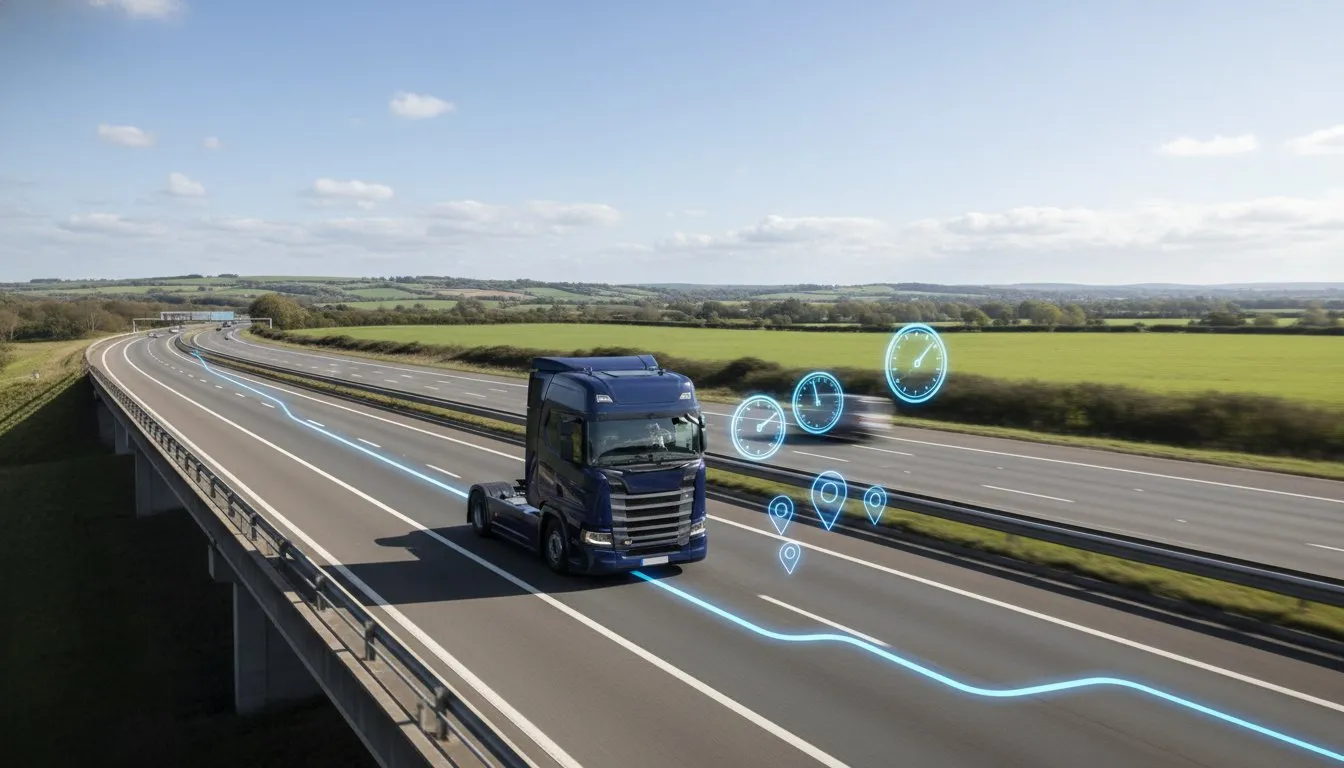
Speed data shouldn't exist in a vacuum. Many operators treat telematics and tachograph analysis as separate entities, but this creates a dangerous blind spot. Effective fleet speed monitoring uk requires a unified approach. When you correlate velocity with driver activity, you uncover the "why" behind speeding incidents. A driver isn't usually speeding for the sake of it; they're often rushing to complete a delivery before their legal driving time expires. Siloing these data sets makes it impossible to address the root cause of the problem.
Using remote tachograph downloads removes the administrative burden of manual data collection. You receive the data you need regardless of where the vehicle is in the country. This is vital for regional operators with assets that rarely return to a central hub. It allows for immediate verification of driver activity. You can instantly see if a high-speed event occurred during a period where a driver was already close to their limit. This level of detail is what separates a professional, compliant operation from a high-risk one.
Live Driver Hours and Speeding
Live monitoring is the most effective way to prevent drivers from "beating the clock." When a transport manager can see live driver hours alongside vehicle speed, they can intervene early. If a driver is behind schedule, the solution isn't to drive faster. The solution is to re-route or adjust expectations. Ensuring your drivers remain within legal working time limits is a daily challenge. Integrated monitoring shows you exactly how much driving time is left. If a driver has 15 minutes of driving time remaining but is 20 miles from their destination, the temptation to speed is high. By spotting this early, you can manage the situation and support your staff.
Preparing for a DVSA Compliance Audit
A DVSA auditor doesn't just look for violations. They look for your systems to prevent them. If you can show an integrated report that combines speed events with tachograph records, you demonstrate total control. It proves you're proactive rather than reactive. Integrated software streamlines this entire process. It removes the need to manually compare spreadsheets from different providers. For a seamless experience, you should look at how Fleetalyse handles tachograph analysis integration. This level of oversight through fleet speed monitoring uk makes audit preparation a simple task rather than a stressful event. You get a clear, consolidated view of your compliance status that protects your licence and keeps your fleet moving safely.
How to Implement an Effective Speed Monitoring Strategy
Data collection is only the first step. To see real results, you must turn that data into a structured management process. A successful fleet speed monitoring uk strategy relies on transparency and consistency. Without a clear framework, drivers may view telematics as a tool for "spying" rather than a system for safety. Your goal is to move from passive observation to active management. This transition requires a combination of the right technology and a culture of accountability.
Start by selecting hardware that fits your specific operation. A heavy goods vehicle requires different oversight compared to a light commercial vehicle. Whether you are using van tracking for local deliveries or trailer tracking for long-haul logistics, the hardware must provide accurate, granular data. Once the technology is in place, organise regular debriefs. Use these sessions to review performance and set clear expectations for the coming week. This ensures that safety remains a daily priority rather than an occasional thought.
Creating a Transparent Driver Policy
A written Speed and Safety Policy is essential. It protects the business and provides clarity for the staff. Define exactly what constitutes a speeding "event." For instance, you might set a threshold of 5mph over the legal limit for more than ten seconds. This removes ambiguity. Drivers need to understand that monitoring isn't about punishment. It's about protecting the company’s Operator Licence and ensuring everyone gets home safely. Include a clear disciplinary framework for persistent offenders. This ensures fairness across the entire fleet and gives you a legal footing if further action is required.
Using Data for Positive Reinforcement
Data shouldn't just be used to identify failures. Use it to highlight your best performers. Implementing league tables is a highly effective way to incentivise safe driving behaviour. It creates a healthy sense of competition amongst the team. Consider a "Driver of the Month" programme with tangible rewards for those with the highest safety scores. This shifts the perception of fleet speed monitoring uk from a restrictive measure to a rewarding one.
When you identify poor performance, use the data for targeted training. Instead of a generic reprimand, show the driver exactly where and when the speeding occurred. This factual approach reduces friction and makes the driver more receptive to change. Continuous review of your safety goals ensures your strategy evolves with your business needs. You can then adjust your thresholds as your fleet’s performance improves over time.
To start building your own safety-first culture, view our tracking and analysis packages.
Why Fleetalyse is the Pragmatic Choice for UK Fleets
Choosing a telematics partner is a decision that impacts your entire operational structure. Many providers offer generic tracking solutions designed for a global market. These often lack the specific regulatory depth required for UK road transport. Fleetalyse is different. We focus exclusively on the practical needs of regional operators. Our approach to fleet speed monitoring uk is built around the reality of DVSA enforcement and the protection of your Operator Licence. We don't just provide data; we provide the tools to manage it effectively.
The integration of GPS tracking with remote tachograph downloads is a core part of our service. This isn't a bolt-on feature. It's a seamless system designed to remove the friction from your daily compliance checks. By combining velocity data with live driver hours, we give you a unified view of your fleet's performance. This level of oversight is essential for any haulier looking to maintain a high OCRS score whilst keeping administrative costs low. We prioritise functional utility over flashy, unnecessary features that add cost without adding value.
Transparency is a cornerstone of our business. Unlike some market competitors who hide complex terms in long-term contracts, we provide clear, upfront details on our rates. You won't find hidden fees or sudden price hikes here. Our UK-based support team understands regional infrastructure. We know the challenges of managing fleets across the motorway network and through congested urban centres. This localized expertise makes us a reliable ally for your business.
Compliance-First Telematics
Our platform is designed specifically for the transport manager. We understand that your time is valuable. That’s why we automate the data collection process as much as possible. Whether you are managing van tracking for local deliveries or monitoring long-distance trailers, the system works in the background to keep you informed. It ensures your fleet is always audit-ready. You won't have to scramble for records if the DVSA requests an inspection. Everything you need is organised, accessible, and accurate.
A Partner, Not Just a Provider
We see ourselves as a pragmatic expert partner for your business. We offer straightforward, honest advice based on years of industry experience. Regional operators trust us because we understand their daily struggles with rising fuel costs and regulatory pressure. We help you use fleet speed monitoring uk to build a safer, more efficient operation. This isn't about theoretical data collection. It's about real-world application that protects your assets and your reputation. We value your resources as much as you do.
See our published pricing for fleet speed monitoring and see how we can support your compliance goals.
Secure Your Operator Licence and Protect Your Profit Margins
Effective fleet speed monitoring uk is no longer a luxury for regional hauliers; it's a vital pillar of business continuity. Integrating velocity tracking with your existing tachograph data allows you to move beyond simple observation. You gain the power to identify the root causes of rushing and prevent incidents before they impact your OCRS score. This proactive approach doesn't just satisfy the DVSA. It directly lowers your fuel consumption and extends the lifecycle of your vans and trailers.
Our platform addresses the specific rigours of the UK transport industry. As UK-based compliance specialists, we prioritise functional utility over flashy features. You'll find seamless tacho analysis integration and a commitment to total transparency. There are no hidden costs or marketing hyperbole here. We provide the straightforward, reliable tools you need to manage your fleet with quiet confidence. Take the next step toward a safer, more efficient operation today.
See our published pricing for your fleet monitoring and compliance
Frequently Asked Questions
Is it legal to monitor my drivers speed in the UK?
It's legal to monitor driver speed provided you comply with UK GDPR and employment laws. You must inform your drivers that tracking is in place and explain exactly how the data is used. Transparency is key; ensure your Speed and Safety Policy clearly outlines that monitoring is for safety and insurance purposes rather than intrusive surveillance.
Can speed monitoring data be used in a DVSA audit?
DVSA auditors value speed data because it demonstrates proactive management control. Providing reports from your fleet speed monitoring uk system proves you have active oversight of your drivers' behaviour. It shows you don't just wait for accidents to happen but use telematics to identify and correct high-risk habits before they lead to serious infringements.
How does speed tracking reduce my insurance premiums?
Insurers look for evidence of risk mitigation when calculating your annual premiums. By sharing speed reports, you provide underwriters with tangible proof that your fleet is managed safely. Consistently lower speeds lead to fewer claims and less severe accidents. This data gives you significant leverage during renewal negotiations to secure more competitive rates.
Will speed monitoring work on trailers as well as HGVs?
Trailer tracking units are designed to operate independently, providing precise velocity data regardless of which tractor unit is towing them. This is essential for hauliers who swap trailers frequently. You get a complete picture of your asset's journey and speed, ensuring that your safety standards are maintained across every part of your mobile inventory.
What is the difference between legal speed and relative speed?
Legal speed is the maximum limit posted on road signs for standard vehicles. Relative speed refers to the specific legal limit for your vehicle class on that particular road. For instance, an HGV might be restricted to 50mph on a road where cars can legally do 60mph. Modern software identifies these nuances to ensure your drivers are always compliant with their specific vehicle limits.
How often should I review my fleet speed reports?
Review your reports weekly to ensure you can conduct driver debriefs whilst events are still fresh. This frequency allows for immediate corrective action and keeps safety at the forefront of your operations. Monthly reviews of fleet speed monitoring uk data are also useful for identifying long-term trends amongst your team and measuring the impact of your safety policies.
Can drivers see their own speed scores in real-time?
Many systems allow drivers to access their own performance scores via mobile apps. This transparency encourages self-correction and reduces the need for heavy-handed management. When drivers see their own data, they take more ownership of their behaviour on the road. It turns safety into a shared goal rather than a top-down mandate.
Does speed monitoring require expensive hardware installation?
Modern GPS tracking hardware is efficient and cost-effective to install across various vehicle types. It's a practical investment that quickly pays for itself through reduced fuel consumption and lower maintenance costs. You don't need complex, flashy systems; you need reliable hardware that provides the granular data required to protect your UK Operator Licence.
Frequently asked questions
The Legal Framework for UK Transport Operators
The DVSA expects every operator to have systems that monitor and manage driver behaviour. Your UK Operator Licence depends on your ability to prove you are in control of your fleet. If your drivers are consistently caught speeding, your Operator Compliance Risk Score (OCRS) will suffer. A poor score leads to more frequent, time-consuming roadside inspections and potential public inquiries. High-quality speed monitoring helps you maintain a "Green" status. It proves to the authorities that you're a proactive, compliant operator. You can find more details on managing these standards at fleetalyse.co.uk.
Legal Speed Limits vs. Contextual Speed
Understanding vehicle-specific speed limits is critical. An HGV over 7.5 tonnes has different legal limits on a dual carriageway compared to a standard car or a small van. However, a legal limit isn't always a safe speed. Driving at 30mph through a congested residential zone during school hours might be legal, but it's often inappropriate for a heavy asset. Effective fleet speed monitoring uk goes beyond simple threshold alerts. Modern software identifies speeding based on: This nuance is essential for fair management. It ensures you aren't penalising a van driver for doing 60mph on a road where a car can do 70mph, but an HGV cannot. It provides the clarity required to protect your drivers and your business reputation simultaneously. Speeding is an expensive habit. It drains your fuel budget and accelerates vehicle depreciation. By implementing fleet speed monitoring uk, you gain the data needed to stop these losses. It's about operational efficiency as much as it's about safety. Every mile per hour over the limit adds unnecessary pressure to your profit margins. You can't manage what you don't measure. Tracking velocity provides the transparency required to transform driver behaviour and protect your bottom line.
Fuel Efficiency and Environmental Impact
Aerodynamic drag increases exponentially with speed. For heavy vehicles, the engine must work significantly harder to overcome air resistance at higher velocities. This directly translates to higher fuel burn. Aerodynamic drag increases significantly at higher speeds; an HGV's fuel consumption typically rises for every mile per hour maintained above its most efficient cruising speed. Reducing your average fleet speed by just a few miles per hour can lead to substantial annual savings. Beyond the immediate cost, reducing speed is a practical way to lower your fleet's carbon footprint. This is vital for ESG (Environmental, Social, and Governance) reporting. Accurate speed data allows you to quantify these emissions savings for clients and stakeholders. It turns compliance into a competitive advantage during tender processes. Many modern contracts now require proof of environmental responsibility. Speed monitoring provides the evidence you need to secure those deals.
Asset Longevity and Maintenance Costs
Speeding rarely happens in isolation. It's usually accompanied by harsh braking and aggressive cornering. These behaviours cause premature wear on tyres, brake pads, and suspension systems. By monitoring speed, you reduce the mechanical stress on your trailers and vans. It's a simple equation: less speed equals less damage. This proactive approach prevents the aggressive driving styles that lead to costly, unplanned maintenance. Reducing speed-related wear means fewer unplanned repairs. It keeps your assets on the road for longer. This extension of the vehicle lifecycle improves your return on investment and lowers the total cost of ownership. You aren't just saving on parts; you're preventing the downtime that disrupts your delivery schedules. A reliable fleet is a profitable fleet. A consistent safety record is your best leverage during annual insurance renewals. Underwriters look for evidence of risk management. By providing detailed reports from your fleet speed monitoring uk system, you demonstrate a proactive approach to safety. This transparency often results in more competitive premiums compared to operators who lack such oversight. Your vehicles are mobile billboards. A speeding van with your logo on it damages your brand in the eyes of the public and potential clients. Adhering to Health and Safety Executive (HSE) guidance regarding road safety protects your professional standing. It ensures your business remains a reliable partner for your customers who value safety and compliance. To see how tracking can protect your bottom line, explore our GPS tracking solutions. Speed data shouldn't exist in a vacuum. Many operators treat telematics and tachograph analysis as separate entities, but this creates a dangerous blind spot. Effective fleet speed monitoring uk requires a unified approach. When you correlate velocity with driver activity, you uncover the "why" behind speeding incidents. A driver isn't usually speeding for the sake of it; they're often rushing to complete a delivery before their legal driving time expires. Siloing these data sets makes it impossible to address the root cause of the problem. Using remote tachograph downloads removes the administrative burden of manual data collection. You receive the data you need regardless of where the vehicle is in the country. This is vital for regional operators with assets that rarely return to a central hub. It allows for immediate verification of driver activity. You can instantly see if a high-speed event occurred during a period where a driver was already close to their limit. This level of detail is what separates a professional, compliant operation from a high-risk one.
Live Driver Hours and Speeding
Live monitoring is the most effective way to prevent drivers from "beating the clock." When a transport manager can see live driver hours alongside vehicle speed, they can intervene early. If a driver is behind schedule, the solution isn't to drive faster. The solution is to re-route or adjust expectations. Ensuring your drivers remain within legal working time limits is a daily challenge. Integrated monitoring shows you exactly how much driving time is left. If a driver has 15 minutes of driving time remaining but is 20 miles from their destination, the temptation to speed is high. By spotting this early, you can manage the situation and support your staff.
Preparing for a DVSA Compliance Audit
A DVSA auditor doesn't just look for violations. They look for your systems to prevent them. If you can show an integrated report that combines speed events with tachograph records, you demonstrate total control. It proves you're proactive rather than reactive. Integrated software streamlines this entire process. It removes the need to manually compare spreadsheets from different providers. For a seamless experience, you should look at how Fleetalyse handles tachograph analysis integration. This level of oversight through fleet speed monitoring uk makes audit preparation a simple task rather than a stressful event. You get a clear, consolidated view of your compliance status that protects your licence and keeps your fleet moving safely. Data collection is only the first step. To see real results, you must turn that data into a structured management process. A successful fleet speed monitoring uk strategy relies on transparency and consistency. Without a clear framework, drivers may view telematics as a tool for "spying" rather than a system for safety. Your goal is to move from passive observation to active management. This transition requires a combination of the right technology and a culture of accountability. Start by selecting hardware that fits your specific operation. A heavy goods vehicle requires different oversight compared to a light commercial vehicle. Whether you are using van tracking for local deliveries or trailer tracking for long-haul logistics, the hardware must provide accurate, granular data. Once the technology is in place, organise regular debriefs. Use these sessions to review performance and set clear expectations for the coming week. This ensures that safety remains a daily priority rather than an occasional thought.
Creating a Transparent Driver Policy
A written Speed and Safety Policy is essential. It protects the business and provides clarity for the staff. Define exactly what constitutes a speeding "event." For instance, you might set a threshold of 5mph over the legal limit for more than ten seconds. This removes ambiguity. Drivers need to understand that monitoring isn't about punishment. It's about protecting the company’s Operator Licence and ensuring everyone gets home safely. Include a clear disciplinary framework for persistent offenders. This ensures fairness across the entire fleet and gives you a legal footing if further action is required.
Using Data for Positive Reinforcement
Data shouldn't just be used to identify failures. Use it to highlight your best performers. Implementing league tables is a highly effective way to incentivise safe driving behaviour. It creates a healthy sense of competition amongst the team. Consider a "Driver of the Month" programme with tangible rewards for those with the highest safety scores. This shifts the perception of fleet speed monitoring uk from a restrictive measure to a rewarding one. When you identify poor performance, use the data for targeted training. Instead of a generic reprimand, show the driver exactly where and when the speeding occurred. This factual approach reduces friction and makes the driver more receptive to change. Continuous review of your safety goals ensures your strategy evolves with your business needs. You can then adjust your thresholds as your fleet’s performance improves over time. To start building your own safety-first culture, view our tracking and analysis packages. Choosing a telematics partner is a decision that impacts your entire operational structure. Many providers offer generic tracking solutions designed for a global market. These often lack the specific regulatory depth required for UK road transport. Fleetalyse is different. We focus exclusively on the practical needs of regional operators. Our approach to fleet speed monitoring uk is built around the reality of DVSA enforcement and the protection of your Operator Licence. We don't just provide data; we provide the tools to manage it effectively. The integration of GPS tracking with remote tachograph downloads is a core part of our service. This isn't a bolt-on feature. It's a seamless system designed to remove the friction from your daily compliance checks. By combining velocity data with live driver hours, we give you a unified view of your fleet's performance. This level of oversight is essential for any haulier looking to maintain a high OCRS score whilst keeping administrative costs low. We prioritise functional utility over flashy, unnecessary features that add cost without adding value. Transparency is a cornerstone of our business. Unlike some market competitors who hide complex terms in long-term contracts, we provide clear, upfront details on our rates. You won't find hidden fees or sudden price hikes here. Our UK-based support team understands regional infrastructure. We know the challenges of managing fleets across the motorway network and through congested urban centres. This localized expertise makes us a reliable ally for your business.
Compliance-First Telematics
Our platform is designed specifically for the transport manager. We understand that your time is valuable. That’s why we automate the data collection process as much as possible. Whether you are managing van tracking for local deliveries or monitoring long-distance trailers, the system works in the background to keep you informed. It ensures your fleet is always audit-ready. You won't have to scramble for records if the DVSA requests an inspection. Everything you need is organised, accessible, and accurate.
A Partner, Not Just a Provider
We see ourselves as a pragmatic expert partner for your business. We offer straightforward, honest advice based on years of industry experience. Regional operators trust us because we understand their daily struggles with rising fuel costs and regulatory pressure. We help you use fleet speed monitoring uk to build a safer, more efficient operation. This isn't about theoretical data collection. It's about real-world application that protects your assets and your reputation. We value your resources as much as you do. See our published pricing for fleet speed monitoring and see how we can support your compliance goals. Effective fleet speed monitoring uk is no longer a luxury for regional hauliers; it's a vital pillar of business continuity. Integrating velocity tracking with your existing tachograph data allows you to move beyond simple observation. You gain the power to identify the root causes of rushing and prevent incidents before they impact your OCRS score. This proactive approach doesn't just satisfy the DVSA. It directly lowers your fuel consumption and extends the lifecycle of your vans and trailers. Our platform addresses the specific rigours of the UK transport industry. As UK-based compliance specialists, we prioritise functional utility over flashy features. You'll find seamless tacho analysis integration and a commitment to total transparency. There are no hidden costs or marketing hyperbole here. We provide the straightforward, reliable tools you need to manage your fleet with quiet confidence. Take the next step toward a safer, more efficient operation today. See our published pricing for your fleet monitoring and compliance
Is it legal to monitor my drivers speed in the UK?
It's legal to monitor driver speed provided you comply with UK GDPR and employment laws. You must inform your drivers that tracking is in place and explain exactly how the data is used. Transparency is key; ensure your Speed and Safety Policy clearly outlines that monitoring is for safety and insurance purposes rather than intrusive surveillance.
Can speed monitoring data be used in a DVSA audit?
DVSA auditors value speed data because it demonstrates proactive management control. Providing reports from your fleet speed monitoring uk system proves you have active oversight of your drivers' behaviour. It shows you don't just wait for accidents to happen but use telematics to identify and correct high-risk habits before they lead to serious infringements.
How does speed tracking reduce my insurance premiums?
Insurers look for evidence of risk mitigation when calculating your annual premiums. By sharing speed reports, you provide underwriters with tangible proof that your fleet is managed safely. Consistently lower speeds lead to fewer claims and less severe accidents. This data gives you significant leverage during renewal negotiations to secure more competitive rates.
Will speed monitoring work on trailers as well as HGVs?
Trailer tracking units are designed to operate independently, providing precise velocity data regardless of which tractor unit is towing them. This is essential for hauliers who swap trailers frequently. You get a complete picture of your asset's journey and speed, ensuring that your safety standards are maintained across every part of your mobile inventory.
What is the difference between legal speed and relative speed?
Legal speed is the maximum limit posted on road signs for standard vehicles. Relative speed refers to the specific legal limit for your vehicle class on that particular road. For instance, an HGV might be restricted to 50mph on a road where cars can legally do 60mph. Modern software identifies these nuances to ensure your drivers are always compliant with their specific vehicle limits.
How often should I review my fleet speed reports?
Review your reports weekly to ensure you can conduct driver debriefs whilst events are still fresh. This frequency allows for immediate corrective action and keeps safety at the forefront of your operations. Monthly reviews of fleet speed monitoring uk data are also useful for identifying long-term trends amongst your team and measuring the impact of your safety policies.
Can drivers see their own speed scores in real-time?
Many systems allow drivers to access their own performance scores via mobile apps. This transparency encourages self-correction and reduces the need for heavy-handed management. When drivers see their own data, they take more ownership of their behaviour on the road. It turns safety into a shared goal rather than a top-down mandate.
Does speed monitoring require expensive hardware installation?
Modern GPS tracking hardware is efficient and cost-effective to install across various vehicle types. It's a practical investment that quickly pays for itself through reduced fuel consumption and lower maintenance costs. You don't need complex, flashy systems; you need reliable hardware that provides the granular data required to protect your UK Operator Licence.