
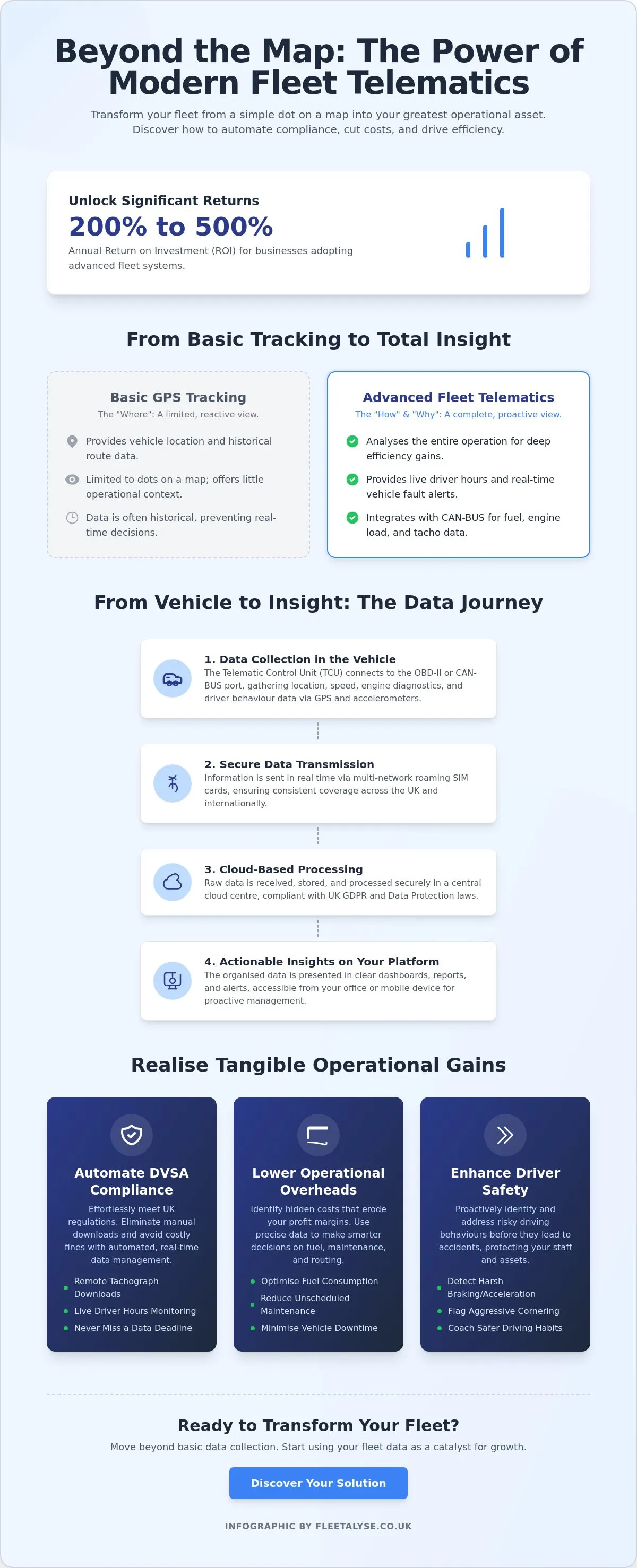
Did you know that businesses adopting advanced fleet systems can achieve an annual return on investment between 200% and 500%? Most UK operators still view telematics as a basic tool for vehicle tracking. It has evolved into the essential backbone of modern transport compliance. If you're still chasing drivers for manual tachograph downloads or worrying about DVSA fines, you're losing time and money. Hidden costs in fuel and maintenance can quietly erode your margins whilst manual admin eats up your week.
Managing a fleet is increasingly complex, especially with the Smart Tachograph 2 mandate for international LCVs arriving in July 2026. This guide shows you how to transform your operations from reactive tracking to proactive management. You'll discover how to automate compliance reporting, gain real-time visibility into driver behaviour, and significantly lower your operational overheads. We'll explore the practical steps to integrate remote tachograph downloads and live driver hours into your daily workflow to keep your business moving efficiently. It's time to move beyond simple data collection and start using your fleet data as a catalyst for growth.
Key Takeaways
- Move beyond basic GPS tracking by understanding how CAN-BUS integration and accelerometers provide a complete picture of your fleet's performance.
- Automate your compliance workflow with remote tachograph downloads to ensure you never miss a data deadline or risk a DVSA fine.
- Discover how telematics identifies poor driver behaviour to help you lower fuel costs and reduce vehicle maintenance requirements.
- Evaluate potential partners based on their commitment to transparent pricing and their practical understanding of the UK regulatory landscape.
What is Telematics? A Straightforward Definition for Fleet Operators
For UK transport operators, the definition of telematics has shifted significantly over the last decade. At its core, What is Telematics? is the convergence of telecommunications and informatics. It is the process of sending, receiving, and storing information via telecommunication devices to monitor remote assets. In the logistics sector, this means transforming a vehicle into a connected data point. It is no longer just about dots on a map. Modern systems pull complex diagnostics from the engine and chassis to provide a 360-degree view of fleet health. This technology is now standard across HGVs, vans, trailers, and plant machinery, providing the essential data needed to survive in a high-pressure industry.
The Core Components of a Telematics System
The hardware is the foundation. Every system starts with a Telematic Control Unit (TCU), commonly known as a black box. This device acts as the brain of the operation. It connects to the vehicle's OBD-II or CAN-BUS port to read data directly from the engine management system. GPS satellites determine the precise location and speed, whilst an internal accelerometer measures G-forces to detect incidents like harsh braking. All this information travels through cellular networks to a central cloud-based centre. This allows you to monitor your assets from any location, whether you're in the office or on the road.
Telematics vs. Simple GPS Tracking
It's easy to mistake a basic GPS tracker for a full system. GPS is purely about location. It tells you where a van is parked or which route a lorry took. Advanced telematics goes much deeper. It looks at the "how" and the "why" of vehicle usage. You aren't just tracking a position; you're analysing the entire operation to find efficiencies.
Consider the difference between historical data and live insights. A basic tracker might show you a route history at the end of the week. A sophisticated system provides live driver hours and real-time alerts. This allows for immediate intervention if a driver is approaching their legal limit or if a vehicle develops a fault. For a UK business, this isn't a luxury. It is a pragmatic requirement for maintaining compliance and keeping operational costs under control. You need to know more than just the destination. You need to know the condition of the asset and the safety of the person behind the wheel.
The Mechanics of Modern Telematics: Hardware, Data, and Software
Understanding the hardware is the first step to building a reliable operation. Most light commercial vehicles use an OBD-II port for quick, plug-and-play installation. Heavy Goods Vehicles (HGVs) require deeper CAN-BUS integration to read fuel levels, engine load, and critical tachograph data. Hardwired units remain the professional choice for permanent installations. These devices provide a stable connection that is difficult to tamper with or accidentally disconnect. Reliable hardware ensures that the data you see in the office matches the reality on the road.
An internal accelerometer is a critical component of any telematics unit. It detects the physical forces acting on the vehicle in three dimensions. This allows the system to flag harsh braking, rapid acceleration, or aggressive cornering. By identifying these patterns, you can address risky behaviour before it leads to a costly accident or vehicle downtime. Raw data from these sensors is useless without proper organisation. Modern software platforms translate these electrical signals into clear, actionable dashboards. This represents the future of fleet management, where data security and cloud storage are paramount for UK transport firms. Protecting driver data is not just a preference; it is a legal necessity under UK GDPR and the Data Protection Act 2018.
How Data Moves from Vehicle to Office
Data doesn't just sit in the vehicle. It moves in tiny packets from engine sensors to the cloud centre via cellular networks. A robust system uses multi-network roaming SIM cards to ensure consistent national coverage. This prevents data "dead zones" in rural areas or during international transit. Updates happen in real time. You see the vehicle's status whilst it is in motion, allowing for dynamic scheduling and immediate response to delays. If you need to upgrade your current setup, you can view our full range of hardware options to find the right fit for your fleet.
Asset and Trailer Tracking Hardware
Trailer tracking presents a unique challenge for many operators. Unlike a van or truck, a trailer may spend days disconnected from a power source. Modern hardware solves this with high-capacity internal batteries or solar-powered tracking units. These devices are designed for extreme durability in harsh environments. They give you visibility of assets that would otherwise be "invisible" once unhitched. This significantly improves asset utilisation. You stop losing trailers in third-party yards and ensure your equipment is being used to its full potential. Secure mounting and long battery life are the two most important factors when selecting these units. It's a simple, pragmatic way to add another layer of security to your operation.
Driving Compliance: Why Remote Tachograph Integration is Non-Negotiable
Compliance isn't just a box-ticking exercise. For UK transport operators, it's the difference between staying on the road and losing your business. The administrative burden of manual tachograph downloads is often the biggest pain point in a transport office. Chasing drivers, finding vehicles, and dealing with missing data gaps creates a constant risk of DVSA fines. Integrating telematics with your tachograph system removes this friction entirely. It's a pragmatic shift from reactive damage control to proactive management. You can find more about these systems at fleetalyse.co.uk to see how they fit your operation.
Maintaining a healthy UK Operator Licence requires robust systems for data collection. The UK government's telematics implementation plan highlights the role of technology in enhancing freight safety and efficiency. By automating these processes, you ensure that every driver card and vehicle unit download happens on time, every time. You aren't just saving time; you're building a digital audit trail that protects your reputation against regulatory scrutiny.
Automating the Tachograph Download Process
Remote Tachograph Download (RTD) technology eliminates the need for vehicles to return to base just for data collection. The system performs scheduled, encrypted downloads whilst the vehicle is anywhere in the UK or Europe. This data flows directly into your tachograph analysis software. You get instant reporting on infringements without lifting a finger. It provides peace of mind that your records are always up to date and ready for inspection. Automated schedules mean you never have to worry about the 28-day or 90-day legal deadlines again.
Live Driver Hours and DVSA Standards
Real-time visibility of driver hours is a game-changer for transport managers. You can see exactly how much driving time a driver has left before they need a break. This prevents accidental breaches of EU and UK drivers' hours rules. It also helps you plan routes more effectively by assigning jobs to the drivers with the most remaining time. This is particularly critical as we approach the 1 July 2026 deadline. From that date, LCVs between 2.5 and 3.5 tonnes used for international hire and reward must be fitted with a Smart Tachograph 2 (G2V2) unit.
During a DVSA audit, having clear, accessible data is vital. Telematics provides a granular level of detail that manual logs simply cannot match. You can prove compliance with speed limits, rest periods, and vehicle safety checks. This transparency builds trust with regulators and demonstrates your commitment to road safety. It's about having the right information at your fingertips when it matters most, ensuring your fleet remains compliant amongst changing regulations.
Realising Operational Gains: Efficiency, Safety, and Cost Reduction
Operational efficiency is the lifeblood of any UK haulier. Implementing telematics provides a direct route to improving your bottom line. Industry data indicates that fleet tracking can reduce fuel costs by up to 15%. This isn't just about shorter routes. It's about how the vehicle is handled. By monitoring engine idling and harsh acceleration, you can identify precisely where fuel is being wasted. This proactive approach extends to vehicle health. Smoother driving reduces wear and tear on tyres and brakes, keeping your assets on the road for longer between service intervals.
Security remains a primary concern for regional operators. Unauthorised use alerts and real-time GPS tracking provide a robust defence against theft. If a trailer or van is moved outside of working hours, you'll know immediately. This visibility often leads to better terms with insurers. Many providers now use data to reward safe driving and proactive risk management. It's a pragmatic way to lower your insurance premiums whilst proving your commitment to safety standards. You can start improving your fleet efficiency today by selecting the right tracking solution for your business.
Improving Driver Behaviour and Safety
Driver behaviour is the single biggest variable in fleet safety. Harsh braking and rapid acceleration are often indicators of distracted or aggressive driving. Telematics platforms allow you to track these events and identify specific training needs for your team. Statistics show that monitoring behaviour can lead to a 40-60% reduction in accidents. Using geofencing allows you to set virtual boundaries around depots or customer sites. You'll receive alerts when a vehicle arrives or leaves, helping you optimise dispatching and reduce unnecessary idling time at the gate. You can even identify your drivers' favourite routes to see which are the most fuel-efficient over time.
Asset Utilisation and Maintenance Planning
Dead mileage is a silent profit killer. It's easy to lose track of underutilised trailers amongst a busy fleet. Tracking hardware gives you the data to see which assets are earning their keep and which are sitting idle. This insight allows you to reallocate resources and improve overall asset utilisation. Maintenance planning also becomes more efficient. Instead of relying on manual logs, you can use engine diagnostics to plan servicing schedules. This prevents unexpected breakdowns and ensures that maintenance doesn't disrupt your daily operations. It's about working smarter, not harder, to keep your fleet moving.
Selecting a Telematics Partner: A Practical Evaluation Framework
Choosing a telematics partner is a long-term operational decision. You need transparency from the outset. Many providers hide costs behind complex contracts or add-on fees for basic features. Look for a partner who offers clear, upfront pricing without hidden surprises. A straightforward software interface is equally important. If your transport manager needs a week of training just to run a report, the system is too complex for a fast-paced environment. Reliability is the final pillar. Hardware must be robust enough to survive the vibration and temperature swings of a commercial vehicle. You need a system that works as hard as your fleet does.
Key Questions to Ask Potential Providers
Ask direct questions during your evaluation to avoid future headaches. Does the system integrate with my existing tachograph analysis software? This is vital for a seamless compliance workflow. If the data doesn't flow automatically, you're back to manual entry. What is the true cost of the hardware compared to the monthly subscription? Some firms offer "free" hardware but lock you into expensive, multi-year terms that cost more in the long run. Transparency in financial terms is a marker of a trustworthy partner. Finally, check how data is handled. Ensure the platform is audit-ready and compliant with UK GDPR. You need to know your data is secure and accessible if the DVSA requests it during an inspection.
Why a Specialist Partner Matters
A specialist UK partner offers distinct advantages over a global software giant. Regional infrastructure and domestic regulations like the Smart Tachograph 2 mandate require specific expertise. A localised partner understands the daily pressures of the UK transport industry. They don't just provide data; they provide context. This empathy for the operator's struggle ensures the features you get are useful, not just flashy. They understand that a missed tacho download isn't just a notification. It's a direct risk to your Operator Licence.
It's about building a relationship with a reliable ally who values your resources and prioritises functional utility. Avoid generic providers who lack deep industry insight. Choose a partner that speaks the language of UK logistics and understands the rigours of real-world transport. This ensures your investment delivers the compliance and efficiency gains you expect. Don't settle for a distant software provider when you can have a pragmatic expert partner. Explore Fleetalyse for transparent, compliance-led telematics and start building a more efficient operation today.
Future-Proof Your Fleet Operations Today
The transition from simple GPS tracking to a comprehensive telematics system is a strategic necessity for any modern UK haulier. You've seen how automated remote tachograph downloads eliminate administrative bottlenecks and protect your Operator Licence. By monitoring driver behaviour and asset utilisation, you can turn raw data into significant fuel savings and improved safety records. These aren't just theoretical gains. They are practical improvements that impact your bottom line every single day.
Managing a fleet is demanding enough without the added stress of manual compliance checks or hidden contract fees. You need a partner that understands the domestic market and the specific rigours of UK transport. We specialise in remote tachograph downloads and provide pragmatic, transparent pricing with dedicated UK-based support. Stop chasing data and start using it to drive your business forward. It is time to move beyond basic tracking and embrace a system built for the realities of the road.
Streamline your fleet compliance with Fleetalyse and take control of your operational efficiency. Your fleet is the heart of your business. It's time to give it the robust support system it deserves.
Frequently Asked Questions
What exactly does a telematics system track?
A telematics system tracks a combination of location data and vehicle diagnostics. It monitors GPS position, speed, and engine load whilst pulling real-time information from the CAN-BUS. Internal accelerometers also record driver behaviour events like harsh braking or rapid acceleration. This provides a complete picture of how your assets are being used on the road.
Is telematics legally required for HGVs in the UK?
There is no specific UK law that mandates the use of telematics for HGVs. However, you are legally required to manage driver hours and tachograph data. Most operators find that meeting these DVSA standards is impossible without digital assistance. The system acts as the bridge between your legal obligations and your daily operations.
How does remote tachograph download work with telematics?
The hardware connects directly to the back of the tachograph unit in the vehicle. It uses a secure cellular connection to transmit driver card and vehicle unit data to your office servers. This happens automatically on a set schedule. It eliminates the need for drivers to return to the depot for manual downloads.
Can telematics help me get DVSA Earned Recognition?
Digital data is a cornerstone of the DVSA Earned Recognition scheme. Telematics systems provide the validated, real-time reporting on drivers' hours and vehicle maintenance that the DVSA requires for accreditation. It proves you have robust systems in place to manage your fleet safely and legally.
Will telematics improve my fleet’s fuel efficiency?
Yes, it directly impacts fuel consumption by identifying inefficient habits. You can monitor excessive idling and aggressive driving patterns that waste fuel. Addressing these behaviours leads to measurable savings. As mentioned earlier, fleet tracking can reduce fuel costs by up to 15% for UK hauliers by encouraging smoother driving styles.
How long does it take to install telematics hardware?
Installation times vary based on the complexity of the hardware. A basic plug-in van tracker takes only a few minutes to set up. A hardwired HGV unit with full tachograph and CAN-BUS integration typically requires one to two hours per vehicle. Professional installation ensures the system is tamper-proof and reliable.
Is the data from telematics systems secure and GDPR compliant?
Data security is a priority for professional providers. Systems are built to comply with the UK General Data Protection Regulation (UK GDPR) and the Data Protection Act 2018. You must ensure you have a clear policy for personal use of vehicles. Conducting a Data Protection Impact Assessment (DPIA) is best practice for any tracking project.
Can I track trailers and non-powered assets with telematics?
You can track trailers and non-powered assets using specialised hardware. These units use long-life internal batteries or solar panels to operate without a constant power source. This ensures you maintain visibility of your trailers even when they are unhitched in a yard or at a customer site.
Frequently asked questions
The Core Components of a Telematics System
The hardware is the foundation. Every system starts with a Telematic Control Unit (TCU), commonly known as a black box. This device acts as the brain of the operation. It connects to the vehicle's OBD-II or CAN-BUS port to read data directly from the engine management system. GPS satellites determine the precise location and speed, whilst an internal accelerometer measures G-forces to detect incidents like harsh braking. All this information travels through cellular networks to a central cloud-based centre. This allows you to monitor your assets from any location, whether you're in the office or on the road.
Telematics vs. Simple GPS Tracking
It's easy to mistake a basic GPS tracker for a full system. GPS is purely about location. It tells you where a van is parked or which route a lorry took. Advanced telematics goes much deeper. It looks at the "how" and the "why" of vehicle usage. You aren't just tracking a position; you're analysing the entire operation to find efficiencies. Consider the difference between historical data and live insights. A basic tracker might show you a route history at the end of the week. A sophisticated system provides live driver hours and real-time alerts. This allows for immediate intervention if a driver is approaching their legal limit or if a vehicle develops a fault. For a UK business, this isn't a luxury. It is a pragmatic requirement for maintaining compliance and keeping operational costs under control. You need to know more than just the destination. You need to know the condition of the asset and the safety of the person behind the wheel. Understanding the hardware is the first step to building a reliable operation. Most light commercial vehicles use an OBD-II port for quick, plug-and-play installation. Heavy Goods Vehicles (HGVs) require deeper CAN-BUS integration to read fuel levels, engine load, and critical tachograph data. Hardwired units remain the professional choice for permanent installations. These devices provide a stable connection that is difficult to tamper with or accidentally disconnect. Reliable hardware ensures that the data you see in the office matches the reality on the road. An internal accelerometer is a critical component of any telematics unit. It detects the physical forces acting on the vehicle in three dimensions. This allows the system to flag harsh braking, rapid acceleration, or aggressive cornering. By identifying these patterns, you can address risky behaviour before it leads to a costly accident or vehicle downtime. Raw data from these sensors is useless without proper organisation. Modern software platforms translate these electrical signals into clear, actionable dashboards. This represents the future of fleet management, where data security and cloud storage are paramount for UK transport firms. Protecting driver data is not just a preference; it is a legal necessity under UK GDPR and the Data Protection Act 2018.
How Data Moves from Vehicle to Office
Data doesn't just sit in the vehicle. It moves in tiny packets from engine sensors to the cloud centre via cellular networks. A robust system uses multi-network roaming SIM cards to ensure consistent national coverage. This prevents data "dead zones" in rural areas or during international transit. Updates happen in real time. You see the vehicle's status whilst it is in motion, allowing for dynamic scheduling and immediate response to delays. If you need to upgrade your current setup, you can view our full range of hardware options to find the right fit for your fleet.
Asset and Trailer Tracking Hardware
Trailer tracking presents a unique challenge for many operators. Unlike a van or truck, a trailer may spend days disconnected from a power source. Modern hardware solves this with high-capacity internal batteries or solar-powered tracking units. These devices are designed for extreme durability in harsh environments. They give you visibility of assets that would otherwise be "invisible" once unhitched. This significantly improves asset utilisation. You stop losing trailers in third-party yards and ensure your equipment is being used to its full potential. Secure mounting and long battery life are the two most important factors when selecting these units. It's a simple, pragmatic way to add another layer of security to your operation. Compliance isn't just a box-ticking exercise. For UK transport operators, it's the difference between staying on the road and losing your business. The administrative burden of manual tachograph downloads is often the biggest pain point in a transport office. Chasing drivers, finding vehicles, and dealing with missing data gaps creates a constant risk of DVSA fines. Integrating telematics with your tachograph system removes this friction entirely. It's a pragmatic shift from reactive damage control to proactive management. You can find more about these systems at fleetalyse.co.uk to see how they fit your operation. Maintaining a healthy UK Operator Licence requires robust systems for data collection. The UK government's telematics implementation plan highlights the role of technology in enhancing freight safety and efficiency. By automating these processes, you ensure that every driver card and vehicle unit download happens on time, every time. You aren't just saving time; you're building a digital audit trail that protects your reputation against regulatory scrutiny.
Automating the Tachograph Download Process
Remote Tachograph Download (RTD) technology eliminates the need for vehicles to return to base just for data collection. The system performs scheduled, encrypted downloads whilst the vehicle is anywhere in the UK or Europe. This data flows directly into your tachograph analysis software. You get instant reporting on infringements without lifting a finger. It provides peace of mind that your records are always up to date and ready for inspection. Automated schedules mean you never have to worry about the 28-day or 90-day legal deadlines again.
Live Driver Hours and DVSA Standards
Real-time visibility of driver hours is a game-changer for transport managers. You can see exactly how much driving time a driver has left before they need a break. This prevents accidental breaches of EU and UK drivers' hours rules. It also helps you plan routes more effectively by assigning jobs to the drivers with the most remaining time. This is particularly critical as we approach the 1 July 2026 deadline. From that date, LCVs between 2.5 and 3.5 tonnes used for international hire and reward must be fitted with a Smart Tachograph 2 (G2V2) unit. During a DVSA audit, having clear, accessible data is vital. Telematics provides a granular level of detail that manual logs simply cannot match. You can prove compliance with speed limits, rest periods, and vehicle safety checks. This transparency builds trust with regulators and demonstrates your commitment to road safety. It's about having the right information at your fingertips when it matters most, ensuring your fleet remains compliant amongst changing regulations. Operational efficiency is the lifeblood of any UK haulier. Implementing telematics provides a direct route to improving your bottom line. Industry data indicates that fleet tracking can reduce fuel costs by up to 15%. This isn't just about shorter routes. It's about how the vehicle is handled. By monitoring engine idling and harsh acceleration, you can identify precisely where fuel is being wasted. This proactive approach extends to vehicle health. Smoother driving reduces wear and tear on tyres and brakes, keeping your assets on the road for longer between service intervals. Security remains a primary concern for regional operators. Unauthorised use alerts and real-time GPS tracking provide a robust defence against theft. If a trailer or van is moved outside of working hours, you'll know immediately. This visibility often leads to better terms with insurers. Many providers now use data to reward safe driving and proactive risk management. It's a pragmatic way to lower your insurance premiums whilst proving your commitment to safety standards. You can start improving your fleet efficiency today by selecting the right tracking solution for your business.
Improving Driver Behaviour and Safety
Driver behaviour is the single biggest variable in fleet safety. Harsh braking and rapid acceleration are often indicators of distracted or aggressive driving. Telematics platforms allow you to track these events and identify specific training needs for your team. Statistics show that monitoring behaviour can lead to a 40-60% reduction in accidents. Using geofencing allows you to set virtual boundaries around depots or customer sites. You'll receive alerts when a vehicle arrives or leaves, helping you optimise dispatching and reduce unnecessary idling time at the gate. You can even identify your drivers' favourite routes to see which are the most fuel-efficient over time.
Asset Utilisation and Maintenance Planning
Dead mileage is a silent profit killer. It's easy to lose track of underutilised trailers amongst a busy fleet. Tracking hardware gives you the data to see which assets are earning their keep and which are sitting idle. This insight allows you to reallocate resources and improve overall asset utilisation. Maintenance planning also becomes more efficient. Instead of relying on manual logs, you can use engine diagnostics to plan servicing schedules. This prevents unexpected breakdowns and ensures that maintenance doesn't disrupt your daily operations. It's about working smarter, not harder, to keep your fleet moving. Choosing a telematics partner is a long-term operational decision. You need transparency from the outset. Many providers hide costs behind complex contracts or add-on fees for basic features. Look for a partner who offers clear, upfront pricing without hidden surprises. A straightforward software interface is equally important. If your transport manager needs a week of training just to run a report, the system is too complex for a fast-paced environment. Reliability is the final pillar. Hardware must be robust enough to survive the vibration and temperature swings of a commercial vehicle. You need a system that works as hard as your fleet does.
Key Questions to Ask Potential Providers
Ask direct questions during your evaluation to avoid future headaches. Does the system integrate with my existing tachograph analysis software? This is vital for a seamless compliance workflow. If the data doesn't flow automatically, you're back to manual entry. What is the true cost of the hardware compared to the monthly subscription? Some firms offer "free" hardware but lock you into expensive, multi-year terms that cost more in the long run. Transparency in financial terms is a marker of a trustworthy partner. Finally, check how data is handled. Ensure the platform is audit-ready and compliant with UK GDPR. You need to know your data is secure and accessible if the DVSA requests it during an inspection.
Why a Specialist Partner Matters
A specialist UK partner offers distinct advantages over a global software giant. Regional infrastructure and domestic regulations like the Smart Tachograph 2 mandate require specific expertise. A localised partner understands the daily pressures of the UK transport industry. They don't just provide data; they provide context. This empathy for the operator's struggle ensures the features you get are useful, not just flashy. They understand that a missed tacho download isn't just a notification. It's a direct risk to your Operator Licence. It's about building a relationship with a reliable ally who values your resources and prioritises functional utility. Avoid generic providers who lack deep industry insight. Choose a partner that speaks the language of UK logistics and understands the rigours of real-world transport. This ensures your investment delivers the compliance and efficiency gains you expect. Don't settle for a distant software provider when you can have a pragmatic expert partner. Explore Fleetalyse for transparent, compliance-led telematics and start building a more efficient operation today. The transition from simple GPS tracking to a comprehensive telematics system is a strategic necessity for any modern UK haulier. You've seen how automated remote tachograph downloads eliminate administrative bottlenecks and protect your Operator Licence. By monitoring driver behaviour and asset utilisation, you can turn raw data into significant fuel savings and improved safety records. These aren't just theoretical gains. They are practical improvements that impact your bottom line every single day. Managing a fleet is demanding enough without the added stress of manual compliance checks or hidden contract fees. You need a partner that understands the domestic market and the specific rigours of UK transport. We specialise in remote tachograph downloads and provide pragmatic, transparent pricing with dedicated UK-based support. Stop chasing data and start using it to drive your business forward. It is time to move beyond basic tracking and embrace a system built for the realities of the road. Streamline your fleet compliance with Fleetalyse and take control of your operational efficiency. Your fleet is the heart of your business. It's time to give it the robust support system it deserves.
What exactly does a telematics system track?
A telematics system tracks a combination of location data and vehicle diagnostics. It monitors GPS position, speed, and engine load whilst pulling real-time information from the CAN-BUS. Internal accelerometers also record driver behaviour events like harsh braking or rapid acceleration. This provides a complete picture of how your assets are being used on the road.
Is telematics legally required for HGVs in the UK?
There is no specific UK law that mandates the use of telematics for HGVs. However, you are legally required to manage driver hours and tachograph data. Most operators find that meeting these DVSA standards is impossible without digital assistance. The system acts as the bridge between your legal obligations and your daily operations.
How does remote tachograph download work with telematics?
The hardware connects directly to the back of the tachograph unit in the vehicle. It uses a secure cellular connection to transmit driver card and vehicle unit data to your office servers. This happens automatically on a set schedule. It eliminates the need for drivers to return to the depot for manual downloads.
Can telematics help me get DVSA Earned Recognition?
Digital data is a cornerstone of the DVSA Earned Recognition scheme. Telematics systems provide the validated, real-time reporting on drivers' hours and vehicle maintenance that the DVSA requires for accreditation. It proves you have robust systems in place to manage your fleet safely and legally.
Will telematics improve my fleet’s fuel efficiency?
Yes, it directly impacts fuel consumption by identifying inefficient habits. You can monitor excessive idling and aggressive driving patterns that waste fuel. Addressing these behaviours leads to measurable savings. As mentioned earlier, fleet tracking can reduce fuel costs by up to 15% for UK hauliers by encouraging smoother driving styles.
How long does it take to install telematics hardware?
Installation times vary based on the complexity of the hardware. A basic plug-in van tracker takes only a few minutes to set up. A hardwired HGV unit with full tachograph and CAN-BUS integration typically requires one to two hours per vehicle. Professional installation ensures the system is tamper-proof and reliable.
Is the data from telematics systems secure and GDPR compliant?
Data security is a priority for professional providers. Systems are built to comply with the UK General Data Protection Regulation (UK GDPR) and the Data Protection Act 2018. You must ensure you have a clear policy for personal use of vehicles. Conducting a Data Protection Impact Assessment (DPIA) is best practice for any tracking project.
Can I track trailers and non-powered assets with telematics?
You can track trailers and non-powered assets using specialised hardware. These units use long-life internal batteries or solar panels to operate without a constant power source. This ensures you maintain visibility of your trailers even when they are unhitched in a yard or at a customer site.