
How much of your week is wasted waiting for a driver to return to the yard just so you can download their tacho data? It's a common headache for regional operators. You're trying to plan urgent jobs and worrying about potential infringements because you lack live driver hours visibility. Relying on manual downloads makes it impossible to react to the day's demands with confidence. You shouldn't have to manage your fleet in the dark.
Achieving this level of clarity eliminates compliance blind spots and moves your compliance from a reactive chore to a strategic tool. You'll gain total visibility of remaining drive times and reduce the administrative overhead that slows your team down. This is about more than just avoiding fines; it's about running a tighter, more efficient operation. This guide explains how real-time data integration and remote tachograph downloads support your O-Licence security whilst keeping your fleet productive in 2026.
Key Takeaways
- Protect your O-Licence by eliminating the blind spots caused by delayed manual data and reactive compliance monitoring.
- Learn how remote tachograph download hardware enables live driver hours visability for instant access to remaining drive times.
- Quantify the administrative savings gained by switching from manual logbooks to automated, real-time digital streaming.
- Identify the specific steps required to audit your current fleet hardware and prepare for a seamless compliance transition.
- Transform your compliance data into a competitive advantage by using live availability to plan urgent jobs with total confidence.
Why Real-Time Visibility Matters for UK Transport Operators
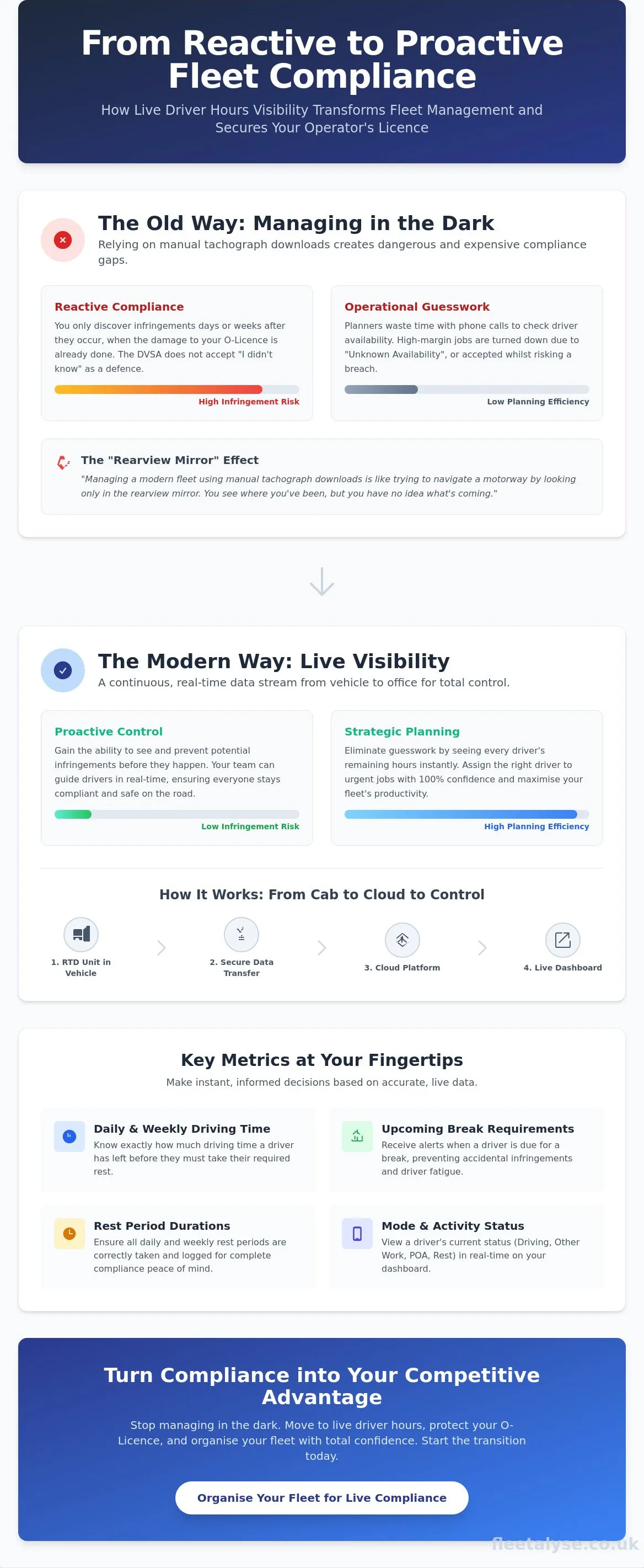
Managing a modern fleet using manual tachograph downloads is like trying to navigate a motorway by looking only in the rearview mirror. You see where you've been, but you have no idea what's coming. For regional operators, this delay creates a dangerous compliance gap. If a driver breaches the EU rules on drivers' hours on a Monday morning, a transport manager might not discover the error until the following week. By then, the damage to your Operator Licence is already done.
The DVSA doesn't accept "I didn't know" as a valid defence. They expect proactive management and robust systems. Moving toward live driver hours visability changes the dynamic entirely. It shifts your role from a reactive record-keeper to an active controller. You gain the quiet confidence that comes from being constantly audit-ready. This transparency is also the foundation of Earned Recognition status, proving to regulators that your business is built on integrity and real-time oversight.
Eliminating the Compliance Blind Spot
Compliance blind spots are expensive. Retrospective infringements often lead to heavy fines and public inquiries. When you wait for weekly or fortnightly downloads, you're operating in the dark. This lack of data also creates "Unknown Availability." You might turn down a high-priority, high-margin job simply because you aren't sure if a driver has the remaining hours to complete it safely. Alternatively, you might assign it and inadvertently trigger a breach. Real-time data removes this guesswork. It protects your business reputation with the DVSA and ensures your clients see you as a reliable, professional partner.
Operational Efficiency Beyond the Rulebook
Compliance shouldn't be a burden that slows you down; it should be a tool that speeds you up. When planners have live driver hours visability, they stop wasting time on manual phone calls. You no longer need to ring around to ask how many hours a driver has left. The data is right there on the screen. This efficiency allows planners to assign the right driver to the right route based on actual, up-to-the-minute availability. It also improves driver retention. Drivers feel less stressed when they know their office team is looking out for them, preventing accidental over-driving before it happens. Working with a specialist like Fleetalyse helps you turn these regulatory requirements into a genuine competitive advantage.
What is Live Driver Hours Visibility and How Does it Work?
Many operators confuse remote downloads with live visibility. A remote download is the automated process of retrieving legal driver card and vehicle unit files for compliance records. Whilst essential, this often happens on a set schedule. In contrast, live driver hours visability provides a continuous, real-time stream of data directly from the tachograph head to your management dashboard. This means the figures you see are accurate to the second, not the previous day.
The system works by creating a digital bridge between the vehicle and the office. It removes the need for drivers to manually report their remaining time. Instead, the data flows automatically, allowing you to make instant decisions based on factual availability. This level of detail is what separates a modern, data-driven fleet from one still reliant on guesswork and phone calls. Integrating this stream with your tachograph analysis software provides a single source of truth for both daily planning and long-term auditing.
The Technology Behind the Dashboard
The process starts with a Remote Tachograph Download (RTD) unit. This hardware connects directly to the digital tachograph head inside the cab. It reads the live activity and transmits it via a secure, encrypted mobile network to a cloud-based platform. Because the data is cloud-hosted, you can access your fleet's status from any device, anywhere. This setup ensures your data remains private and protected whilst providing the flexibility needed for regional operations. You can organise your compliance hardware today to begin streaming this vital information directly to your team.
Key Metrics Tracked in Real-Time
To manage a fleet effectively, you must understand how the official UK government guidance applies to every driver in every moment. Live driver hours visability tracks several critical metrics simultaneously:
- Daily driving time remaining: Know exactly how much time a driver has left before they must stop.
- Upcoming break requirements: See when a driver is due for a rest to avoid accidental infringements.
- Weekly and fortnightly totals: Track cumulative hours to ensure you don't breach long-term limits.
- Rest period countdowns: Monitor daily and weekly rest to ensure drivers are fully legal before their next shift starts.
Having these metrics visible in real-time allows planners to react to delays or urgent job requests with total precision. If a delivery is delayed at a depot, you'll know immediately if the driver has the hours to finish the route or if a swap is required. This proactive approach keeps your fleet moving safely and legally. For more information on how to implement these tools, visit Fleetalyse to explore our specialist compliance solutions.
Manual vs. Live Tracking: Comparing Compliance Strategies
Choosing between manual downloads and live driver hours visability is a choice between looking backward and looking forward. A reactive compliance strategy relies on data that is often days or weeks old. By the time a transport manager identifies a breach in a manual logbook or a downloaded card, the legal window to prevent that error has already closed. This approach leaves your business vulnerable to fines and a declining O-Licence score. It's a high-risk way to manage a modern fleet.
Adopting a proactive mindset requires automated tools. Real-time tracking doesn't just record what happened; it tells you what is happening right now. This allows you to intervene before a driver exceeds their limits. Moving from a reactive to a proactive strategy transforms compliance from a source of stress into a predictable, managed part of your daily workflow. Operators who partner with Fleetalyse often find that the subscription cost is quickly offset by the reduction in administrative hours and the elimination of infringement penalties.
The Hidden Costs of Manual Downloads
Manual data collection is a significant drain on resources. Think about the man-hours spent chasing drivers to return to the yard just to slot a card into a reader. If a vehicle has to divert from its route or return to the depot specifically for a download, you're paying for wasted fuel and unproductive driver time. There's also the constant risk of data loss or corruption during manual transfers. If a driver card is damaged or a file is misplaced before it's uploaded to your analysis software, you're left with a legal gap that's impossible to fill. These hidden costs quietly erode your profit margins every single month.
Why Live Visibility Wins the Audit
Staying on top of complex HGV driver hour rules is difficult enough without adding manual data entry into the mix. During a roadside check, a DVSA officer looks for evidence of robust management. Providing immediate, accurate records via live driver hours visability demonstrates that you maintain a "Continuous Monitoring" approach. It proves you aren't just checking boxes once a month; you're managing your fleet with integrity every hour of the day. Automated reporting features further simplify this process. They gather the necessary data into clean, audit-ready formats, making the annual audit process a straightforward exercise rather than a frantic scramble for missing paperwork.
How to Organise Your Fleet for Live Compliance Monitoring
Transitioning to a real-time system is a structured process, not an overnight overhaul. It requires a move from legacy manual habits to an automated workflow. Start by auditing your current tachograph hardware. Most digital tachograph heads manufactured after 2011 support remote data retrieval, but you must verify vehicle compatibility across your entire fleet. Once you've confirmed your hardware status, the next step is selecting a telematics partner that understands the specific nuances of UK transport law.
Install Remote Tachograph Download units across your vehicles to establish the data link. This hardware allows for live driver hours visability without needing the vehicle to return to the depot. Training your transport planners is the next vital phase. They need to transition from making manual phone calls to using the live dashboard for all dispatch decisions. Finally, use the initial weeks of data to review and refine your internal processes. This allows you to identify patterns in driver behaviour and close compliance gaps before they lead to DVSA interventions.
Choosing the Right Telematics Partner
Your telematics partner should act as a pragmatic expert, not just a hardware vendor. Look for a provider that offers UK-based support and industry expertise. It's essential that their system integrates directly with your existing tachograph analysis software to maintain a single source of truth. Verify the transparency of their costs and contract terms upfront. Avoid generic, global providers who lack a deep understanding of the regional challenges faced by UK hauliers. You can organise your fleet compliance hardware through a specialist who values your time and operational clarity.
Engaging Your Drivers in the Process
Drivers often view new technology with suspicion. Address these concerns directly by explaining the personal benefits. Live visibility means fewer intrusive phone calls during their rest periods and less paperwork at the end of a shift. Set clear expectations about how the data will be used. It shouldn't be a tool for micromanagement, but a safety net that prevents accidental infringements. Use the data to reward compliant behaviour and professional driving standards. When drivers realise the system protects their own vocational licence, they are more likely to support the transition.
Enhancing Your Fleet Operations with Fleetalyse Solutions
Fleetalyse operates as a pragmatic expert partner for UK transport operators. We don't provide flashy, unnecessary features that complicate your day. Instead, we focus on functional utility and operational clarity. Our approach to remote tachograph and compliance monitoring is grounded in the daily struggles of regional hauliers. By providing live driver hours visability, we help you remove the hidden complexities that often lead to infringement fines. We value your time and resources, which is why our system is built for reliability rather than theoretical data collection.
Our solutions offer seamless integration across your entire operation. You don't just see where your vehicles are; you see exactly how much drive time is left. Combining GPS fleet tracking with live driver hours visability allows for a more efficient dispatch process. This unified view ensures that every decision you make is backed by accurate, real-time figures. Regional operators choose us because we're transparent about costs and dedicated to the domestic market. We understand the local infrastructure and the specific pressures of UK road transport.
A Specialised Solution for UK Fleets
We focus exclusively on the challenges of UK transport regulations. Our platform provides straightforward, declarative data that managers can act on immediately. There is no need to sift through complex reports to find the information you need. Whether you're managing HGVs, vans, or tracking trailers, Fleetalyse ensures every asset is visible and secure. This level of oversight is essential for maintaining your O-Licence and achieving Earned Recognition status. We provide the industry credentials and technical expertise required to keep your fleet compliant whilst improving overall productivity.
Getting Started with Live Visibility
Fleetalyse simplifies the transition from manual downloads to live monitoring. We use a benefit-first structure in our software design, ensuring the most valuable information is always front and centre. You won't find any typical marketing hyperbole here, just a reliable tool built for real-world application. We lead you through a logical progression from hardware installation to granular data analysis. This structured approach prevents your team from feeling overwhelmed during the switch. You can book a demo to see how we can organise your fleet compliance and transform your operational efficiency. Our team is ready to provide the practical support you need to eliminate compliance blind spots for good.
Secure Your Fleet's Future with Real-Time Compliance
Operating a fleet in 2026 requires more than just meeting the minimum legal standards. It demands a move away from the risks of manual data collection and toward a proactive, automated strategy. By integrating live driver hours visability, you eliminate the uncertainty that leads to infringements and operational delays. You gain the ability to plan with precision whilst ensuring your O-Licence remains secure. This shift transforms compliance from a reactive chore into a strategic asset for your business.
Fleetalyse acts as a pragmatic partner for regional hauliers. We are specialists in UK transport compliance, offering a straightforward approach to asset management. Our systems provide automated remote tachograph downloads for total peace of mind, backed by transparent pricing with no hidden complexities. You don't need to manage your fleet in the dark any longer. Take control of your data and turn compliance into a genuine competitive advantage for your team.
Streamline your fleet compliance with Fleetalyse live driver hours tracking and start running a more efficient, audit-ready operation today.
Frequently Asked Questions
Is live driver hours visibility a legal requirement for UK operators?
No, live driver hours visability is not a specific legal requirement, but maintaining accurate records of driving time and rest periods is mandatory. Most operators use live tools to ensure they meet their O-Licence obligations proactively. It acts as a safety net that prevents the retrospective infringements common with manual data collection, helping you stay on the right side of DVSA standards.
How often does the data update on a live driver hours dashboard?
Data typically updates every minute or whenever a driver changes their activity status on the tachograph head. This near real-time streaming ensures that the "time remaining" figures on your dashboard are always current. It allows planners to make dispatch decisions based on what is happening on the road right now, rather than relying on reports that are several days old.
Can live tracking prevent all tachograph infringements?
Live tracking cannot physically prevent a driver from committing an infringement, but it provides the alerts necessary for managers to intervene. By seeing a driver approaching their limit in real-time, you can contact them to ensure they find a safe place to stop. This proactive management demonstrates to regulators that you are actively monitoring and controlling your fleet's compliance behaviour.
Does live visibility work for both HGV and van fleets?
Live visibility is primarily designed for HGV fleets equipped with digital tachographs. For van fleets, compliance monitoring usually focuses on GPS tracking and shift times unless the vehicle falls under tacho regulations due to weight or towing. If your vans are fitted with tachographs, the same live driver hours visability benefits apply, ensuring total consistency across your entire commercial vehicle operation.
What happens if a vehicle is in a remote area with poor signal?
If a vehicle enters a remote area with poor mobile signal, the Remote Tachograph Download unit stores the data locally. Once the vehicle returns to an area with coverage, the hardware automatically uploads the buffered information to the cloud. You won't lose any compliance data, though the dashboard may show the last known status until the connection is restored.
Will live driver hours tracking work with older digital tachographs?
Most digital tachographs manufactured after 2011 are compatible with live tracking hardware. This generally includes VDO versions 1.4 and above or Stoneridge versions 7.3 and above. If your fleet uses older units, you may need to upgrade the tachograph head to enable real-time data streaming. It's best to audit your hardware compatibility before beginning a fleet-wide installation.
How does live visibility help with the HGV Working Time Directive (WTD)?
Live visibility tracks total shift duration alongside driving time, which is essential for managing Working Time Directive limits. It helps you monitor the 60-hour maximum working week and ensures drivers take the required breaks after six hours of work. Having this data visible in real-time prevents accidental breaches of both tachograph rules and WTD regulations during busy periods.
Can I integrate live hours data with my existing payroll system?
You can integrate live hours data with payroll systems through tachograph analysis integration. By automating the flow of data from the vehicle to your analysis software, you create a seamless link for calculating driver pay based on actual digital records. This reduces the administrative burden on your office team and eliminates the human errors often found in manual timesheets.
Frequently asked questions
Eliminating the Compliance Blind Spot
Compliance blind spots are expensive. Retrospective infringements often lead to heavy fines and public inquiries. When you wait for weekly or fortnightly downloads, you're operating in the dark. This lack of data also creates "Unknown Availability." You might turn down a high-priority, high-margin job simply because you aren't sure if a driver has the remaining hours to complete it safely. Alternatively, you might assign it and inadvertently trigger a breach. Real-time data removes this guesswork. It protects your business reputation with the DVSA and ensures your clients see you as a reliable, professional partner.
Operational Efficiency Beyond the Rulebook
Compliance shouldn't be a burden that slows you down; it should be a tool that speeds you up. When planners have live driver hours visability, they stop wasting time on manual phone calls. You no longer need to ring around to ask how many hours a driver has left. The data is right there on the screen. This efficiency allows planners to assign the right driver to the right route based on actual, up-to-the-minute availability. It also improves driver retention. Drivers feel less stressed when they know their office team is looking out for them, preventing accidental over-driving before it happens. Working with a specialist like Fleetalyse helps you turn these regulatory requirements into a genuine competitive advantage. Many operators confuse remote downloads with live visibility. A remote download is the automated process of retrieving legal driver card and vehicle unit files for compliance records. Whilst essential, this often happens on a set schedule. In contrast, live driver hours visability provides a continuous, real-time stream of data directly from the tachograph head to your management dashboard. This means the figures you see are accurate to the second, not the previous day. The system works by creating a digital bridge between the vehicle and the office. It removes the need for drivers to manually report their remaining time. Instead, the data flows automatically, allowing you to make instant decisions based on factual availability. This level of detail is what separates a modern, data-driven fleet from one still reliant on guesswork and phone calls. Integrating this stream with your tachograph analysis software provides a single source of truth for both daily planning and long-term auditing.
The Technology Behind the Dashboard
The process starts with a Remote Tachograph Download (RTD) unit. This hardware connects directly to the digital tachograph head inside the cab. It reads the live activity and transmits it via a secure, encrypted mobile network to a cloud-based platform. Because the data is cloud-hosted, you can access your fleet's status from any device, anywhere. This setup ensures your data remains private and protected whilst providing the flexibility needed for regional operations. You can organise your compliance hardware today to begin streaming this vital information directly to your team.
Key Metrics Tracked in Real-Time
To manage a fleet effectively, you must understand how the official UK government guidance applies to every driver in every moment. Live driver hours visability tracks several critical metrics simultaneously: Having these metrics visible in real-time allows planners to react to delays or urgent job requests with total precision. If a delivery is delayed at a depot, you'll know immediately if the driver has the hours to finish the route or if a swap is required. This proactive approach keeps your fleet moving safely and legally. For more information on how to implement these tools, visit Fleetalyse to explore our specialist compliance solutions. Choosing between manual downloads and live driver hours visability is a choice between looking backward and looking forward. A reactive compliance strategy relies on data that is often days or weeks old. By the time a transport manager identifies a breach in a manual logbook or a downloaded card, the legal window to prevent that error has already closed. This approach leaves your business vulnerable to fines and a declining O-Licence score. It's a high-risk way to manage a modern fleet. Adopting a proactive mindset requires automated tools. Real-time tracking doesn't just record what happened; it tells you what is happening right now. This allows you to intervene before a driver exceeds their limits. Moving from a reactive to a proactive strategy transforms compliance from a source of stress into a predictable, managed part of your daily workflow. Operators who partner with Fleetalyse often find that the subscription cost is quickly offset by the reduction in administrative hours and the elimination of infringement penalties.
The Hidden Costs of Manual Downloads
Manual data collection is a significant drain on resources. Think about the man-hours spent chasing drivers to return to the yard just to slot a card into a reader. If a vehicle has to divert from its route or return to the depot specifically for a download, you're paying for wasted fuel and unproductive driver time. There's also the constant risk of data loss or corruption during manual transfers. If a driver card is damaged or a file is misplaced before it's uploaded to your analysis software, you're left with a legal gap that's impossible to fill. These hidden costs quietly erode your profit margins every single month.
Why Live Visibility Wins the Audit
Staying on top of complex HGV driver hour rules is difficult enough without adding manual data entry into the mix. During a roadside check, a DVSA officer looks for evidence of robust management. Providing immediate, accurate records via live driver hours visability demonstrates that you maintain a "Continuous Monitoring" approach. It proves you aren't just checking boxes once a month; you're managing your fleet with integrity every hour of the day. Automated reporting features further simplify this process. They gather the necessary data into clean, audit-ready formats, making the annual audit process a straightforward exercise rather than a frantic scramble for missing paperwork. Transitioning to a real-time system is a structured process, not an overnight overhaul. It requires a move from legacy manual habits to an automated workflow. Start by auditing your current tachograph hardware. Most digital tachograph heads manufactured after 2011 support remote data retrieval, but you must verify vehicle compatibility across your entire fleet. Once you've confirmed your hardware status, the next step is selecting a telematics partner that understands the specific nuances of UK transport law. Install Remote Tachograph Download units across your vehicles to establish the data link. This hardware allows for live driver hours visability without needing the vehicle to return to the depot. Training your transport planners is the next vital phase. They need to transition from making manual phone calls to using the live dashboard for all dispatch decisions. Finally, use the initial weeks of data to review and refine your internal processes. This allows you to identify patterns in driver behaviour and close compliance gaps before they lead to DVSA interventions.
Choosing the Right Telematics Partner
Your telematics partner should act as a pragmatic expert, not just a hardware vendor. Look for a provider that offers UK-based support and industry expertise. It's essential that their system integrates directly with your existing tachograph analysis software to maintain a single source of truth. Verify the transparency of their costs and contract terms upfront. Avoid generic, global providers who lack a deep understanding of the regional challenges faced by UK hauliers. You can organise your fleet compliance hardware through a specialist who values your time and operational clarity.
Engaging Your Drivers in the Process
Drivers often view new technology with suspicion. Address these concerns directly by explaining the personal benefits. Live visibility means fewer intrusive phone calls during their rest periods and less paperwork at the end of a shift. Set clear expectations about how the data will be used. It shouldn't be a tool for micromanagement, but a safety net that prevents accidental infringements. Use the data to reward compliant behaviour and professional driving standards. When drivers realise the system protects their own vocational licence, they are more likely to support the transition. Fleetalyse operates as a pragmatic expert partner for UK transport operators. We don't provide flashy, unnecessary features that complicate your day. Instead, we focus on functional utility and operational clarity. Our approach to remote tachograph and compliance monitoring is grounded in the daily struggles of regional hauliers. By providing live driver hours visability, we help you remove the hidden complexities that often lead to infringement fines. We value your time and resources, which is why our system is built for reliability rather than theoretical data collection. Our solutions offer seamless integration across your entire operation. You don't just see where your vehicles are; you see exactly how much drive time is left. Combining GPS fleet tracking with live driver hours visability allows for a more efficient dispatch process. This unified view ensures that every decision you make is backed by accurate, real-time figures. Regional operators choose us because we're transparent about costs and dedicated to the domestic market. We understand the local infrastructure and the specific pressures of UK road transport.
A Specialised Solution for UK Fleets
We focus exclusively on the challenges of UK transport regulations. Our platform provides straightforward, declarative data that managers can act on immediately. There is no need to sift through complex reports to find the information you need. Whether you're managing HGVs, vans, or tracking trailers, Fleetalyse ensures every asset is visible and secure. This level of oversight is essential for maintaining your O-Licence and achieving Earned Recognition status. We provide the industry credentials and technical expertise required to keep your fleet compliant whilst improving overall productivity.
Getting Started with Live Visibility
Fleetalyse simplifies the transition from manual downloads to live monitoring. We use a benefit-first structure in our software design, ensuring the most valuable information is always front and centre. You won't find any typical marketing hyperbole here, just a reliable tool built for real-world application. We lead you through a logical progression from hardware installation to granular data analysis. This structured approach prevents your team from feeling overwhelmed during the switch. You can book a demo to see how we can organise your fleet compliance and transform your operational efficiency. Our team is ready to provide the practical support you need to eliminate compliance blind spots for good. Operating a fleet in 2026 requires more than just meeting the minimum legal standards. It demands a move away from the risks of manual data collection and toward a proactive, automated strategy. By integrating live driver hours visability, you eliminate the uncertainty that leads to infringements and operational delays. You gain the ability to plan with precision whilst ensuring your O-Licence remains secure. This shift transforms compliance from a reactive chore into a strategic asset for your business. Fleetalyse acts as a pragmatic partner for regional hauliers. We are specialists in UK transport compliance, offering a straightforward approach to asset management. Our systems provide automated remote tachograph downloads for total peace of mind, backed by transparent pricing with no hidden complexities. You don't need to manage your fleet in the dark any longer. Take control of your data and turn compliance into a genuine competitive advantage for your team. Streamline your fleet compliance with Fleetalyse live driver hours tracking and start running a more efficient, audit-ready operation today.
Is live driver hours visibility a legal requirement for UK operators?
No, live driver hours visability is not a specific legal requirement, but maintaining accurate records of driving time and rest periods is mandatory. Most operators use live tools to ensure they meet their O-Licence obligations proactively. It acts as a safety net that prevents the retrospective infringements common with manual data collection, helping you stay on the right side of DVSA standards.
How often does the data update on a live driver hours dashboard?
Data typically updates every minute or whenever a driver changes their activity status on the tachograph head. This near real-time streaming ensures that the "time remaining" figures on your dashboard are always current. It allows planners to make dispatch decisions based on what is happening on the road right now, rather than relying on reports that are several days old.
Can live tracking prevent all tachograph infringements?
Live tracking cannot physically prevent a driver from committing an infringement, but it provides the alerts necessary for managers to intervene. By seeing a driver approaching their limit in real-time, you can contact them to ensure they find a safe place to stop. This proactive management demonstrates to regulators that you are actively monitoring and controlling your fleet's compliance behaviour.
Does live visibility work for both HGV and van fleets?
Live visibility is primarily designed for HGV fleets equipped with digital tachographs. For van fleets, compliance monitoring usually focuses on GPS tracking and shift times unless the vehicle falls under tacho regulations due to weight or towing. If your vans are fitted with tachographs, the same live driver hours visability benefits apply, ensuring total consistency across your entire commercial vehicle operation.
What happens if a vehicle is in a remote area with poor signal?
If a vehicle enters a remote area with poor mobile signal, the Remote Tachograph Download unit stores the data locally. Once the vehicle returns to an area with coverage, the hardware automatically uploads the buffered information to the cloud. You won't lose any compliance data, though the dashboard may show the last known status until the connection is restored.
Will live driver hours tracking work with older digital tachographs?
Most digital tachographs manufactured after 2011 are compatible with live tracking hardware. This generally includes VDO versions 1.4 and above or Stoneridge versions 7.3 and above. If your fleet uses older units, you may need to upgrade the tachograph head to enable real-time data streaming. It's best to audit your hardware compatibility before beginning a fleet-wide installation.
How does live visibility help with the HGV Working Time Directive (WTD)?
Live visibility tracks total shift duration alongside driving time, which is essential for managing Working Time Directive limits. It helps you monitor the 60-hour maximum working week and ensures drivers take the required breaks after six hours of work. Having this data visible in real-time prevents accidental breaches of both tachograph rules and WTD regulations during busy periods.
Can I integrate live hours data with my existing payroll system?
You can integrate live hours data with payroll systems through tachograph analysis integration. By automating the flow of data from the vehicle to your analysis software, you create a seamless link for calculating driver pay based on actual digital records. This reduces the administrative burden on your office team and eliminates the human errors often found in manual timesheets.