

Operator licence application steps: a practical checklist

Apply for your operator licence through the Vehicle Operator Licensing service, submit statutory evidence of financial standing, your vehicle list, a nominated transport manager and maintenance arrangements, then advertise where the rules require it. Straightforward applications are usually decided within seven to nine weeks, so submit well in advance before you need the licence.
Three bodies shape this process: the Traffic Commissioner, who applies statutory tests and decides your case; the DVSA, which administers the scheme on the commissioner’s behalf; and, on the operational side, tools like Fleetalyse, which give you the audit trails regulators expect to see.
- Apply online, at least nine weeks ahead of your start date.
- Gather financial, vehicle, transport manager and maintenance evidence before you begin the form.
- Advertise heavy goods vehicle applications correctly, within the required window.
- Consider an interim licence only if a genuine gap in cover exists, not as a way to skip preparation.
Key Takeaways
A correct operator licence application combines statutory evidence, correct advertising and demonstrable operational systems, and typically takes several weeks to decide.
| Point | Details |
|---|---|
| Apply early | Submit at least nine weeks before you need the licence to allow for standard processing time. |
| Prepare evidence first | Gather financial standing, vehicle schedule, transport manager and maintenance documents before starting the online form. |
| Advertise correctly | Heavy goods vehicle applications must be advertised within 21 days using the government template, with the full page uploaded. |
| Avoid common refusal triggers | Incomplete evidence, advertising errors and weak maintenance arrangements cause most refusals. |
| Build audit trails early | Fleetalyse’s remote tachograph downloads and maintenance scheduling generate the documented systems commissioners expect to see. |
Table of Contents
- Operator licence application steps: preparing and submitting online
- What documents do you need for an operator licence?
- How do Traffic Commissioners assess your application?
- How long does operator licence approval take?
- Which compliance tools support a strong application?
- What inspectors actually look for
- Get application ready with Fleetalyse
- Frequently asked questions
- Sources
Operator licence application steps: preparing and submitting online
Most refusals trace back to poor preparation rather than a badly filled form. Get your paperwork in order first, then the online submission becomes a formality rather than a hunt for missing documents.
Before you open the application:
- Confirm which licence type you need (Standard National, Standard International or Restricted) and check whether any exemptions apply to your vehicles.
- Collect financial evidence, such as bank statements or an accountant’s certificate, covering the required period.
- Compile your vehicle schedule: make, registration and plated weight for every vehicle and trailer.
- Identify your nominated transport manager and safety inspector, with proof of competence for the transport manager.
- Note your proposed operating centres and check whether they need planning permission or local authority sign off.
Working through the Vehicle Operator Licensing service:
- Register or sign in to the Vehicle Operator Licensing service.
- Select your licence type and confirm the traffic area for each operating centre. A separate application is needed for each traffic area where you plan to base vehicles.
- Complete the operating centre and vehicle details sections.
- Advertise your application locally if it involves heavy goods vehicles, then upload the advert as evidence.
- Nominate your transport manager and safety inspector within the form.
- Upload supporting documents: financial evidence, convictions declarations and maintenance arrangements.
- Review everything, pay the application fee by debit or credit card, and submit.
The online service lets you save your progress partway through, which matters given how many separate documents this process demands.
Pro Tip: Upload the full newspaper page showing the publication’s name and date the moment your advert appears, not days later. Keep PDF copies of every receipt and evidence file as you go, so nothing gets scrambled together at the final submission stage.
What documents do you need for an operator licence?
The Traffic Commissioner and DVSA expect a specific, itemised set of evidence, not a general sense that your business is well run. Missing or inconsistent documents are the single biggest reason applications stall.
You will typically need:
- Financial standing evidence: bank statements or accountants’ certificates showing you hold the required funds.
- Vehicle schedule: registration numbers, makes and plated weights for every vehicle and trailer on the licence.
- Transport manager evidence: proof of professional competence, contract or employment details, and hours committed to the role.
- Driver and licence history: convictions and cautions relevant to road transport, declared honestly and in full.
- Safety inspector details: named individual or contracted provider responsible for vehicle inspections.
- Maintenance arrangements: a signed maintenance contract, or documented in house facilities and inspection schedules.
For heavy goods vehicle licences, you must advertise your application in a local newspaper within 21 days of the DVSA receiving it, using the government’s advert template, then upload a scan of the whole page, not a cropped clipping, so the paper’s name and date are visible.
Where a document is genuinely delayed, such as a pending accountant’s certificate, say so in an accompanying statement rather than submitting nothing. A brief, honest explanation is far better received than silence, and it gives the caseworker something concrete to work with while the missing piece arrives.
Pro Tip: Check file formats before you upload. PDF and JPEG are almost always accepted; scanned documents that are cropped, blurry or missing a visible date are a common, entirely avoidable cause of requests for resubmission.
How do Traffic Commissioners assess your application?
Traffic Commissioners weigh four statutory tests: professional competence, financial standing, satisfactory arrangements for maintenance and driver hours, and the suitability of your operating centres. Legislation is explicit that where these requirements are not satisfied, the commissioner must refuse the application. There is no discretion to wave through a weak case.
The recurring reasons applications fail are predictable:
- Incomplete financial evidence — submit statements covering the full required period, not a partial snapshot.
- Advertising errors — miss the 21 day window or the correct template and your application is ruled out of time.
- Weak maintenance arrangements — a vague promise to “arrange something” reads very differently to the commissioner than a signed contract with inspection intervals stated.
- Transport manager competence gaps — an unqualified or over committed nominee undermines the whole application.
- Undeclared convictions — omissions here are treated far more harshly than honest disclosure.
The traffic commissioner must consider whether an applicant meets the statutory tests of competence, financial standing and satisfactory arrangements, and must refuse the application where those requirements are not satisfied.
Pro Tip: Treat your maintenance contract as evidence, not paperwork. A commissioner wants to see inspection frequency, defect reporting routes and named responsibility, not a one line agreement.
How long does operator licence approval take?
Apply well in advance before you need the licence. In straightforward cases, a decision usually arrives within seven to nine weeks, though missing documents push that timeline back considerably.
- An interim licence can be requested where a genuine operational gap exists, but the commissioner will only consider one once a complete application is already under consideration. It is not a way to skip preparation.
- Once submitted, your application is published in Applications and Decisions, where objections can be raised and must be considered before determination.
- A contested application, or one triggering an interview, will run well beyond the standard window.
Which compliance tools support a strong application?
Traffic Commissioners are assessing whether your systems already work, not whether you intend to build them later. Many applications fail precisely because operators treat the process as form filling rather than proof of a functioning safety structure.
Digital records now carry real weight here. Automated remote tachograph downloads give you a continuous, timestamped log of driver hours without chasing cards manually. Telematics covering vehicle condition, combined with a documented maintenance schedule, shows the commissioner an operating routine rather than a one off effort for the application.
Practical priorities before you submit:
- Set up remote tachograph downloads so driver hours data is already flowing.
- Use a maintenance contract template with clear inspection intervals and defect procedures.
- Keep an audit folder showing at least three months of activity: inspection records, corrective actions and driver hours reports.
- Assign named roles for safety management so responsibility is unambiguous on paper.
Modern compliance tools such as automated tachograph downloads and digital fleet records provide the kind of audit trail regulators now expect as standard, not as a bonus.
Pro Tip: Have sample compliance reports ready to attach before the commissioner asks for them. A prepared operator answers a query in a day; an unprepared one loses weeks chasing evidence retrospectively.
What inspectors actually look for
The application tests whether your systems already work, not whether you can describe them well on paper. The two failures I see most often are advert timing mistakes that put an application out of time, and maintenance arrangements that exist as an intention rather than a documented, working routine.
Get application ready with Fleetalyse
Fleetalyse gives operators a faster route to “satisfactory arrangements” than building spreadsheets and paper files from scratch, because your evidence is already generated as part of daily operations rather than assembled under deadline pressure.
Remote tachograph downloads create a continuous driver hours record without manual card chasing, which is exactly the kind of evidence a Traffic Commissioner wants to see. Driver behaviour monitoring consolidates safety records into a single reportable history, and maintenance scheduling keeps inspection intervals documented rather than remembered. For operators managing freight logistics alongside compliance, this freight shipping guide covers useful operational context too. If you want a platform that pulls tachograph, maintenance and driver data into one place before your application goes in, look at Fleetalyse’s fleet analysis software and start building your audit trail now, not after submission.
Frequently asked questions
What are the eligibility criteria for an operator licence? Eligibility depends on licence type. Standard National and Standard International licences require a nominated transport manager with proven professional competence, alongside financial standing and satisfactory maintenance arrangements. Restricted licences, used when you carry only your own goods, don’t require a transport manager but still demand financial evidence and suitable operating centres.
How much does an operator licence application cost? Fees vary by licence type and are payable by debit or credit card during the online application. Check the current fee schedule on the Vehicle Operator Licensing service before you submit, since amounts differ between Standard and Restricted licences.
What’s the most common mistake in operator licence applications? Advertising timing errors rank among the most frequent causes of rejection. If the advert date falls outside the 21 day window relative to when the DVSA receives your application, it’s ruled out of time and must be re-advertised, adding weeks to your timeline.
Can I operate while my application is being decided? No, not under a standard licence. An interim licence is available in specific circumstances, but only once a complete application is already under consideration, and the commissioner decides case by case. Operating without a valid licence, or continuing after suspension, risks prosecution and seizure of vehicles.
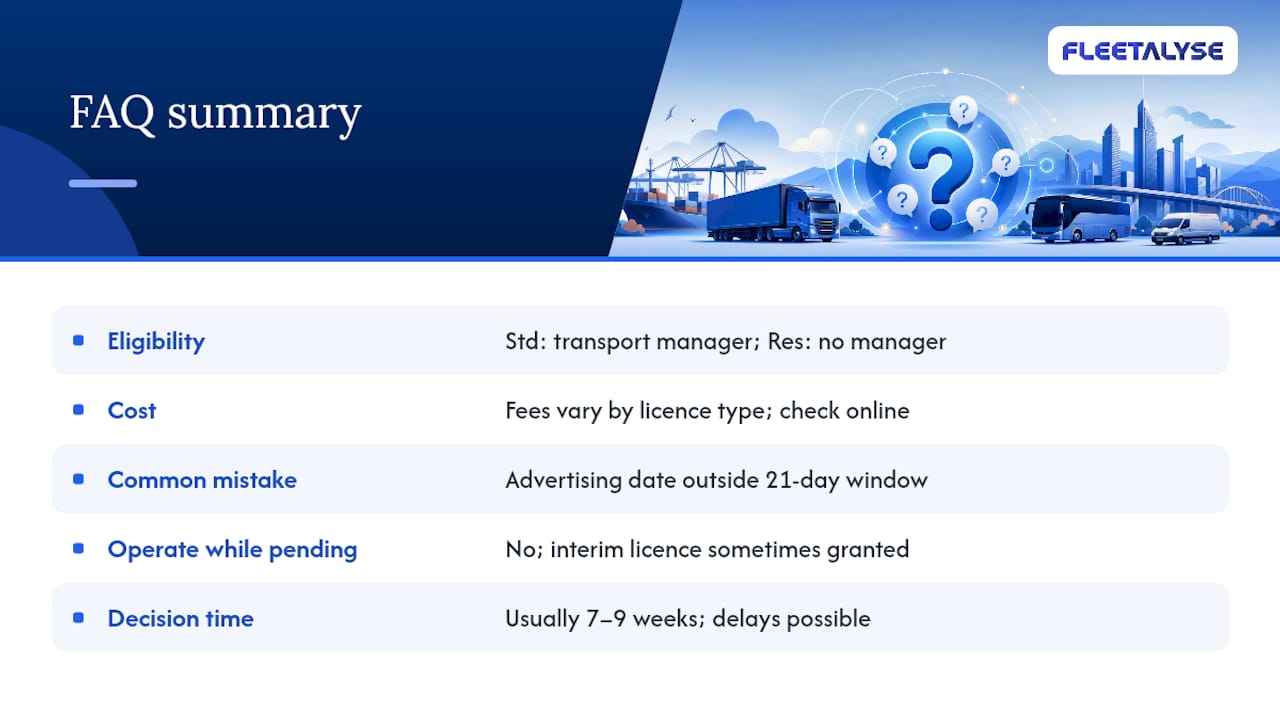
How long does it take to get an operator licence? Straightforward applications are usually decided within seven to nine weeks of submission. Missing evidence, advertising errors or objections during the Applications and Decisions publication period all extend that timeline significantly.
Sources
- Gov