
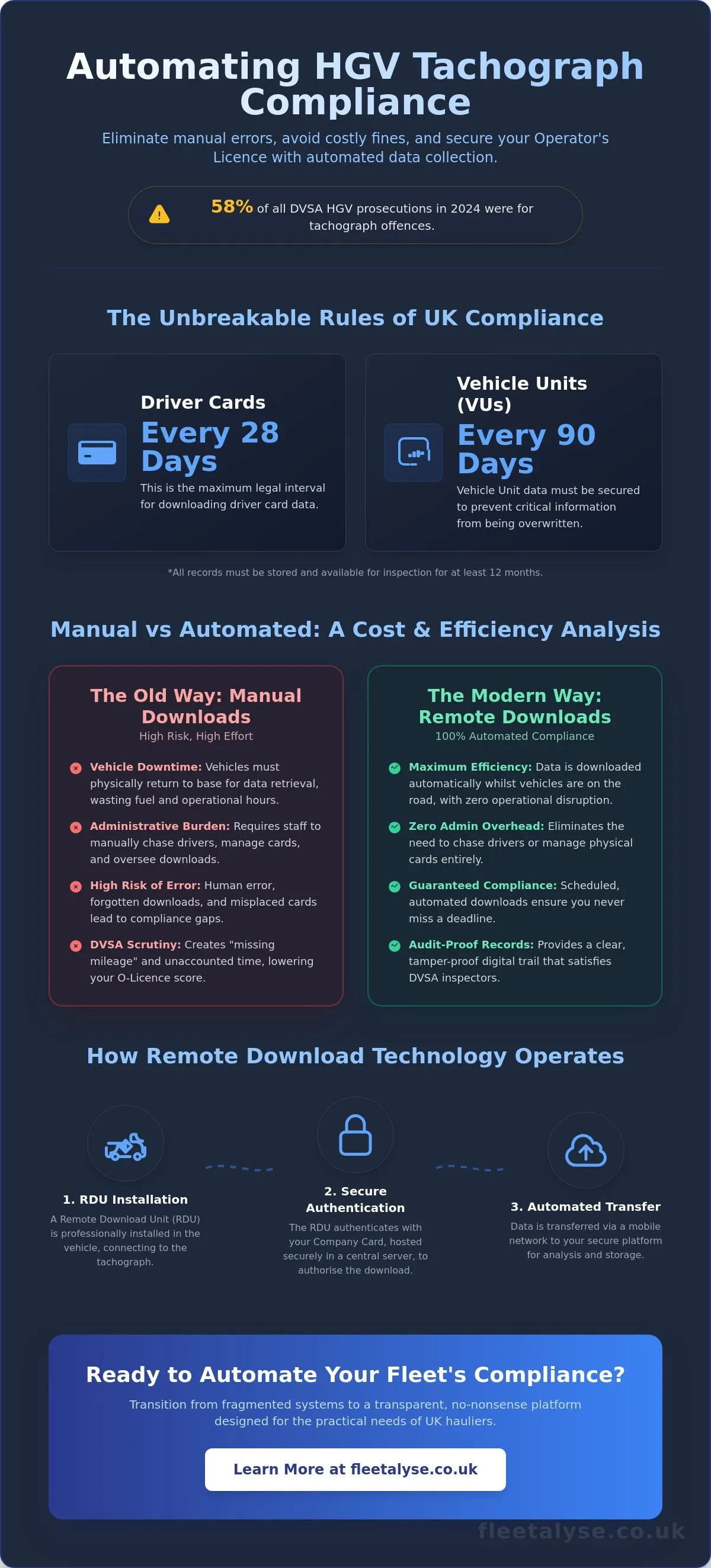
In 2024, tachograph offences accounted for 58% of all DVSA HGV prosecutions. It's a staggering figure that highlights how easily manual systems fail under pressure. You're likely tired of chasing drivers for card reads or seeing vehicles sit idle just to pull VU data. Implementing a reliable tachograph download for HGV fleets is no longer optional if you want to avoid Graduated Fixed Penalty Notices of up to £300 per offence. Missing a deadline isn't just an admin error; it's a direct threat to your O-licence and your business's reputation.
We agree that compliance shouldn't be a manual burden that disrupts your daily operations. This guide shows you exactly how to automate your entire data collection process to eliminate human error. You'll learn how to secure 100% automated compliance and gain real-time visibility of driver hours whilst significantly reducing administrative overhead. We'll examine the impact of the July 2026 Smart Tachograph 2 regulations and provide a clear roadmap to making your fleet's records entirely audit-proof against DVSA scrutiny.
Key Takeaways
- Understand the strict UK legal framework for 28-day driver card and 90-day vehicle unit download cycles to protect your O-licence.
- Discover how Remote Download Units (RDUs) and centralised company card servers automate data collection without manual intervention or driver downtime.
- Analyse the hidden operational costs of manual collection and how a tachograph download for HGV fleets eliminates the need for vehicles to return to base for data retrieval.
- Learn the benefits of integrating tachograph data with live driver hours and GPS tracking for real-time visibility into your fleet's remaining shift capacity.
- Identify how to transition from fragmented legacy systems to a transparent, no-nonsense compliance platform designed for the practical needs of UK hauliers.
Understanding Tachograph Download Requirements for HGV Fleets
UK law is clear regarding data collection for heavy goods vehicles. If you operate vehicles over 3.5 tonnes, you're bound by strict domestic and EU drivers' hours regulations. A What is a Tachograph? is the mandatory device at the heart of this framework. It records driving time, breaks, and rest periods to ensure road safety. Failing to capture this data accurately isn't just a minor administrative slip; it's a breach of your operator's licence conditions. Implementing a consistent tachograph download for HGV fleets ensures your business remains on the right side of the law.
The Legal Deadline: 28 and 90 Day Rules
You must adhere to two non-negotiable download cycles to stay compliant. Driver cards require a download at least every 28 days, whilst Vehicle Units (VUs) must be downloaded every 90 days. These are maximum intervals. Many regional operators choose shorter cycles to identify potential infringements before they escalate. If you delay these downloads, you risk data being overwritten on older vehicle units. Once that data is gone, it's impossible to recover, leaving a permanent gap in your records. Remote downloading removes this risk by pulling data automatically on a schedule that suits your operation.
- Driver Cards: Mandatory download every 28 days.
- Vehicle Units: Mandatory download every 90 days.
- Data Retention: Records must be stored and available for inspection for at least 12 months.
Operator Licence Protection and DVSA Standards
Your O-licence is your business's most valuable asset. The DVSA uses tachograph data as a primary metric to assess your risk profile. During an audit or roadside stop, inspectors look specifically for "missing mileage" or "unaccounted time". These gaps suggest a driver might be working off the card or that the vehicle is being used for unauthorised trips. If your records show frequent gaps, your operator's licence score drops. This triggers more frequent roadside inspections and could lead to a Public Inquiry.
Automation is your best defence against these pitfalls. Digital records provide a clear, tamper-proof trail that demonstrates your commitment to safety. If you're aiming for Earned Recognition status, having 100% automated, accurate data is essential. It proves to the DVSA that you're a proactive, compliant operator. You don't want to explain missing data to a Traffic Commissioner. Using a robust system like Fleetalyse for your tachograph download for HGV fleets ensures every kilometre is accounted for. This transparency builds trust and keeps your fleet moving without unnecessary interruptions.
How Remote Tachograph Download Technology Operates
The core of a remote tachograph download for HGV fleets is a secure, automated handshake between the vehicle and your office. Unlike manual methods that require a physical download key and a driver's presence, remote systems use a dedicated Remote Download Unit (RDU) to bridge the gap. This hardware acts as a gateway, pulling data directly from the vehicle unit (VU) and the driver card without requiring the ignition to be on. It's a silent, background process that ensures you remain compliant with UK tachograph download regulations at all times.
Central to this operation is the Company Card. In a manual setup, this card must be inserted into the tachograph head. With remote technology, your Company Card is hosted in a secure, centralised card server at your office or a data centre. When a download is triggered, the RDU communicates with this server to authenticate the request. This encrypted "handshake" proves to the tachograph that the request is authorised by the fleet operator. Once verified, the data transfer begins over stable GPRS or 4G networks, ensuring the files reach your system safely.
The Remote Download Unit (RDU) Explained
The RDU is a small, discreet device typically installed behind the vehicle's dashboard. It connects directly to the rear of the tachograph or via the CAN-bus system. Modern units are designed for broad compatibility, working seamlessly with older digital tachographs and the latest Smart Tachograph version 2 (G2V2) models. Whilst some operators prefer a plug-and-play approach via the front port, a professional, permanent installation is usually better. It prevents accidental disconnection and keeps the unit out of the driver's way, ensuring a reliable tachograph download for HGV fleets every single time.
The Data Journey: From Vehicle to Analysis
The process begins with a "wake-up" command sent from the server. The RDU activates the tachograph's remote download mode, pulls the required .ddd files, and transmits them via an encrypted mobile connection. You don't need to wait for the vehicle to return to the depot or for the driver to finish their shift. Most fleet managers set an automated schedule, such as a weekly download for driver cards and a monthly pull for VUs, to stay well ahead of legal deadlines.
Once the data reaches the server, it's automatically pushed into your tachograph analysis software. This creates a closed-loop system where data moves from the truck to a compliant report without human intervention. It's a practical way to manage your fleet's administrative burden whilst maintaining an audit-ready status. If you're looking to upgrade your current hardware, you can view our range of remote download solutions to get started today.
Manual vs Remote Downloads: A Cost and Efficiency Analysis
Many operators view manual downloads as a "free" task performed by existing staff. This is a false economy. Every hour a vehicle sits idle at the depot for a manual VU pull is an hour of lost earning potential. When you factor in the fuel required for a vehicle to deviate from its route just for a card read, the costs mount quickly. A remote tachograph download for HGV fleets turns this dead time back into productive road time. It's a pragmatic shift from reactive fire-fighting to proactive asset management.
The administrative burden of manual collection is often underestimated. Chasing drivers, managing physical USB keys, and manually uploading files to analysis software creates a significant labour drain. This fragmented approach is where errors happen. A single lost .ddd file or a missed 28-day deadline isn't just an inconvenience. It's a regulatory breach that can lead to a Graduated Fixed Penalty Notice of up to £300 per offence. In 2025, the average court fine for records offences reached £756.26, proving that the cost of manual failure far outweighs the price of automation.
The Hidden Cost of Manual Data Collection
Manual compliance is an administrative anchor. Transport managers can spend several hours every week cross-referencing calendars and tracking down drivers who are away on long-haul routes. This process is inherently inefficient. Beyond the wage costs of this administrative labour, you must consider the risk of data corruption. Physical download tools can fail or be misplaced, leading to gaps in your records that are impossible to fill. Automation removes this human element, ensuring that your data is captured, encrypted, and stored without anyone needing to touch the vehicle.
Operational Gains Through Automation
Removing the "compliance police" role from your transport office allows staff to focus on high-value tasks like route optimisation and fuel management. It also improves driver relations. Drivers value their rest periods and don't want to spend the end of a long shift in the office waiting for a card reader. Automation removes this friction entirely. Whilst there is an upfront investment in hardware, the reduction in vehicle downtime and administrative hours means a tachograph download for HGV fleets typically pays for itself within the first year of operation. It transforms compliance from a recurring headache into a silent, reliable background utility that protects your business interests.
Integrating Tachograph Data with Live Driver Hours and Tracking
Treating compliance data as a separate entity from your daily operational tracking is a common mistake. If your tacho files only move once a month, they're a historical record rather than a management tool. Integrating a tachograph download for HGV fleets with your live operational data changes your transport office from reactive to proactive. You stop looking at what happened weeks ago and start seeing what's happening right now on the road. This shift allows you to make informed decisions that protect your business and your drivers simultaneously.
This integration provides a 360-degree view of your entire operation. You aren't just seeing a dot on a map; you're seeing the precise legal capacity of your workforce. It eliminates the dangerous guesswork that often leads to accidental infringements. When your GPS data and tachograph data work in tandem, your ETAs become genuinely reliable. You can provide customers with realistic delivery windows because your system accounts for mandatory driver breaks that a standard GPS simply ignores. This level of transparency builds trust with your clients and protects your drivers from the pressure of unrealistic schedules.
Real-Time Visibility of Driver Availability
Having a single source of truth for driver availability is a game-changer for busy transport managers. With our Live Driver Hours feature, you see the current "Drive," "Rest," and "Work" statuses for every driver on one centralised screen. There's no need to interrupt a driver's rest period with a phone call to check their remaining hours. You can plan the next day's schedule with total confidence, knowing every assignment is based on legally verified data. This proactive approach reduces the administrative friction that typically slows down a regional fleet.
Synergy with GPS Fleet Tracking
Synergy between location and compliance data is where true efficiency is found. If an urgent collection arises, you can instantly identify the closest vehicle that also has the legal driving time to reach the destination and return to base. It’s about making the most of every asset without risking a DVSA fine. By monitoring driver behaviour alongside compliance, you gain a deep understanding of how your fleet operates under real-world conditions. You can learn more about GPS Fleet Tracking and how it acts as the foundation for your remote tachograph download for HGV fleets.
Ready to eliminate the guesswork and protect your O-licence with a fully integrated system? Secure your integrated remote download and tracking solution now.
Optimising Your Fleet Compliance with Fleetalyse Solutions
Choosing a compliance partner often feels like navigating a maze of hidden fees and complex contracts. At Fleetalyse, we take a different approach. We provide a no-nonsense, transparent service designed specifically for the rigours of the UK transport industry. Our system for tachograph download for HGV fleets is built for reliability, ensuring that regional hauliers can focus on their core business without worrying about the technicalities of data collection. We value your time and resources, prioritising functional utility over flashy, unnecessary features that don't add value to your bottom line.
Transparency is the cornerstone of our brand. Unlike generic software providers that hide costs behind "get a quote" buttons, we're open about our terms from the start. This commitment to honesty helps you manage your budget with confidence. You aren't just buying hardware; you're gaining a pragmatic expert partner that understands the daily struggles of asset management and regulatory adherence. Our platform integrates your tacho data with live driver hours and GPS tracking, providing a unified view of your fleet's health and compliance status.
Why Fleetalyse is the Choice for UK Operators
We've tailored our services to meet the specific needs of domestic commercial fleets. We understand the local infrastructure and the precise expectations of the DVSA. When you work with us, you're supported by people who know the industry inside out.
- Focus on Regional Hauliers: We specialise in the UK market, offering localised insight that global providers simply cannot match.
- Transparent Costs: We provide clear financial and contractual details upfront, manifesting our commitment to fairness and clarity.
- Expert UK-Based Support: Our team consists of real people who understand UK tachograph regulations and are ready to help when you need it.
- Pragmatic Technology: Our Remote Download Units are built for real-world application, ensuring consistent performance in all conditions.
Getting Started: Your Path to Automated Compliance
Transitioning from manual data collection to an automated tachograph download for HGV fleets is a straightforward process. We've simplified the path to ensure your operation isn't disrupted during the switch.
- Step 1: Fleet Assessment: We help you identify the right hardware for your specific vehicle types, including the latest Smart Tachograph version 2 models.
- Step 2: Installation: Choose between our professional installation service or follow our clear guidance for a self-install approach that gets your units live quickly.
- Step 3: Go Live: Once installed, your data begins flowing automatically into our analysis platform. You'll have immediate access to live driver hours and automated reports.
Don't let manual compliance hold your business back or put your O-licence at risk. It's time to move toward a more efficient, audit-proof future with a partner you can trust. Ready to automate? Start your compliance journey here.
Secure Your Fleet's Future with Automated Compliance
Manual data collection is a liability your business doesn't need to carry. We've explored how a reliable tachograph download for HGV fleets eliminates vehicle downtime and protects your Operator Licence from DVSA scrutiny. By integrating this technology with live driver hours, you gain the real-time visibility needed to plan routes effectively and prevent infringements before they happen. It's about turning a regulatory chore into a competitive operational advantage for your regional fleet.
Fleetalyse provides a no-nonsense path to full automation. You receive DVSA-compliant automated records and real-time live driver hours monitoring without the burden of complex, long-term contracts. Our no-contract transparent pricing and expert UK-based technical support ensure you're never left guessing about your compliance status or your costs. It's time to stop chasing driver cards and start focusing on your fleet's growth and efficiency. Automate your HGV compliance today - Get started now. Take total control of your data and drive your business forward with quiet confidence.
Frequently Asked Questions
Do I still need a company card if I use remote tachograph downloading?
Yes, you still need a company card to authenticate every download. In a remote setup, your card is placed in a card reader connected to a networked server rather than being physically inserted into the vehicle's tachograph. This allows the system to perform the digital handshake required to authorise the transfer of .ddd files from any vehicle in your fleet, regardless of its location.
How often does the remote system download the driver card and vehicle unit?
The system typically downloads driver cards every 7 to 14 days and vehicle units every 30 days. Whilst the legal maximums are 28 and 90 days, more frequent downloads ensure you have fresh data for analysis and prevent any risk of data being overwritten on older units. You can customise these schedules to suit your specific operational requirements and fleet size.
Will remote tachograph downloading work with my existing analysis software?
Yes, most remote download systems are designed to be platform-agnostic. They produce standard .ddd files that are compatible with all major UK analysis platforms. Our solution provides seamless tachograph analysis integration, meaning your files are automatically sent to your chosen provider as soon as the download is complete. This removes the need for any manual upload steps in your office.
What happens if the vehicle is in a poor signal area during a scheduled download?
The Remote Download Unit (RDU) will simply retry the connection once the vehicle moves back into an area with GPRS or 4G coverage. Most systems have built-in logic to manage intermittent signals, ensuring that a tachograph download for HGV fleets is completed as soon as a stable connection is established. No data is lost or corrupted during these temporary signal drops.
Is remote downloading compatible with the new Gen 2 Smart Tachographs?
Yes, modern RDUs are fully compatible with the latest Smart Tachograph version 2 (G2V2) hardware. These units are specifically designed to handle the additional data fields required by the newest regulations. Ensuring your hardware is up to date is essential for fleets operating internationally, especially with the July 2026 deadline for light commercial vehicles over 2.5 tonnes performing international transport.
Can I see live driver hours on my mobile phone or tablet?
Yes, our platform is accessible via any web-enabled device, including smartphones and tablets. You can view real-time "Drive," "Rest," and "Work" statuses whilst on the move. This allows transport managers to make quick decisions about load assignments or driver availability without needing to be sat at a desktop computer. It provides the flexibility required for modern, fast-paced logistics operations.
How much does it cost to install remote tachograph downloading per vehicle?
Costs vary based on the specific hardware requirements and the size of your fleet. We prioritise transparent pricing and provide detailed financial terms upfront rather than using hidden fees. Every plan price is published on our pricing page and only installation labour varies, so we focus on providing a solution that typically pays for itself through reduced administrative labour and eliminated vehicle downtime.
Does remote downloading help with DVSA Earned Recognition?
Yes, it's a vital tool for operators seeking or maintaining Earned Recognition status. The DVSA requires proof that you have robust, automated systems in place to monitor compliance. Using a tachograph download for HGV fleets ensures your records are 100% accurate and submitted on time. This consistency is a core requirement for meeting the audit standards and proving you are a low-risk operator.
Frequently asked questions
The Legal Deadline: 28 and 90 Day Rules
You must adhere to two non-negotiable download cycles to stay compliant. Driver cards require a download at least every 28 days, whilst Vehicle Units (VUs) must be downloaded every 90 days. These are maximum intervals. Many regional operators choose shorter cycles to identify potential infringements before they escalate. If you delay these downloads, you risk data being overwritten on older vehicle units. Once that data is gone, it's impossible to recover, leaving a permanent gap in your records. Remote downloading removes this risk by pulling data automatically on a schedule that suits your operation.
Operator Licence Protection and DVSA Standards
Your O-licence is your business's most valuable asset. The DVSA uses tachograph data as a primary metric to assess your risk profile. During an audit or roadside stop, inspectors look specifically for "missing mileage" or "unaccounted time". These gaps suggest a driver might be working off the card or that the vehicle is being used for unauthorised trips. If your records show frequent gaps, your operator's licence score drops. This triggers more frequent roadside inspections and could lead to a Public Inquiry. Automation is your best defence against these pitfalls. Digital records provide a clear, tamper-proof trail that demonstrates your commitment to safety. If you're aiming for Earned Recognition status, having 100% automated, accurate data is essential. It proves to the DVSA that you're a proactive, compliant operator. You don't want to explain missing data to a Traffic Commissioner. Using a robust system like Fleetalyse for your tachograph download for HGV fleets ensures every kilometre is accounted for. This transparency builds trust and keeps your fleet moving without unnecessary interruptions. The core of a remote tachograph download for HGV fleets is a secure, automated handshake between the vehicle and your office. Unlike manual methods that require a physical download key and a driver's presence, remote systems use a dedicated Remote Download Unit (RDU) to bridge the gap. This hardware acts as a gateway, pulling data directly from the vehicle unit (VU) and the driver card without requiring the ignition to be on. It's a silent, background process that ensures you remain compliant with UK tachograph download regulations at all times. Central to this operation is the Company Card. In a manual setup, this card must be inserted into the tachograph head. With remote technology, your Company Card is hosted in a secure, centralised card server at your office or a data centre. When a download is triggered, the RDU communicates with this server to authenticate the request. This encrypted "handshake" proves to the tachograph that the request is authorised by the fleet operator. Once verified, the data transfer begins over stable GPRS or 4G networks, ensuring the files reach your system safely.
The Remote Download Unit (RDU) Explained
The RDU is a small, discreet device typically installed behind the vehicle's dashboard. It connects directly to the rear of the tachograph or via the CAN-bus system. Modern units are designed for broad compatibility, working seamlessly with older digital tachographs and the latest Smart Tachograph version 2 (G2V2) models. Whilst some operators prefer a plug-and-play approach via the front port, a professional, permanent installation is usually better. It prevents accidental disconnection and keeps the unit out of the driver's way, ensuring a reliable tachograph download for HGV fleets every single time.
The Data Journey: From Vehicle to Analysis
The process begins with a "wake-up" command sent from the server. The RDU activates the tachograph's remote download mode, pulls the required .ddd files, and transmits them via an encrypted mobile connection. You don't need to wait for the vehicle to return to the depot or for the driver to finish their shift. Most fleet managers set an automated schedule, such as a weekly download for driver cards and a monthly pull for VUs, to stay well ahead of legal deadlines. Once the data reaches the server, it's automatically pushed into your tachograph analysis software. This creates a closed-loop system where data moves from the truck to a compliant report without human intervention. It's a practical way to manage your fleet's administrative burden whilst maintaining an audit-ready status. If you're looking to upgrade your current hardware, you can view our range of remote download solutions to get started today. Many operators view manual downloads as a "free" task performed by existing staff. This is a false economy. Every hour a vehicle sits idle at the depot for a manual VU pull is an hour of lost earning potential. When you factor in the fuel required for a vehicle to deviate from its route just for a card read, the costs mount quickly. A remote tachograph download for HGV fleets turns this dead time back into productive road time. It's a pragmatic shift from reactive fire-fighting to proactive asset management. The administrative burden of manual collection is often underestimated. Chasing drivers, managing physical USB keys, and manually uploading files to analysis software creates a significant labour drain. This fragmented approach is where errors happen. A single lost .ddd file or a missed 28-day deadline isn't just an inconvenience. It's a regulatory breach that can lead to a Graduated Fixed Penalty Notice of up to £300 per offence. In 2025, the average court fine for records offences reached £756.26, proving that the cost of manual failure far outweighs the price of automation.
The Hidden Cost of Manual Data Collection
Manual compliance is an administrative anchor. Transport managers can spend several hours every week cross-referencing calendars and tracking down drivers who are away on long-haul routes. This process is inherently inefficient. Beyond the wage costs of this administrative labour, you must consider the risk of data corruption. Physical download tools can fail or be misplaced, leading to gaps in your records that are impossible to fill. Automation removes this human element, ensuring that your data is captured, encrypted, and stored without anyone needing to touch the vehicle.
Operational Gains Through Automation
Removing the "compliance police" role from your transport office allows staff to focus on high-value tasks like route optimisation and fuel management. It also improves driver relations. Drivers value their rest periods and don't want to spend the end of a long shift in the office waiting for a card reader. Automation removes this friction entirely. Whilst there is an upfront investment in hardware, the reduction in vehicle downtime and administrative hours means a tachograph download for HGV fleets typically pays for itself within the first year of operation. It transforms compliance from a recurring headache into a silent, reliable background utility that protects your business interests. Treating compliance data as a separate entity from your daily operational tracking is a common mistake. If your tacho files only move once a month, they're a historical record rather than a management tool. Integrating a tachograph download for HGV fleets with your live operational data changes your transport office from reactive to proactive. You stop looking at what happened weeks ago and start seeing what's happening right now on the road. This shift allows you to make informed decisions that protect your business and your drivers simultaneously. This integration provides a 360-degree view of your entire operation. You aren't just seeing a dot on a map; you're seeing the precise legal capacity of your workforce. It eliminates the dangerous guesswork that often leads to accidental infringements. When your GPS data and tachograph data work in tandem, your ETAs become genuinely reliable. You can provide customers with realistic delivery windows because your system accounts for mandatory driver breaks that a standard GPS simply ignores. This level of transparency builds trust with your clients and protects your drivers from the pressure of unrealistic schedules.
Real-Time Visibility of Driver Availability
Having a single source of truth for driver availability is a game-changer for busy transport managers. With our Live Driver Hours feature, you see the current "Drive," "Rest," and "Work" statuses for every driver on one centralised screen. There's no need to interrupt a driver's rest period with a phone call to check their remaining hours. You can plan the next day's schedule with total confidence, knowing every assignment is based on legally verified data. This proactive approach reduces the administrative friction that typically slows down a regional fleet.
Synergy with GPS Fleet Tracking
Synergy between location and compliance data is where true efficiency is found. If an urgent collection arises, you can instantly identify the closest vehicle that also has the legal driving time to reach the destination and return to base. It’s about making the most of every asset without risking a DVSA fine. By monitoring driver behaviour alongside compliance, you gain a deep understanding of how your fleet operates under real-world conditions. You can learn more about GPS Fleet Tracking and how it acts as the foundation for your remote tachograph download for HGV fleets. Ready to eliminate the guesswork and protect your O-licence with a fully integrated system? Secure your integrated remote download and tracking solution now. Choosing a compliance partner often feels like navigating a maze of hidden fees and complex contracts. At Fleetalyse, we take a different approach. We provide a no-nonsense, transparent service designed specifically for the rigours of the UK transport industry. Our system for tachograph download for HGV fleets is built for reliability, ensuring that regional hauliers can focus on their core business without worrying about the technicalities of data collection. We value your time and resources, prioritising functional utility over flashy, unnecessary features that don't add value to your bottom line. Transparency is the cornerstone of our brand. Unlike generic software providers that hide costs behind "get a quote" buttons, we're open about our terms from the start. This commitment to honesty helps you manage your budget with confidence. You aren't just buying hardware; you're gaining a pragmatic expert partner that understands the daily struggles of asset management and regulatory adherence. Our platform integrates your tacho data with live driver hours and GPS tracking, providing a unified view of your fleet's health and compliance status.
Why Fleetalyse is the Choice for UK Operators
We've tailored our services to meet the specific needs of domestic commercial fleets. We understand the local infrastructure and the precise expectations of the DVSA. When you work with us, you're supported by people who know the industry inside out.
Getting Started: Your Path to Automated Compliance
Transitioning from manual data collection to an automated tachograph download for HGV fleets is a straightforward process. We've simplified the path to ensure your operation isn't disrupted during the switch. Don't let manual compliance hold your business back or put your O-licence at risk. It's time to move toward a more efficient, audit-proof future with a partner you can trust. Ready to automate? Start your compliance journey here. Manual data collection is a liability your business doesn't need to carry. We've explored how a reliable tachograph download for HGV fleets eliminates vehicle downtime and protects your Operator Licence from DVSA scrutiny. By integrating this technology with live driver hours, you gain the real-time visibility needed to plan routes effectively and prevent infringements before they happen. It's about turning a regulatory chore into a competitive operational advantage for your regional fleet. Fleetalyse provides a no-nonsense path to full automation. You receive DVSA-compliant automated records and real-time live driver hours monitoring without the burden of complex, long-term contracts. Our no-contract transparent pricing and expert UK-based technical support ensure you're never left guessing about your compliance status or your costs. It's time to stop chasing driver cards and start focusing on your fleet's growth and efficiency. Automate your HGV compliance today – Get started now. Take total control of your data and drive your business forward with quiet confidence.
Do I still need a company card if I use remote tachograph downloading?
Yes, you still need a company card to authenticate every download. In a remote setup, your card is placed in a card reader connected to a networked server rather than being physically inserted into the vehicle's tachograph. This allows the system to perform the digital handshake required to authorise the transfer of .ddd files from any vehicle in your fleet, regardless of its location.
How often does the remote system download the driver card and vehicle unit?
The system typically downloads driver cards every 7 to 14 days and vehicle units every 30 days. Whilst the legal maximums are 28 and 90 days, more frequent downloads ensure you have fresh data for analysis and prevent any risk of data being overwritten on older units. You can customise these schedules to suit your specific operational requirements and fleet size.
Will remote tachograph downloading work with my existing analysis software?
Yes, most remote download systems are designed to be platform-agnostic. They produce standard .ddd files that are compatible with all major UK analysis platforms. Our solution provides seamless tachograph analysis integration, meaning your files are automatically sent to your chosen provider as soon as the download is complete. This removes the need for any manual upload steps in your office.
What happens if the vehicle is in a poor signal area during a scheduled download?
The Remote Download Unit (RDU) will simply retry the connection once the vehicle moves back into an area with GPRS or 4G coverage. Most systems have built-in logic to manage intermittent signals, ensuring that a tachograph download for HGV fleets is completed as soon as a stable connection is established. No data is lost or corrupted during these temporary signal drops.
Is remote downloading compatible with the new Gen 2 Smart Tachographs?
Yes, modern RDUs are fully compatible with the latest Smart Tachograph version 2 (G2V2) hardware. These units are specifically designed to handle the additional data fields required by the newest regulations. Ensuring your hardware is up to date is essential for fleets operating internationally, especially with the July 2026 deadline for light commercial vehicles over 2.5 tonnes performing international transport.
Can I see live driver hours on my mobile phone or tablet?
Yes, our platform is accessible via any web-enabled device, including smartphones and tablets. You can view real-time "Drive," "Rest," and "Work" statuses whilst on the move. This allows transport managers to make quick decisions about load assignments or driver availability without needing to be sat at a desktop computer. It provides the flexibility required for modern, fast-paced logistics operations.
How much does it cost to install remote tachograph downloading per vehicle?
Costs vary based on the specific hardware requirements and the size of your fleet. We prioritise transparent pricing and provide detailed financial terms upfront rather than using hidden fees. Every plan price is published on our pricing page and only installation labour varies, so we focus on providing a solution that typically pays for itself through reduced administrative labour and eliminated vehicle downtime.
Does remote downloading help with DVSA Earned Recognition?
Yes, it's a vital tool for operators seeking or maintaining Earned Recognition status. The DVSA requires proof that you have robust, automated systems in place to monitor compliance. Using a tachograph download for HGV fleets ensures your records are 100% accurate and submitted on time. This consistency is a core requirement for meeting the audit standards and proving you are a low-risk operator.