
The DVSA issues over 20,000 fixed penalty notices for tachograph offences annually, often because simple deadlines were missed in the chaos of daily operations. You're likely familiar with the frustration of chasing drivers for cards or manually downloading vehicle units just to stay on the right side of the law. It's a high-stakes game of admin that eats into your time and risks your operator licence. You might be wondering, how does remote tachograph download work? It's a straightforward technical bridge that connects your fleet's data directly to your office, regardless of where your vehicles are in the country.
We agree that manual data entry and deadline tracking are unnecessary drains on your resources. This guide explains the technical mechanics, compliance benefits, and operational efficiency of automated retrieval. We'll show you how to achieve total compliance automation and gain real-time visibility into driver hours. By the end of this article, you'll understand how to eliminate the "blind spots" in your data management and protect your business from avoidable fines. We'll move past the theory and look at the practical, grounded steps to making your fleet more efficient.
Key Takeaways
- Understand the technical mechanics of how does remote tachograph download work and the hardware required to automate your fleet's data retrieval.
- Master the 28-day and 90-day DVSA deadlines with automated scheduling that removes the risk of missing critical compliance milestones.
- Explore the practical difference between "downloaded data" and "live driver hours" to improve your fleet's daily operational efficiency.
- Learn how to integrate automated .ddd file retrieval with your current analysis tools for a seamless, audit-ready management system.
- Reduce administrative overhead and eliminate manual data entry errors that often lead to costly graduated fixed penalties.
Understanding Remote Tachograph Download Technology
Remote tachograph download is an automated, wireless retrieval system designed for the modern fleet. It represents a significant shift from the traditional method of using physical download keys. Instead of manual intervention, data is transmitted via a secure cellular network. This is often called over-the-air (OTA) transfer. It allows operators to pull data from any location at any time, ensuring the office stays updated without the vehicle returning to base. If you're looking to streamline your operation, Fleetalyse provides the tools to make this transition seamless.
If you're wondering how does remote tachograph download work for your specific fleet, the answer lies in the hardware's ability to communicate with a secure server without driver input. The system retrieves two distinct types of information. It collects Vehicle Unit (VU) data, which covers the lorry's activity, and it pulls Driver Card data to track individual hours. UK operators are moving to this model to secure 100% compliance. Manual collection is simply too slow and too risky for a busy haulage business where every minute counts.
The Role of the Digital Tachograph
Digital tachographs have been a legal requirement for new commercial vehicles in the UK since 2006. To fully grasp what a tachograph is, you must view it as a high-precision data logger rather than just a clock. Every unit generates .ddd files. These files are the only format accepted by UK compliance software and the DVSA for legal reporting.
The technology took a major leap with the introduction of Smart Tachographs (Gen 2). These units are designed with remote connectivity as a core feature. They integrate more easily with telematics devices, ensuring the data transfer is fast and secure. For an operator, this means you don't have to worry about file formats or physical connections. The system handles the technical heavy lifting, leaving you with clean, actionable data.
Why Manual Downloading is Becoming Obsolete
Manual downloading is a legacy process that no longer fits the pace of the transport industry. It creates a massive administrative burden. You have to wait for drivers to return to a central depot and then physically plug in a device to extract the data. This is inefficient and expensive. Research suggests remote downloading can save up to two days per vehicle per year in administration time alone.
The risks of sticking with manual systems are also high. Physical download keys can fail or become corrupted without warning. If a file is lost, you can't recreate it, leading to gaps in your records and potential DVSA fines. Managing remote drivers is particularly difficult with manual systems. If a driver is on a long-distance run, they might not be back before the 28-day card deadline. Remote downloading solves this by retrieving data regardless of the vehicle's location. It removes the blind spots in your compliance schedule and protects your operator licence.
The Technical Process: How Data Moves from Cab to Cloud
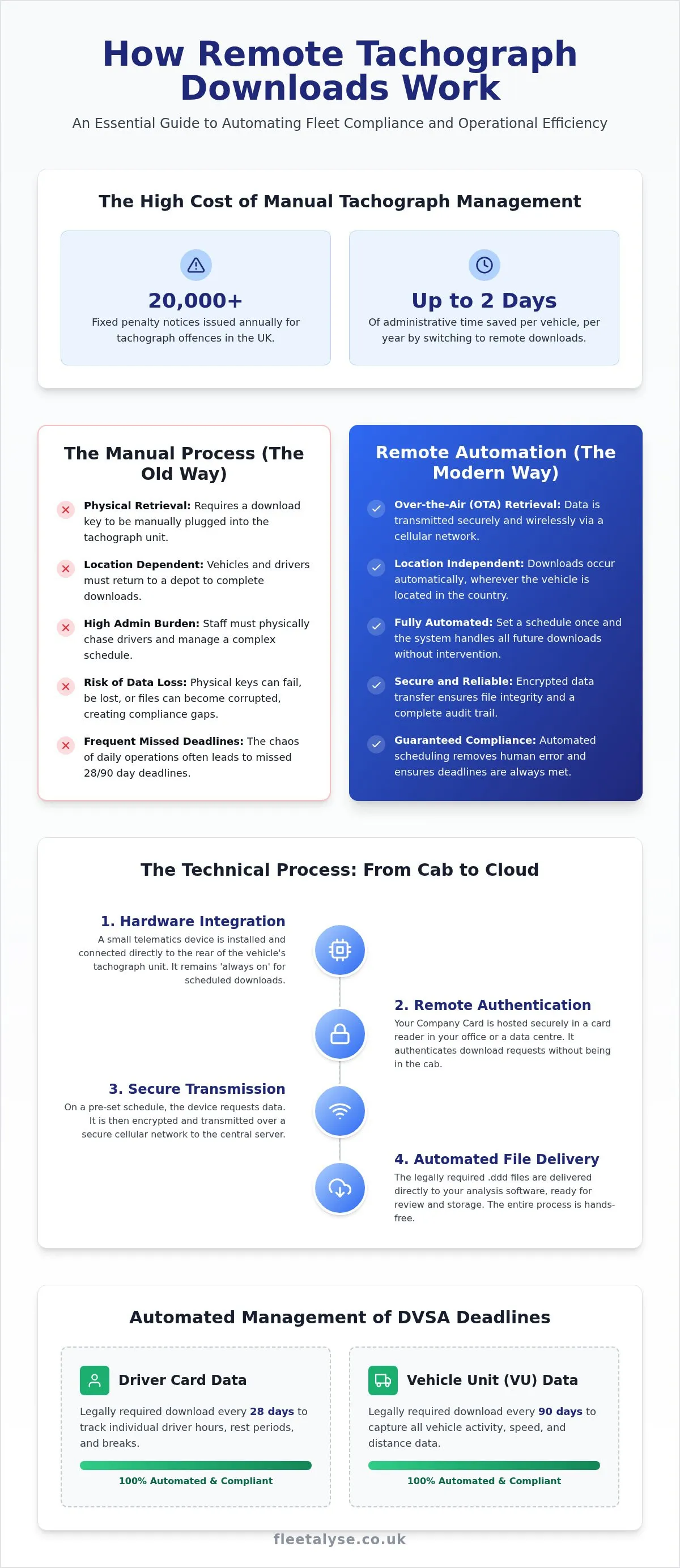
Moving from manual keys to automated systems requires a specific technical setup that operates silently in the background. Understanding how does remote tachograph download work involves three core components: the vehicle hardware, the company card authentication, and the secure transmission network. This combination ensures that data moves from the vehicle to your office without any driver intervention or physical contact. It creates a reliable bridge that keeps your records current and your fleet compliant.
Step 1: Hardware Integration and Connection
The process begins with a small telematics device. This unit is professionally installed and interfaces directly with the rear of the tachograph head. It draws a tiny amount of power from the vehicle, ensuring it remains "always on" even when the ignition is switched off. This constant power is vital for scheduled downloads that typically happen overnight to avoid disrupting the driver's day. Most modern VDO and Stoneridge units are fully compatible with this technology. We recommend a quick compatibility check for older vehicles to ensure the tachograph firmware supports remote commands. Once connected, the device acts as a secure gateway for all future data requests.
Step 2: Remote Authentication via Company Card
Security is the priority during the authentication phase. In a manual setup, you'd have to insert your Company Card into the lorry's tachograph slot. In a remote system, your Company Card stays in a card reader at your office or a secure data centre. This is known as "Card Hosting". When a download is scheduled, the remote server communicates with your hosted card to verify the request. Many operators ask how does remote tachograph download work in terms of security; it effectively "unlocks" the tachograph from hundreds of miles away using encrypted protocols. Only once this secure digital handshake is confirmed will the tachograph release the requested .ddd files.
Step 3: Automated Data Retrieval and Analysis
Once authenticated, the system pulls the encrypted .ddd files from both the Vehicle Unit and the Driver Card. These files travel via GPRS or 4G networks to secure cloud storage, protected by the same level of encryption used in online banking. The "handshake" protocol is the secure digital greeting between the vehicle and the server that confirms identity and data integrity before any transfer begins. From the cloud, the information is pushed directly into your tachograph analysis software. This removes the need for manual file uploads and ensures your reports are always based on the latest data. You can explore our hardware configurations to see which setup best suits your specific HGV or van fleet.
Ensuring Compliance with DVSA Tachograph Regulations
Compliance is binary. You're either legal or you're not. In the UK, the DVSA is clear about your obligations: Driver Card data must be retrieved at least every 28 days, and Vehicle Unit (VU) data every 90 days. These aren't suggestions; they're hard limits. Understanding how does remote tachograph download work in a regulatory context is about more than just moving files. It's about building a proactive shield around your operator licence. By automating these downloads, you ensure that no driver or vehicle ever slips through the cracks, even during busy periods or staff holidays.
Beyond the download deadlines, you must maintain an audit-ready digital archive for a minimum of 12 months. If you use this data to monitor Working Time Directive (WTD) compliance, that retention period extends to 24 months. Manual systems often fail here due to lost USB sticks or corrupted local hard drives. A remote system stores your .ddd files in a secure cloud environment, creating a permanent, timestamped trail of your compliance efforts. This level of organisation is invaluable during a DVSA enquiry, as it proves you have a robust, professional management system in place.
Meeting the 28-Day and 90-Day Deadlines
Waiting until the 28th day to download a card is a high-risk strategy. If a driver is away or a vehicle is in a remote workshop, you've already committed an infringement. Remote systems eliminate this "deadline chicken" by performing downloads on a daily or weekly cycle. When a traffic officer asks how does remote tachograph download work during a site visit, you can demonstrate a system that captures data as soon as the vehicle is in signal. Even if a truck is off-road for maintenance, the hardware will trigger a download the moment it receives power, ensuring your records stay unbroken.
Audit Readiness and the DVSA Guide to Maintaining Roadworthiness
The DVSA "Guide to Maintaining Roadworthiness" emphasises the need for continuous monitoring. Automated reports help you identify "missing mileage" immediately, a common red flag for inspectors that suggests a vehicle was moved without a card. Because the data is retrieved in near real-time, you can spot driver infringements within hours rather than weeks. This allows for immediate debriefing and corrective training. It transforms your compliance from a reactive admin chore into a live management tool that identifies risks before they lead to a court summons or a public inquiry. This pragmatic approach is why Fleetalyse focuses on delivering clean, actionable data that supports your daily operational decisions.
Operational Advantages: Live Driver Hours and Fleet Visibility
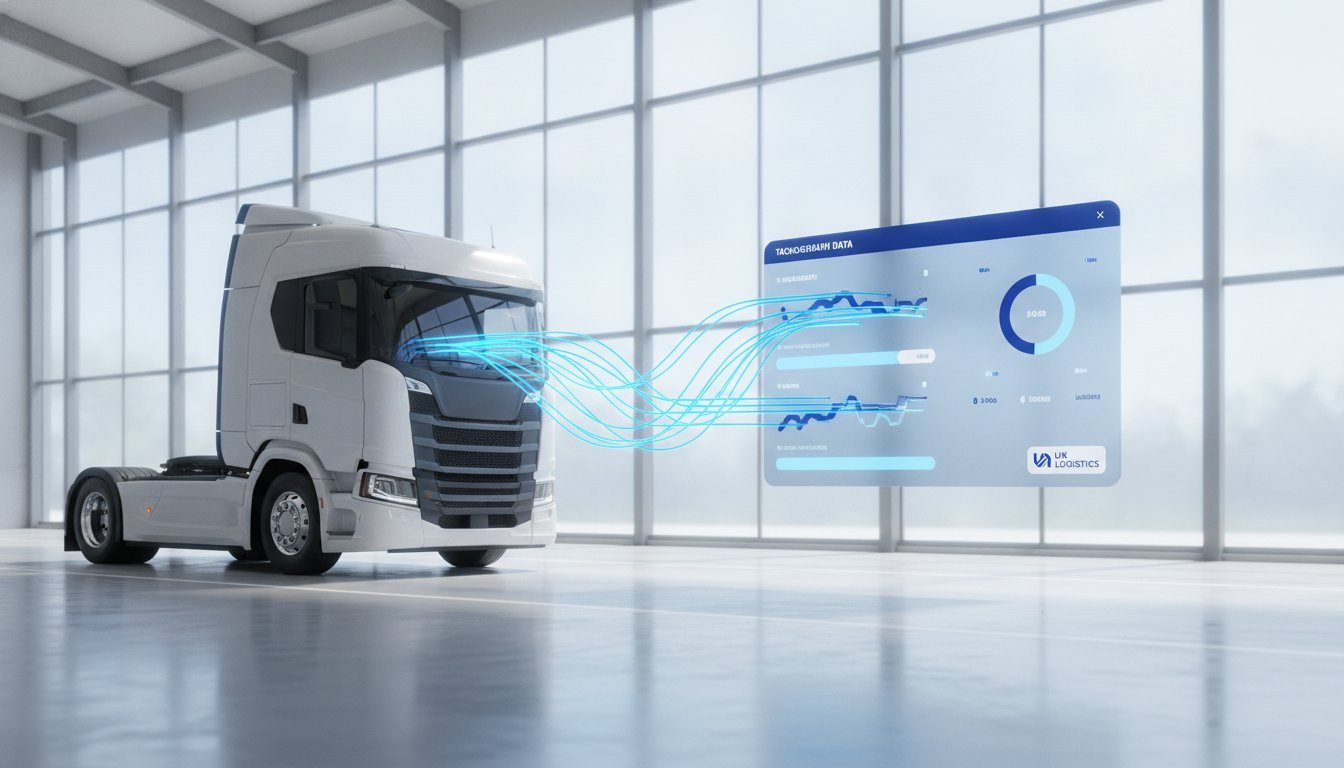
Remote tachograph downloading is often viewed strictly through the lens of compliance. Whilst staying legal is the priority, the operational benefits of the technology are what truly transform a transport business. The real value lies in the shift from historical data to live intelligence. When you consider how does remote tachograph download work for a fleet manager, it is about moving beyond retrospective reporting. You aren't just looking at what happened weeks ago; you're looking at your drivers' remaining hours in real time. This visibility allows you to manage your assets with a level of precision that manual systems cannot match.
By shifting to an automated system, you gain a live compliance heartbeat. You no longer have to guess which driver has the capacity for an extra drop or a last-minute collection. This data is the foundation of a modern, efficient haulage operation. It removes the guesswork that often leads to either wasted vehicle capacity or accidental hours infringements. It is a practical tool for regional operators who need to maximise every minute of the working day.
Real-Time Visibility for Better Planning
Traditional downloads provide a snapshot of the past. Live Driver Hours give you a window into the present. Through a secure dashboard, you can see "Drive," "Rest," and "Other Work" statuses as they happen. This allows you to plan the next leg of a journey with total accuracy. If a driver has only 40 minutes of driving time remaining, you don't dispatch them on a 60-minute route. This proactive approach prevents accidental infringements and reduces "dead mileage" caused by inefficient routing. Integrating this data with GPS fleet tracking creates a complete operational picture. You see exactly where the vehicle is and precisely how long it can legally stay on the road. It makes your dispatching decisions grounded in fact rather than estimates.
Reducing Administrative Overhead
Administrative burden is a silent drain on your profit margins. Manual systems require drivers to deviate from their routes to return to a depot just for a card download. This wastes fuel, increases vehicle wear, and frustrates your staff. Remote systems make this entire process invisible. There is no need for drivers to physically hand over cards or for managers to spend hours at a computer uploading .ddd files. The system handles the filing automatically. This allows your management team to focus on exception reporting and driver training rather than data collection. Staff morale improves when compliance becomes frictionless and "invisible" to the daily routine. You can view our integration options to see how to automate these processes for your fleet today.
Implementing Remote Downloads with Fleetalyse
Choosing a compliance partner is about finding a team that understands the practicalities of the UK haulage industry. At Fleetalyse, we focus on providing simple hardware that delivers powerful, actionable data. We don't believe in marketing hyperbole or hidden contractual complexities. Our approach is grounded in transparency and industry expertise. We've explained how does remote tachograph download work from a technical perspective; our job is to ensure that technology serves your specific business goals without adding to your administrative burden.
Our service is designed for regional operators who need reliability above all else. We provide a straightforward path to total compliance automation, backed by a commitment to honest pricing. To ensure your fleet is fully protected, we offer a site-wide compliance health check. This process identifies any gaps in your current data retrieval methods and helps you transition to a more robust, automated system that keeps you audit-ready at all times.
Seamless Integration with Your Current Systems
You don't need to overhaul your entire office to benefit from automation. Fleetalyse is built to work alongside your favourite tachograph analysis providers. We act as the secure data conduit, retrieving .ddd files and pushing them directly into your existing software. This makes the transition frictionless for your management team. Our hardware is compatible with HGVs, vans, and trailers, ensuring every asset in your fleet is covered by the same high standard of visibility. If you ever need assistance, you'll speak directly with our UK-based team of transport experts. We don't use distant call centres; we provide localized support from professionals who understand DVSA regulations inside out.
Taking the First Step Toward Automated Compliance
Moving away from manual downloads is a significant operational upgrade. We recommend requesting a demonstration of our live driver hours dashboard to see the technology in action. This allows you to see exactly how your fleet's data is presented and how it can inform your daily dispatching decisions. Our quick-start guide simplifies the transition, covering everything from hardware installation to server authentication. Switching to Fleetalyse provides an immediate return on investment by recapturing administrative hours and preventing the graduated fixed penalties that stem from missing download deadlines. You can visit our website to learn more about our pragmatic approach to fleet management and compliance. Let's work together to make your compliance invisible and your operation more efficient.
Take Control of Your Fleet Compliance
Transitioning to an automated system is a pragmatic step for any UK operator looking to eliminate the administrative burden of manual data collection. We've explored how does remote tachograph download work by connecting your vehicle units directly to the cloud, ensuring you never miss a 28-day or 90-day deadline again. This technology doesn't just keep you legal; it provides live visibility into driver hours, allowing for smarter dispatching and reduced dead mileage. By moving away from physical download keys, you secure your data against loss or corruption whilst maintaining the required 12-month digital archive for DVSA audits.
Fleetalyse offers a localised, expert approach to fleet management that prioritises functional utility. With our DVSA-compliant automated reporting, real-time live driver hours tracking, and expert UK-based support, you can focus on growing your business instead of chasing paperwork. It's time to make compliance a seamless part of your daily routine rather than a constant source of stress. Streamline your compliance with Fleetalyse Remote Tachograph Downloads and gain total peace of mind for your operation. We're here to help you build a more efficient, audit-ready fleet today.
Frequently Asked Questions
Do I still need my Company Card if I use remote tachograph downloads?
Yes, you still need your Company Card to authenticate every data transfer. In a remote setup, the card remains in a card reader at your office or a secure data centre rather than being taken to the vehicle. This allows the system to perform a secure digital handshake with the tachograph to "unlock" the data. Without this card being hosted and available 24/7, the remote server cannot legally access or retrieve the .ddd files.
Will remote downloading work if the vehicle ignition is turned off?
Yes, remote downloading works perfectly while the vehicle ignition is turned off. The telematics device is wired into a permanent power source within the vehicle, allowing it to remain active in a low-power state. This is essential for scheduling downloads overnight or during weekend breaks when the vehicle is stationary. It draws a minimal amount of current, ensuring it won't drain a healthy battery during standard operational downtime.
Is remote tachograph download legal according to DVSA standards?
Remote tachograph download is entirely legal and is the preferred method for many DVSA-compliant operators. The system produces the same digital .ddd files as manual downloads, which are the only format accepted for legal reporting in the UK. By automating the process, you significantly reduce the risk of human error and ensure that you consistently meet the mandatory 28-day and 90-day deadlines required to protect your operator licence.
What happens if a vehicle is in an area with no mobile signal?
If a vehicle is in an area with no mobile signal, the download will simply pause. The hardware is designed to store the pending request and retry the transfer as soon as a GPRS or 4G connection is re-established. No data is lost or corrupted during this period. Once the signal returns, the encrypted files are automatically pushed to the server, ensuring your compliance records remain complete and unbroken.
Can I use remote download for older analogue tachographs?
No, remote downloading is only compatible with digital and smart tachographs. Analogue units use paper charts that require physical collection and manual filing. If your fleet still operates older vehicles with analogue heads, those must be managed through traditional manual processes. However, any vehicle fitted with a digital unit since 2006 can typically be upgraded to support automated, wireless data retrieval for better fleet visibility.
How often should I schedule remote downloads for my fleet?
We recommend scheduling downloads much more frequently than the legal minimums. Whilst the law requires card downloads every 28 days and vehicle units every 90 days, most professional operators schedule weekly or even daily retrievals. This proactive approach helps you understand how does remote tachograph download work as a live management tool, allowing you to identify driver infringements or missing mileage almost immediately rather than weeks after the event.
Is the data encrypted during the remote transfer process?
Yes, all data is fully encrypted during the entire transfer process from the vehicle to the cloud. The system uses secure protocols similar to those used in online banking to protect your sensitive driver and vehicle information. This ensures that the .ddd files remain tamper-proof and secure from unauthorised access whilst in transit. Security is a fundamental part of how does remote tachograph download work for modern UK transport businesses.
Do I need different hardware for Smart Tachographs and older digital units?
Most modern telematics units are built to be compatible with both older digital tachographs and the latest Smart Tachograph 2 models. You generally don't need entirely different hardware, though specific connection cables or firmware updates might be necessary depending on the tachograph manufacturer. We always recommend a compatibility check to ensure your specific combination of vehicle and tachograph head supports the full range of remote download features.
Frequently asked questions
Do I still need my Company Card if I use remote tachograph downloads?
Yes, you still need your Company Card to authenticate every data transfer. In a remote setup, the card remains in a card reader at your office or a secure data centre rather than being taken to the vehicle. This allows the system to perform a secure digital handshake with the tachograph to "unlock" the data. Without this card being hosted and available 24/7, the remote server cannot legally access or retrieve the .ddd files.
Will remote downloading work if the vehicle ignition is turned off?
Yes, remote downloading works perfectly while the vehicle ignition is turned off. The telematics device is wired into a permanent power source within the vehicle, allowing it to remain active in a low-power state. This is essential for scheduling downloads overnight or during weekend breaks when the vehicle is stationary. It draws a minimal amount of current, ensuring it won't drain a healthy battery during standard operational downtime.
Is remote tachograph download legal according to DVSA standards?
Remote tachograph download is entirely legal and is the preferred method for many DVSA-compliant operators. The system produces the same digital .ddd files as manual downloads, which are the only format accepted for legal reporting in the UK. By automating the process, you significantly reduce the risk of human error and ensure that you consistently meet the mandatory 28-day and 90-day deadlines required to protect your operator licence.
What happens if a vehicle is in an area with no mobile signal?
If a vehicle is in an area with no mobile signal, the download will simply pause. The hardware is designed to store the pending request and retry the transfer as soon as a GPRS or 4G connection is re-established. No data is lost or corrupted during this period. Once the signal returns, the encrypted files are automatically pushed to the server, ensuring your compliance records remain complete and unbroken.
Can I use remote download for older analogue tachographs?
No, remote downloading is only compatible with digital and smart tachographs. Analogue units use paper charts that require physical collection and manual filing. If your fleet still operates older vehicles with analogue heads, those must be managed through traditional manual processes. However, any vehicle fitted with a digital unit since 2006 can typically be upgraded to support automated, wireless data retrieval for better fleet visibility.
How often should I schedule remote downloads for my fleet?
We recommend scheduling downloads much more frequently than the legal minimums. Whilst the law requires card downloads every 28 days and vehicle units every 90 days, most professional operators schedule weekly or even daily retrievals. This proactive approach helps you understand how does remote tachograph download work as a live management tool, allowing you to identify driver infringements or missing mileage almost immediately rather than weeks after the event.
Is the data encrypted during the remote transfer process?
Yes, all data is fully encrypted during the entire transfer process from the vehicle to the cloud. The system uses secure protocols similar to those used in online banking to protect your sensitive driver and vehicle information. This ensures that the .ddd files remain tamper-proof and secure from unauthorised access whilst in transit. Security is a fundamental part of how does remote tachograph download work for modern UK transport businesses.
Do I need different hardware for Smart Tachographs and older digital units?
Most modern telematics units are built to be compatible with both older digital tachographs and the latest Smart Tachograph 2 models. You generally don't need entirely different hardware, though specific connection cables or firmware updates might be necessary depending on the tachograph manufacturer. We always recommend a compatibility check to ensure your specific combination of vehicle and tachograph head supports the full range of remote download features.