

Transport manager CPC requirements for UK candidates

You need the Transport Manager Certificate of Professional Competence (CPC) to be named as a transport manager on a standard operator’s licence in the UK. This Level 3, Ofqual-regulated qualification applies to standard national or international operator’s licences covering goods vehicles over 3,500 kg and passenger vehicles carrying more than nine paying passengers.
There isn’t just one CPC. Road haulage and passenger transport operations each require their own certificate, so if you plan to manage both goods and passenger fleets, you’ll need to pass both exams separately.
Two things follow immediately from that. First, the exam itself has two mandatory components, a multiple-choice knowledge paper and a case study, and you must pass both to qualify. Second, passing the exam is only step one: your appointment as a named transport manager still needs approval from the Traffic Commissioner, who checks good repute and your capacity to manage transport operations continuously and effectively.
- You must hold the CPC matching your licence type (goods, passenger, or both).
- The exam requires passing both the multiple-choice paper and the case study.
- Nomination on an operator’s licence needs Traffic Commissioner approval, not just a pass certificate.
Quick fact: The CPC is a Level 3 qualification, roughly equivalent to an A level in academic weight, and it sits within a framework shaped by Regulation (EC) No 1071/2009 on common rules for road transport operators.
Key Takeaways
Holding the correct Transport Manager CPC is the legal minimum; passing the exam, satisfying the Traffic Commissioner, and evidencing continuous and effective management are what actually keep you appointed.
| Point | Details |
|---|---|
| Choose the right CPC | Road haulage and passenger transport are separate qualifications; pass both if you’ll manage both. |
| Pass both exam papers | The multiple-choice and case study papers must each be passed independently; resits are per paper. |
| Plan around quarterly sittings | Exams run four times a year (March, June, September, December), so book early to avoid delays. |
| Prepare Traffic Commissioner evidence | Keep your original certificate and be ready to show continuous, documented management once nominated. |
| Automate compliance records | Tachograph downloads, driver hours alerts and maintenance logs build the audit trail commissioners expect. |
Table of Contents
- Who legally needs a transport manager CPC?
- What does the transport manager CPC exam involve?
- Where can you take an approved CPC course in the UK?
- How hard is the CPC and what should you budget?
- What happens after you pass the CPC exam?
- Does a foreign transport manager CPC count in Great Britain?
- How do you evidence “continuous and effective” management day to day?
- Why the exam is the easy part
- Ready to become a UK transport manager? Here’s your plan
- Where to check the official rules yourself
- Sources
Who legally needs a transport manager CPC?
The trigger is the operator’s licence type, not your job title. Anyone acting as transport manager on a standard national or international operator’s licence for goods vehicles over 3,500 kg, or for passenger vehicles with more than nine seats where passengers pay to travel, must hold the appropriate CPC. Restricted goods licences, by contrast, don’t carry this requirement, which is why some smaller operators run for years without ever needing a qualified transport manager.
Holding the certificate gets you through the door, but it isn’t the whole test. You also need to satisfy the Traffic Commissioner on residency and good repute: broadly, you need a genuine link to the UK and you must not be someone a commissioner has previously disqualified or found unsuitable.
Statutory guidance from the Senior Traffic Commissioner makes clear that a CPC is necessary but not sufficient on its own. A transport manager must be of good repute and demonstrate continuous and effective management, and can be disqualified or refused approval if the commissioner has concerns, regardless of the certificate on file.
The phrase “continuous and effective” does real work here. It means the commissioner expects you to actually manage the fleet, not merely lend your name to a licence application. If you act as an external transport manager for several operators, there are limits on how many operators and vehicles you can be responsible for at once, and the operator has a duty to tell the Traffic Commissioner about material changes, such as you leaving the role or reducing your hours.
- The licence type (goods over 3,500 kg, or passenger over 9 seats, paid) determines whether a CPC is required at all.
- Residency and good repute checks run alongside the qualification, not instead of it.
- External transport managers face caps on how many operators and vehicles they can cover.
What does the transport manager CPC exam involve?
Every candidate sits two mandatory papers: a multiple-choice knowledge test and a case study assessment. You must pass both to be awarded the CPC; passing one and failing the other means resitting only the failed component, not starting from scratch. That resit structure matters for planning, since it means a single bad exam day doesn’t cost you months of extra study on material you’ve already mastered.
The two qualifications, road haulage and passenger transport, are entirely separate exams built on different syllabus content. Road haulage CPC content, as set out in awarding body specifications such as CILT(UK)'s road haulage syllabus, covers business management, financial management, technical standards, and access to the market, while the passenger CPC swaps in passenger-specific compliance and market rules.
| Exam element | Format | Pass requirement |
|---|---|---|
| Multiple-choice paper | Onscreen or paper-based knowledge test | Must be passed independently |
| Case study paper | Written scenario-based assessment | Must be passed independently |
| Overall qualification | Both papers combined | Both components required; resits allowed per paper |
OCR’s CPC syllabus confirms exams run four times a year, in March, June, September and December, with single-paper resits permitted. That cadence means a failed paper in June doesn’t sink your whole year; you can resit in September and still be qualified well before Christmas.
- Both papers, multiple-choice and case study, must be passed to gain the CPC.
- Road haulage and passenger transport CPCs are separate qualifications with separate content.
- Exams sit four times yearly, with resits available for individual failed papers.
Where can you take an approved CPC course in the UK?
Several awarding organisations and training providers deliver the CPC in the UK, and Ofqual regulates the qualification itself to ensure consistency across providers. CILT(UK) (the Chartered Institute of Logistics and Transport) publishes widely used specifications for the road haulage certificate, while Logistics UK and City & Guilds are among the training and assessment routes candidates commonly encounter when booking courses and sitting exams.
Three routes exist to holding the qualification, though only one is realistically open to new candidates today.
- Examination route, the standard path: study, then sit and pass both papers. This is how the overwhelming majority of new transport managers qualify.
- Acquired rights, a historical route recognising experience gained before certain regulatory changes took effect; it isn’t available to people entering the profession now.
- Discretionary exemption by experience, granted rarely and only where a Traffic Commissioner is satisfied that extensive prior management experience substitutes for the exam. Don’t plan around this route; treat the exam as the default expectation.
Exam responses must be given in English, which matters if you’re used to studying or working in another language and are weighing whether a foreign qualification route might be simpler. Course fees, exam fees and availability vary by provider, so check directly with your chosen training organisation before booking, since prices aren’t set centrally by government.
How hard is the CPC and what should you budget?
Recommended entry skills sit around Level 2 English and maths, broadly GCSE grade C/4 equivalent, because the case study paper demands clear written analysis under time pressure. Candidates without recent formal study often underestimate this: the case study isn’t a memory test, it’s an applied problem-solving exercise where you have to spot compliance issues in a scenario and justify a management response.
Training runs through three broad formats, and each suits a different kind of candidate.
Classroom courses compress learning into intensive blocks, often a week or two of full-day sessions, which works well if you learn better with a tutor present and fellow candidates to compare notes with. Distance learning spreads the same content over months, costs less upfront, but demands the self-discipline to actually open the materials each week rather than let them slide. Blended courses mix the two, typically self-study modules punctuated by tutor-led sessions or webinars.
There’s no single government-set exam fee. Providers set their own course and exam charges, and costs typically include course materials on top of the exam fee itself, plus any resit charges if a paper needs retaking. Budget for the full package, not just the headline exam price, when comparing providers.
A realistic timeline from enrolment to certificate:
- Weeks 1 to 12: study period, varying by route (classroom is faster, distance learning slower).
- Exam sitting: booked around the quarterly March, June, September, December schedule.
- Certificate issue: typically several weeks after results are confirmed.
- Resit window: the next quarterly sitting if either paper needs retaking.
Pro Tip: Book your exam sitting before you finalise your study plan, not after. The quarterly schedule means missing a booking window by even a week can cost you three months, so work backwards from the exam date rather than forwards from your start date.
What happens after you pass the CPC exam?
Passing the exam doesn’t automatically make you a transport manager on anyone’s licence. The operator, whether that’s you as a sole trader or a limited company you work for, has to apply to the Traffic Commissioner to have you formally named on the operator’s licence, submitting your original certificate as evidence alongside the relevant licence application forms.
The commissioner isn’t rubber-stamping the paperwork. They assess several things beyond the certificate itself:
- Continuous and effective management: can you realistically dedicate the time this fleet needs, or are you already stretched across other operators?
- Time availability: if you’re an external transport manager managing multiple operations, does your capacity genuinely stack up against the caps on operators and vehicles?
- Compliance history: has this operator, or you personally, had prior enforcement action, undeclared convictions, or public inquiry findings?
- Good repute: essentially, is there anything in your background that would make a commissioner doubt your suitability for the role?
Day-to-day, the role carries ongoing duties that don’t stop once you’re approved: checking driver licences regularly, confirming vocational drivers hold valid Driver CPC cards, maintaining training and disciplinary records, and overseeing vehicle maintenance schedules. Fail to discharge these consistently and the consequences escalate quickly, from a warning letter through to a public inquiry, and in serious cases, disqualification from acting as a transport manager at all. Our guide to operator licence compliance walks through what commissioners typically flag during routine reviews.
- Original certificates and licence application evidence go through the operator, not directly from you to the commissioner.
- Approval hinges on capacity and history, not just the qualification on paper.
- Non-compliance risks range from warnings to full disqualification.
Does a foreign transport manager CPC count in Great Britain?
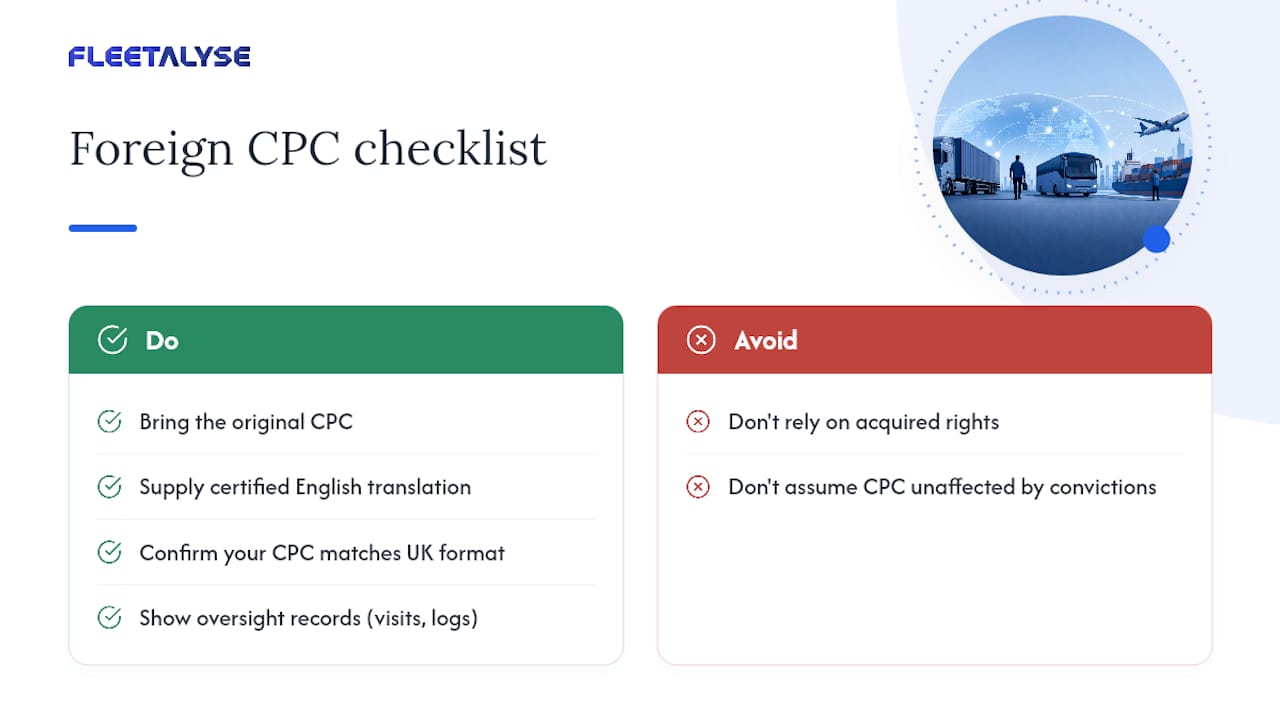
Sometimes, but not automatically. A certificate issued by another EU member state may be accepted in Great Britain, provided it’s in the recognised format and covers content broadly equivalent to the UK qualification. The Traffic Commissioner will still want to see the original document and satisfy themselves it meets the standard expected of a UK-based transport manager.
Traffic Commissioners expect evidence of active oversight, not just a certificate from any jurisdiction. Records showing how often you visit an operating centre, who assists you, and how corrective actions get logged carry real weight in public inquiries when management effectiveness is questioned.
“Acquired rights”, sometimes called grandfathering, refers to a historical exemption for people who were already working as transport managers before certain regulatory changes took effect. It’s essentially closed to new entrants now; if you’re reading this because you’re planning a career move into transport management, assume the exam route applies to you and don’t waste time chasing a legacy exemption that no longer exists in practice.
If you hold a foreign CPC and are relocating to work in Great Britain, expect to provide the original certificate, likely a certified translation if it isn’t in English, and be prepared for the commissioner to ask supporting questions about your management experience. Awarding body guidance also notes that a CPC, while generally a lifetime qualification, can still be affected by later events such as certain criminal convictions, and commissioners can request original certificates at any point to verify continuing eligibility.
How do you evidence “continuous and effective” management day to day?
Here’s the gap almost nobody warns new transport managers about: passing the CPC teaches you the regulatory framework, but it doesn’t teach you how to run the paperwork trail a Traffic Commissioner actually wants to see. Many newly qualified managers discover this the hard way, usually during their first vehicle examiner visit or, worse, at a public inquiry, when they’re asked to produce records they simply haven’t been keeping.
This is where modern fleet systems earn their place, and it’s also why compliance software has become close to standard practice for operators serious about avoiding enforcement action. A workable evidence trail typically includes:
- Routine tachograph downloads on a fixed schedule, not an ad hoc “when we remember” basis, so driver hours data is always current and retrievable.
- Automated driver hours alerts that flag infringements before they become a pattern, rather than discovering three months of breaches during an annual audit.
- Maintenance scheduling that timestamps when vehicles were inspected and by whom, closing the gap between “we think it was serviced” and proof.
- Compliance dashboards that generate the kind of dated, auditable report a commissioner’s office actually wants to review.
Fleetalyse’s remote tachograph download capability and automated driver behaviour monitoring exist precisely to close this gap between the qualification and the evidence a public inquiry demands. A tool like this doesn’t replace your judgement as transport manager, but it does remove the excuse of “we didn’t have time to check” when a commissioner asks how often you actually reviewed driver hours data last quarter.
Pro Tip: Document who has delegated authority to act on your behalf, and make sure the delegation itself is dated and recorded. Telematics timestamps on downloads and reports give you an independent, tamper-resistant record of when checks happened, which carries far more weight at a public inquiry than a manual spreadsheet someone could have edited last night.

Our essential transport manager compliance guide breaks down which specific records matter most when protecting your operator’s licence.
Why the exam is the easy part
Most people preparing for the CPC treat it as the finish line. It isn’t. The exam tests whether you understand the rules; it says nothing about whether you can run the systems that prove you’re following them.
I’ve noticed a consistent pattern in how new transport managers get caught out. They pass comfortably, get named on the licence, and then run the operation on memory and goodwill for the first six months, trusting that drivers will mention hours issues and that maintenance gets done “because the workshop knows the schedule”. That works fine right up until a DVSA earned recognition visit or a random roadside check turns up a gap in the paper trail, and suddenly the transport manager is explaining to a Traffic Commissioner why there’s no record of the checks they’re legally required to be doing.
The mistake isn’t laziness. It’s assuming that competence is something you demonstrate by knowing the rules, when the Traffic Commissioner actually judges you on documented, timestamped evidence that you applied them. A spreadsheet updated manually once a fortnight will always lose that argument against automated tachograph downloads and driver hours alerts that generate their own audit trail without anyone remembering to update anything.
If you’re studying for the CPC right now, my honest advice is to start thinking about your evidence systems before you sit the exam, not after you’re named on a licence and scrambling. Ask training providers and future employers what compliance software they already run. The qualification gets your name on the paperwork; the systems are what keep it there.
Ready to become a UK transport manager? Here’s your plan
Passing the exam is the entry ticket, but staying compliant afterwards is what actually protects the operator’s licence you’ve worked to be named on.
Once you’re qualified and named on a licence, the real work is building systems that make “continuous and effective” management provable rather than assumed. Fleetalyse’s fleet analysis software gives newly appointed transport managers exactly this: automated compliance dashboards, remote tachograph downloads, and driver behaviour monitoring that generate the dated evidence trail a Traffic Commissioner expects to see, without you having to chase it manually. For fleets already running plug-and-play GPS hardware, Fleetalyse’s unlocked GPS trackers integrate straight into the same compliance workflow, so tracking, hours monitoring and maintenance scheduling sit on one platform rather than three separate spreadsheets.
Where to check the official rules yourself
Before you commit to a training provider or submit a nomination, verify the current requirements directly against primary sources rather than relying solely on guides like this one.
- Statutory Document 3 from the Senior Traffic Commissioner gives the full statutory guidance on good repute, continuous and effective management, and what commissioners weigh at public inquiries.
- The Regulated Professions Register confirms how the CPC is recognised as a qualifying credential and clarifies the road haulage versus passenger transport distinction.
- Awarding body syllabuses, such as OCR’s CPC guide, detail exact exam structure, sitting dates and resit rules for the qualification you’re studying towards.
- The Goods Vehicles (Licensing of Operators) Act 1995 provides the primary legislative basis underpinning operator licensing, useful if you want to understand the legal foundation rather than just the guidance built on top of it.
Keep your original certificate somewhere secure and accessible; Traffic Commissioners can request it at any point, not just when you’re first nominated, and a missing original can hold up an otherwise straightforward licence check. This article provides general information and isn’t a substitute for professional or legal advice; always confirm current requirements with GOV.UK or a qualified adviser before making licensing decisions.
This article is general information, not a substitute for advice from a qualified lawyer. Consult a qualified legal professional about your own circumstances before acting on anything here.
Sources
- Statutory Document 3: transport managers - GOV.UK
- Transport Manager | Regulated Professions Register - GOV.UK
- OCR CPC syllabus: student and tutor guide