
The 3.5 tonne limit is no longer the only line in the sand for fleet operators. From 1 July 2026, the van tachograph rules uk are changing significantly, pulling vehicles over 2.5 tonnes into the scope of international regulation. If your vans cross borders for hire or reward, the days of manual logbooks and guesswork are over. It's a shift that's causing genuine concern for regional operators who already juggle tight margins and complex schedules.
We understand that regulatory changes often feel like a moving target. You're likely worried about the cost of new hardware or the risk of a DVSA roadside stop resulting in a heavy penalty. This guide provides the clarity you need to prepare. You'll learn exactly which vehicles require a Smart Tachograph 2, how EU drivers' hours rules apply to your team, and how to manage data whilst avoiding administrative headaches. We'll examine the 2.5t versus 3.5t distinctions and outline a practical plan for 2026 compliance. By the end, you'll have a clear strategy to keep your drivers on the road and your business fully protected.
Key Takeaways
- Prepare for the 1 July 2026 deadline when vans between 2.5 and 3.5 tonnes used for international hire or reward must meet new compliance standards.
- Understand how the updated van tachograph rules uk redefine weight threshold calculations for vehicles towing trailers.
- Identify the essential hardware requirements for the Smart Tachograph 2, including automated border crossing detection and GNSS positioning.
- Master the EU drivers' hours regulations to prevent costly DVSA penalties and ensure your team adheres to mandatory rest periods.
- Discover how remote download technology removes the administrative burden of manual data collection whilst ensuring your distributed fleet stays compliant.
Understanding Van Tachograph Rules in the UK
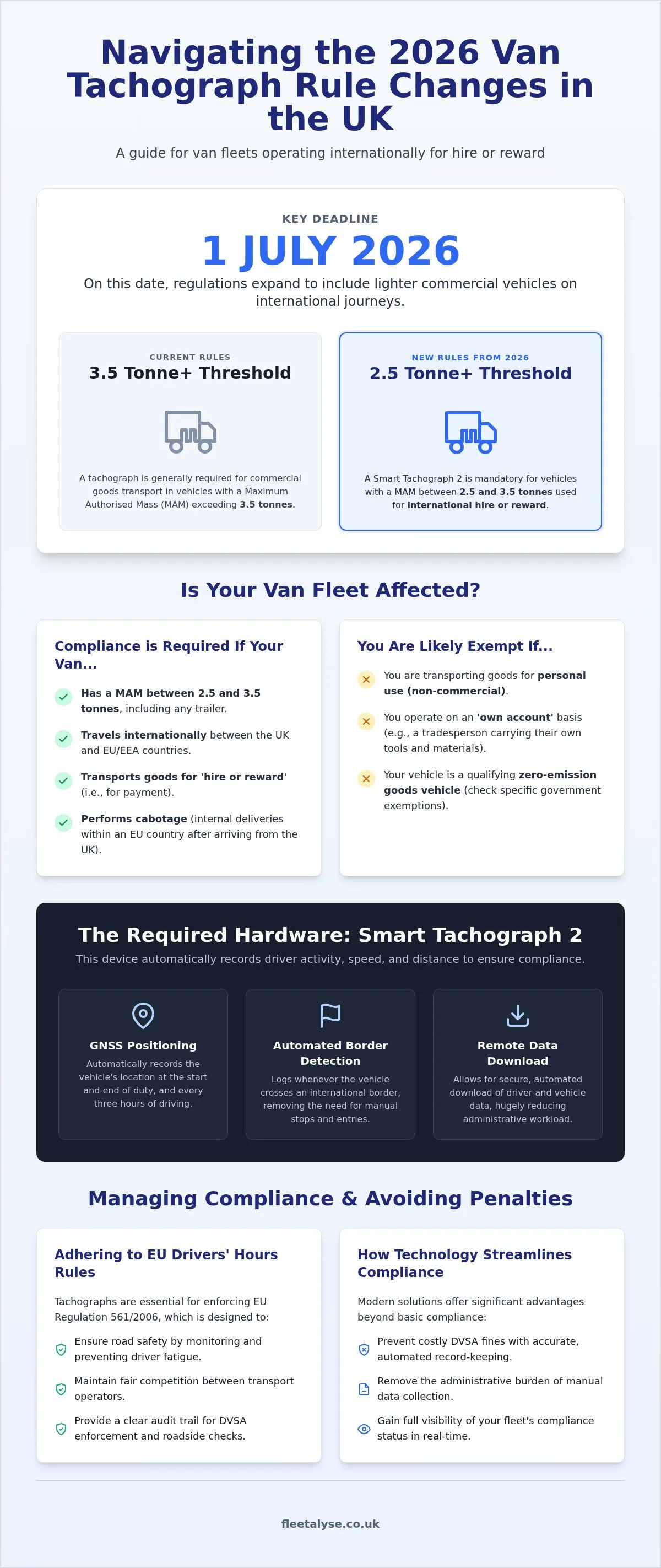
A tachograph is a digital device fitted to a vehicle that automatically records speed, distance, and driver activity. Understanding What is a Tachograph? is the first step for any operator transitioning from simple van use to regulated haulage. These devices serve three primary functions: ensuring road safety by monitoring fatigue, maintaining fair competition between transport businesses, and providing a clear audit trail for enforcement. The DVSA uses this data to verify that drivers aren't pushing beyond safe limits. Currently, the standard threshold for van tachograph rules uk is a Maximum Authorised Mass (MAM) of 3.5 tonnes. However, the rules are changing. Operators must now look beyond the traditional limits to remain compliant.
The Legal Framework for Van Operators
UK operators currently follow EU Regulation 561/2006. Following Brexit, these have been brought into UK law as "assimilated rules." These regulations apply primarily to the commercial carriage of goods. If you transport items for others for payment, known as hire or reward, you're strictly regulated. "Own account" transport, where you move your own tools or products, sometimes falls under different exemptions, but the legal lines are blurring. The UK is aligning with the EU Mobility Package I to ensure UK fleets can still operate across borders without facing legal friction. This alignment is the driving force behind why the van tachograph rules uk are undergoing such a significant shift in 2026. It's about creating a level playing field for all commercial operators, regardless of vehicle size.
Tachograph vs. GB Domestic Rules
Not every van journey requires a tachograph. Many smaller operations currently fall under GB domestic rules. These are generally less restrictive than the full tachograph regime and often rely on manual record-keeping rather than digital hardware. The 3.5-tonne limit has historically been the dividing line for these two sets of standards. If your vehicle and trailer combination stays below this weight, you usually avoid the requirement for a recording device. However, the 2026 changes specifically target the 2.5 to 3.5-tonne bracket for international work. For clarity, Maximum Authorised Mass (MAM) is the weight of a vehicle or trailer including the maximum load it can safely carry whilst being used on the road. Managing this weight is critical, as exceeding it can trigger different regulatory requirements and immediate DVSA penalties.
2026 Threshold Change: Is Your Van Fleet Affected?
The compliance landscape shifts permanently on 1 July 2026. This date marks the official implementation of the new weight threshold for international transport. Under the updated van tachograph rules uk, vehicles with a Maximum Authorised Mass (MAM) over 2.5 tonnes and up to 3.5 tonnes must be fitted with a Smart Tachograph 2 if they are used for international journeys for hire or reward. It is a significant departure from the previous 3.5 tonne limit. This calculation must include the weight of any trailer being towed. If your combined van and trailer weight exceeds 2.5 tonnes, you are now within the scope of these regulations.
International Commercial Freight Requirements
These regulations apply specifically to journeys between the UK and EU or EEA countries. For small couriers and specialised transport firms, even an occasional cross-channel delivery triggers the requirement for a fitted and calibrated tachograph. It is not just about the journey across the border. You must also consider cabotage rules. Cabotage refers to the commercial transport of goods within a single country by an operator from another country. If your van makes internal deliveries within an EU member state after arriving from the UK, you must adhere to these strict recording standards. Managing these requirements manually is a recipe for error. Implementing van tracking and live data monitoring ensures your fleet remains visible and compliant during every stage of an international trip.
Who is Exempt from the 2026 Rules?
Not every van operator needs to invest in new hardware. The rules exclude the non-commercial carriage of goods for personal use. If you are moving personal items to a property abroad, these regulations do not apply. However, for those using a professional service, Let's Move London specialises in both residential and commercial relocations while ensuring all transport activity remains compliant with the latest regulations. The "own account" exemption remains a critical distinction for many businesses. This applies if you carry tools, equipment, or materials required for your own work, provided that driving the vehicle is not your main activity. A builder carrying their own supplies to a site would typically fall under this exemption. There are also specific considerations for alternative fuel vehicles. The UK government has proposed legislation to exempt zero-emission goods vehicles weighing between 3.5 and 4.25 tonnes from tachograph and drivers' hours rules. This move aims to support the adoption of electric vans by offsetting the additional weight of their batteries. Always verify your vehicle's specific MAM and usage case before assuming an exemption applies, as the DVSA remains strict on enforcement.
Smart Tachograph 2: Hardware and Implementation
The transition to the Smart Tachograph Version 2, or G2V2, represents a major technical upgrade for the industry. This hardware is now the mandatory standard for all new commercial vehicles and will soon be the baseline for compliance under the van tachograph rules uk for international operators. It is designed to provide more accurate data whilst reducing the manual workload for drivers. Unlike previous digital iterations, the G2V2 is built to be resilient against tampering and highly efficient for roadside enforcement. Choosing the right hardware now prevents the need for costly replacements as regulations tighten further in the coming years.
G2V2 Technology Explained
The G2V2 unit relies on three core technological pillars to maintain compliance. The integrated GNSS (Global Navigation Satellite System) module provides precise location tracking, recording the vehicle's position at the start and end of the shift and every three hours of accumulated driving. This ensures a transparent record of the vehicle's movement across different regions. Smart 2 tachographs detect border crossings automatically by using satellite positioning to identify when the vehicle enters a new country's territory. This removes the legal requirement for drivers to stop at the first available point to manually enter a country code. Finally, the DSRC (Dedicated Short Range Communication) interface allows the DVSA to perform roadside inspections remotely. Officers can read basic compliance data from a moving vehicle without needing to pull the driver over, significantly reducing operational delays for compliant fleets.
Retrofitting Timeline for Van Fleets
Preparing your budget for 2026 requires a clear understanding of your current fleet's hardware. Whilst HGVs have earlier deadlines for replacing analogue or first-generation digital units, vans between 2.5 and 3.5 tonnes must meet the G2V2 standard by July 2026 if they are used for international hire or reward. Retrofitting is a precise process. You must use an approved tachograph centre for both the installation and the mandatory calibration. These centres ensure the unit is correctly sealed and synced with the vehicle's speed sensors. When planning your upgrades, ensure your new hardware is fully compatible with your existing van tracking and analysis software. Integrating these systems early allows for a frictionless transition, providing you with real-time visibility and automated data management long before the deadline arrives.
Managing Driver Hours and Compliance for Vans
Adopting the van tachograph rules uk means moving away from flexible schedules toward a rigid, safety-first framework. It's a common misconception that van drivers can work unlimited hours simply because their vehicles are smaller than HGVs. Once you're in scope, you must adhere to the same EU drivers' hours rules as heavy haulage operators. The standard daily driving limit is 9 hours. You can extend this to 10 hours twice in any fixed week. To prevent fatigue, you're also capped at 56 hours of driving per week and 90 hours over any two consecutive weeks. Drivers must take a break of at least 45 minutes after 4.5 hours of driving. You can split this into a 15-minute break followed by a 30-minute one. Drivers must carry records for the current day and the previous 28 days, whilst operators must store this data for at least 12 months.
Rest Periods and Driver Wellbeing
Compliance isn't just about what happens behind the wheel; it's about what happens when the engine is off. Drivers must take a regular daily rest period of 11 hours. You can reduce this to 9 hours, but only three times between any two weekly rest periods. Every week, a driver needs a rest of 45 hours. This can be reduced to 24 hours provided the difference is compensated by an equivalent period of rest taken en bloc before the end of the third week following the reduction. Using live driver hours tracking prevents accidental infringements by giving fleet managers real-time visibility. It's far easier to redirect a driver before they break a rule than to deal with the fallout afterwards.
The Consequences of Non-Compliance
The DVSA takes a zero-tolerance approach to hours violations. Roadside fines are immediate. Serious or repeated infringements can lead to the revocation of your "O" licence, effectively shutting down your commercial operations. Beyond legal penalties, non-compliance drives up insurance premiums and damages your professional reputation amongst clients who value safety. Relying on manual logbooks is no longer sufficient for modern van fleets because they're prone to human error and difficult to audit quickly. Automated systems provide the accuracy required to protect your business. To safeguard your fleet, enrol in our live driver hours monitoring service and remove the guesswork from your compliance strategy.
Streamlining Van Compliance with Remote Tachograph Technology
Transitioning to a regulated framework requires a shift in how you handle vehicle data. Manual collection is a significant administrative burden. It often forces vehicles to deviate from their routes just to visit a central depot for a physical download. Under the van tachograph rules uk, failure to retrieve data within the legal windows is a serious offence. Remote technology removes this logistical barrier entirely. It allows you to focus on operations whilst the system handles the heavy lifting of compliance.
Why Remote Download is Essential for Vans
Efficiency is the backbone of any successful van operation. Traditional methods require a driver to be physically present for a technician to extract data from the unit. This process wastes fuel and valuable driving time. By implementing remote tachograph download, you automate the entire collection process. The system retrieves data wirelessly from the vehicle, no matter where it is in the UK or Europe. This ensures you never miss the critical 28-day deadline for driver cards or the 90-day window for vehicle units. It also eliminates the risk of human error, such as lost files or corrupted data, which can lead to severe DVSA penalties during an audit. You gain a clean, digital audit trail without lifting a finger.
Live Driver Hours Monitoring
Compliance is most effective when it's proactive rather than reactive. Integrating your hardware with tachograph analysis integration gives your transport managers a live overview of the entire fleet. You can see exactly how many hours a driver has remaining before they must take a mandatory break. This visibility allows for more intelligent route planning. You won't accidentally assign a long-distance job to a driver who is nearing their daily limit. Proactive alerts notify managers before an infringement occurs, protecting the business and the driver's record. Combining this with GPS fleet tracking provides a total overview of your assets. You'll see the vehicle's location alongside its compliance status on a single screen. It's a level of control that manual logbooks simply cannot match, ensuring your fleet remains efficient and fully compliant with the van tachograph rules uk as the 2026 deadline approaches.
Future-Proof Your Van Fleet for 2026
The changes to the van tachograph rules uk represent a permanent shift in how light commercial vehicles are managed across the country. By the 1 July 2026 deadline, every van between 2.5 and 3.5 tonnes used for international hire or reward must be equipped with a Smart Tachograph 2. This isn't just a hardware upgrade. It is a fundamental change in how you monitor driver safety and manage operational data. Proactive planning today prevents the risk of fleet downtime and costly DVSA penalties tomorrow.
Success in this new regulatory environment depends on automation. Fleetalyse provides the infrastructure you need to stay compliant without the administrative headache. Our solutions deliver DVSA-ready reporting, real-time driver hours visibility, and seamless integration with analysis software. This ensures your data is accurate and always available when it matters most. Automate your van fleet compliance with Fleetalyse remote tachograph solutions to keep your business moving. You've built a strong operation; let us help you protect it as the industry evolves.
Frequently Asked Questions
Do the new 2026 van tachograph rules apply to domestic journeys within the UK?
No, the 2026 changes specifically target international transport. If your van operations are confined solely within the UK, you remain exempt from these new requirements. However, if you cross into the EU or EEA for hire or reward, you must comply. It is vital to monitor your routes carefully, as even a single international job triggers the need for a calibrated tachograph and strict adherence to the updated van tachograph rules uk.
What is the minimum weight for a van to require a tachograph in 2026?
The new threshold applies to vans with a Maximum Authorised Mass (MAM) over 2.5 tonnes and up to 3.5 tonnes. This calculation must include the weight of any trailer being towed. If your combined vehicle and trailer weight exceeds 2.5 tonnes during an international journey for hire or reward, you fall under the updated regulations. Always check your vehicle's plate to confirm its specific MAM before planning any cross-border trips or commercial deliveries.
Does a van driver need a Driver CPC if they are now using a tachograph?
No, van drivers operating vehicles at or below 3.5 tonnes on a standard Category B licence don't currently need a Driver CPC. This remains the case even if the vehicle is now required to have a tachograph fitted for international work. Whilst the tachograph records your hours and rest periods, it doesn't change the underlying licensing requirements. Driver CPC qualifications are still generally reserved for those operating larger HGVs on Category C or D licences.
What happens if I use a van for an international journey without a tachograph after July 2026?
Operating without a required tachograph after 1 July 2026 carries severe risks. The DVSA can issue immediate roadside fines and prohibit your vehicle from continuing its journey. For businesses, the consequences are even greater. Serious or repeated violations can lead to a formal inquiry and the potential revocation of your operator's licence. It's also likely that your insurance premiums will rise significantly following a recorded compliance failure or a serious safety infringement.
How often must I download data from a van tachograph and driver card?
You must download data from the driver card at least every 28 days. The vehicle unit itself must be downloaded at least every 90 days. These are the legal maximum intervals; many operators choose to download more frequently to ensure data security. Using automated remote downloads removes the risk of missing these deadlines. It ensures your records are always up to date for DVSA inspections without requiring manual intervention from your drivers or staff.
Are there any exemptions for van drivers who only cross the border occasionally?
There are no specific exemptions for occasional international trips. If your van is used for hire or reward across a border just once, it must be compliant with the van tachograph rules uk. The only real exemptions apply to non-commercial personal use or "own account" transport where driving isn't the individual's main activity. If you're moving goods for payment, the frequency of your trips doesn't change your legal obligations or hardware requirements.
What is a Smart Tachograph Version 2 and do I need one for my van?
The Smart Tachograph Version 2 (G2V2) is the latest generation of recording hardware. It features automated border crossing detection and a DSRC interface for remote roadside checks. If your van is over 2.5 tonnes and performs international work for hire or reward, you must have this specific version fitted by the 2026 deadline. It provides a more secure and automated way to record driver activity compared to older digital or analogue units used in HGVs.
Can I use a third-party GPS tracker instead of a tachograph for compliance?
No, a standard GPS tracker cannot replace a tachograph for legal compliance. Whilst GPS tracking is an excellent tool for fleet management and route planning, it doesn't meet the DVSA's technical standards for recording drivers' hours. A tachograph is a sealed, calibrated device specifically designed to prevent tampering and provide a legally binding record of work. However, integrating your tachograph with a professional GPS system allows for more efficient data analysis and remote monitoring.
Frequently asked questions
Who is Exempt from the 2026 Rules?
Not every van operator needs to invest in new hardware. The rules exclude the non-commercial carriage of goods for personal use. If you are moving personal items to a property abroad, these regulations do not apply. The "own account" exemption remains a critical distinction for many businesses. This applies if you carry tools, equipment, or materials required for your own work, provided that driving the vehicle is not your main activity. A builder carrying their own supplies to a site would typically fall under this exemption. There are also specific considerations for alternative fuel vehicles. The UK government has proposed legislation to exempt zero-emission goods vehicles weighing between 3.5 and 4.25 tonnes from tachograph and drivers' hours rules. This move aims to support the adoption of electric vans by offsetting the additional weight of their batteries. Always verify your vehicle's specific MAM and usage case before assuming an exemption applies, as the DVSA remains strict on enforcement. The transition to the Smart Tachograph Version 2, or G2V2, represents a major technical upgrade for the industry. This hardware is now the mandatory standard for all new commercial vehicles and will soon be the baseline for compliance under the van tachograph rules uk for international operators. It is designed to provide more accurate data whilst reducing the manual workload for drivers. Unlike previous digital iterations, the G2V2 is built to be resilient against tampering and highly efficient for roadside enforcement. Choosing the right hardware now prevents the need for costly replacements as regulations tighten further in the coming years.
Do the new 2026 van tachograph rules apply to domestic journeys within the UK?
No, the 2026 changes specifically target international transport. If your van operations are confined solely within the UK, you remain exempt from these new requirements. However, if you cross into the EU or EEA for hire or reward, you must comply. It is vital to monitor your routes carefully, as even a single international job triggers the need for a calibrated tachograph and strict adherence to the updated van tachograph rules uk.
What is the minimum weight for a van to require a tachograph in 2026?
The new threshold applies to vans with a Maximum Authorised Mass (MAM) over 2.5 tonnes and up to 3.5 tonnes. This calculation must include the weight of any trailer being towed. If your combined vehicle and trailer weight exceeds 2.5 tonnes during an international journey for hire or reward, you fall under the updated regulations. Always check your vehicle's plate to confirm its specific MAM before planning any cross-border trips or commercial deliveries.
Does a van driver need a Driver CPC if they are now using a tachograph?
No, van drivers operating vehicles at or below 3.5 tonnes on a standard Category B licence don't currently need a Driver CPC. This remains the case even if the vehicle is now required to have a tachograph fitted for international work. Whilst the tachograph records your hours and rest periods, it doesn't change the underlying licensing requirements. Driver CPC qualifications are still generally reserved for those operating larger HGVs on Category C or D licences.
What happens if I use a van for an international journey without a tachograph after July 2026?
Operating without a required tachograph after 1 July 2026 carries severe risks. The DVSA can issue immediate roadside fines and prohibit your vehicle from continuing its journey. For businesses, the consequences are even greater. Serious or repeated violations can lead to a formal inquiry and the potential revocation of your operator's licence. It's also likely that your insurance premiums will rise significantly following a recorded compliance failure or a serious safety infringement.
How often must I download data from a van tachograph and driver card?
You must download data from the driver card at least every 28 days. The vehicle unit itself must be downloaded at least every 90 days. These are the legal maximum intervals; many operators choose to download more frequently to ensure data security. Using automated remote downloads removes the risk of missing these deadlines. It ensures your records are always up to date for DVSA inspections without requiring manual intervention from your drivers or staff.
Are there any exemptions for van drivers who only cross the border occasionally?
There are no specific exemptions for occasional international trips. If your van is used for hire or reward across a border just once, it must be compliant with the van tachograph rules uk. The only real exemptions apply to non-commercial personal use or "own account" transport where driving isn't the individual's main activity. If you're moving goods for payment, the frequency of your trips doesn't change your legal obligations or hardware requirements.
What is a Smart Tachograph Version 2 and do I need one for my van?
The Smart Tachograph Version 2 (G2V2) is the latest generation of recording hardware. It features automated border crossing detection and a DSRC interface for remote roadside checks. If your van is over 2.5 tonnes and performs international work for hire or reward, you must have this specific version fitted by the 2026 deadline. It provides a more secure and automated way to record driver activity compared to older digital or analogue units used in HGVs.
Can I use a third-party GPS tracker instead of a tachograph for compliance?
No, a standard GPS tracker cannot replace a tachograph for legal compliance. Whilst GPS tracking is an excellent tool for fleet management and route planning, it doesn't meet the DVSA's technical standards for recording drivers' hours. A tachograph is a sealed, calibrated device specifically designed to prevent tampering and provide a legally binding record of work. However, integrating your tachograph with a professional GPS system allows for more efficient data analysis and remote monitoring.