
1 July 2026: UK tachograph rules checklist for fleet managers
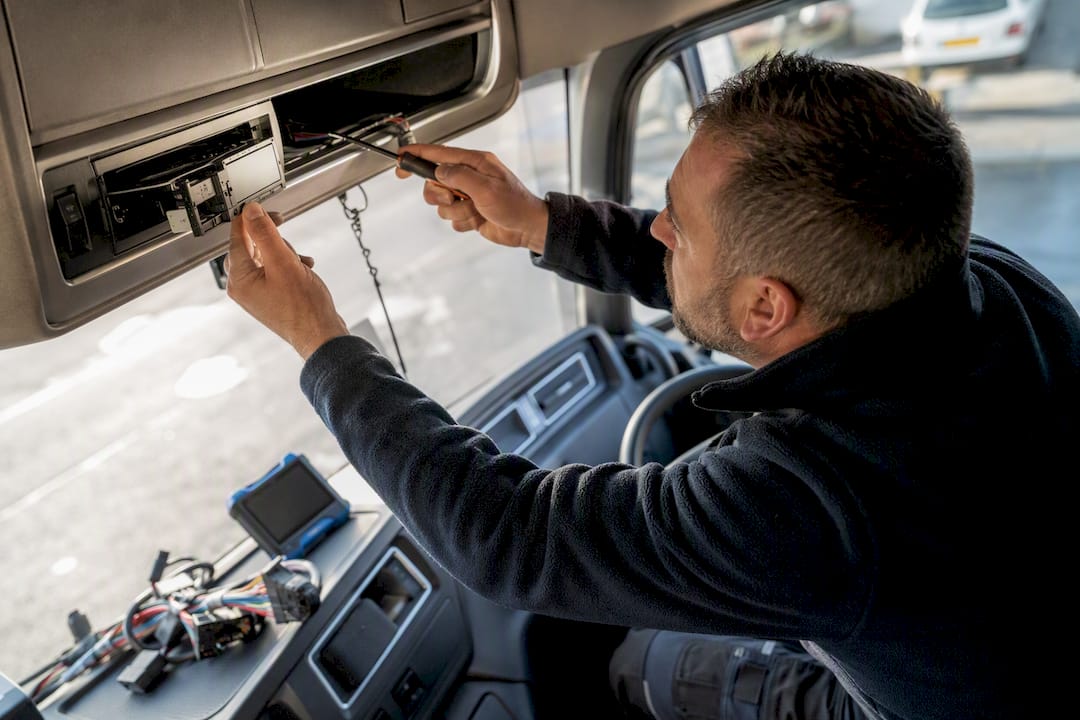
If you drive or operate commercial vehicles that cross UK borders, or vehicles over the relevant weight thresholds, you need an approved tachograph fitted and used correctly. Check the vehicle’s registration date and whether its journeys are international. If either answer is unclear, treat the vehicle as in scope until you confirm otherwise against Gov, the 2025 Regulations, and Fleetalyse’s compliance tools.
TL;DR:
- Vehicles between 2,500kg and 3,500kg used on cross-border trips may require a smart tachograph by July 2026, even if they are exempt for domestic UK routes.
- Tachograph compliance involves regular data downloads every 28, 56, or 90 days, with stricter retention rules applying to international journeys under specific regulations.
- Correctly categorizing each vehicle’s scope based on weight, registration date, and journey type is essential to avoid enforcement failures.
- Smart 2 tachographs automatically log border crossings and enable remote interrogation, reducing roadside checks and manual oversight.
- Implementing automated, scheduled remote downloads and training staff on compliance procedures will diminish administrative errors and improve audit readiness.
Table of Contents
- When you must use a tachograph under UK rules
- Tachograph types and the smart 2 fitting deadlines
- Driver and operator duties: cards, downloads and records
- How international journeys change the requirements
- Building a tachograph compliance checklist that actually holds up
- Making remote downloads and automation work for your fleet
- How tachograph rules affect different types of operations
- Reading tachograph data properly during a compliance audit
- Where drivers and transport managers can get proper training
- Author perspective: what to prioritise this year
- Fleetalyse: remote tachograph downloads without the admin burden
- Sources
When you must use a tachograph under UK rules
Assimilated rules are what the retained EU drivers’ hours regulations became after Brexit. They still govern most UK domestic and EU-facing haulage, and DVSA enforces them alongside AETR, the international agreement covering journeys to non-EU European states such as Switzerland, Norway, or countries further east. GOV.UK sets out exactly when a tachograph is required and how these two frameworks overlap for UK operators.
Vehicle weight decides most of the scope question. Goods vehicles over 3.5 tonnes have needed tachographs for years. What changes the picture now is international use: vans and light goods vehicles between 2,500kg and 3,500kg on cross-border trips are being pulled into scope by staged rule changes, even though the same van running domestic UK routes might stay exempt.
Common exemptions include:
- Vehicles used solely for UK domestic collection or delivery under certain thresholds, subject to conditions.
- Emergency service and breakdown recovery vehicles.
- Some specialist vehicles used for maintenance, testing, or non-commercial purposes.
- Own-account operators moving goods incidental to their main business, within defined limits.
Exemptions are narrow and condition-based, not blanket categories, so check the exact wording for your operation rather than assuming a “similar” vehicle qualifies.
Tachograph types and the smart 2 fitting deadlines
Four tachograph types exist on UK roads today, and knowing which one sits in your cab changes what you’re legally required to do with it.
- Analogue tachographs use paper discs and are largely legacy kit on older vehicles still in service.
- Digital tachographs record data electronically onto a vehicle unit and driver card, standard on trucks registered from 2006 onwards.
- Smart 1 tachographs added GNSS positioning and remote early-detection capability, mandatory from 2019.
- Smart 2 tachographs go further still, automatically logging border crossings and supporting DVSA’s remote interrogation systems.
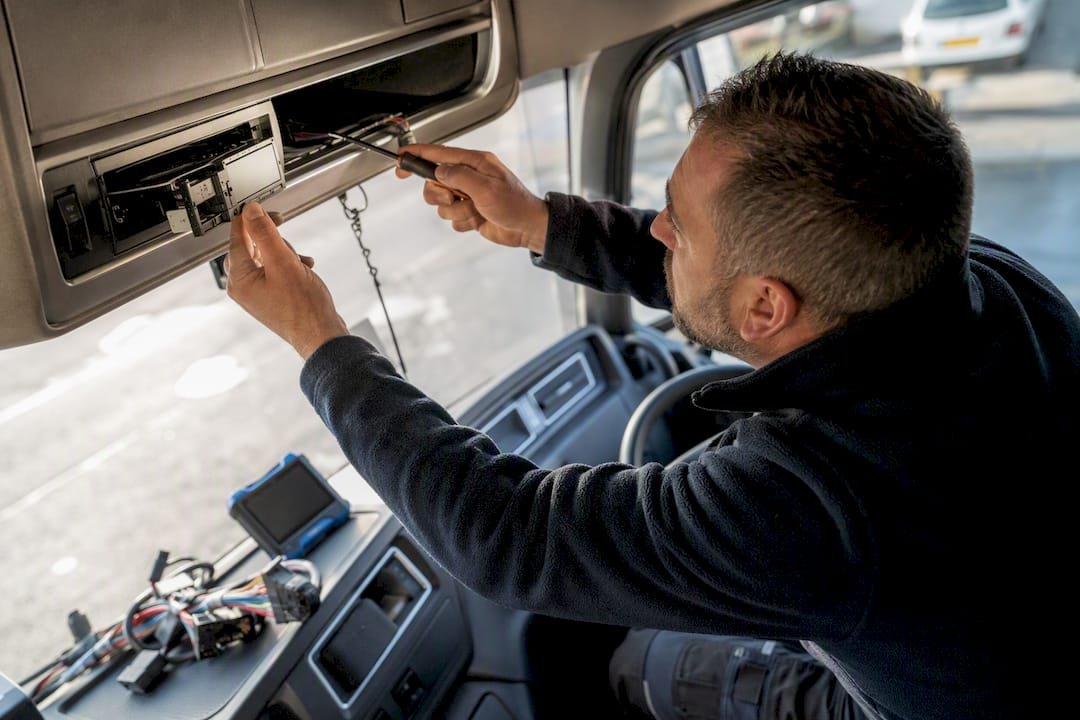
The fitment timeline matters more than the technical detail. Key dates include 31 December 2024 for certain new vehicle type-approvals, 19 August 2025 and 24 December 2025 as retrofit milestones for specific vehicle categories, and 1 July 2026, when goods vehicles between 2,500kg and 3,500kg used on international journeys may need a Smart Tachograph Version 2 fitted, with retrofit dates differing by vehicle type and prior fitment.
The practical shift: smart 2 units record GNSS position at border crossings automatically and can be interrogated remotely by enforcement authorities without stopping the vehicle, turning what used to be a physical roadside check into a data query that can happen while your driver is still on the road.
Driver and operator duties: cards, downloads and records
Compliance splits cleanly into two roles, and confusing them is where most small fleets lose their footing.
- Drivers must insert their driver card before starting any duty in an in-scope vehicle, select the correct activity mode throughout the shift (driving, other work, availability, rest), and use manual entry with a printout where the card or unit fails.
- Operators must issue and manage company cards, keep the tachograph calibrated and maintained by an approved workshop, and download data at the intervals the law requires rather than waiting for an inspection to prompt it.
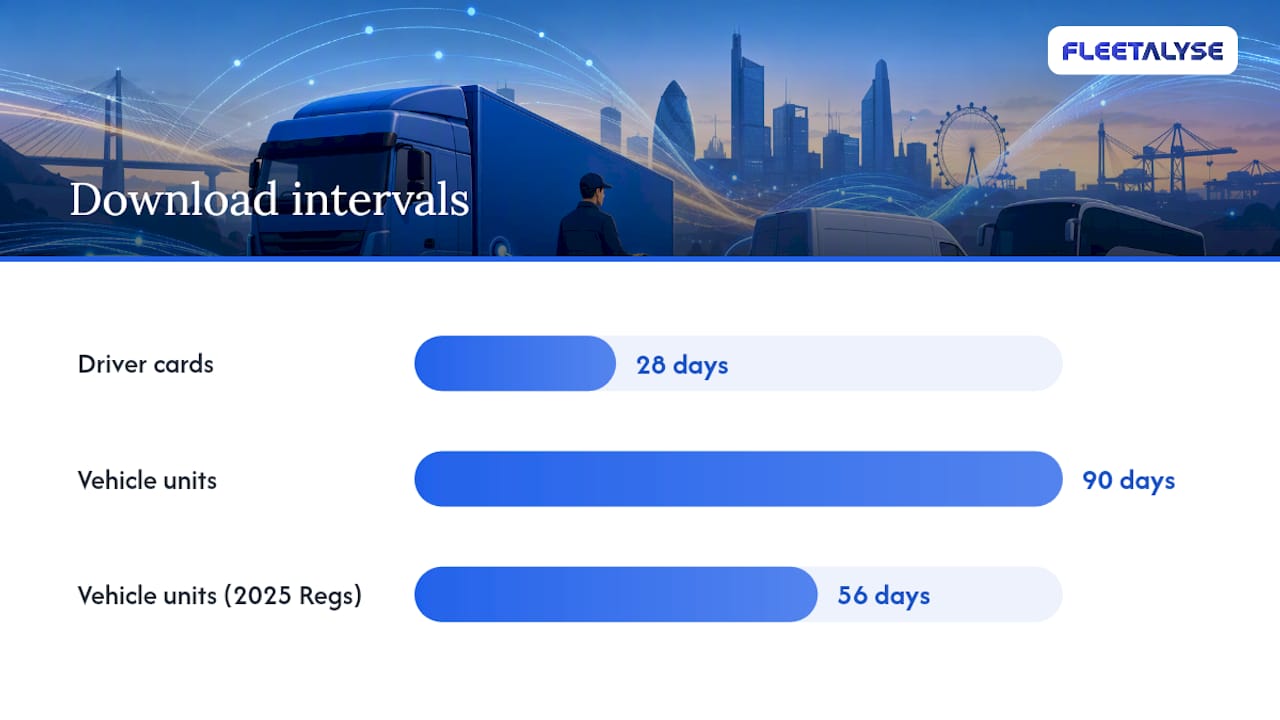
Retention and download intervals sit at the centre of this. DVSA guidance requires operators to download vehicle unit data every 90 days and driver card data every 28 days, and drivers must use their card whenever they’re behind the wheel of a vehicle fitted with a digital or smart tachograph. The 2025 Regulations add a further wrinkle: certain in-scope international journeys now carry a 56-day retention expectation rather than the standard 28 or 90 day cycle, so check which rule applies before you set a download schedule.
Driver and company smart cards both come through a government application process, and operators are responsible for confirming every driver holds the right card before they’re rostered onto an in-scope vehicle.
Pro Tip: Set download reminders against the shortest applicable interval for your fleet, not the longest. A fleet running mixed domestic and international work should default to the 28 and 56 day cycle rather than risk missing a tighter deadline on one vehicle.
How international journeys change the requirements
Cross-border work adds obligations that a UK-only operation never encounters, and Northern Ireland’s land border with the Republic of Ireland makes this especially relevant for operators moving goods between the two.
The 56-day retention rule applies specifically to journeys captured under the Trade and Cooperation Agreement and the 2025 Regulations, meaning an operator running the same van on a UK-only round trip one week and a cross-Channel delivery the next needs to know which retention clock applies to which trip.
From 1 July 2026, vans and light goods vehicles between 2,500kg and 3,500kg on international routes may need a Smart Tachograph Version 2, closing a gap that previously let lighter commercial vehicles avoid tachograph rules entirely on European work.
At the border itself, get into these habits:
- Log the correct country code at every border crossing, even where smart 2 automation captures GNSS position.
- Check ferry and rail operators’ own documentation requirements, which sometimes exceed DVSA’s baseline.
- Keep attestation forms (covering periods of leave, sickness, or other non-driving duty) accessible for roadside checks, particularly on mixed UK/EU rosters.
Building a tachograph compliance checklist that actually holds up
Most enforcement failures aren’t dramatic. They’re small administrative gaps that compound across a fleet.
- Review scope first. Categorise every vehicle by weight, registration date, and journey type. Mixed fleets are the single biggest source of misclassification, according to DVSA’s own guidance.
- Audit your tachograph fleet. Confirm which units are analogue, digital, smart 1, or smart 2, and match that against the retrofit deadlines relevant to each vehicle.
- Schedule downloads on a calendar, not a memory. Twenty-eight days for driver cards, 90 for vehicle units, 56 where the 2025 Regulations apply.
- Train staff on manual entry procedures so a card fault or malfunction doesn’t turn into an unrecorded gap.
- Keep calibration certificates and attestation forms filed and retrievable, not just stored somewhere on a depot shelf.
The most common failures worth watching for: treating a mixed fleet as uniformly exempt or uniformly in scope, missing a download window because no one owns the task, drivers making manual entries incorrectly after a card fault, and failing to document border crossings on older units without automatic GNSS logging.
Pro Tip: Assign one named person to own the download calendar. Compliance tasks with no clear owner are the ones that slip, and DVSA’s remote interrogation capability means a missed download is discoverable faster than it used to be.
When DVSA does check, expect them to request downloaded tachograph data, driver card records, calibration certificates, and attestation forms covering any non-driving periods. Increasingly, some of that check happens remotely before a vehicle is even stopped.
Making remote downloads and automation work for your fleet
Smart 2 data volume is the real reason manual download management is becoming impractical. Automatic border logs and remote interrogation mean DVSA can query records faster than a paper-based system can respond, and transport managers who move to scheduled automated downloads close that gap before it becomes a finding.
A workable compliant workflow needs:
- Hardware fitted for remote data capture without disrupting daily vehicle use.
- A clear company-card policy defining who downloads what and when.
- Automated alerts for missed or corrupted downloads rather than relying on someone remembering.
- An auditable log retained across the correct period for each vehicle’s journey type.
A fleet running ten vehicles on mixed domestic and international routes typically needs three separate download clocks running simultaneously (28-day, 56-day, and 90-day) which is precisely the kind of tracking that becomes unreliable once it’s managed on a spreadsheet. Prioritise vehicles moving into international scope first, test your alert thresholds before relying on them, and set calibration reminders well ahead of the workshop date, not on it. Fleetalyse’s buyer’s guide to remote-download solutions covers the practical fitment and policy questions in more depth.
How tachograph rules affect different types of operations
Not every operator feels these rules the same way, and the differences are worth knowing before you copy a generic compliance template onto your own fleet.
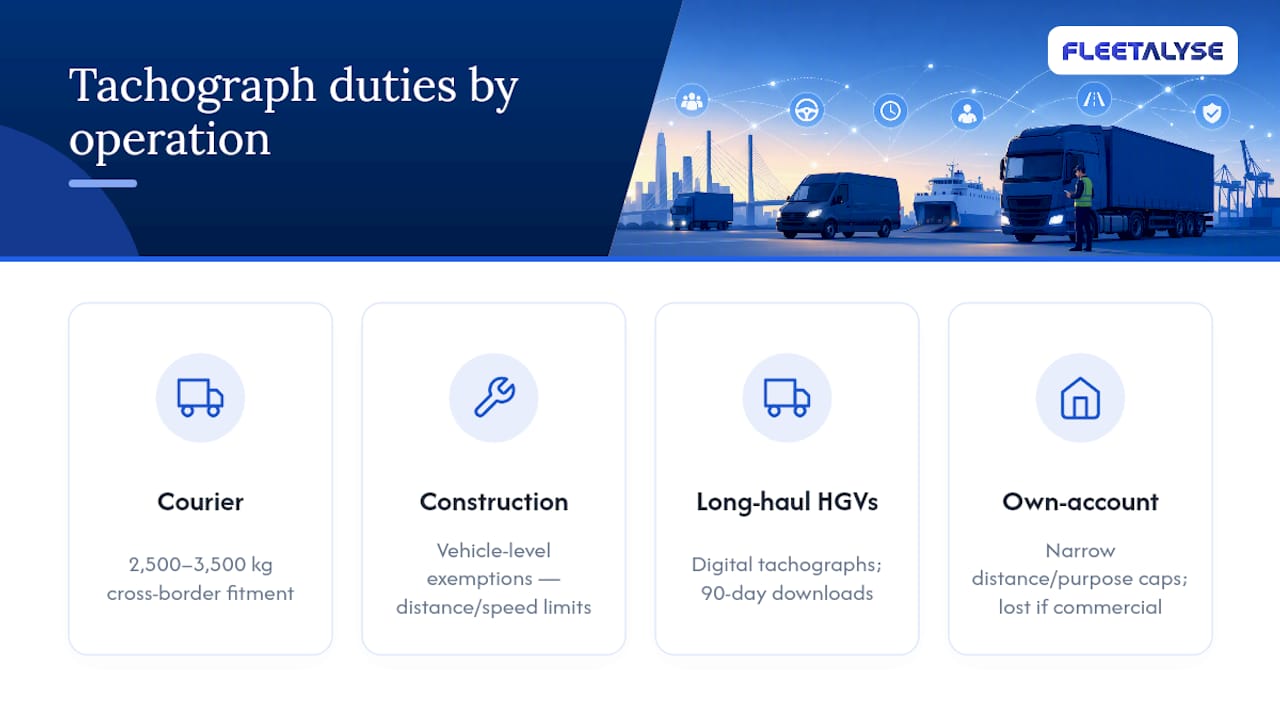
Courier and parcel delivery services running light vans have historically sat outside tachograph scope for domestic work, which is exactly why the 2,500kg to 3,500kg international threshold arriving in July 2026 matters so much to this sector. A courier fleet that’s never touched a tachograph before may suddenly need fitment, driver training, and a download policy for the specific subset of vans doing cross-border runs, while domestic-only vans in the same yard stay exempt.
Construction and plant vehicles often qualify for specialist exemptions, but only under narrow conditions, typically tied to distance travelled, speed limitations, or the vehicle being used incidentally to construction work rather than as a general haulage asset. Operators in this sector frequently assume an exemption applies fleet-wide when it actually applies vehicle-by-vehicle, and sometimes trip-by-trip.
Long-haul HGV operators face the most mature end of the rules, having lived with digital tachographs and 90-day download cycles for years. Their compliance burden now is less about scope and more about smart 2 migration timing and border-crossing logging accuracy.
Own-account operators, businesses moving their own goods rather than acting as hauliers for hire, get some of the narrowest exemptions of all, usually capped by distance or vehicle purpose, and lose that exemption the moment the vehicle’s use shifts even slightly towards commercial carriage for others.
The common thread: sector doesn’t determine your obligations, vehicle weight, registration date, and journey type do. A construction firm and a parcel courier can end up with near-identical tachograph duties if their vehicles share a weight bracket and both occasionally cross a border.
Reading tachograph data properly during a compliance audit
Downloaded tachograph data is only useful if someone actually interprets it correctly, and this is where audit readiness often breaks down even in fleets that never miss a download.
A vehicle unit download shows driving time, speed traces, distance, and, on smart 2 units, GNSS position logs at border crossings. A driver card download shows the same data from the individual’s perspective across every vehicle they’ve driven. Auditors, whether internal or DVSA, cross-reference the two to check for gaps: a period where the vehicle moved but no driver card was inserted, or activity mode selections that don’t match the actual journey pattern.
The most useful audit habit is comparing downloaded data against your own operational records, delivery schedules, timesheets, before an external check does it for you. Discrepancies caught internally can usually be explained and corrected. The same discrepancy found first by DVSA during a roadside or remote interrogation carries far more weight, because it looks like something you either missed or chose not to notice.
Retention periods aren’t just a legal formality here, they’re what makes an audit possible at all. If your 28-day driver card cycle or 90-day vehicle unit cycle has gaps because a download was missed, you can’t retrospectively reconstruct that period. Fleetalyse’s guidance on how long tachograph data must be kept in the UK sets out the practical side of building a retention system that survives scrutiny rather than one that technically meets the letter of the rule but falls apart the first time someone asks for six months of history.
Where drivers and transport managers can get proper training
Tachograph competence isn’t something you pick up by osmosis, and the rules change often enough that training needs refreshing rather than treated as a one-off induction task.
Driver CPC training, the mandatory periodic training scheme for professional drivers, typically includes a tachograph module covering activity mode selection, manual entry procedure, and what to do when a card or unit malfunctions mid-shift. It’s a reasonable baseline but rarely covers fleet-specific policy, such as which download interval applies to which vehicle in a mixed fleet.
Transport managers carry a heavier training burden. They need working knowledge of the retention rules, the fitment deadlines relevant to their vehicle mix, and enough technical familiarity with their tachograph systems to spot a corrupted download before it becomes a 90-day gap. DVSA’s own guidance pages are the most reliable free resource for this, updated as regulations shift, and worth checking quarterly rather than once at induction.
Industry publications also fill a gap official guidance leaves open: practical, real-world examples of how compliance failures actually happen. Velocerta’s blog covers exactly this kind of ground, useful reading for transport managers who want to see how other fleets have gone wrong before they repeat the same mistake.
The most overlooked training resource, though, is simply reviewing your own fleet’s download and audit data periodically as a team exercise, walking through a real download together and discussing what would happen if DVSA asked for it tomorrow.
Author perspective: what to prioritise this year
Retrofit vehicles moving into international scope first. Shift from manual audits to scheduled remote downloads and automated driver-hours alerts. Validate your process against DVSA guidance rather than assuming last year’s approach still holds.
— Vytautas
Fleetalyse: remote tachograph downloads without the admin burden
Manual download management doesn’t scale once you’re running mixed fleets against three different retention clocks, and that’s exactly the gap Fleetalyse’s remote tachograph download platform closes. It pulls driver card and vehicle unit data automatically, on schedule, without a technician visiting each vehicle.
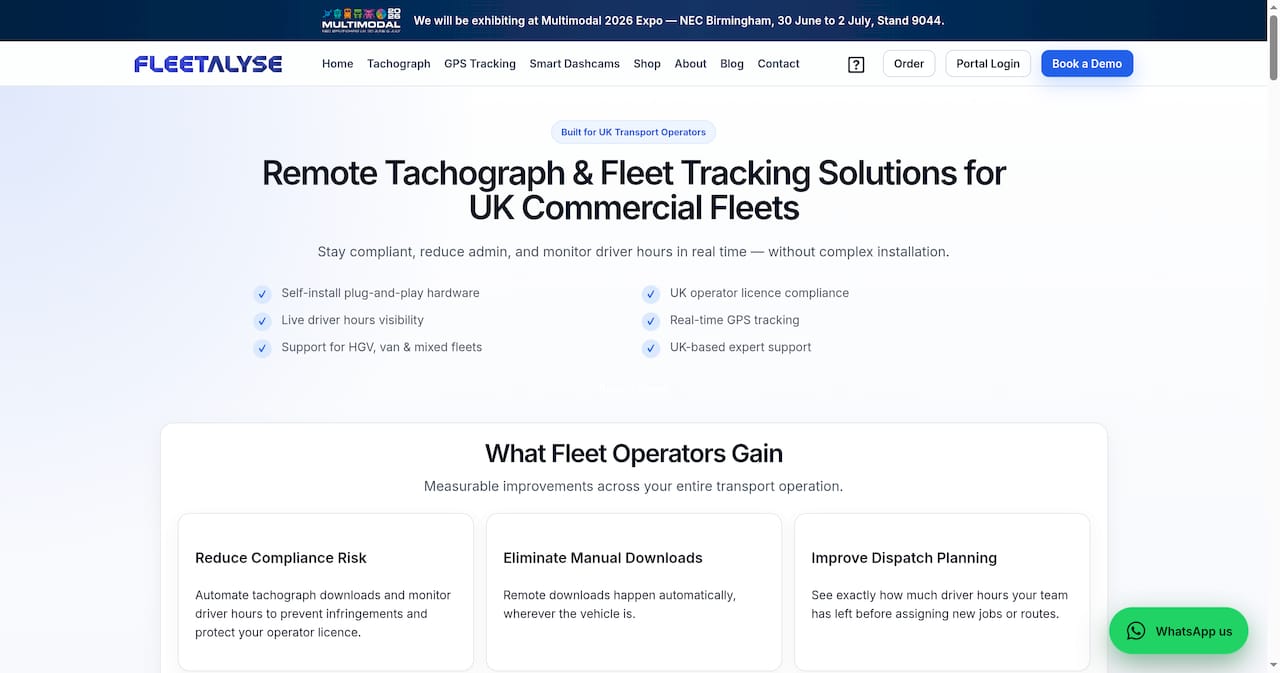
You get UK-based support, automated alerts when a download is missing or a card hasn’t been used correctly, and an audit-ready log retained across the period your journey type requires, whether that’s 28, 56, or 90 days. That means fewer surprises at the roadside and a much shorter scramble when DVSA asks for six months of records. It pairs naturally with driver behaviour monitoring if you want driver-hours alerts and behaviour data in the same dashboard, and with compatible GPS hardware for fleets still building out their telematics fitment. If your fleet has any vehicles moving into international scope ahead of the 1 July 2026 deadline, check the remote tachograph downloads page and get in touch for a demo before that migration window closes.
This article is general information, not a substitute for advice from a qualified lawyer. Consult a qualified legal professional about your own circumstances before acting on anything here.
Sources
- Tachographs: rules for drivers and operators
- The Drivers’ Hours and Tachographs (Amendment and Modification) Regulations 2025
- Tachograph rules for international journeys: What you need to know