
If a DVSA officer pulled you over right now, would you know exactly what they're about to see on their screen? Most UK drivers and transport managers treat the digital tachograph card as a simple logbook. In reality, it's a forensic legal diary that tracks your every move with second-by-second precision. Understanding exactly what data is stored on a driver's tacho card is the only way to stay ahead of the 56-day inspection rule and avoid those costly £300 fixed penalties.
We know that keeping up with shifting UK regulations feels like a full-time job. You're likely tired of the manual download admin and the constant fear of an accidental infringement hiding in your records. This guide promises to clear the fog. You'll discover the specific information recorded on your card, from GNSS location points to shift start times, and how it impacts your fleet compliance.
We'll break down the technical data fields, explain the differences between card generations, and share a strategy for efficient data management. By the end, you'll have the confidence to face any roadside inspection and the knowledge to protect your operator licence.
Key Takeaways
- Identify the specific activity states recorded on your card, including how manual entries and "unknown" periods are handled during shifts.
- Discover what data is stored on a driver's tacho card concerning vehicle registration marks and odometer readings for every vehicle you operate.
- Understand the critical 28-day download deadline and how the card's internal memory capacity manages your 56-day activity history.
- Learn how to modernise your compliance strategy by replacing manual admin with automated remote tachograph download solutions.
- Gain clarity on the technical logs that DVSA officers review during roadside inspections to ensure your fleet remains fully compliant.
Understanding the Digital Tachograph Driver Card
The driver card acts as your professional identity within the transport industry. It is a personal legal document that you must keep in your possession during all commercial operations. Without it, you cannot legally drive a vehicle equipped with digital tachograph hardware. These digital tachograph systems ensure that every minute of your shift is accounted for, helping the DVSA enforce UK and EU drivers' hours regulations. A driver card is an encrypted smart card designed specifically for recording work activity, rest periods, and vehicle usage.
It's vital to distinguish this from other card types. While you use a driver card, your employer uses a company card to lock and download data. Mechanics use a workshop card for calibrations. You must carry your specific card at all times. If you are stopped at the roadside, failing to produce it can lead to immediate fines or a prohibition notice. This card is your evidence of compliance.
The Legal Status of Your Driver Card
While the physical card is issued to you by the DVLA, the information it holds is a shared responsibility. You own the card, but the operator owns the data for compliance reporting. This creates a unique legal dynamic. You are responsible for the accuracy of manual entries, but your employer is legally bound to download and analyse the files. You must produce your card for inspection by the police or DVSA officers whenever requested. They will check exactly what data is stored on a driver's tacho card to verify you are working within legal limits. Any missing data or gaps in your record can trigger an investigation into your working patterns.
Card Generations: From Gen 1 to Smart Tacho 2
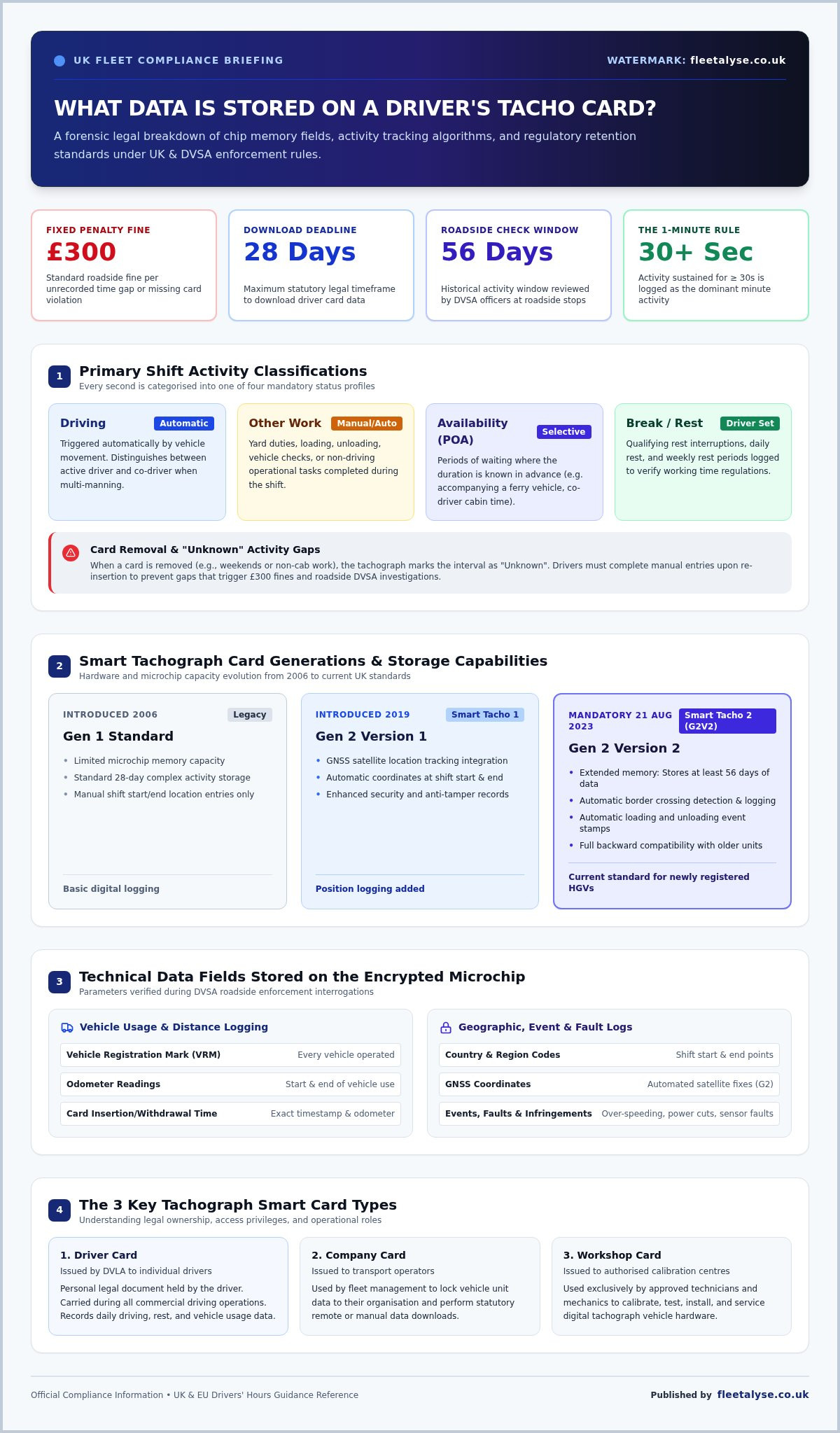
Technology has moved quickly since the first digital units appeared in 2006. Early Gen 1 cards had limited memory, often struggling to hold more than 28 days of complex activity. The introduction of Smart Tachograph Version 1 (Gen 2 V1) in 2019 added GNSS location tracking at the start and end of shifts. This improved transparency for operators and enforcement bodies alike.
The latest Smart Tachograph Version 2 (G2V2) cards, mandatory for new vehicles registered since 21 August 2023, offer even greater capacity. These cards are designed to store at least 56 days of data to meet the new inspection window requirements. They automatically record border crossings and loading or unloading events. All generations are generally backward compatible. A new G2V2 card will work in an older vehicle unit, though it won't unlock the advanced features of that older hardware. Understanding what data is stored on a driver's tacho card across these generations helps you manage your rest periods with greater precision.
Primary Activity Data: Tracking Your Daily Shift
Every second you spend behind the wheel or in the yard is forensically documented. When operators ask what data is stored on a driver's tacho card, they often overlook the sheer level of detail involved. The microchip categorises your time into four distinct states: Driving, Other Work, Availability (POA), and Break or Rest. Under the current "1-minute rule", the activity that continues for 30 seconds or more within a single calendar minute is registered as the predominant activity for that block. This leaves no room for guesswork. If you're multi-manning, the card also records whether you are the active driver or the co-driver, ensuring both individuals stay within crew-based limits.
Gaps in your record are a major red flag for enforcement officers. If you remove your card for a weekend or to perform work away from the cab, the tachograph will register an "Unknown" period. You must address this using manual entries when you re-insert the card. Failing to account for these periods is a common source of £300 fixed penalties. To stay on top of these records without the stress of manual checks, you might consider how automated tachograph analysis integration provides real-time visibility of your hours.
Daily and Weekly Work Cycles
Your card acts as a chronological diary of your professional life. It logs the exact time and date of every shift start and end. You are required to manually enter the country and region where your work begins and finishes. This data helps authorities verify that you're adhering to the UK government guidance on tachographs regarding daily and weekly rest requirements. For drivers using the latest Smart Tacho 2 units, the card even stores automatic border crossings, removing the need to stop at the roadside when entering a new country.
Events, Faults, and Infringements
The card chip isn't just a clock; it's a security monitor. It records specific events that could indicate tampering or mechanical issues. This includes power supply interruptions, sensor pairing errors, and card insertion while the vehicle is moving. It also logs sustained over-speeding events, defined as exceeding the speed limiter threshold for more than 60 seconds. Every card withdrawal and insertion is timestamped, preventing drivers from "swapping" cards to hide driving time. If a conflict occurs, such as two cards being inserted simultaneously in a single-manned operation, the system logs a card conflict fault that will be visible during any future audit or roadside stop.
Vehicle and Technical Information Recorded on the Chip
Every time you insert your card into a vehicle unit, a digital handshake occurs. This process ensures that the technical details of the HGV are mirrored onto your personal chip. When reviewing what data is stored on a driver's tacho card, you'll find it records the Vehicle Registration Mark (VRM) and the unique Vehicle Identification Number (VIN) for every lorry you operate. It also captures the odometer reading at the exact moment of insertion and withdrawal. This creates a waterproof link between your activity and the specific distance the vehicle has travelled.
The card also stores calibration details for the vehicles you have driven. This includes the date of the last calibration and the workshop that performed the service. Having this data on your card helps enforcement officers verify that the vehicle's recording equipment was accurate and legal during your shift. It provides an extra layer of security, ensuring that the speeds and distances recorded are beyond dispute.
Vehicle Usage History
The card maintains a rolling history of the vehicles you have driven, typically storing data for at least the last 20 unique assets. This technical log is essential for transport managers performing "Vehicle vs Driver" audits. It allows them to cross-reference your card data with the vehicle unit files to ensure no unassigned driving has occurred. Essentially, the card links your professional identity to specific HGV assets for every kilometre of the journey.
Smart Tachograph Specifics (G2V2)
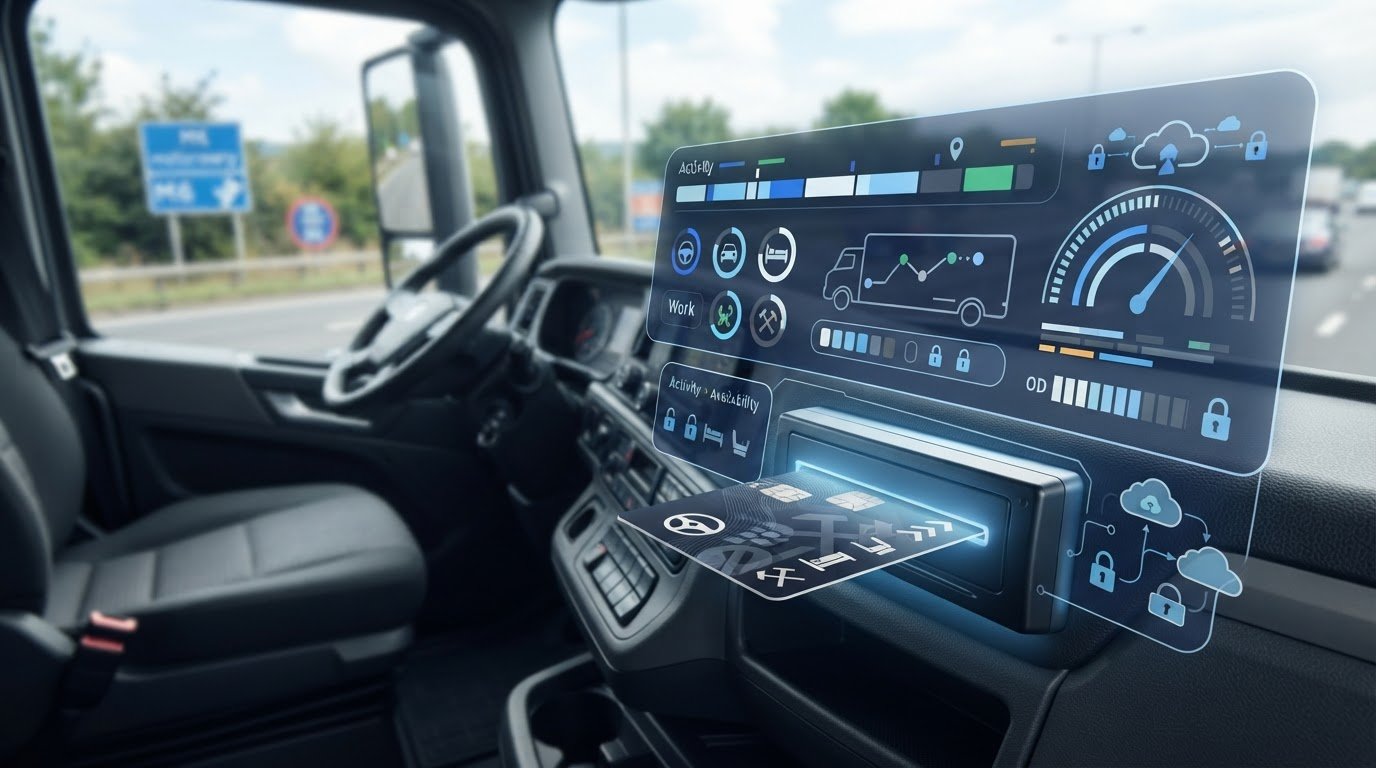
The evolution of European Commission tachograph standards has significantly increased the technical data recorded. If you're using a Smart Tachograph Version 2 (G2V2), your card now stores GNSS position data. This happens at the start and end of the shift, and at every 3-hour increment of accumulated driving. These satellite coordinates provide an undeniable record of your route and resting locations.
International compliance is also simpler with the latest hardware. The card automatically logs country border crossings without you needing to stop. It also tracks your "load" or "unload" status if you've entered these details into the vehicle unit. This granular level of technical reporting ensures that what data is stored on a driver's tacho card satisfies the latest cabotage and posting of workers regulations. It provides a level of transparency that older Gen 1 cards simply cannot match.
Data Retention Limits and Legal Compliance Standards
UK law is strict regarding the timing of data retrieval. Every transport operator must download driver card data at least once every 28 calendar days. While you might wonder exactly what data is stored on a driver's tacho card after this window, the physical chip has finite space. Most older cards are designed to hold approximately 28 days of average activity. Once the memory is full, the oldest data is overwritten by new shift records. This creates a high-stakes compliance race. If you miss the download deadline, the evidence required to prove your drivers' hours compliance could simply vanish.
Operators are also legally required to retain these raw .DDD files in chronological order for at least 12 months. For Working Time Directive records, this retention period extends to 24 months. Losing this data doesn't just result in a fine; it can trigger a full fleet audit and put your operator licence in jeopardy. Don't assume "buffer" data, which refers to historical records beyond the 28-day mark, is a legal fallback. While some modern cards can physically store up to 56 days of work to meet the latest roadside inspection rules, the DVSA expects downloads to be regular and systematic.
The 28-Day Download Cycle
The overwriting process is automatic and irreversible. When a card reaches its storage limit, the chip deletes the earliest entries to make room for today's shift. If you rely on manual downloads, a single driver being away on a long-haul route or a misplaced USB key can lead to missing data. This gap is an automatic compliance violation. Remote downloading eliminates this risk by pulling data automatically over the air. It ensures the 28-day window is never missed regardless of where the vehicle is located.
DVSA Audit Requirements
During an audit, officers will scrutinise what data is stored on a driver's tacho card to identify "missing mileage" problems. They cross-reference vehicle odometer readings with driver activity. If the vehicle moved but no driver card was inserted, you face a serious investigation. By using Fleetalyse Tachograph Analysis Integration, you can automatically detect these discrepancies. The software uses the card data to generate infringement reports. This allows you to address issues before they become legal headaches. To secure your fleet's compliance and automate your download schedule, you can start your remote tachograph download subscription today.
Modernising Data Retrieval: Moving Beyond Manual Downloads
Manual data collection is a significant administrative drain on UK transport operations. The traditional method of chasing drivers with a USB download key is inefficient and prone to human error. When you consider what data is stored on a driver's tacho card, the importance of capturing every byte accurately becomes clear. Remote tachograph download technology removes this friction by automating the entire process. A small telematics device installed in the vehicle unit pulls the cryptographically signed .DDD files over the air. It sends them directly to your analysis platform without the driver ever needing to leave the cab or visit a depot office.
This shift to real-time data retrieval provides a level of visibility that manual systems cannot match. Instead of waiting weeks to find an infringement in a pile of paperwork, managers can see live driver hours as they happen. This proactive approach allows you to intervene before a driver exceeds their legal limit. Centralising this information in cloud-based storage also simplifies the audit process. You no longer need to hunt for missing files during a DVSA inspection. Every record is indexed, dated, and ready for immediate review.
The Benefits of Remote Tachograph Downloads
The most immediate gain is the elimination of "dead time" caused by depot returns. Drivers on long-haul routes or those who are tramping don't need to return to base just for a card read. This keeps your fleet on the road and earning. Automating the schedule guarantees 100% compliance with the 28-day rule. By removing the risk of missing data, you significantly reduce the chance of receiving "Operator Licence" warnings or prohibitions from the DVSA. It's a straightforward way to protect your professional reputation and your business's future.
Securing Your Fleet’s Future
Live visibility changes how you plan your routes. When dispatchers know exactly how much driving time remains for every individual in the fleet, they can make smarter decisions about load assignments. This prevents the "stranded driver" scenario where a shift ends just miles from a delivery point. Fleetalyse acts as a transparent, reliable compliance partner, providing the tools you need to manage these complexities with quiet confidence. Our platform is built for the rigours of real-world UK logistics, focusing on functional utility over unnecessary features. You can organise your remote tachograph downloads with Fleetalyse today to take full control of your compliance data.
Take Control of Your Fleet Compliance
Your driver card is more than a simple plastic chip; it is the definitive legal record of your professional conduct. We've explored how it logs second-by-second activity, vehicle history, and GNSS location data to satisfy the latest UK and EU regulations. Understanding exactly what data is stored on a driver's tacho card allows you to manage your shift patterns with precision and face DVSA inspections with total confidence.
The transition from manual downloads to automated systems is no longer just a convenience. It's a strategic necessity for modern operators. By removing the administrative burden of chasing cards, you ensure that no 28-day deadline is ever missed. Fleetalyse provides the tools you need to succeed, offering real-time driver hours monitoring and DVSA-ready compliance reports without any hidden fees for data storage. Our platform is built to handle the rigours of real-world logistics, giving you the clarity needed to focus on your core business.
Automate your tacho compliance and save time with Fleetalyse today. Stay ahead of the regulations and keep your fleet moving safely.
Frequently Asked Questions
How much data can a driver card store?
A standard driver card is designed to store a minimum of 28 days of average driver activity. This ensures compliance with the previous legal inspection window. However, Smart Tachograph Version 2 (Gen2 V2) cards issued since August 2023 have expanded memory to hold at least 56 days of data. Once the chip is full, the oldest records are automatically overwritten. It's vital to download data regularly to prevent legal gaps.
Is my speed recorded on my driver tacho card?
Your detailed second-by-second speed is not stored on the driver card; it's held within the vehicle unit's internal memory. However, the card does record overspeeding events. These are defined as instances where the vehicle exceeds the speed limiter threshold for more than 60 seconds. When you consider what data is stored on a driver's tacho card, remember that these infringement logs are visible to DVSA officers during roadside stops.
What happens if I lose my driver card while on duty?
You must report a lost or stolen card to the DVLA immediately and apply for a replacement within seven calendar days. You can continue driving without a card for a maximum of 15 calendar days. During this period, you must produce manual printouts at the start and end of every shift. Sign these printouts and keep them available for inspection to prove you are adhering to drivers' hours rules.
How often must an operator download a driver’s tacho card?
Under UK law, an operator must download data from the driver card at least every 28 calendar days. The vehicle unit itself must be downloaded every 90 days. Failing to meet these deadlines is a compliance violation, even if no driving hours were exceeded. Many fleets now use remote downloading to automate this process. This ensures the 28-day window is never missed regardless of where the driver is located.
Can I see the data on my own tacho card without a card reader?
You cannot view the raw digital data on the chip without a card reader and analysis software. However, you can access your recent activity through the vehicle unit's display screen or by generating a daily printout. These printouts show your driving, work, and rest periods for the current day. For a full historical view of what data is stored on a driver's tacho card, a digital download and analysis are required.
Does the tacho card record my location at all times?
The card does not track your location continuously like a live GPS feed. On Smart Tachographs, it records your GNSS position at the start and end of your daily work period. It also logs your location after every three hours of accumulated driving time. Gen2 V2 cards also record country border crossings automatically. This data provides a geographical snapshot of your journey rather than a minute-by-minute breadcrumb trail of your exact route.
What should I do if my tacho card data is corrupted?
If your card is malfunctioning or corrupted, you must treat it like a lost card. Report the fault to the DVLA and apply for a replacement within seven days. You are permitted to drive for up to 15 calendar days without the card, provided you produce and sign manual printouts for every shift. Keep the corrupted card with you as evidence until your new licence arrives to avoid fines during inspections.
Can a driver card be used in any digital tachograph unit?
Yes, driver cards are generally backward compatible. You can use a newer Smart Tachograph card in an older Gen 1 vehicle unit. While the card will record your activity correctly, it won't unlock advanced features, such as automatic location recording, if the vehicle unit doesn't support them. Every digital tachograph unit is designed to accept any valid driver card issued within the UK or EU, ensuring consistent compliance across different fleet assets.
Frequently asked questions
How much data can a driver card store?
A standard driver card is designed to store a minimum of 28 days of average driver activity. This ensures compliance with the previous legal inspection window. However, Smart Tachograph Version 2 (Gen2 V2) cards issued since August 2023 have expanded memory to hold at least 56 days of data. Once the chip is full, the oldest records are automatically overwritten. It's vital to download data regularly to prevent legal gaps.
Is my speed recorded on my driver tacho card?
Your detailed second-by-second speed is not stored on the driver card; it's held within the vehicle unit's internal memory. However, the card does record overspeeding events. These are defined as instances where the vehicle exceeds the speed limiter threshold for more than 60 seconds. When you consider what data is stored on a driver's tacho card, remember that these infringement logs are visible to DVSA officers during roadside stops.
What happens if I lose my driver card while on duty?
You must report a lost or stolen card to the DVLA immediately and apply for a replacement within seven calendar days. You can continue driving without a card for a maximum of 15 calendar days. During this period, you must produce manual printouts at the start and end of every shift. Sign these printouts and keep them available for inspection to prove you are adhering to drivers' hours rules.
How often must an operator download a driver’s tacho card?
Under UK law, an operator must download data from the driver card at least every 28 calendar days. The vehicle unit itself must be downloaded every 90 days. Failing to meet these deadlines is a compliance violation, even if no driving hours were exceeded. Many fleets now use remote downloading to automate this process. This ensures the 28-day window is never missed regardless of where the driver is located.
Can I see the data on my own tacho card without a card reader?
You cannot view the raw digital data on the chip without a card reader and analysis software. However, you can access your recent activity through the vehicle unit's display screen or by generating a daily printout. These printouts show your driving, work, and rest periods for the current day. For a full historical view of what data is stored on a driver's tacho card, a digital download and analysis are required.
Does the tacho card record my location at all times?
The card does not track your location continuously like a live GPS feed. On Smart Tachographs, it records your GNSS position at the start and end of your daily work period. It also logs your location after every three hours of accumulated driving time. Gen2 V2 cards also record country border crossings automatically. This data provides a geographical snapshot of your journey rather than a minute-by-minute breadcrumb trail of your exact route.
What should I do if my tacho card data is corrupted?
If your card is malfunctioning or corrupted, you must treat it like a lost card. Report the fault to the DVLA and apply for a replacement within seven days. You are permitted to drive for up to 15 calendar days without the card, provided you produce and sign manual printouts for every shift. Keep the corrupted card with you as evidence until your new licence arrives to avoid fines during inspections.
Can a driver card be used in any digital tachograph unit?
Yes, driver cards are generally backward compatible. You can use a newer Smart Tachograph card in an older Gen 1 vehicle unit. While the card will record your activity correctly, it won't unlock advanced features, such as automatic location recording, if the vehicle unit doesn't support them. Every digital tachograph unit is designed to accept any valid driver card issued within the UK or EU, ensuring consistent compliance across different fleet assets.