
Manual tachograph downloads are a relic of a slower era that puts your UK Operator Licence at unnecessary risk. Every minute spent chasing drivers across a yard or manually plugging in download tools is time lost to actual fleet management. You might be asking, what is a remote tacho download and how does it change the compliance game for your business? It's a valid question for any operator tired of the monthly scramble to meet DVSA deadlines.
We understand the pressure of managing a busy fleet. Chasing driver cards every 28 days and vehicle units every 90 days is a logistical headache that often leads to missing data and potential fines. This guide explains how remote tachograph technology automates these legal requirements, removes the manual burden, and provides a clear shield for your compliance record. We'll explore the mechanics of wireless data transfer, the benefits of live driver hours, and why moving to an automated system is the most practical decision you'll make for your fleet today.
Key Takeaways
- Understand what is a remote tacho download and how wireless GPRS technology replaces the need for manual download tools.
- Automate the mandatory 28-day driver card and 90-day vehicle unit downloads to ensure your fleet remains fully compliant with DVSA standards.
- Learn how secure company card hosting and remote download devices (RDL) allow for data collection without vehicles ever needing to return to the depot.
- Reduce administrative overhead and eliminate dead mileage by switching from reactive manual collection to a proactive, automated system.
- Gain real-time visibility of live driver hours to prevent infringements before they occur and protect your UK Operator Licence.
Understanding Remote Tachograph Downloads in the UK
Compliance shouldn't be a manual chore. For many UK fleet managers, the term 'download day' triggers a logistical scramble. So, what is a remote tacho download? Simply put, it's the wireless, automated transfer of data from a Digital tachograph directly to your analysis software via a GPRS connection. This technology replaces the traditional method of physically plugging a download key into the vehicle unit or a driver's card reader. It's a shift from reactive chasing to proactive management.
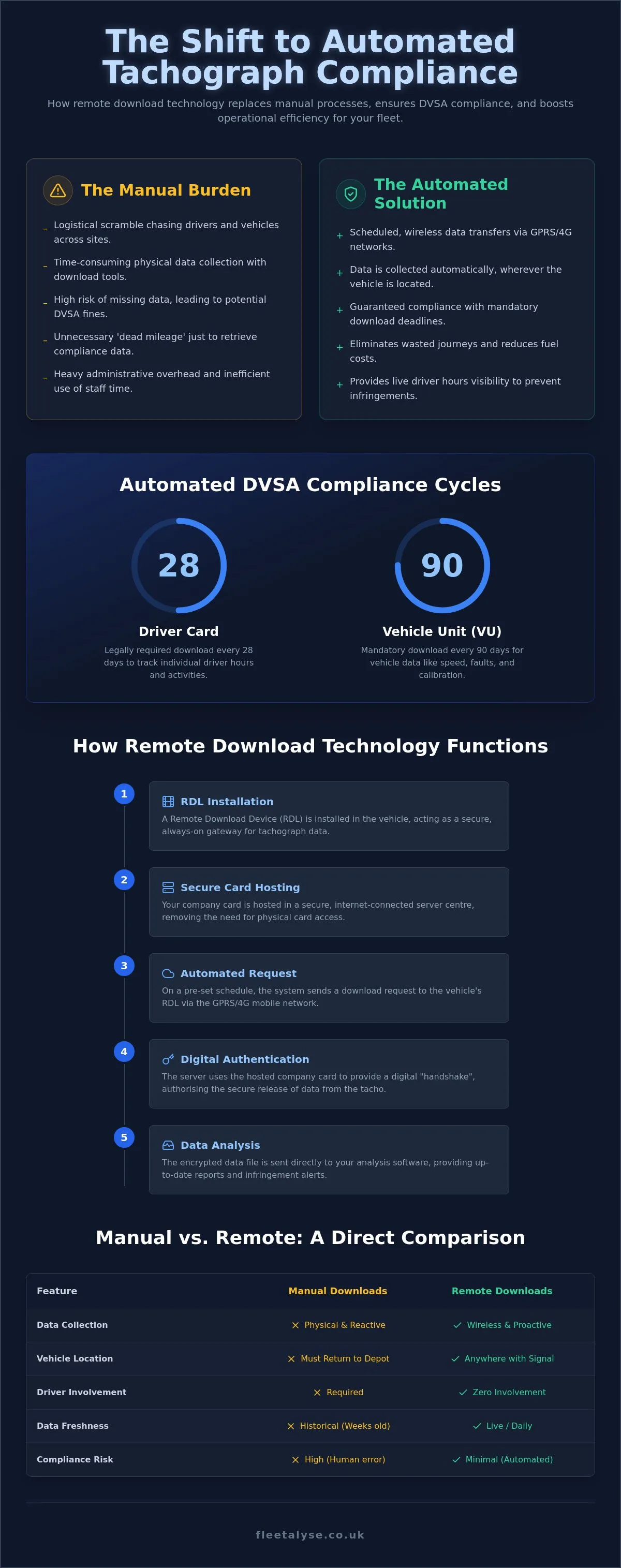
The UK transport industry is moving toward automation at a rapid pace. In an environment where 35 transport firms went into administration in the first half of 2026, operational efficiency is no longer optional. Manual data collection creates unnecessary gaps in visibility. By contrast, a remote system ensures that both driver card data and vehicle unit (VU) data are collected without human intervention. This distinction is vital. Whilst driver cards track individual hours and must be downloaded every 28 days, the VU records vehicle speed, faults, and calibration details every 90 days. Remote systems handle both streams simultaneously.
Manual vs. Remote: A Comparison
Manual downloads are a logistical burden. They require vehicles to return to a specific site, often resulting in 'dead mileage' just to retrieve data. Drivers must be physically present. Transport staff must manually upload files to a server. This process is prone to error and missed deadlines. It's an inefficient use of your most expensive assets.
Remote technology removes these barriers. The vehicle can be anywhere in the UK or abroad. The data will still flow. This is achieved through a secure connection between the vehicle and your office. A key part of this process is the 'Company Card'. Instead of keeping this card in a desk drawer, it's hosted in a secure, internet-connected reader. This allows the system to authenticate the download request remotely. It ensures total security and legal compliance without the driver ever leaving the cab.
The Role of Digital Tachographs in 2026
The regulatory landscape is tightening. As of July 1, 2026, Smart Tachograph 2 requirements have extended to light commercial vehicles over 2.5 tonnes involved in international transport. Relying on manual, analogue-style data management is a risk to your Operator Licence. Modern fleets use remote tachograph download solutions to stay ahead of DVSA scrutiny. The process acts as a seamless, encrypted wireless handshake that protects your data integrity. Transitioning to an automated system ensures you meet the latest G2V2 standards while focusing on your core business operations.
How Remote Tacho Download Technology Functions
The mechanics of remote downloading are straightforward but highly secure. It begins with a small piece of hardware called a Remote Download Device (RDL). This unit is installed directly into the vehicle. It either plugs into the tachograph's front port or integrates with the rear CAN bus. Once fitted, the RDL acts as an always-on gateway for your data. It's a fit-and-forget solution that removes the need for physical download keys or manual intervention.
To fully understand what is a remote tacho download, you must look at the transmission path. The RDL uses the mobile network, typically GPRS or 4G, to send encrypted files directly to a secure server. You don't need to wait for the vehicle to return to the yard. Instead, you can schedule downloads to occur automatically. Most UK operators set these for once a week or even daily. This ensures you always have a current view of driver activities without ever touching the vehicle unit.
The Authentication Handshake Explained
The tachograph unit is designed to protect sensitive data. It requires a specific "key" to release information. In a manual setup, this is your physical company card. With remote technology, your company card stays in a secure, centralised server centre. When a download is scheduled, the RDL sends a request to the server. The server verifies the company card and sends a digital "handshake" back to the vehicle. This unlocks the data. It happens in seconds. There's zero driver involvement and no need to remove cards from the vehicle unit during the process.
Compatibility and Integration
Modern RDL hardware is designed for universal application. It's compatible with all major brands, including VDO and Stoneridge. The data doesn't just sit in a folder. It flows directly into your tachograph analysis integration platform. This creates a seamless link between the vehicle and your compliance software. You gain access to live driver hours, which is far more valuable than historical data retrieved weeks after the event. Knowing a driver is nearing their limit in real time allows for immediate operational adjustments. If you're ready to stop chasing cards and start automating your office, you can view our setup options to get started today.
Compliance Benefits: Meeting DVSA and Operator Licence Standards
Compliance is the backbone of any successful transport operation. In the UK, the Driver and Vehicle Standards Agency (DVSA) sets strict maximum intervals for data retrieval. Driver cards must be downloaded at least every 28 days. Vehicle units (VUs) require a download at least every 90 days. Understanding what is a remote tacho download helps you realise that these are not just targets, but legal maximums. Missing these deadlines by even 24 hours puts your Operator Licence at risk. Automated systems remove the human element of forgetfulness, ensuring data is pulled well before the legal limit.
Consistent data flow is also a prerequisite for the DVSA Earned Recognition scheme. To qualify, operators must prove they have robust systems in place to monitor and manage their drivers' hours. Remote technology provides this evidence automatically. It reduces the occurrence of 'missing mileage' and unassigned driving incidents. When data is collected daily, you can identify immediately if a vehicle has moved without a card inserted. This allows Transport Managers to rectify issues whilst the details are still fresh in the driver's mind, rather than weeks later during a manual audit.
Protecting Your Operator Licence
The Transport Manager holds a legal responsibility to monitor driver behaviour and ensure adherence to the 'General Undertakings' of the O-Licence. A significant 'compliance gap' often occurs during periods of annual leave or unexpected sick days. If a vehicle is away from the depot and the manual download deadline passes, the business is in breach. Automated remote downloads prevent this scenario entirely. The system doesn't take holidays. It ensures that every second of driving is recorded and analysed, allowing you to spot systemic infringements before they lead to a Public Inquiry.
Audit Readiness and Data Storage
UK law requires that you store downloaded tachograph data for at least 12 months. If you use this data for Working Time Directive compliance, that requirement extends to 24 months. Relying on local hard drives or physical download keys is a gamble. Hardware fails and keys get lost. Cloud-based storage centres offer far superior security and redundancy compared to traditional office filing systems. They provide a clear, timestamped audit trail for DVSA officers during roadside stops or office inspections. Remote downloads provide real-time compliance for UK hauliers by ensuring that every file is encrypted, transmitted, and safely archived without manual touchpoints. This level of transparency is exactly what regulators look for during an audit.
Operational Efficiency: Why Manual Downloads Are Costing You Money
Efficiency in transport is often measured in pence per mile, but the hidden costs of manual compliance can erode your margins quickly. Manual downloads require vehicles to return to a central depot or for a driver to visit a specific terminal. This creates "dead mileage". Every mile driven solely to retrieve data is a mile wasted on fuel, vehicle wear, and driver wages. When considering what is a remote tacho download, it's essential to look beyond the hardware and focus on the bottom line. Removing the need for a vehicle to detour for a download allows your fleet to stay on the most profitable routes.
Administrative time is another significant drain on resources. Transport office staff often spend hours each week chasing drivers, manually uploading files, and cross-referencing data. This is reactive work that adds no value to your service. Automating this process frees your team to focus on proactive tasks like route optimisation or customer service. It also improves driver retention. Drivers want to spend their time behind the wheel, not dealing with office paperwork or the friction of card-chasing. A smoother compliance process makes for a more professional and less stressed workforce.
Live Driver Hours and Productivity
There is a fundamental difference between "downloaded data" and live driver hours monitoring. Historical data tells you where you went wrong weeks ago; live data tells you how to stay right today. Knowing exactly how many hours a driver has remaining in their shift prevents over-scheduling and accidental infringements. This level of visibility is a powerful tool for productivity. It allows you to assign new jobs with confidence, knowing the driver has the legal capacity to finish the run. This prevents expensive "hours" fines and ensures your fleet operates at its maximum legal limit without crossing the line.
Calculating the Return on Investment (ROI)
The financial case for automation is clear when you compare the modest monthly subscription cost against the hourly rate of your admin staff. If your team saves just a few hours a week, the system pays for itself. There is also the "insurance" value to consider. Avoiding a single DVSA Public Inquiry can save a business from total closure. Automated systems allow your fleet to scale without the need to hire additional compliance staff. You can add more vehicles and drivers to your operation while keeping your overheads flat. If you are ready to stop wasting time on manual collection, you can get started with our automated solution here.
Transitioning to Automated Compliance with Fleetalyse
Adopting new technology works best when you have a partner who understands the local industry. At Fleetalyse, we don't just provide software. We offer a transparent, professional service grounded in UK transport expertise. Our remote tachograph download solution is designed to fit into your current operation without causing disruption. We focus on functional utility over flashy, unnecessary features. This ensures you get a reliable system that protects your O-Licence from day one.
Transitioning to an automated system often starts with a single question: what is a remote tacho download and how will it change my daily routine? For most fleets, the change is immediate. You stop chasing cards. You stop worrying about deadlines. Whether you operate HGVs, vans, or trailers, our hardware is easy to install. We provide national UK coverage and ongoing support from our specialised team. Having a UK-based partner matters. We understand the specific regulations and infrastructure challenges you face every day.
Getting Started with Remote Downloads
The process begins with a straightforward fleet assessment. We look at the age and make of your vehicles to determine the specific hardware requirements. This is particularly important for vehicles that must meet the latest Smart Tachograph 2 mandates. Once the assessment is complete, we set up your secure company card hosting. This removes the need for you to manage physical cards in your office. Finally, we train your team to use our intuitive dashboard. We ensure your transport office staff can navigate the system with maximum efficiency from the first download.
Beyond Tachographs: A Unified Fleet View
Compliance is just one part of asset management. By combining your tacho data with GPS fleet tracking, you gain a complete overview of your operations. You can see live driver hours alongside real-time vehicle locations. This unified view helps you organise your fleet more effectively. It reduces administrative overhead and allows for better resource allocation. Fleetalyse helps you move from reactive problem-solving to proactive fleet management. To see how our system can protect your business and improve your efficiency, book a consultation with our team today.
Secure Your Fleet’s Future with Automated Compliance
Manual data collection is a liability that modern UK operators don't need to carry. By understanding what is a remote tacho download and integrating it into your daily routine, you replace administrative friction with total regulatory certainty. You guarantee that every driver card and vehicle unit is downloaded before legal deadlines, shielding your Operator Licence from avoidable scrutiny. This shift moves your business from reactive crisis management to proactive operational excellence.
Fleetalyse acts as your pragmatic partner in this transition. Our system offers real-time driver hours visibility and seamless analysis integration to keep your fleet moving safely. Supported by our UK-based technical support, you can scale your operations without increasing your compliance burden. It's time to let automation handle the paperwork while you focus on the road ahead.
Optimise your fleet compliance with Fleetalyse remote tacho downloads today. Take the first step toward a more efficient, audit-ready future for your business.
Frequently Asked Questions
Do I still need a Company Card if I use remote tacho downloads?
Yes, you still need a valid Company Card to authorise the data transfer. In a remote setup, your card is kept in a secure, internet-connected card reader at a central location rather than in your office desk. This allows the system to perform a digital handshake with the vehicle's tachograph remotely. It removes the need for you to physically take the card to the vehicle or insert it into a local download tool.
How often does a remote tacho download happen?
Remote downloads typically occur daily or weekly depending on your operational preferences. Whilst UK law mandates maximum intervals of 28 days for driver cards and 90 days for vehicle units, daily downloads are considered best practice for modern fleets. This frequency provides real-time visibility of driver hours and ensures you identify potential infringements immediately rather than weeks after the event has occurred.
Is remote tachograph downloading legal under DVSA regulations?
Yes, remote downloading is a fully legal and DVSA-recognised method for collecting tachograph data. It helps operators meet their obligations under the UK Drivers' Hours and Tachographs Regulations by ensuring data is retrieved consistently and accurately. Automated systems are often preferred by regulators because they provide a transparent, tamper-proof audit trail that demonstrates a proactive approach to fleet compliance and road safety.
What hardware do I need to install for remote tacho downloads?
You need to install a small Remote Download Device (RDL) in each vehicle. This hardware connects directly to the tachograph unit through the front port or the rear CAN bus. The device uses the mobile network to transmit encrypted data files to your analysis server. Once the initial installation is complete, the hardware stays in the vehicle and operates autonomously without any further input from the driver or office staff.
Can I use remote downloads for older analogue tachographs?
No, remote downloading technology is only compatible with digital and smart tachographs. Analogue units use paper charts that require physical collection and manual scanning for analysis. If your fleet still includes older vehicles with analogue units, you'll need to continue using manual processes for those specific assets. Most UK commercial vehicles registered after May 2006 are equipped with digital units that support remote technology.
What happens if a vehicle is in an area with poor mobile signal?
The data remains securely stored on the vehicle unit and the RDL until a stable connection is re-established. If a vehicle enters a temporary mobile "black spot", the system will simply retry the transmission once the signal returns. You don't lose any data during this process. The system is built to handle the realities of UK infrastructure, ensuring your compliance records remain complete even when vehicles travel through remote areas.
How much does a remote tachograph download system cost in the UK?
Most providers offer this service through a monthly subscription model per vehicle. This fee generally covers the RDL hardware, the data transmission costs, and the secure hosting of your company card. When evaluating what is a remote tacho download worth to your business, you should consider the reduction in administrative hours and the elimination of dead mileage. These savings often far outweigh the modest monthly cost of the subscription.
Will remote downloads work with my existing tacho analysis software?
Yes, most remote download systems are designed to integrate seamlessly with leading tachograph analysis platforms. The data files are transmitted in the standard .ddd format, which is the industry norm for UK compliance. This ensures that your data flows directly into your reporting dashboard for immediate analysis. It's always best to confirm the specific integration path with your provider to ensure a frictionless connection between the vehicle and your office software.
Frequently asked questions
Do I still need a Company Card if I use remote tacho downloads?
Yes, you still need a valid Company Card to authorise the data transfer. In a remote setup, your card is kept in a secure, internet-connected card reader at a central location rather than in your office desk. This allows the system to perform a digital handshake with the vehicle's tachograph remotely. It removes the need for you to physically take the card to the vehicle or insert it into a local download tool.
How often does a remote tacho download happen?
Remote downloads typically occur daily or weekly depending on your operational preferences. Whilst UK law mandates maximum intervals of 28 days for driver cards and 90 days for vehicle units, daily downloads are considered best practice for modern fleets. This frequency provides real-time visibility of driver hours and ensures you identify potential infringements immediately rather than weeks after the event has occurred.
Is remote tachograph downloading legal under DVSA regulations?
Yes, remote downloading is a fully legal and DVSA-recognised method for collecting tachograph data. It helps operators meet their obligations under the UK Drivers' Hours and Tachographs Regulations by ensuring data is retrieved consistently and accurately. Automated systems are often preferred by regulators because they provide a transparent, tamper-proof audit trail that demonstrates a proactive approach to fleet compliance and road safety.
What hardware do I need to install for remote tacho downloads?
You need to install a small Remote Download Device (RDL) in each vehicle. This hardware connects directly to the tachograph unit through the front port or the rear CAN bus. The device uses the mobile network to transmit encrypted data files to your analysis server. Once the initial installation is complete, the hardware stays in the vehicle and operates autonomously without any further input from the driver or office staff.
Can I use remote downloads for older analogue tachographs?
No, remote downloading technology is only compatible with digital and smart tachographs. Analogue units use paper charts that require physical collection and manual scanning for analysis. If your fleet still includes older vehicles with analogue units, you'll need to continue using manual processes for those specific assets. Most UK commercial vehicles registered after May 2006 are equipped with digital units that support remote technology.
What happens if a vehicle is in an area with poor mobile signal?
The data remains securely stored on the vehicle unit and the RDL until a stable connection is re-established. If a vehicle enters a temporary mobile "black spot", the system will simply retry the transmission once the signal returns. You don't lose any data during this process. The system is built to handle the realities of UK infrastructure, ensuring your compliance records remain complete even when vehicles travel through remote areas.
How much does a remote tachograph download system cost in the UK?
Most providers offer this service through a monthly subscription model per vehicle. This fee generally covers the RDL hardware, the data transmission costs, and the secure hosting of your company card. When evaluating what is a remote tacho download worth to your business, you should consider the reduction in administrative hours and the elimination of dead mileage. These savings often far outweigh the modest monthly cost of the subscription.
Will remote downloads work with my existing tacho analysis software?
Yes, most remote download systems are designed to integrate seamlessly with leading tachograph analysis platforms. The data files are transmitted in the standard .ddd format, which is the industry norm for UK compliance. This ensures that your data flows directly into your reporting dashboard for immediate analysis. It's always best to confirm the specific integration path with your provider to ensure a frictionless connection between the vehicle and your office software.